The 75-page report, “No Money, No Care: Obstetric Violence in Sierra Leone,” documents cases of verbal abuse, medical neglect, and abandonment of women and girls facing serious obstetric complications, practices that experts interviewed say are common. Many women interviewed said they were shamed and mistreated by healthcare providers for expressing pain, needing help, or for not having enough money to pay fees. Others described humiliating experiences in which healthcare providers treated them brusquely or withheld important health information. Some cases documented constitute obstetric violence, a largely unaddressed form of gender-based violence prevalent across the world.
The Harms of State-Mandated Parental Notification for Abortion and Judicial Bypass in the United States
The 89-page report, “Whose Abortion Is It? The Harms of State-Mandated Parental Notification for Abortion and Judicial Bypass in the United States,” documents how state-mandated parental notification laws in six US states threaten young people’s health and safety and undermine their human rights. Most young people considering abortion involve a parent in their decision. Those who do not often have no access to a parent or fear that parental involvement will lead to severe consequences, such as physical abuse, loss of housing, family alienation, or forced continuation of a pregnancy against their wishes. The alternative to notifying a parent involves petitioning a judge for a court order in an invasive, stressful, and often traumatizing process called “judicial bypass.”
Increasing Barriers to Accessing Sexual and Reproductive Health Care in Romania
The 73-page report, “‘It’s Happening Even Without You Noticing’: Increasing Barriers to Accessing Sexual and Reproductive Health Care in Romania,” documents that, although these rights are partially protected under Romanian law, in practice women and girls are regularly and systematically thwarted in their efforts to exercise these rights.
The 85-page report, “‘Forced to Give Up on Their Dreams’: Sexual Violence against Girls in Guatemala,” documents the numerous barriers that girls who are survivors of sexual violence face accessing essential health care, education, social security, and justice. Guatemalan law classifies any sexual activity involving a child under 14 as sexual violence. Guatemala’s National Registry of Persons (RENAP) reported that between 2018 and 2024, 14,696 girls under 14 gave birth and became mothers, in many cases against their will.
Inadequate Cervical Cancer Prevention and Care for Black Women in the United States Mississippi Delta
The report, “No Excuse: Inadequate Cervical Cancer Prevention and Care for Black Women in the United States Mississippi Delta,” documents that state and federal policies and a lack of investment in prevention are failing to ensure Black women in the rural Mississippi Delta—a region with some of the worst health indicators and highest rates of poverty in the entire United States—have access to comprehensive, affordable, and equal reproductive healthcare services and information. Mississippi has the highest rate of cervical cancer deaths in the United States and Black women in the state are almost 1.5 times as likely to die of the disease as white women. Black women living in the largely rural Mississippi Delta area in the southern United States have an even greater risk of dying from the disease.
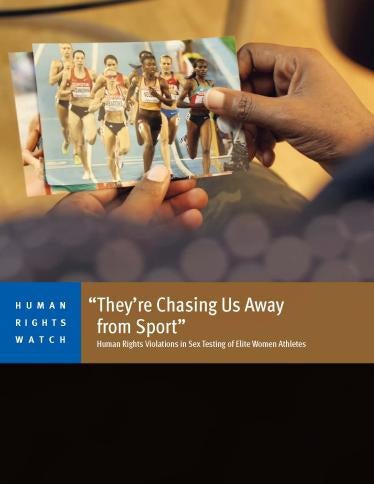
Human Rights Violations in Sex Testing of Elite Women Athletes
The 120-page report, “‘“They’re Chasing Us Away from Sport’”: Human Rights Violations in Sex Testing of Elite Women Athletes,” documents the experiences of more than a dozen women athletes from the Global South who have been affected by sex testing regulations. Human Rights watch found that global regulations that encourage discrimination, surveillance, and coerced medical intervention on women athletes result in physical and psychological injury and economic hardship. The International Olympic Committee – the supreme body in global sports – is developing guidelines to address human rights violations caused by sex testing policies.
Young People, Sexual Health Education, and HPV in Alabama
The 65-page report, “‘It Wasn’t Really Safety, It Was Shame’: Young People, Sexual Health Education, and HPV in Alabama,” documents the Alabama state government’s failure to provide young people with comprehensive, inclusive, and accurate information on sexual and reproductive health. Human Rights Watch also found that the state is not addressing barriers to the human papillomavirus (HPV) vaccine – an effective tool to prevent several types of cancer – and that vaccination rates throughout Alabama remain low.
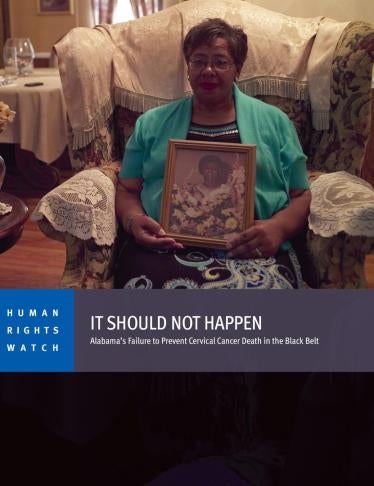
Alabama’s Failure to Prevent Cervical Cancer Death in the Black Belt
This report documents how state and federal policies contribute to a treacherous reproductive health environment in Alabama, where women are dying from cervical cancer at rates higher than in any other US state. The report presents the experiences of women mostly from the Alabama Black Belt, a largely rural region of Alabama that is primarily African American and has high rates of poverty and poor physical health. Human Rights Watch found that governments are not doing enough to facilitate access to reproductive health care services and provide information to prevent these deaths.
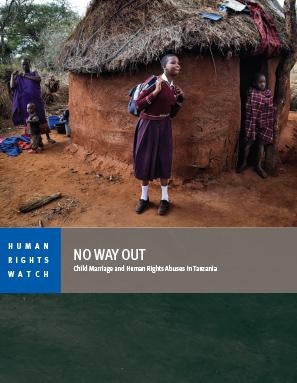
Child Marriage and Human Rights Abuses in Tanzania
This 75-page report documents how child marriage severely curtails girls’ access to education, and exposes them to exploitation and violence – including marital rape and female genital mutilation (FGM) – and reproductive health risks.
A Five-Point Plan to Curtail Sexual Violence in Somalia
This 72-page report provides a roadmap for the government and its international donors to establish a comprehensive strategy to reduce rape, provide survivors with immediate and urgent assistance, and develop a long-term approach to end these abuses.
Accountability for Maternal Health Care in South Africa
This report documents maternity care failures that include abuse of maternity patients by health workers and substandard care in Eastern Cape Province, putting women and their newborns at high risk of death or injury. It examines shortcomings in the tools used by health authorities to identify and correct health system failures that contribute to poor maternal health.