Reports

France’s Persistent Education Shortcomings in Mayotte

The 73-page report, “Exceptional Failure: France’s Persistent Education Shortcomings in Mayotte,” finds that Mayotte’s municipalities often impose significant and arbitrary barriers to school enrollment, including by demanding documentation not required by law. Children who are enrolled often attend overcrowded schools ill-equipped to meet their basic needs, such as access to drinking water, sanitation, nutritious food, and a safe learning environment. Children living in informal settlements known as bangas, are particularly affected, as are children from migrant families.

A boy looks over a school fence
A woman looks out of the window of a damaged building

Search

  • December 7, 2011

    Child Marriage in Yemen

    This 54-page report documents the lifelong damage to girls who are forced to marry young. Yemeni girls and women told Human Rights Watch about being forced into child marriages by their families, and then having no control over whether and when to bear children and other important aspects of their lives.
  • December 13, 2010

    Attacks on Teachers and Schools in Pakistan’s Balochistan Province

    This 40-page report documents the killing of at least 22 teachers and other education personnel by suspected militants between January 2008 and October 2010. The report – based on interviews with teachers, students, victims’ families and friends, and government officials in Balochistan – describes these attacks and their consequences for the quality of education in the province.

  • July 13, 2010

    Afghan Women and the Risks of Reintegration and Reconciliation

    This 65-page report addresses the potential challenges to women's rights posed by future government agreements with insurgent forces. The report describes how in areas under Taliban control, women are often subjected to threats, intimidation and violence, girls' education is targeted, and women political leaders and activists are attacked and killed with impunity.
  • April 15, 2010

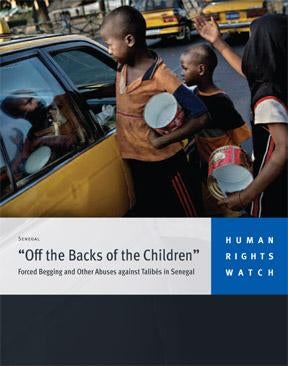
    Forced Begging and Other Abuses against Talibés in Senegal

    This 114-page report documents the system of exploitation and abuse in which at least 50,000 boys known as talibés - the vast majority under age 12 and many as young as four - are forced to beg on Senegal's streets for long hours, seven days a week, by often brutally abusive teachers, known as marabouts.
  • December 9, 2009

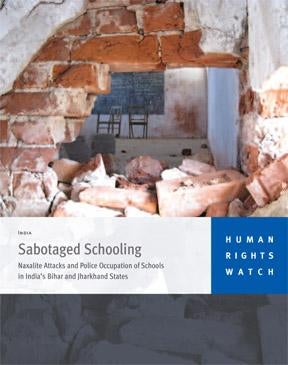
    Naxalite Attacks and Police Occupation of Schools in India’s Bihar and Jharkhand States

    This 103-page report details how the Maoists - known as Naxalites - a longstanding, pan-Indian armed militant movement, are targeting and blowing up state-run schools. At the same time, police and paramilitary forces are disrupting education for long periods by occupying schools as part of anti-Naxalite operations.
  • August 10, 2009

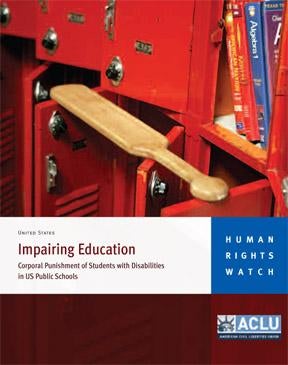
    Corporal Punishment of Students with Disabilities in US Public Schools

    In this 70-page report, the ACLU and Human Rights Watch found that students with disabilities made up 18.8 percent of students who suffered corporal punishment at school during the 2006-2007 school year, although they constituted just 13.7 percent of the total nationwide student population.
  • August 19, 2008

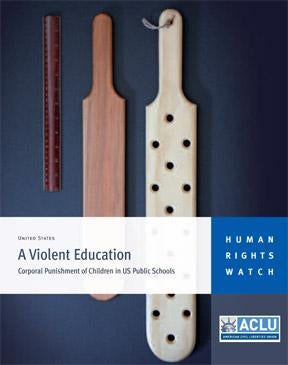
    Corporal Punishment of Children in US Public Schools

    In this 125-page report, the ACLU and Human Rights Watch found that in Texas and Mississippi children ranging in age from 3 to 19 years old are routinely physically punished for minor infractions such as chewing gum, talking back to a teacher, or violating the dress code, as well as for more serious transgressions such as fighting. Corporal punishment, legal in 21 states, typically takes the form of “paddling,” during which an administrator or teacher hits a child repeatedly on the buttocks with a long wooden board. The report shows that, as a result of paddling, many children are left injured, degraded, and disengaged from school.

  • October 3, 2007

    Submission from Human Rights Watch to the Committee on the Rights of the Child

    In this submission to the Committee on the Rights of the Child, Human Rights Watch provided information to the Committee on violations of the Convention on the Rights of the Child by the Bhutanese government against ethnic Nepali children in Bhutan and Bhutanese refugees in Nepal.
  • August 27, 2007

    Insurgent Attacks on Civilians in Thailand’s Southern Border Provinces

    This 105-page report documents abuses of women in detention based on interviews with women and girls, Sunni and Shia, in prison; their families and lawyers; and medical service providers in the prisons at a time of escalating violence involving security forces and armed groups.

  • July 10, 2006

    Attacks on Education in Afghanistan

    This 142-page report documents 204 incidents of attacks on teachers, students and schools since January 2005. This number, which underestimates the severity of the crisis due to the difficulty of gathering data in Afghanistan, reflects a sharp increase in attacks as the security situation in many parts of the country has deteriorated.

  • October 11, 2005

    Government Neglect and the Right to Education for Children Affected by AIDS

    This 55-page report is based on firsthand testimony from dozens of children in three countries hard-hit by HIV/AIDS: South Africa, Kenya, and Uganda. It documents how governments fail children affected by AIDS when they leave school or attempt to return.
  • September 12, 2005

    Barriers to the Right to Education

    This 60-page report is based on interviews with hundreds of children in all regions of the world. Human Rights Watch investigations in more than 20 countries found that school fees and related education costs, the global HIV/AIDS epidemic, discrimination, violence and other obstacles keep an estimated 100 million children out of school, the majority of whom are girls.
  • June 19, 2005

    Abuse and Exploitation of Child Domestic Workers in Indonesia

    This 74-page report documents how Indonesian children as young as 12 work 14 to 18 hours a day, seven days a week, without a day off. They are also forbidden from leaving their place of employment or contacting their families.
  • July 28, 2004

    Abuses Against Children Affected by HIV/AIDS in India

    This 209-page report documents how many doctors refuse to treat or even touch HIV-positive children. Some schools expel or segregate children because they or their parents are HIV-positive. Many orphanages and other residential institutions reject HIV-positive children or deny that they house them.

  • June 2, 2004

    Right to Basic Education for Children on Farms in South Africa

    This 59-page report found that the government’s failure to negotiate contracts with farm owners impedes children’s right to basic education. In the worst cases, farm owners have deliberately obstructed children's access to the schools.