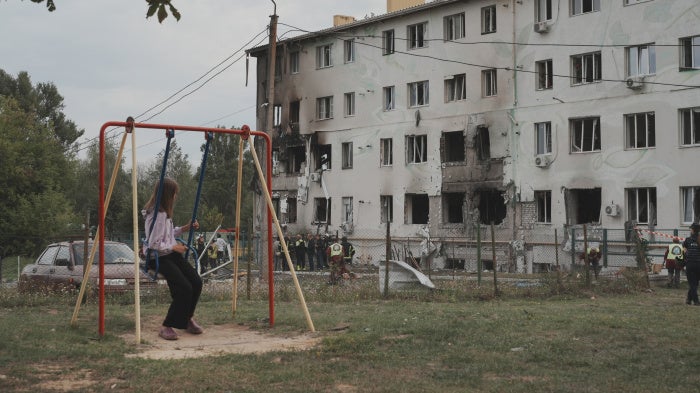
Russian attacks on civilians in Ukraine escalated in 2025, continuing to inflict immense civilian suffering and widespread destruction. Many of these attacks, often involving explosive weapons with wide-area effects and short-range drones, sometimes in combination, have had a devastating impact on Ukrainian civilians and may constitute war crimes. In 2025, the use of explosive weapons in populated areas contributed to a 31 percent increase in civilian casualties compared with 2024.
From the start of Russia’s full-scale invasion in February 2022 to December 2025, 14,999 Ukrainian civilians were killed and 40,601 injured, according to the United Nations Human Rights Monitoring Mission in Ukraine (HRMMU).
Negotiations to end the war launched in February by the United States’ administration continued throughout the year. In November, the United States presented a controversial peace framework that reportedly demanded major concessions from Ukraine and contained a provision for amnesty for wartime actions, undermining the potential for justice and accountability for abuses committed during the war.
As a result of the United States administration’s January executive order pausing “foreign development assistance,” civil society groups in Ukraine lost an estimated 75 percent of their funding and had to suspend crucial human rights programs and projects supporting war crimes investigations.
In July, Ukraine notified the United Nations (UN) of its “suspension” of obligations under the 1997 Mine Ban Treaty. The treaty does not allow a suspension during armed conflict, and this move is not covered by the article of the Vienna Convention on the Law of Treaties that Ukraine cited to justify its action. In 2024, Ukraine used landmines it had received from the United States. Russia, not party to the treaty, has used landmines extensively, heavily impacting Ukrainian civilians.
The war continued to dominate domestic politics. Threats to media freedom, domestic corruption investigations, and confrontations between law enforcement agencies fueled political instability. July saw a major government reshuffle, the largest since the start of the full-scale war, resulting in the appointment of a new prime minister and cabinet. To support Ukrainian military servicemen, parliament voted in September to create a military ombudsperson body. In February, the parliament reaffirmed constitutional provisions against holding presidential elections until martial law is lifted.
Escalation of Russia’s Attacks on Civilians
Throughout the year, Russian forces continued to attack densely populated civilian areas along the frontline and across Ukraine. Many of these attacks may constitute war crimes.
The civilian toll reached its highest monthly level in three years in the month of July, with 286 killed and 1,388 injured. The high casualty rates resulted from a series of Russian attacks, including a combined missile and drone attack on Kyiv on July 31, which killed 31 people, including five children, and injured 171. Most casualties occurred after a Russian missile struck a residential apartment block, making it the deadliest single attack on Kyiv in a year.
Throughout the year, Russian attacks on Izium, Zaporizhzhia, Dnipro, Kryvyi Rih, Odesa, and other cities killed and injured civilians and damaged vital infrastructure.
On September 9, Russian forces carried out a deadly airstrike in the village of Yarova, Donetska region, killing 25 civilians and injuring 19. Most were pensioners who were waiting to collect their monthly pension payments from a mobile post office.
On November 19, a Russian missile strike on a nine-story residential building in Ternopil killed 39 people and injured 90. Search and rescue operations at the site continued for four days, as many residents were buried under the rubble.
On April 4, Russian forces carried out an indiscriminate attack that killed 20 civilians and injured 73 others in a residential neighborhood of Kryvyi Rih, Dnipropetrovska region. The attack, which involved a munition that burst midair above a children’s playground, killed nine children and injured others, including a 3-month-old baby—the highest number of children killed and injured in a single attack since the start of the full-scale invasion. The attack also damaged six educational institutions and other civilian infrastructure nearby.
From December 2024 to November 2025, at least 514 civilians were killed and 3,042 injured in attacks using short-range drones, with the highest number of casualties occurring in and around Kherson city. Russian drone operators used their first-person-view (FPV) capability to deliberately target Ukrainian civilians. Some drones were used to deploy banned antipersonnel landmines and to carry out attacks with incendiary weapons in populated areas. Attacks targeting civilians are war crimes and those designed to instill terror may amount to crimes against humanity.
Throughout the year, the World Health Organization (WHO) had verified 577 attacks on healthcare, an increase compared to the previous year. At least 2,665 health facilities and personnel have been affected since February 2022. Between December 2024 and November 2025, the HRMMU verified casualties among 22 humanitarian and 116 emergency service workers, some from “double-tap” strikes, a tactic widely used by Russian forces.
By the end of the year, Russian forces escalated attacks on Ukraine’s energy grid, causing rolling nationwide blackouts.
Prisoners of War (POWs) and Conflict-Related Civilian Detainees
Russian authorities and military forces continued to systematically torture and ill-treat Ukrainian POWs and civilians in their custody, constituting war crimes and crimes against humanity. Many detainees remain in atrocious prison conditions, where they are deprived of adequate food, hygiene, and medical care. In March, the UN Independent International Commission of Inquiry concluded that Russian authorities had committed enforced disappearances and torture as crimes against humanity, noting that these abuses were “pursuant to a coordinated state policy.”
Throughout the year, over a thousand military personnel and Ukrainian civilians were freed through prisoner exchanges. According to Ukrainian authorities, Russia continues to detain more than 8,000 Ukrainian POWs and thousands of civilians.
Ukrainian authorities transferred some of their own citizens, convicted of collaboration, to Russia, a concerning development given the already complex challenge of ensuring the return of unlawfully held Ukrainian civilians from Russia.
An in-depth media investigation published in May documented the deaths of at least 206 Ukrainian POWs in Russian prisons. The report provided further evidence of Russia’s systematic torture of Ukrainian POWs, as well as Russia’s attempts to conceal abuses and lack of adequate medical care.
Ukrainian prosecutors reported that Russian forces had extrajudicially executed 268 Ukrainian POWs since February 2022. Between December 2024 and May 2025, the HRMMU verified 36 executions of Ukrainians hors de combat.
An OSCE Moscow Mechanism report issued in September documented Russia’s widespread abuse and deliberate mistreatment of Ukrainian POWs, revealing a “systematic failure” to uphold the standards mandated under international law. The report stated that these violations may constitute war crimes and, in some cases, crimes against humanity.
In April, the body of a 27-year-old Ukrainian journalist Viktoriia Roshchyna was returned to Ukraine. In September, the Ukrainian Prosecutor General's Office reported that Roshchyna, who disappeared in the Russian-occupied territory in 2023, had died in a detention center in Russia’s Perm region. A forensic examination revealed that Roshchyna’s body showed signs consistent with torture.
Ukrainian authorities have been implicated in abuses while holding Russian POWs. The HRMMU documented instances of torture and ill-treatment of Russian POWs before their transfer to official internment facilities, as well as beatings and verbal abuse upon admission.
In January, a coalition of human rights groups launched the “People First” campaign, urging all parties involved in peace negotiations to prioritize unconditional release of all detained Ukrainian civilians and to make the release and repatriation of POWs from both sides a top negotiating priority.
Abuses under Russian Occupation
Russian authorities continued their efforts to forcibly integrate occupied areas of Ukraine by imposing Russian law and administrative structures in these territories, in violation of international law.
Russia escalated efforts to coerce residents of occupied areas to accept Russian citizenship. A March presidential decree required residents of Russian-occupied parts of Zaporizka, Khersonska, Donetska, and Luhanska regions to “regulate their legal status” by September 10 or face expulsion. Under the decree, Ukrainians without Russian passports are subject to Russia’s residency regulations and risk forcible deportation, which could amount to a crime against humanity. The impact of the decree was unclear at time of writing.
In March, Russian authorities reported having issued 3,5 million passports to residents in Russian-occupied eastern Ukraine since the mass “passportisation” process began. Research from civil society groups suggests that Russian forces used threats, the deprivation of social benefits, and restrictions on access to health care, education, freedom of movement, employment, and property rights to coerce residents into accepting Russian passports.
Russian authorities continued to conscript Ukrainian civilians in occupied areas into Russia’s armed forces and to coerce them to serve in the Russian military, a war crime under international law. In March, President Putin signed a decree launching a spring conscription campaign, which included occupied areas.
Russian authorities continued to subject Ukrainian children living in occupied areas to military-patriotic education. Occupation officials reportedly trained Ukrainian children as drone operators. Some children received conscription notices into the Russian army a year before reaching conscription age, prompting families to flee.
Russian authorities continued to suppress Ukrainian identity, language, and culture in occupied areas by imposing the Russian curriculum and making Russian the only language of instruction in schools. The Russian government’s August restrictions on the usage of popular instant messaging apps in Russia and Russia-occupied territories further impeded access to Ukrainian online education.
In 2025, water shortages worsened in occupied areas, especially in Donetska region, due to the previous damage to water supply infrastructure. Donetsk residents, who had tap water only a few hours every three days, were forced to queue at water trucks, prompting locals to describe the situation as a “humanitarian and ecological catastrophe.”
Occupation authorities ramped up efforts unlawfully to seize private property they deemed “unused.” Enforcing laws adopted in 2024 that strip Ukrainians who fled occupied areas of their property rights, by November, occupation authorities had issued notices regarding over 20,000 properties in Donetska, Luhanska, Zaporizka, and Khersonska regions. These regulations, which require property owners to present a Russian passport in person within 30 days of receiving the notice in order to retain their property, violate international law.
Crimea
The human rights situation in Russian-occupied Crimea remained dire. Russian occupying authorities continued to persecute politically active members of the Crimean Tatar community and others critical of Russia’s actions in Crimea. Rights groups reported that as of mid-2025, 220 people faced politically motivated prosecution in Crimea, including more than 130 Crimean Tatars.
In September, the European Union sanctioned two senior Russian officials of the Penal Enforcement Service in occupied Crimea for their involvement in the ill-treatment and denial of medical care to detainees. Detainees harmed by such practices included, among others, human rights defenders Iryna Danylovych and Amet Suleymanov.
Russian authorities continued the indoctrination and military training of children in occupied Crimea. Authorities pressured and punished children for expressing pro-Ukraine views.
Gaps in Protection of Internally Displaced Persons and Refugees
Internally Displaced Persons (IDPs)
At least 3.8 million Ukrainians were registered as IDPs as of April, with most struggling with loss of income and housing. Older people, single parents, and people with disabilities relied heavily on state and humanitarian aid, which was reduced following a decrease in US funding. An April survey found that 69 percent of IDPs believed the war had negatively affected their mental health.
Several government programs in 2025 provided support to IDPs, including monthly allowances, housing, and a simplified mortgage program. The government also offered limited compensation for property lost in Russia-occupied territories, but implementation of these programs was challenging and has not provided durable housing solutions, drawing criticism from the Ukrainian Ombudsman.
In April, parliament adopted at first reading a bill to strengthen IDP support, guaranteeing financial assistance, evacuation mechanisms, and integration into host communities. At time of writing, the bill was pending.
Refugees
As of September, some 5.7 million Ukrainians who fled the war remained as refugees abroad, with 90 percent residing in EU states. Although their temporary protection status was extended until March 2027, some EU states, including Poland, Germany, Hungary, the Netherlands, and Ireland decreased financial assistance and/or limited access to housing for Ukrainian refugees. In September, EU member states adopted a common framework for a gradual phase-out of Ukrainians’ temporary protection status and their potential return and reintegration into Ukraine.
Apparent disparities in welfare benefits compared to those provided to local populations contributed to signs of declining public sympathy for Ukrainian refugees. A March survey found that Ukrainian refugees in Italy, Poland, the Czech Republic, and Germany reported experiencing high levels of hostility from host communities.
In the United States, approximately 250,000 Ukrainians applied for temporary humanitarian parole under the Uniting for Ukraine (U4U) program. In January, the program was suspended as part of broader immigration restrictions, preventing any new Ukrainian humanitarian parole applications. With initial two-year permits expiring in 2025, many Ukrainians now face the risk of losing their legal status, which may result in arrest or deportation.
Freedom of Expression
Anti-corruption activists and independent media outlets faced harassment. In mid-July, Ukrainian authorities raided the home and the place of military service of a prominent anti-corruption activist Vitaliy Shabunin as part of an investigation into alleged military evasion and fraud. The raids were carried out without required court orders and included other due process violations. The Anti-Corruption Action Center, which Shabunin co-founded, linked the raids and investigation to the center’s work exposing corruption.
A Ukrainian military construction company put pressure on Kyiv Independent, an English-language Ukrainian news outlet, demanding in September that the outlet retract an investigation mentioning it and threatening to file a complaint with the Security Service of Ukraine (SBU), alleging high treason and aiding an aggressor state. The outlet’s editorial office refused the demands.
In September, Ukraine’s parliament resumed live broadcasts of its sessions, suspended for security reasons in February 2022, in response to civil society groups’ calls to improve public trust and accountability.
A bill introduced in parliament in September and adopted in the first reading in November allows published investigative information to be treated as defamatory until a court rules otherwise. Ukrainian and international watchdogs urged parliament to refrain from adopting the bill, arguing that it would enable strategic lawsuits against public participation (SLAPPs) and could undermine anti-corruption investigations and press freedom.
A bill restricting access to court decisions in cases of “special public interest” during martial law and for a year afterward remained pending in parliament, despite calls from human rights and civil society groups rejecting it.
Rule of Law
Ukrainian authorities continued to enforce overly broad and vague anti-collaboration laws. By November, HRMMU found that in 72 of 950 analyzed court cases from the period covering December 2024 to May 2025, collaboration charges were for work that employees could lawfully be compelled to do by an occupying power under international law.
In July, officers from the SBU conducted dozens of searches targeting staff of the National Anti-Corruption Bureau (NABU), reportedly with due process violations, and accused the staff of “cooperation with the aggressor state” and treason. NABU condemned the action as an attempt to pressure and obstruct their investigations.
Also in July, new, swiftly adopted legislation undercut the independence of NABU and another key anti-corruption body, the Specialized Anti-Corruption Prosecutor’s Office (SAPO). The law granted the prosecutor general expanded authority to reassign NABU cases, raising concerns about political interference in investigations of high-level corruption. Despite calls to veto the bill, President Zelensky signed it into law the same day. Following days of mass protests in Kyiv and other cities and intense criticism from the EU parliament, authorities repealed the legislation, restoring the independence of both institutions.
The establishment of independent anti-corruption institutions is a core requirement for Ukraine’s EU integration. At time of writing, Ukraine’s EU membership bid remained stalled with Hungary blocking the opening of accession negotiations.
In November, Ukraine’s anti-corruption agencies alleged that senior officials were involved in a corruption scheme within the state-owned energy sector. Following the allegations, the government dismissed two ministers implicated in the scandal. President Zelenskyy also announced the resignation of his Chief of Staff Andriy Yermak, hours after anti-corruption agents searched Yermak’s residence.
In August, the State Service on Ethnopolitics and Freedom of Conscience used the 2024 law on religious organizations to designate the Ukrainian Orthodox Church (UOC), one of Ukraine’s largest religious organizations, as an entity affiliated with the Russian Orthodox Church, which is banned in Ukraine. The state service initiated a lawsuit to dissolve the UOC’s Kyiv branch, which could lead to restrictions on its property rights and access to places of worship.
In July, parliament adopted a law allowing multiple citizenships, which will take effect in 2026. Rights groups criticized provisions in the law that allow for the revocation of Ukrainian citizenship for those who “voluntarily” acquire Russian passports, warning that the law’s vague definitions did not account for the widespread coercion used by Russian authorities in occupied territories and could lead to Ukrainians losing their nationality as a result of being forced to acquire Russian passports under duress.
Accountability for Serious International Crimes and Reparations
On January 1, Ukraine’s accession to the Rome Statute, the International Criminal Court’s founding treaty, entered into force. In joining the Court, Ukraine invoked article 124 of the treaty, which allows it to limit the ICC’s jurisdiction over war crimes committed by its own nationals for seven years.
The Office of the Prosecutor General in Ukraine launched a working group with legal experts and civil society representatives to address reforms needed to fully incorporate the Rome Statute into national law.
In June 2025, Ukraine and the Council of Europe (CoE) signed an agreement to establish a special tribunal to prosecute senior Russian officials for the crime of aggression.
The Register of Damages for Ukraine, launched by the CoE in 2023, opened 14 claim categories for documenting losses, injuries, and destruction caused by Russia’s war. At time of writing, the register serves primarily as a record-keeping mechanism, while compensation mechanisms and funding sources—potentially from frozen Russian assets—remain undefined. In February, Russia designated the register an “undesirable organization,” a move that poses a significant obstacle to reparations and is likely to hinder residents of occupied areas from submitting claims and accessing future compensation.
A law codifying the definition of conflict-related sexual violence in national legislation and providing for interim reparations came into force in June. At time of writing, the government had not yet adopted the necessary by-laws to implement it.