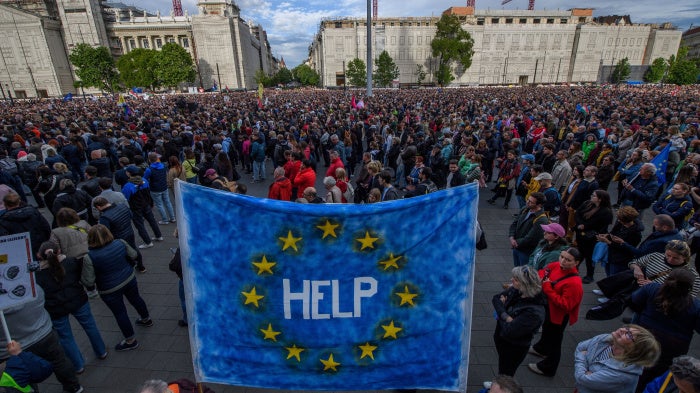
Efforts by EU institutions and member states to restrict migration to the bloc at all costs continued to give rise to grave human rights risks and abuses. EU initiatives to improve economic and social rights progressed although implementation, which largely rests with member states, lags. Racism and other forms of discrimination are a persistent concern in the EU, exacerbated by the normalisation of far-right narratives by mainstream parties. Member states continued to backslide on rule of law commitments, but the EU Council took no effective action, and the European Commission provided inconsistent follow-through in response to these worrying trends. Civil society space continued to shrink, in part because of EU actions.
Migrants, Refugees, and Asylum Seekers
The European Commission and EU member states pursued changes that would undermine the rights of migrants and asylum seekers, ahead of the 2024 EU Migration and Asylum Pact coming into full effect in 2026. Some governments (Poland, Greece, Finland, Germany) restricted or suspended access to asylum procedures, while the EU as a whole moved towards making it easier to reject applications swiftly, shift responsibility for asylum seekers to countries outside the EU, and increase deportations.
In March, the European Commission proposed a Returns Regulation to replace the 2008 Returns Directive with provisions that would expand the use of detention, extend detention time limits, and remove safeguards against unfair procedures and unsafe deportations. The proposal paves the way for the creation of so-called return hubs in countries outside the EU where people slated for deportation could be sent instead of their countries of origin.
The Court of Justice of the European Union (CJEU) clarified in August that current EU law requires that an asylum seeker’s country of origin must provide adequate protections for the entire population and throughout its territory to be designated as “safe,” and that this designation must be based on accessible information and subject to effective judicial review.
In December, the Civil Liberties, Justice and Home Affairs Committee of the European Parliament as well as EU governments endorsed European Commission proposals to adopt a common list of “safe countries origin” and redefine the “safe third country” concept to permit sending asylum seekers to countries with which they have no connection.
The CJEU ruled in June that a person could not be held criminally liable for facilitating the unlawful entry of a minor in their care, finding that this would constitute “serious interference” with the right to family life and the fundamental rights of the child. The ruling came as member states and the European Parliament negotiated new rules on human smuggling (not yet in force at this writing) that raise serious risks of over-criminalization of migrants and people providing humanitarian assistance while failing to align EU law with the United Nations Smuggling Protocol.
The European Commission proposed tripling funding for migration management in the 2028-2034 budget to €81 billion, including €34 billion dedicated to border enforcement. The proposed budget would allocate €12 billion to the EU border agency Frontex, whose mandate is expected to expand significantly in 2026.
The EU Fundamental Rights Agency criticized the lack of progress in accountability for widespread rights violations at EU borders, emphasizing that structural changes are needed to ensure effective national investigations.
The European Court of Human Rights ruled in January that Greece violated the rights of an asylum seeker as part of “a systematic practice of ‘pushbacks’ of third-country nationals by the Greek authorities.” In June, the Court declared inadmissible a case against Italy over the interception by the Libyan Coast Guard of 17 people and their subsequent return and ill-treatment in Libya, arguing Italy had not had jurisdiction despite its role in alerting Libya about the boat. At writing, the court’s Grand Chamber had not yet ruled in three cases against Poland, Latvia, and Lithuania over pushbacks to Belarus.
Amid EU support for repressive tactics by third countries and the lack of safe and orderly channels, at least 1,549 died or went missing in attempts to reach EU territory by sea in the first nine months of the year, the majority in the central Mediterranean.
Discrimination and Intolerance
The growing influence and success of far-right parties in many parts of the EU, including in government, and the mainstreaming of their narratives and policies helped fuel discrimination and intolerance towards marginalized communities, particularly affecting migrants, Muslims, and lesbian, gay, bisexual, and transgender (LGBT) people. European mainstream political parties responded to the loss of support to far-right parties by seeking to emulate their policies and rhetoric instead of countering their hateful rhetoric, thereby helping to normalize them. Mainstream media and social media also helped amplify anti-rights narratives by the far-right.
In February, the European Commission dropped the proposed Horizontal Equal Treatment Directive from its 2025 work program. The directive aims to close significant legal gaps in EU anti-discrimination law.
Following civil society criticism, the Commission reversed course in July, referring to support by the European Parliament and a large majority of members in the Council of the EU, and highlighting that the directive would be “expanding the protection against discrimination on the grounds of religion or belief, disability, age, and sexual orientation beyond the area of employment.” The proposal remained stalled in the Council at time of writing.
In March, the European Commission adopted a Roadmap for Women’s Rights, a long-term vision for achieving gender equality. The roadmap aims “to uphold and advance women’s rights and to address new gender equality challenges, such as technology-facilitated bias, discrimination, and violence.” Civil society groups criticized the roadmap for lacking a sufficiently inclusive focus on all women and girls in their diversity, including women and girls with disabilities, and failing to address the current backlash against women’s rights organizations.
In May, the Council of Europe’s European Commission against Racism and Intolerance (ECRI) published its annual report reflecting on trends across Europe in 2024, including in EU member states. The report highlighted racial profiling by law enforcement, segregation of Roma children at school, transphobic hate speech, and healthcare-related challenges of intersex persons.
In June, the EU’s Fundamental Rights Agency published its annual report reflecting on 2024, which identified as key trends: a democratic backsliding in the EU, widespread violence against women, pervasive discrimination and rising online hate against Muslims, Jews, Black people, and LGBT people, as well as ill-treatment against migrants at the EU’s borders.
In July, the European Commission closed a public consultation seeking input for the EU’s new anti-racism strategy, which aims to follow the EU’s first Anti-Racism Action Plan (2020-2025). The Commission is expected to adopt the strategy in the fourth quarter of 2025, with implementation beginning in 2026.
In October, the European Commission published its LGBTIQ equality strategy 2026-2030, which focuses on protecting LGBTIQ+ people from harmful practices and hate crimes, empowering LGBTIQ+ communities and equality bodies, and engaging civil society and member states.
In November, the Court of Justice of the European Union ruled that EU member states have an obligation to recognize same-sex marriages lawfully concluded between two Union citizens in another member state where they exercised their EU right to free movement.
Poverty and Inequality
EU data from April 2025 showed that, while poverty rates declined from previous years, 93.3 million people (21 percent of the population) were “at risk of poverty or social exclusion” in 2024, including 27.5 million who experiencedsevere material or social deprivation. RatesRates were highest in Bulgaria (30.3 percent), and exceeded 25 percent in Romania, Greece, Spain, and Lithuania.

The EU poverty data also showed that low educational attainment and unemployment had the greatest influence on the “at risk of poverty or social exclusion” rate; 10.9 percent of employed people were at risk compared to 66.6 percent of unemployed people.

A European Commission report published in September showed that one in five people in the EU workforce was not employed; the research showed women, people aged 55 and older, migrants, and people with disabilities faced particular barriers accessing jobs.
In March, the European Committee of Social Rights, a body that monitors rights compliance in the Council of Europe region—including in all EU member states—published the findings of its first ad hoc inquiry, on social rights and the cost-of-living crisis. The Committee set out recommendations to Council of Europe member states on measures to guarantee economic and social rights during periods of rapid inflation, including adjusting social security amounts, increasing minimum wage levels, improving public housing stock and reducing the use of forced evictions, and “ensuring stable, consistent and safe access to adequate energy.” The Committee also emphasized the centrality of access to energy as part of the European Social Charter’s right to protection against poverty and social exclusion, in a landmark decision about an informal settlement in Spain that had been cut off from electricity supply since 2020.
EU-wide inflation averaged 2 percent in July, stabilizing after three years of higher rates. Inflation exceeded 5 percent only in Estonia and Romania. Energy prices, often a significant expense for households with low incomes, decreased across the EU from their peak in 2022 and 2023.
The extent of homelessness was hard to estimate due to variations in measurement and definition. However, an NGO report estimated that 1.29 million people were homeless in EU member states and the UK. An EU-funded pilot project to improve the quality of homelessness data expanded its work during the year.
At the institutional level, EU bodies made some progress in implementing, monitoring, and consulting on economic and social rights and anti-poverty plans. In June, the European Commission launched a 10-week consultation on a new action plan on the European Pillar of Social Rights. In July, the Commission announced a 14-week consultation on its first ever EU-wide anti-poverty strategy. In her State of the Union address, Commissioner von der Leyen also announced that a package of measures on affordability and cost of living would follow, including relating to reducing EU dependence on fossil fuels and improving access to affordable housing.
The Social Protection Committee, an EU advisory body, updated the monitoring framework of the European Child Guarantee, a key EU-wide policy instrument to tackle child poverty, including by better accounting for educational factors that influence child poverty. EU-commissioned research on free school meals for “children in need,” a key aspect of the Child Guarantee and a policy goal for all member states by 2030, showed that the policy improved child health, nutrition, and educational outcomes, while generating economic benefits. Despite these advances, civil society organizations and trade unions raised concerns about the risk to social rights if EU states look to fund defense spending at the expense of social security budgets, in the context of budget pressures and greater regional insecurity.
Rule of Law
EU institutions and member states took steps to strengthen rule of law monitoring and conditionality but failed to act decisively to end egregious abuses. In a context of backsliding across several EU member states, the European Commission proposed stricter rule of law conditions for access to EU funds in the new EU seven-year budget (2028-2034), including implementation of the recommendations of its annual rule of law report.
The Commission’s 2025 EU Rule of Law report highlighted a generally negative trend with significant progress or full implementation of only 18 percent of its 2024 recommendations across member states, while rule of law Commissioner McGrath noted “systemic concerns” in some member states. Bulgaria, Hungary, and Slovakia were among the states that failed to implement the majority of EU rule of law recommendations.
EU leaders consistently denounced the Hungarian government’s persistent and long-standing rule of law and EU treaty breaches, including in a declaration by an unprecedented majority of 20 EU member states, rejecting Hungary’s March ban on public LGBT events and its use of facial recognition surveillance against attendees, and calling for a response by the Commission. In June, the CJEU advocate-general issued an opinion in the infringement case over the 2021 anti-LGBT “propaganda” law, concluding that the law is in breach of EU fundamental values enshrined in article 2 of the EU Treaty, as well as other EU laws and the Charter of Fundamental Rights. The CJEU had yet to rule on the case at this writing.
The CJEU infringement case against Hungary over its 2023 Defence of National Sovereignty Act, used to target civil society and media groups, was expedited by the court but the Commission failed to seek interim measures to suspend the law’s effect. Following strong EU diplomatic pressure, and domestic opposition, Hungary paused the passing of a so-called “Transparency of Public Life” bill, the government’s most brazen attempt yet to eviscerate independent civil society. €18 billion in EU funds to Hungary remain frozen over rule of law concerns with the European Parliament calling in November for further freezes of parts or the entirety of EU payments where justified.
In June, Hungary formally moved to withdraw from the International Criminal Court (ICC) despite EU member states’ legally binding commitments to respect the ICC treaty. The European Commission said it was examining the withdrawal’s compliance with EU law.
Despite the continued systematic breakdown in the rule of law by Hungarian authorities and the EU’s growing discontent, the EU Council failed in May and October to put to a vote whether Hungary is at risk of a serious breach of EU treaty values.
Amid an increasingly hostile climate to civil society in EU member states, negotiations between the European Parliament and Council on an EU Directive on Transparency of Interest Representation on behalf of Third Countries advanced, deepening concern over stigmatization of foreign-funded groups and risks to the operations of civil society. The proposed Directive came against the backdrop of increasing scrutiny of civil society funding and advocacy activities, including a new European Court of Auditors report asking for greater transparency of EU funding to NGOs. Following pressure and calls for investigations led by some European Parliament groups, in November a right-wing parliamentary body started hearings on “transparency” of NGO funds. In a July report to the UN General Assembly, Special Rapporteur for human rights defenders, Mary Lawlor, criticized some EU member states for silencing climate defenders and restricting their right to peaceful protest.
Foreign Policy
The response to Israel’s escalating atrocities in Palestine remained the most divisive issue for EU members. In June, an internal EU report found Israel in breach of human rights obligations under the EU-Israel Association Agreement based on an assessment of Israel’s conduct in the occupied Palestinian Territory. In September, after months of massive protests across Europe, the Commission proposed to suspend the agreement’s trade pillar and sanction Israeli ministers, but member states’ reluctance to adopt those measures increased after a ceasefire announcement in October. Lacking necessary majorities in the Council, several governments announced unilateral measures, including banning trade with settlements, halting arms exports, and declaring Israeli ministers “personae non gratae.”
Russia’s full-scale invasion of Ukraine and Europe’s security dominated EU foreign policy. On May 9, the EU, the Council of Europe, Ukraine, and a group of EU and non-EU states agreed to establish a Special Tribunal for the crime of aggression against Ukraine. EU states reaffirmed commitments to accountability and the return of prisoners of war, civilians, and Ukrainian children, but unlike in previous years, throughout 2025, the European Council failed to express its support for the ICC's proceedings on Ukraine. The EU adopted further sanctions on Russia and Russian officials including over the deportation and indoctrination of Ukrainian children and abuses in detention.
The EU did not trigger its blocking statute to protect operators in the EU from the effect of US sanctions targeting ICC officials (including EU nationals), a UN expert (also an EU national) and civil society groups supporting the work of the court.
The EU also failed to take actions over Hungary’s decision to withdraw from the court, and to condemn Hungary’s and Italy’s failure to arrest individuals wanted by the ICC.
The EU collectively, and several of its members, remained leading actors in UN human rights fora, presenting resolutions on North Korea, Russia, Belarus, Myanmar, Eritrea, Burundi, and establishing an accountability mechanism on Afghanistan, as well as on key thematic issues.
The externalization of migration controls continued to undermine EU’s foreign policy across and beyond the Mediterranean, with toned-down criticism or even open political and financial support for restrictive measures by transit countries, such as Tunisia, Libya, and Mauritania.
The EU re-prioritized engagement with Syria’s new leadership, lifting most economic sanctions and calling for accountability for past and on-going crimes. The EU remained largely silent on the dire records of Saudi Arabia, the UAE, Bahrain, and other Gulf countries.
In July, EU officials raised concerns over China’s serious abuses during the 25th EU-China summit and maintained sanctions on four Chinese officials targeted since March 2021 for large-scale arbitrary detentions in Xinjiang; the bloc, however, remains reluctant to prioritize and mainstream human rights in its engagement with China, and to adopt bolder steps such as by taking the lead in creating a UN human rights monitoring mechanism on China or sanctioning more of those responsible of serious violations.
In February, the EU Commission visited India and ignored appeals to raise concerns over the authorities’ authoritarian drift. In September, it unveiled its “New Strategic EU-India Agenda,” overlooking India’s abuses.
The EU sanctioned officials involved in violations and condemned crimes in Sudan and eastern Congo but was largely absent from key political processes addressing conflicts in Africa. A renewed approach for the Sahel, still discussed by member states, could address the lack of EU engagement.
In November, the EU – Community of Latin American and Caribbean States (CELAC) Summit missed an opportunity to call out setbacks in some countries in the region and to commit to concrete actions. In September, the Commission proposed the adoption of the EU-Mercosur Agreement, despite concerns over its lack of environmental and human rights safeguards.
The Commission’s deregulation effort led to further delays in the implementation of the EU’s deforestation-free products regulation and severely undermined its Corporate Sustainability Due Diligence Directive. The Commission continued to actively prepare for the implementation of the Forced Labor Regulation.
EU institutions showed growing resolve to address transnational repression, as demonstrated by a November 2025 European Parliament resolution.
While the 2028-2034 EU budget proposed in July by the Commission includes an increase in funding for EU’s external action, it also confirms a continued shift towards investment-driven models.