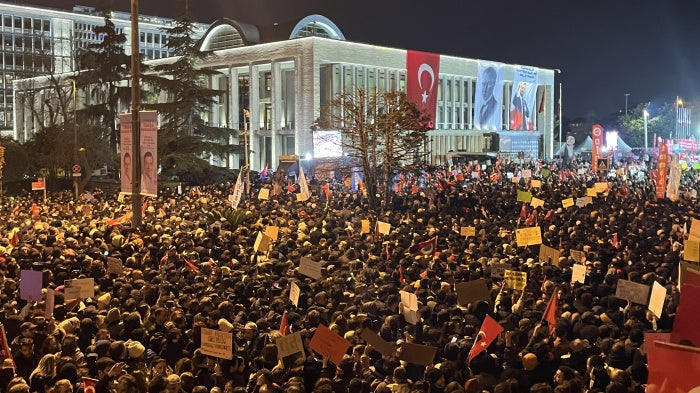
The government of President Recep Tayyip Erdoğan consolidated its authoritarian trajectory with an unprecedented onslaught on the main political opposition Republican People’s Party (CHP) that threatened freedom of political association and free and fair elections. A year after the party made gains over Erdoğan's Justice and Development Party in local elections, on March 19, the authorities detained Istanbul mayor and Erdoğan rival Ekrem İmamoğlu. Concurrently, the Erdoğan government pursued an end to the four-decade conflict with the armed Kurdistan Workers’ Party (PKK), in negotiation with its jailed leader, Abdullah Öcalan. On May 12, the PKK declared its decision to disband and disarm.
The government exercises control over domestic courts and persists in non-compliance with binding judgements of the European Court of Human Rights (ECtHR), leading to serious human rights violations.
An annual inflation rate officially recorded as 31 percent at time of writing left low- and middle-income people’s rights to food and housing vulnerable to increasing food and rental prices.
Freedom of Expression
Public broadcaster TRT, news wire service Anadolu Ajansı, and most private TV news channels are government-aligned, as is the broadcasting watchdog, the Radio and Television High Council (RTÜK), that imposes arbitrary fines on oppositional TV news media and streaming platforms, as well as broadcasting suspensions that are disproportionate and violate the right to freedom of expression.
Journalists, public figures, and social media users frequently face prosecution and sometimes detention pending trial for criticism of the government and judiciary. At time of writing, 27 journalists and media workers were in pretrial detention or serving sentences.
On November 26, Fatih Altaylı, a journalist broadcasting on YouTube, was convicted and sentenced to a prison term of four years and two months on baseless charges of threatening President Erdoğan during a broadcast. Detained in June, he remains in prison pending appeal. Two executives from the Turkish Industry and Business Association (TÜSİAD) are on trial on charges of “publicly disseminating misinformation” and “attempting to influence a fair trial” on the basis of February speeches including criticism of the government’s human rights record.
In November, five staff members at the satirical magazine Leman stood trial for “inciting hostility and public enmity” on the basis of a cartoon in the June 25 edition that the authorities claimed, and the magazine refuted, was of the Prophet Muhammed. The cartoonist was released in November after five months in detention, while the trial continues.
On the day police arrested İmamoğlu, the government imposed bandwidth reduction (internet throttling) for 42 hours, making social media platforms inaccessible without the use of VPNs, many of which are partly blocked. Regular court and internet regulator decisions arbitrarily order social media companies to take down online content. The X account of Ekrem İmamoğlu, with 9.7 million followers, has been blocked in Türkiye since May 8.
Freedoms of Association and Assembly
During a wave of protests following İmamoğlu's arrest, police arbitrarily arrested and courts detained hundreds of people, mostly students, exercising their right to protest. They faced trial on charges including attending unauthorized demonstrations and failure to disperse.
Thousands of people face detention, ongoing investigations, and unfair trials on terrorism charges for alleged links with the movement led by deceased US-based cleric Fethullah Gülen, which the government deems a terrorist organization responsible for the July 15, 2016 attempted military coup. The justice minister announced in July that investigations against 58,000 and trials of 24,000 individuals were continuing, and that a total of 11,640 remanded and convicted persons alleged to be connected with the Gülen movement remained in prison. Many have faced prolonged and arbitrary imprisonment. In 2025, arrests and new criminal investigations were conducted against hundreds of individuals alleged to have continuing links with the movement.
Attacks on Lawyers and Human Rights Defenders
In 2025, lawyers faced heightened judicial harassment, particularly when representing clients in politically motivated cases or making statements advocating human rights protection.
In March, an Istanbul court approved the removal of the board of the Istanbul Bar Association in a civil case initiated by the Istanbul prosecutor after the association issued a December 2024 statement calling for an investigation into the killing of two Kurdish journalists in a Turkish drone strike in Syria. The bar association has appealed the decision. A directly related criminal case against the association for “spreading terrorist propaganda” and “misinformation” continues.
Lawyers acting for İmamoğlu and those arrested in related cases faced criminal investigation and sometimes detention. İmamoğlu’s defense lawyer Mehmet Pehlivan has been held in pretrial detention since June and in November was indicted on charges of “membership of a criminal organization” in the main case against İmamoğlu (see details below).
Osman Kavala, Çiğdem Mater, Can Atalay, Mine Özerden, and Tayfun Kahraman, known for their civil society engagement, remain in prison after their convictions on baseless charges of organizing the 2013 Gezi Park protests and attempting to overthrow the government. Kavala has been arbitrarily detained since October 2017 and the others since their April 2022 convictions. Türkiye has flagrantly disregarded ECtHR decisions ordering Kavala’s release. In 2025, the Istanbul prosecutor widened the investigation, prosecuting talent manager Ayse Barım, who was detained for eight months, and investigating journalist İsmail Saymaz.
Enes Hacıoğulları, an LGBT rights defender and youth delegate to the Council of Europe Congress of Local and Regional Authorities, was detained for a month on the basis of a widely shared and non-inciteful speech he made to the congress about police abuses during the protests against İmamoglu’s arrest. His trial on charges of “disseminating misinformation,” for which he could face a two- to six-year prison sentence, continues.
In May, Syrian refugee rights advocate Taha Elgazi was deported to Syria months after the Turkish authorities arbitrarily revoked his Turkish citizenship.
Torture and Ill-Treatment in Custody
Young people who the police arrested during the mass demonstrations following İmamoğlu's detention reported ill-treatment on apprehension and while in custody. A widespread culture of impunity persists with rare instances of law enforcement officials being held accountable.
Exceptions include the May 8 court conviction in the southern province of Hatay of four ranked soldiers to life imprisonment on charges of torturing to death two Syrian refugees and torturing four others who had crossed the border into Türkiye on March 11, 2023. Human Rights Watch had previously documented the case. In September, 13 gendarmes stood trial in Hatay for the death in custody of Ahmet Güreşçi and the torture of his brother Sabri Güreşçi, a case documented by Human Rights Watch and Amnesty International in a 2023 report on police and gendarmerie abuses. The trial continues, and the defendants face a possible sentence of life imprisonment if convicted.
Kurdish Conflict and Crackdown on Opposition
The Erdoğan government pursued an end to the four-decade conflict with the armed Kurdistan Workers’ Party (PKK), in negotiation with jailed PKK leader Abdullah Öcalan. On May 12, the PKK announced its compliance with a February 27 call by Öcalan to the armed group to disband and disarm, and a cross-party parliamentary commission began in August to examine relevant legal reforms. In the scope of ending the conflict, the government has yet to take steps to ensure equal rights for Kurds and other minority groups, to promote anti-discrimination measures, to amend abusive counterterrorism legislation, or to release political prisoners.
Among the jailed Kurdish activists and politicians on trial for or convicted of terrorism offenses for legitimate non-violent political activities and speeches are former Peoples’ Democratic Party (HDP) co-chairs Selahattin Demirtaş and Figen Yüksekdağ. They have been in prison since November 4, 2016.
İmamoğlu was arrested on March 19 along with two district mayors and over 100 municipal employees, council members, and businesspeople. After repeated waves of arrests, in November, the Istanbul prosecutor indicted İmamoğlu and 401 others on a series of charges, accusing the mayor of abusing his public office to establish a criminal organization and others of being members of it, with other charges centering on corruption, bribery, and fraud. The trial will begin on March 9, 2026.
İmamoğlu also faces a series of other ongoing trials, which are at different stages, based on arbitrary accusations. Several could result in him being banned from politics in the case of a final conviction.
Lawsuits against the leadership of the CHP nationally and in Istanbul that were aimed at removing party chair Özgur Özel and others continued through 2025. These cases and the detention of CHP mayors and council members in Istanbul districts and in cities including Adana and Antalya reinforce concerns of a concerted effort by the authorities to sideline the main political opposition party, gravely undermining the rights to freedom of political association and free and fair elections.
Refugees, Asylum Seekers, and Migrants
Türkiye hosts one of the largest refugee populations in the world—with Syrians under temporary protection officially stated to number 2.4 million and substantial numbers of Afghans and other groups. Authorities have increasingly ignored protection claims and sought to reduce the refugee population by issuing unlawful deportation orders that are often based on arbitrarily labelling people irregular migrants or a security threat and coercing them to sign “voluntary” return forms. Examples include an April detention and deportation order issued against Turkmenistan activists Alisher Sakhatov and Abdulla Orusov, labelling them a threat to national security, despite a lack of concrete evidence. The whereabouts of the two since July is unknown and there are grave concerns they may have been deported to Turkmenistan despite a Constitutional Court interim ruling barring their return to Turkmenistan because of serious risk of persecution there.
Women’s and Girls’ Rights, Sexual Orientation and Gender Identity
The government used itsdesignation of 2025 as the "year of the family" to justify measures that undermined women's rights and the rights of lesbian, gay, bisexual, and transgender (LGBT) people. On May 2, the Ministry of Family and Social Policies issued a circular to 81 provincial directoratesinstructing them to avoid using terms like gender, sexual orientation, and gender identity, citing threats to family unity and society. In October, a draft law was leaked that proposed criminalizing conduct deemed “contrary to biological sex” as well as its so-called “promotion,” and prohibiting access to gender-affirming care outside strict new limits. While no law has yet been officially proposed, there are concerns that the government has not ruled out such measures.
The authorities justified increased arbitrary censorship of social media and digital platforms, and criminal investigations of artists with vague references to "public morality," and obscenity. In October, the Istanbul prosecutor indicted the all-female music group Manifest accusing its members of exhibitionism and obscenity on the basis of their costumes and dancing during a concert. The six singers were released with travel bans after testifying before the prosecutor, and they cancelled their national tour.
Istanbul Pride was banned for the eleventh consecutive year, and many cities across the country imposed similar bans.
Climate Change Policy
Türkiye avoided committing to a phase out of fossil fuels with its September announcement of revised but unambitious greenhouse gas emission mitigation targets. In 2025, local community groups challenged the government decision to expand the Afşin Elbistan coal power plant A.