Five years since the February 2021 military coup, the Myanmar junta’s assault on the population has decimated the country’s infrastructure, economy, civil and political life, rule of law, and healthcare and education systems. The military’s post-coup atrocities amount to war crimes and crimes against humanity, fueled by decades of impunity.
The military responded to armed resistance in 2025 with repeated aerial and artillery attacks on civilians and civilian infrastructure, including in the immediate aftermath of the devastating March earthquake.
Throughout 2025, the junta ramped up violence and repression to lay the groundwork for sham elections, which were held in three phases between December 28 and January 25.
Since the coup, trafficking, scam centers, and other illicit economies have proliferated, with Myanmar becoming the world’s top producer of opium and one of the main sources of synthetic drugs.
Conflict Abuses
The Myanmar military carried out increasing airstrikes in 2025, including deliberate and indiscriminate attacks on civilians in opposition-held areas. The military’s growing use of armed drones, paramotors, and gyrocopters to carry out unlawful attacks is creating new threats for civilians. In 2025, fighting took place in all 14 of Myanmar’s states and regions.
Military airstrikes have struck residential areas, schools, hospitals, religious sites, and camps for internally displaced people (IDPs), killing thousands. On January 31, an airstrike on an IDP camp in Koke Ko village in Sagaing Region killed 11 civilians, including a pregnant woman and at least three children. At least 22 displaced people were killed on July 11 by military airstrikes on a monastery in Lin Ta Lu village, Sagaing Region, where over 150 people were sheltering.
On March 14, the military conducted an airstrike on a crowded market in Let Pan Hla village in Mandalay Region, killing at least 27 civilians, including several children as young as 2-years-old, and destroying homes. On August 17, airstrikes in Mawchi, Karenni State, killed at least 25 civilians, including five children, and destroyed a preschool and houses.
On the evening of October 6, a military paramotor (motorized paraglider) attack on a Buddhist festival gathering at a primary school in Chaung U, Sagaing Region, killed at least 24 people, including 3 children. More than 135 paramotor attacks have been reported since December 2024.
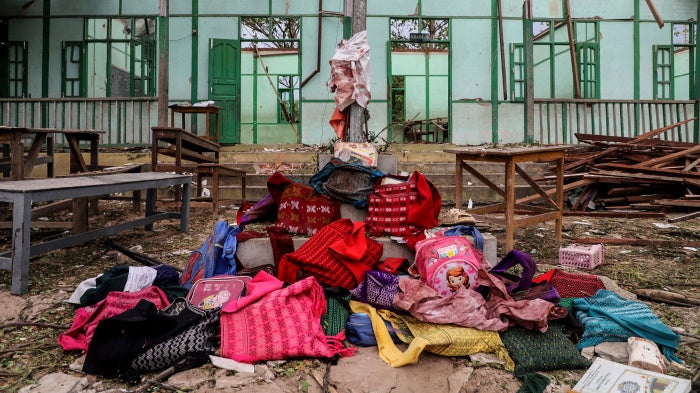
Schools in Myanmar continue to come under attack. On May 12, an airstrike on an opposition-run school in Oe Htein Kwin village in Sagaing Region killed 22 students and two teachers. On September 12, a military jet bombed two private boarding schools in Rakhine State’s Kyauktaw township overnight, killing an estimated 23 students.
Myanmar is one of very few countries that continue to use internationally banned cluster munitions and antipersonnel landmines. Cluster munitions, which the military has domestically produced since 2022, appear to have been used in an attack on a school in Paing Yat village, Karen State, on June 9, killing six.
Since enacting the People’s Military Service Law in February 2024, the junta has carried out conscription through abusive tactics such as abducting young men and boys and detaining family members of missing conscripts. The military’s recruitment and use of child soldiers has surged since the coup. Military recruiters have abducted or opportunistically recruited children when unaccompanied, displaced, or working, then concealed or failed to verify their ages. The military has sent children to the front lines and used them as guides, porters, and human shields.
Non-state armed groups have also recruited child soldiers and carried out other conflict-related abuses, such as using antipersonnel landmines.
Aid Blockages, Displacement, and Humanitarian Crisis
The junta enforces deadly blockages of humanitarian aid as a method of collective punishment against civilian populations. These blockages sustain the military’s longstanding “four cuts” strategy, designed to maintain control of an area by isolating and terrorizing civilians.
On March 28, a 7.7 magnitude earthquake struck central Myanmar, causing thousands of deaths and widespread destruction that impacted 17 million people. Following the earthquake, the junta obstructed access to lifesaving services in opposition-held areas. The junta’s years of unlawful attacks on healthcare facilities and health workers severely hampered the emergency response. Despite announcing a ceasefire, the military reportedly carried out more than 550 attacks in the two months following the earthquake.
At least 3.6 million people in the country are internally displaced. Many live in makeshift shelters and open fields with limited access to food, health care, and water. Foreign aid cuts, skyrocketing prices, and lack of access to medical care has exacerbated growing malnutrition, waterborne illness, and preventable deaths. Over 15 million people are facing acute food insecurity, with Rakhine State especially impacted.
Arbitrary Detention, Torture, and Ill-Treatment
Junta authorities have arrested more than 30,000 people since the coup, including over 6,200 women and 625 children. More than 2,200 people are reported to have died in junta custody, although the actual figure is likely higher. Torture, sexual violence, and other ill-treatment is rampant in prisons, interrogation centers, military bases, and other detention sites, with reports of rape, beatings, prolonged stress positions, electric shock and burning, denial of medical care, and deprivation of food, water, and sleep. In July, activist Ma Wutt Yee Aung, 26, died in Insein prison due to reported lack of medical treatment for long-term head injuries she sustained from torture.
The security forces have arbitrarily arrested activists, journalists, humanitarian workers, lawyers, and religious leaders. Authorities also detain family members—including children—and friends of activists as a form of coercion and collective punishment.
The junta uses a sweeping counterterrorism law to crack down on aid workers, journalists, and activists. Journalist Than Htike Myint was arrested in February, beaten during interrogation, and sentenced to five years in prison in April on terrorism charges for having contacts of opposition force members in his phone.
Rule of law has collapsed since the coup. Military authorities have imposed systematic obstacles and restrictions on lawyers and abolished all semblance of an independent judiciary. The junta uses special closed courts inside prisons for politically sensitive cases and closed military tribunals in townships under martial law.
Political and Digital Repression
In July, the military announced it would hold elections in December 2025 and January 2026. In preparation for the polls, the junta replaced the State Administration Council with the State Security and Peace Commission and declared a new state of emergency and martial law orders.
Also in July, the junta passed an “election protection” law criminalizing criticism of the election, prohibiting any speech, organizing, or protest that disrupts any part of the electoral process. Authorities arrested hundreds of people under the new law, including children.
The military has limited or no control over significant parts of the country; a census in 2024 was conducted in only 145 out of 330 townships. Polls were not held in 65 townships. Volker Türk, the UN high commissioner for human rights, stated in September that “conditions do not exist for free and representative elections.”
In January, the junta enacted a cybersecurity law that further restricts online content and expands surveillance. The junta’s severe restrictions on internet and phone services, with rolling shutdowns around the country—particularly in conflict areas—impeded access to information, humanitarian efforts, and community protection, including in the wake of the March earthquake.
With millions of Myanmar nationals having fled the country, the junta has cracked down on activists outside its borders through requests for deportations, digital surveillance, and revocation of passports. In October, the junta announced it was detaining pro-democracy activist Thuzar Maung along with her husband and three children, over two years after they were abducted in Malaysia and forcibly disappeared.
Rohingya
The Myanmar military has long subjected ethnic Rohingya to atrocity crimes, including the ongoing crimes against humanity of apartheid, persecution, and deprivation of liberty.
Since late 2023, Rohingya civilians have been caught in the fighting between the junta and ethnic Arakan Army forces in Rakhine State. Both parties have carried out grave abuses, including extrajudicial killings, widespread arson, and unlawful recruitment. The Arakan Army, which now controls most of Rakhine State, has ramped up oppressive measures against Rohingya in northern Rakhine State, including forced labor and arbitrary detention. Arakan Army restrictions on livelihoods and agriculture, compounded by extortion and exorbitant prices, have exacerbated already severe food shortages and the junta’s blockade on aid, in place since late 2023.
The Arakan Rohingya Salvation Army (ARSA) and other Rohingya armed groups—after fighting alongside the Myanmar military in 2024—are again deploying fighters in clashes against the Arakan Army in northern Rakhine State.
The conflict has internally displaced over 400,000 people in Rakhine and southern Chin States and forced at least 150,000 Rohingya to flee into Bangladesh since late 2023.
From January to November 2025, an estimated 5,600 Rohingya attempted dangerous boat journeys from Myanmar and Bangladesh seeking refuge in third countries; more than 820 died or went missing. On November 20, junta authorities detained over 500 Rohingya after intercepting their boat off the coast of Rakhine State.
Sexual and Gender-Based Violence
Military personnel have frequently been responsible for sexual and gender-based violence during conflict and against people in detention, including rape, gang rape, sexual enslavement, sexual torture, sexual mutilation, and forced nudity. Perpetrators act with impunity and survivors lack access to needed services. Following the March earthquake, women and girls faced increased risk of gender-based violence, with little to no access to humanitarian services, protection, or redress.
Section 377 of the penal code, drawn from a British colonial-era law, criminalizes same-sex sexual behavior, embedding discrimination against sexual and gender minorities.
Resource Extraction
Since the coup, unregulated extraction of heavy rare earth metals in Myanmar has surged, primarily in Kachin and Shan States by Chinese-linked operators who export the raw materials for processing. More than 300 mining sites have been established without any environmental or labor standards, with devastating impacts on the environment and communities’ health and safety.
Use of chemical leaching mining processes has led to severe contamination of rivers, with elevated levels of arsenic and other toxic metals found downstream in Thailand and the Mekong River basin. Ethnic armed groups and local militia that control the border areas often facilitate the mining operations.
Key International Actors
China and Russia continue to provide arms, military equipment, and political support to the Myanmar junta while blocking international action on the military’s crimes at the UN Security Council.
In July, the United States lifted sanctions on junta allies involved in the sale of arms and related supplies to the Myanmar military. In November, the US announced the termination of Temporary Protected Status (TPS) for people from Myanmar; TPS protects non-US citizens from deportation to countries where return would be unsafe.
In November 2024, the International Criminal Court prosecutor requested an arrest warrant for Min Aung Hlaing, leader of the junta, for the alleged crimes against humanity of deportation and persecution of the Rohingya committed in 2017. The judges have not yet issued a public decision on the request.
In July 2025, the International Court of Justice accepted the interventions of four states in Gambia’s case against Myanmar under the Genocide Convention, in addition to the seven previous interveners. The merit hearings are expected in January 2026.
In February, an Argentine court issued arrest warrants for 25 individuals from Myanmar for crimes against humanity and genocide committed against the Rohingya. The case was brought under the principle of universal jurisdiction.
The UN General Assembly convened a High-Level Conference on the Rohingya in September.