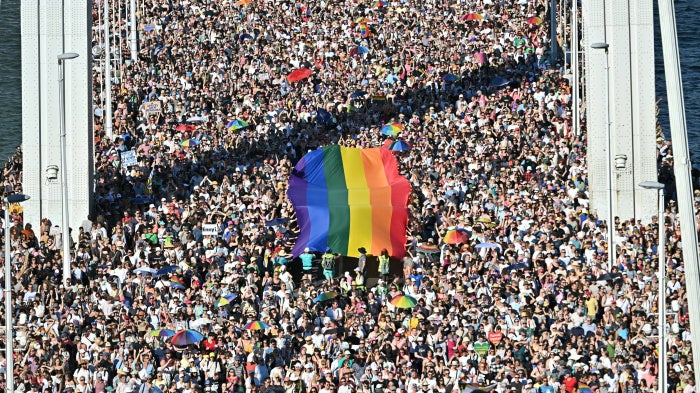
The government intensified its assault on rule of law and rights in 2025, drawing growing domestic and international criticism. Constitutional amendments banned public LGBT events, including Budapest Pride, yet local authorities and record crowds defied the restrictions. In May, parliament tabled a bill on “transparency of public life,” enabling the government to defund and dissolve any organization it designates “a threat to Hungarian sovereignty.”
Other rights concerns included continued unlawful pushbacks of migrants and asylum seekers at Hungary’s border with Serbia, and discrimination against LGBT people, women and girls, and minority groups. After refusing to arrest Israeli Prime Minister Benjamin Netanyahu, sought by the International Criminal Court (ICC) for crimes against humanity and war crimes committed in Gaza, when he visited in April, Hungary formally notified the UN secretary-general in June of its withdrawal from the ICC. The withdrawal will take effect in June 2026.
Attacks on Rule of Law and Public Institutions
In April, parliament enacted sweeping constitutional amendments without consultation allowing the government to invoke alleged "child protection" to restrict freedom of assembly and ban public LGBT events, such as the Budapest Pride. Other amendments allowed stripping non-EU dual nationals of citizenship on national security grounds.
In May, a ruling party deputy introduced a “transparency of public life” bill that would empower the government-appointed Sovereignty Protection Office (SPO) to place foreign-funded civil society and media groups on a state watchlist and freeze their grants pending review. The proposed law would also require donors to sign declarations confirming that their contributions are “not foreign”, and foreign-funded organizations and their leadership to register as “politically exposed” entities, subjecting them to asset declaration requirements, audits, inspections, and onerous regulatory oversight. Violations could lead to fines (up to 25 times the grant amount received), dissolution of the organization, and confiscation of assets. The European Commission and the Council of Europe’s Commissioner for Human Rights expressed opposition to the bill and urged Hungary to withdraw or amend it to comply with EU law and international human rights standards. Following international and domestic criticism, the government postponed the vote temporarily.
In June, the Budapest Court of Appeal ruled that Hungary’s Supreme Court president had unlawfully suspended another judge from his role as president of the judicial council for two years. The suspended judge was targeted after criticizing the court’s case assignment system. In a related case in June, the Budapest Court of First Instance found the dismissal of a former chief advisor to the Supreme Court unlawful, ruling it a disproportionate sanction after the advisor co-authored an academic paper with mild criticism of the Supreme Court president.
Freedom of Media
The government continued its attacks on independent media and journalists. In February, authorities detained and charged two journalists who were waiting to question Prime Minister Viktor Orban, accusing them of misdemeanors and holding them for three hours. In May, police physically obstructed Telex journalists from questioning officials during a public campaign event.
In May, the Budapest Chief Prosecutor’s Office sought a 2.5-year prison sentence and other sanctions for alleged financial wrongdoing by Zoltán Varga, owner of the Central Media Group, which publishes 24.hu, one of Hungary’s largest independent news outlets. Varga has repeatedly faced pressure to sell, surveillance, and reported Pegasus spyware targeting.
In an escalating campaign against independent media, in June, the SPO targeted journalist Szabolcs Vörös, co-founder of Válasz Online and correspondent for Reporters Without Borders (RSF), publishing what RSF described as a defamatory pamphlet one day after Válasz Online interviewed Ukrainian President Volodymyr Zelensky, who criticized Orbán’s Russia policy. In May, the SPO launched a wider smear campaign through social media making baseless claims that outlets including Telex, Átlátszó, 444.hu, Magyar Hang, Klubrádió, and Direkt36 served foreign interests and misused international funding. Absent any proof, the SPO claimed these organizations received billions of forints from the EU and USAID, portraying external support as corruption. In coordinated smear attacks, pro-government media accused independent outlets like 444.hu and it’s international partners of engaging in "information warfare.”
The introduction of the “transparency of public life” bill compounded concerns about curbs to press freedom.
Attacks on Civil Society
The “transparency of public life” bill would grant the SPO sweeping powers to investigate, deprive of funding, and forcibly close foreign-funded organizations if it deems them threats to national sovereignty. In July, the SPO announced it had identified 1,479 domestic beneficiaries of European Commission-funded projects, claiming about 500 were under monitoring for alleged “political activity.” It singled out universities and civil society and media groups, such as Central European University, the Hungarian Helsinki Committee, Political Capital, and Republikon. The SPO described these groups as part of a “foreign-financed political pressure network” allegedly aimed at undermining Hungary’s sovereignty.
Sexual Orientation and Gender Identity
The government continued its attacks on and scapegoating of lesbian, gay, bisexual, and transgender (LGBT) people.
In March, Hungary’s parliament amended the law on freedom of assembly banning Pride marches and other public LGBT events, imposing fines on potential participants, and authorizing the use of facial recognition to identify attendees.
In June, Hungarian police banned an LGBT-related event on three separate occasions despite organizers’ two successful appeals to the Supreme Court. Also in June, the Budapest mayor announced the city would organize Pride as a municipal event thereby sidestepping anti-LGBT provisions in the freedom of assembly law. Police nonetheless banned Pride ex officio. Hundreds of thousands marched in the largest Budapest Pride in history, which went ahead without major incidents. Authorities announced they would not fine participants but launched a criminal investigation against the mayor, who faces prison time if charged and convicted.
In September, police banned the planned October Pride in Pécs, citing the pink triangle, a symbol representing LGBT victims of the Holocaust, as “displaying homosexuality.” The Supreme Court upheld the ban, but the march went ahead and police opened a criminal investigation.
The Court of Justice of the EU (CJEU) in March ruled that Hungarian authorities are obliged to correct personal data where it does not correctly reflect a person’s self-determined gender identity.
Women’s Rights
The government’s failure to address domestic violence was highlighted in February when a Japanese woman was killed by her husband, sparking public outcry. Police initially described her death as accidental. A local women’s rights group reported, however, that the victim had repeatedly sought help for prior abuse, but authorities had taken no action. Hungary has not ratified the Istanbul Convention on violence against women, leaving systemic gaps in protection and support services for survivors.
Discrimination against Roma
Discrimination persisted in education, healthcare, and employment, with Roma children still unlawfully segregated or placed in schools for children with mental health conditions. In June, the European Court of Human Rights (ECtHR) ruled that Hungary had breached the European Convention on Human Rights when authorities in 2014 forcibly separated a Roma mother from her newborn without justification. The UN Special Rapporteur on the right to education in March 2025, warned about Roma students wrongfully placed in special education and about segregation in schools.
Migrants and Asylum Seekers
Access to Hungary’s asylum system remained effectively blocked due to a 2020 law that prevents most asylum seekers from submitting protection claims within the country.
By August, 64,194 people in Hungary had registered for temporary protection under the EU Temporary Protection Directive activated following Russia’s full-scale invasion of Ukraine.
Authorities continued unlawful, sometimes violent, pushbacks of migrants and asylum seekers to Serbia. The number of “arrests and escorts across the fence” increased to 3,092 between January and August from 1,830 for the same period in 2024.
In June, the ECtHR ruled that Hungarian authorities violated the rights of asylum seekers by removing them to Serbia without assessing their individual protection needs. The court found breaches of the prohibition of collective expulsion, the prohibition of inhuman or degrading treatment, and the right to an effective remedy.
Hungary failed to pay the €200 million fine imposed by a 2024 CJEU judgment over ongoing restrictions on the right to asylum. Hungary faces an additional €1 million daily penalty for missing the September 2024 deadline, with the sum to be deducted from its share of the EU budget, already partly frozen due to rule of law concerns.