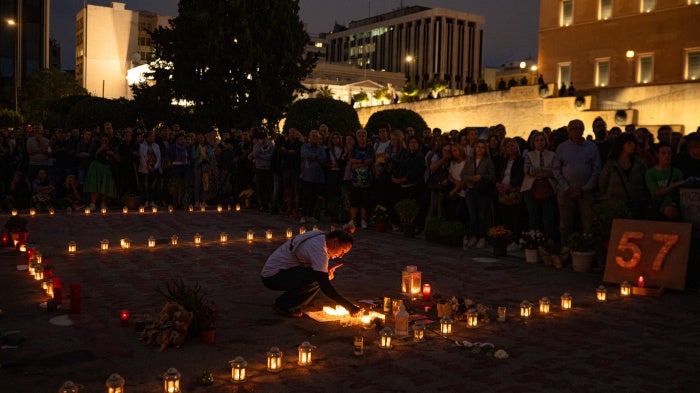
Rule of law deteriorated in Greece due to government actions that undermine democratic institutions and harm human rights, including interfering with media freedom and attacking civil society. Lack of accountability for the 2023 fatal Tempi train crash exposed wider rule of law failings, and triggered mass protests. Violations of asylum seekers and migrants’ rights continued, including pushbacks, inadequate reception conditions, and a government policy to suspend access to asylum for certain arrivals.
Freedom of Media
For the fourth year, Greece ranked last in the EU at Reporters Without Borders (RSF) press freedom index, reflecting a hostile environment for journalists. Journalists face constant challenges, including intimidation and harassment, state surveillance, abusive lawsuits (known as SLAPPs, strategic lawsuits against public participation), and government interference, all contributing to self-censorship.
In July, a coalition of nongovernmental groups urged the prime minister to address persistent press freedom concerns, including state surveillance, SLAPPs, and government pressure on media independence. The Greek government committed to implement the European Union anti-SLAPPS directive in a way that would also apply to abusive lawsuits brought in Greece.
In April, on the fourth anniversary of the killing of crime reporter Giorgos Karaivaz, media freedom and journalist organizations renewed their call for justice, warning that ongoing impunity casts a shadow over the media landscape.
An Athens court in April largely dismissed a defamation lawsuit by former government official, Grigoris Dimitriadis, against journalists and one media outlet, for their exposure of his alleged role in the Predator surveillance scandal. However, the court did find one headline to be “simple defamation,” a decision the affected outlet has appealed.
Rule of Law
Nationwide protests in January and March over the 2023 fatal Tempi train crash highlighted deep outrage over lack of accountability around the accident, as the case exposed wider rule of law failings. A January poll showed over 80 percent of Greeks lack faith in the justice system’s ability to uncover the truth about the disaster, which has been marred by allegations of a government cover-up.
In June, the European Public Prosecutor’s Office referred two former ministers to the Greek parliament for alleged criminal involvement in a major EU fraud. The office criticized Greece’s law on ministerial responsibility, which reserves authority to investigate and prosecute ministers exclusively for Greece’s parliament, keeping such cases out of the criminal justice system.
Surveillance
The “Predatorgate” surveillance scandal, involving the government-ordered use of spyware to surveil journalists and politicians, continued to raise rule of law concerns with no one held accountable to date.
The trial of four executives whose companies developed and traded Predator spyware began in September. To date, it is the only criminal accountability related to the scandal.
A joint media investigation from January highlighted the pervasive and, potentially, disproportionate use of surveillance systems by Greece for migration control at its borders and in refugee camps, raising privacy and discrimination concerns.
Attacks on Civil Society
At this writing, CIVICUS, a nongovernmental group assessing civic freedoms globally, maintained its assessment of Greece’s civic space as “obstructed.”
In May, the Council of Europe (CoE) Commissioner for Human Rights, warned against the harassment of human rights defenders by Greek authorities and called on authorities to end all forms of criminalization of human rights defenders.
In August, UN special rapporteur on human rights defenders raised concerns over a proposal to remove nongovernmental groups from the official registry if they legally challenge or oppose the government’s migration policies. Removal would strip them of access to EU and government funding.
The criminal case against human rights defenders Panayote Dimitras and Tommy Olsen for exposing violations at Greece’s borders remained pending at this writing, with Dimitras still under a travel ban.
A felony trial of 24 humanitarian workers began in December and continues what a European Parliament report called the “largest case of criminalization of solidarity in Europe.” The defendants face potential sentences of up to 20 years in prison over their 2018 efforts to rescue asylum seekers and migrants. Many of the same defendants were acquitted of misdemeanor charges in the same case, in 2024.
Migrants and Asylum Seekers
In July, the government suspended access to asylum for three months for people arriving by boat from North Africa, allowing for their summary return without registration. The CoE Commissioner for Human Rights and UNHCR condemned the measure as a violation of international and EU law.
A law adopted in September introduced prison terms of two to five years for rejected asylum seekers who fail to leave Greece.
The European Court of Human Rights (ECtHR) issued interim measures on multiple occasions with respect to the asylum suspension, ordering Greece to allow applicants access to asylum and protect them from deportation until their cases have been examined by domestic courts.
By the end of November, 41,271 asylum seekers and migrants had arrived in Greece by the Aegean Sea, across the land border with Türkiye, or from North Africa to the islands of Crete and Gavdos, which emerged as major points of entry for people on the move.
The surge in arrivals on Crete and Gavdos overwhelmed local authorities, leading to people being housed in informal and unsuitable temporary spaces, in unsanitary conditions.
In a historic May development, the Greek Naval Court prosecutor concluded that 17 Hellenic Coast Guard officers—including the then-chief of the Hellenic Coast Guard—should face felony charges in connection with the Pylos shipwreck in June 2023 in which an estimated 650 people died. The indictment was expanded in November with criminal charges against an additional four senior officers, including the current Chief of the Hellenic Coast Guard.
In May, the CoE Human Rights Commissioner criticized Greece over persistent reports of summary returns at its land and sea borders, calling on authorities to adopt a “zero-tolerance” approach to such practices, ensure that allegations are promptly investigated, and hold those responsible accountable.
News emerged in April that Frontex, the European Union’s border agency, was investigating Greece over 12 cases of potential human rights violations related to pushbacks.
In a January ruling, ECtHR found that Greece had violated an asylum seeker’s rights as part of a “systematic” practice of pushbacks of third-country nationals from the Evros region to Türkiye.
The Council of State, the highest administrative court, annulled in March a government decision designating Türkiye as a safe third country for asylum seekers. In April, the government reinstated a similar decision, in defiance of the court’s ruling.
A coalition of 11 nongovernmental groups warned in October about poor reception conditions in the EU-funded Closed Controlled Access Centres on the Aegean islands.
Migrant Children
According to official data, as of the beginning of September, there were 1,795 unaccompanied migrant children in Greece.
A media investigation in March found that unaccompanied migrant children live in dire conditions, facing extreme overcrowding, systemic neglect, and prolonged confinement in Aegean camps.
The ECtHR granted interim measures in June for 45 unaccompanied children in a camp in Samos, warning that the authorities were failing to protect them.
In two separate rulings in June, the ECtHR condemned Greece for violating the rights of 39 unaccompanied children by failing in 2019 and 2020 to provide adequate reception conditions and detaining them in police stations and other facilities.
Women’s Rights
Persistent genderinequality in leadership and pay, femicides, and widespreadgender-based violence remain the most pressing issues.
A law adopted in January toughens penalties for domestic violence but was criticized by civil society and opposition MPs for failing to focus sufficiently on prevention.
Additionally, the trial for the 2024 killing of Kyriaki Griva, fatally stabbed outside an Athens police station after being turned away while seeking protection, began in June, highlighting failings in the handling of domestic violence by police. An Athens prosecutor pressed charges in January against four police officers for failing in their duty to protect her.
Sexual Orientation and Gender Identity
The Greek government amended the civil code in April to ban male same-sex couples and single men from having children through surrogacy.
Racism and Intolerance
In July, the Racist Violence Recording Network warned that negative public discourse on migration fueled by political leaders and the media is normalizing xenophobia and risks escalating racist violence.
The CoE Commissioner criticized Greece in June for failing to adequately address police violence, racism, and discrimination against Roma people, most living in poverty and inadequate housing conditions in segregated settlements.