Since Hun Manet became prime minister in 2023, the human rights situation has continued to deteriorate, with a sustained campaign by the Cambodian government to suppress all forms of dissent. The ruling Cambodian People’s Party (CPP) controls all branches of government, including the judiciary. The government punishes dissent with arbitrary detention, often followed by coerced confessions or public apologies, and engages in pervasive surveillance and transnational repression of critics who have fled to other countries.
Political and Transnational Repression
Opposition parties—including the Candlelight Party, Khmer Will Party, and Nation Power Party—remain under persistent pressure: leaders and supporters endure harassment, arbitrary arrests, and politically motivated charges. In May 2025, Rong Chhun, a senior adviser to the Nation Power Party, was convicted of incitement and sentenced to four years in prison.
In September, a wave of arrests swept up opposition politicians and activists on treason and incitement charges, the detainees held in overcrowded prisons. As of November, 88 political prisoners were in detention. Political opposition leader Kem Sokha remains under house arrest, having received a 27-year sentence in 2023 on politically motivated treason charges.
The Cambodian government also regularly attempts to silence and intimidate exiled critics and dissidents through transnational repression, including in Thailand, Malaysia, and Japan. In January 2025, former opposition lawmaker and dual French-Cambodian national Lim Kimya was shot dead in Bangkok in what was widely viewed as a political assassination. Thai authorities arrested and charged a suspect, but it remains unclear who ordered the killing.
Restrictions on Civil Society and Media
Civil society organizations such as Equitable Cambodia and CENTRAL have had their members targeted—administratively, legally, and through threats of criminal proceedings—for their advocacy. Cambodian authorities continue to use broadly defined laws on plotting, incitement, and national security to suppress dissent, and civil society’s ability to operate is now almost entirely constrained. Meaningful civic participation is virtually impossible.
Media freedom is under acute threat, with independent and online outlets facing legal intimidation, censorship, and the threat of forced shutdown, making investigative reporting increasingly dangerous.
On December 4, 2024, environmental journalist Chhoeung Chheng was shot while investigating illegal logging near the Boeung Per Wildlife Sanctuary and died three days later. Although one suspect was convicted in May 2025, his case remains a rare exception in a broader climate of impunity for attacks on Cambodian journalists.
Cambodian authorities accused British journalist Gerald Flynn of using a “fake” visa and placed him on a blacklist shortly after he appeared in a France24 documentary critical of carbon offsetting projects in Cambodia.
On July 31, 2025, Cambodian authorities arrested two journalists covering the aftermath of Thai-Cambodia border clashes. They were later charged with treason under article 445 of the criminal code, which carries a sentence of 7 to 15 years. Authorities accused them of photographing a prohibited military zone and supplying information harmful to national defense.
In his annual report to the United Nations Human Rights Council, the UN special rapporteur on human rights in Cambodia highlighted that human rights defenders and others “perceived to be dissidents” are targeted with prosecutions for incitement and related offenses in exercising their rights to freedom of expression and peaceful assembly.
Citizenship Law
In mid-2025, the government passed constitutional amendments and implementing legislation to remove the prohibition on depriving a citizen of their nationality under Cambodian law. The former prime minister and current Senate president, Hun Sen, had announced on June 27 that he had instructed the justice minister to study revoking citizenship for Cambodians who “side with foreign nations to harm our country.”
Cambodian authorities are now able to strip citizenship from individuals convicted of treason or perceived as acting against national interests. Cambodian civil society groups condemned the law as vague and open to arbitrary application—potentially targeting opposition figures, critics abroad, and human rights defenders.
Environmental Defenders
The Cambodian government continues to crack down on environmental activism. Mother Nature Cambodia activists were convicted in 2024 and sentenced to six to eight years in prison. In May 2025, environmental reporter Ouk Mao was arrested in Stung Treng after exposing illegal logging. Other defenders documenting deforestation or environmental harm are now being accused of spreading false information or incitement to create “social disorder.”
Environmental activist Ouch Leng continued to be harassed after he was arrested by Cambodian military personnel in Stung Treng in November 2024 while investigating illegal logging in a protected forest. After his release, police surrounded his home, prompting him to flee the country.
Indigenous Rights
Indigenous communities in Cambodia struggle to be recognized as Indigenous and often cannot obtain collective land titles due to an onerous and complex process under Cambodian law. Insecure land tenure puts them at risk of forced eviction, driven by agribusiness, carbon offsetting projects, and construction of tourism infrastructure.
Indigenous communities face harms from predatory microfinance lending. Microfinance institutions have accepted “soft titles” issued by local authorities as collateral, even when these overlap with collective land titles, undermining Indigenous land protections. Over-indebtedness results in coerced land sales, reduced access to food, and loss of traditional ways of living and access to work. Human Rights Watch and others have documented deaths by suicide linked to debt among Indigenous borrowers.
The internal watchdog of the International Finance Corporation completed its investigation following a complaint filed by Cambodian civil society organizations, but the results were not public at time of writing. Its initial review in 2023 found that there were “preliminary indications of harm” to borrowers and violations of IFC performance standards, including provisions on Indigenous communities, triggering a full investigation.
Border Clashes and Returned Migrants
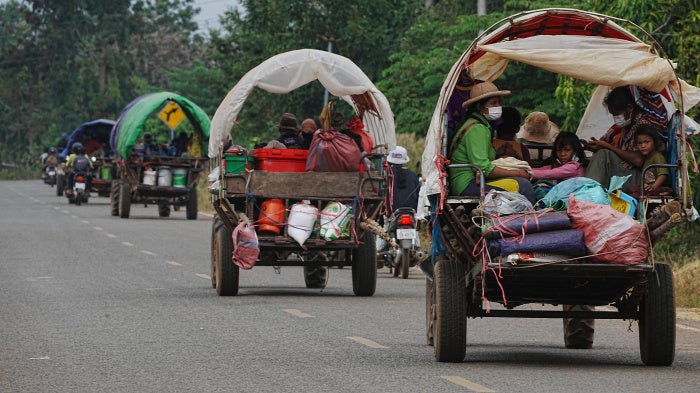
Border clashes between Thailand and Cambodia in July 2025 killed and injured civilians, including children, displaced around 300,000 people, and damaged religious and cultural sites. Human Rights Watch reported on the use of explosive weapons in populated areas during the fighting.
Landmine explosions along the contested border that seriously injured Thai soldiers preceded the clashes. Thailand and Cambodia have ratified the 1997 Mine Ban Treaty, which comprehensively prohibits any production, transfer, stockpiling, or use of antipersonnel mines. Cambodia also alleged that Thailand used internationally prohibited cluster munitions. On October 25, 10-year-old Sern Sovann died from an explosion after reportedly bringing home an item from a nearby field in Cambodia’s Preah Vihear province near the border with Thailand. Cambodia alleged it was a cluster munition remnant, which Thailand denied.
A ceasefire took effect on July 28, 2025, but further fighting started on December 8, with both sides conducting attacks at multiple points along the border that displaced more than half a million people. Thai and Cambodian leaders agreed to another ceasefire on December 27, which included the return of 18 Cambodian soldiers held in Thai custody since July.
As tensions increased mid-year, more than 900,000 Cambodian migrant workers returned from Thailand, fearing harassment. The Cambodian government also called on workers to come home and promised to provide jobs, but returned migrants have urgent unmet needs and no livelihoods. Credit officers were trying to collect repayments of microfinance debt, further straining heavily indebted households.
Online Scam Centers
Reports of operations of cyber-scam compounds have continued to grow, with victims trafficked into forced criminality. Authorities make occasional raids, but reported abuses remain systemic: detainees lack protection and have minimal access to remedies. In October, the US and UK announced sanctions on individuals and entities linked to the Cambodia-based Prince Group, which the US Department of the Treasury’s Office of Foreign Assets Control (OFAC) designated as a transnational criminal organization for its involvement in online investment scams.
On January 21, 2025, Cambodian authorities detained two journalists after their outlets published a video allegedly showing torture inside a Phnom Penh cyberscam compound. Police accused them of spreading false information that threatened national security and the dignity of national leaders and charged them with incitement.