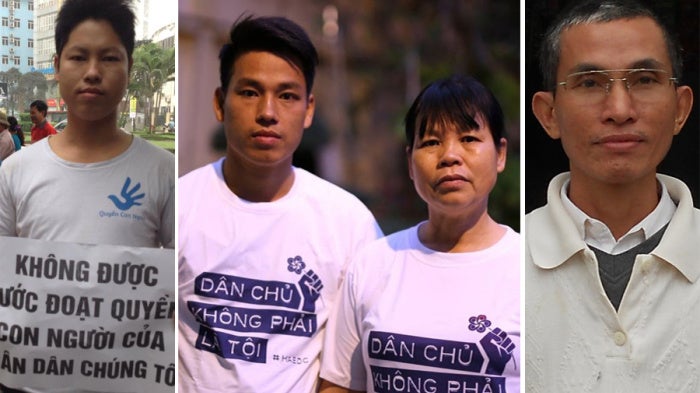
Vietnamese authorities severely restrict the rights to freedom of expression, association, peaceful assembly, movement, and religion, and prohibit human rights organizations and independent labor unions, media, and political parties. Under the Communist Party-controlled judiciary, the courts routinely deny defendants their due process rights. Public Security agents patrol the internet and arrest critics they deem threatening to the Party’s monopoly on power.
In 2025, Communist Party leadership carried out a political restructuring that further enhanced the already considerable power of the Ministry of Public Security, an agency active in the government’s harsh repression of dissidents.
The European Union, despite expressing concerns over Vietnam’s repression and receiving complaints filed by human rights groups for abuses directly linked to the EU-Vietnam trade deal, has been seeking an upgrade of its bilateral partnership with the country. The United States, the EU, and Australia carried out bilateral human rights dialogues with Vietnam in January, July and August respectively, but Vietnam did not publicly commit to any measurable benchmarks for improving its rights record.
In July, during the UN Human Rights Committee’s periodical review of Vietnam’s compliance with the International Covenant on Civil and Political Rights (ICCPR), Vietnam dismissed virtually all concerns raised by the committee about restricted freedom of expression, religion, and other rights. In October, in a closed slate vote, Vietnam was elected to another term as UN Human Rights Council member for 2026-2028.
Political Prisoners and Detainees
Party-controlled courts continue to sentence advocates of online free speech and civil society activists to long prison sentences on bogus charges of “propaganda” (article 117 of the penal code) and “infringing on the interests” of the state (article 331). In 2025 Vietnam held more than 160 political prisoners and arrested at least 40 others for criticizing the government. In September, a court convicted and sentenced political prisoner Trinh Ba Phuong—already serving a 10-year sentence—to an additional 11 years for criticizing the Party. In October, police arrested former political prisoner Huynh Ngoc Tuan for his political writing on social media.
The government intensified its use of article 331 to target people who use social media to publicly raise religious freedom, land rights, rights of Indigenous peoples, and government or party corruption, among other issues. Between 2018 and February 2025, the courts sentenced at least 124 people to harsh prison terms under article 331, a significant increase over the previous six-year period. In 2025, courts sentenced at least 32 people to prison under article 331, including blogger Truong Huy San and prominent lawyer Tran Dinh Trien. In a set of hastily convened show trials in December, courts convicted five journalists and dissidents under article 117, including two in absentia who were in exile, and sentenced them to lengthy prison terms.
In September, political prisoner Vuong Van Tha died under unclear circumstances while serving a 12-year prison sentence for criticizing the authorities.
In October, the government hosted the signing ceremony of the UN Cybercrime Convention, a treaty that obliges governments to establish broad surveillance powers and has the potential to expand cross-border access to data and facilitate transnational repression.
Freedom of Association and Assembly
As a matter of law and practice, the Vietnamese government does not allow independent unions to represent workers: its Trade Union Law allows only government-controlled “unions.”
The government has still not ratified International Labour Organization Convention No. 87 on Freedom of Association and Protection of the Right to Organize, despite pledging to do so. While the government claims that the Vietnam General Confederation of Labor is a “labor confederation” of enterprise-level unions, it is not independent, nor does it comprise labor unions: its leaders are appointed by the Vietnamese government or the Party.
The new Trade Union Law enacted in 2024 went into effect in 2025. While this law carries some improvements such as allowing foreign workers to participate in enterprise-level unions, foreign workers still cannot hold union leadership positions. The revised law does not introduce substantive reforms to pave the way for genuinely independent unions.
During its ICCPR review, Vietnam claimed that it has “more than 70,000 associations, many of which operated nationwide,” but failed to note that none of them were independent.
Right to Fair Trial
Vietnamese authorities apply a double standard in criminal cases, with different rules and approaches for cases that implicate political opposition or where authorities want to send a message to the public. In politically motivated cases, the government curbs defendants’ rights in ways it does not in typical criminal cases, denying defendants access to legal counsel for months, preventing family visits, and blocking family members, activists, and friends from attending trials.
In non-political cases in which authorities want to send a message to local communities, prosecutors and courts stage public trials to name and shame the defendants (and indirectly, their families) and “educate” the public. These so-called “mobile trials” (xet xu luu dong) use makeshift courts in public spaces such as sports stadiums, local community spaces, schools, and universities, or government facilities to hold trials of criminal suspects. In virtually all cases, the courts predetermine the defendants’ guilt before these public court spectacles begin. In 2025, Vietnam carried out dozens of mobile trials across the country.
In both kinds of cases, police, prosecutors, and courts deny defendants the presumption of innocence.
Freedom of Movement
The Vietnamese authorities systematically block rights activists, bloggers, dissidents, and their family members from domestic and international travel, and routinely place activists under house arrest during events deemed politically sensitive.
In January, police blocked three religious activists, Nguyen Xuan Mai, Nguyen Ngoc Dien, and Thich Nhat Phuoc, from leaving Vietnam to attend the International Religious Freedom Summit in the United States.
In June and August, police banned Huynh Trong Hieu from leaving Vietnam for “security” reasons. Huynh Trong Hieu’s father, Huynh Ngoc Tuan, and sister, Huynh Thuc Vy, are former political prisoners.
In March and June, local authorities in An Giang province blocked roads and placed several Hoa Hao Buddhist followers under house arrest to prevent them from carrying out religious ceremonies.
In July, security agents prevented a Cao Dai religious activist, Hua Phi, from attending a meeting with a US diplomat in Ho Chi Minh City.
In August, local authorities blocked roads to prevent land rights activist Trinh Ba Khiem from leaving his house.
Freedom of Religion and Belief
The government restricts religious practice through legislation, registration requirements, and surveillance. Religious groups must get approval from, and register with, the government and operate under government-controlled management boards. Religious groups not recognized by the government are labeled “evil religions” (ta dao).
The police monitor, harass, and sometimes violently crack down on religious groups operating outside government-controlled institutions. Followers of independent religious groups are subject to intimidation, intrusive surveillance, public criticism, forced renunciation of faith, pretrial detention, interrogation, torture, and imprisonment.
In March and May, courts in Gia Lai and Dak Lak provinces convicted and sentenced Montagnard activists Ro Cham Grong, Y Po Mlo, and Y Thinh Nie to between seven and nine years in prison for “undermining the national great unity” under article 116 of the penal code. In July, a court in An Giang province convicted and sentenced 17-year-old Ho Trong Phuc to one year in prison for being affiliated with an independent Hoa Hao Buddhist group and sharing news critical of the Communist Party on social media.
In a 2025 report, the US Commission on International Religious Freedom recommended that Vietnam be designated a “country of particular concern.”