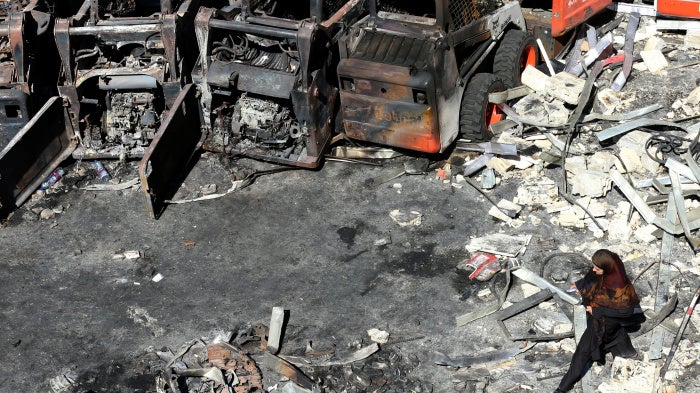
Despite a November 2024 ceasefire, people in Lebanon continued to suffer from the consequences of nearly 14 months of hostilities between Hezbollah and Israel. Near-daily Israeli strikes continued in Lebanon in 2025, resulting in over 330 people killed, according to Lebanon’s Health Ministry, including at least 127 civilians, as of October 2025, according to the UN Office of the High Commissioner for Human Rights (OHCHR).
In January and February 2025, the Israeli military withdrew from most of the southern Lebanese border villages and towns that it had occupied in late 2024, but its forces remained stationed on Lebanese territory in at least five locations. The hostilities resulted in nearly US $14 billion dollars in economic losses, according to the World Bank, including $6.8 billion worth of damage to physical structures alone. Several towns and villages were reduced to rubble, and more than 64,417 people remained displaced in Lebanon as of October 2025.
Lebanon’s parliament elected a new president, Joseph Aoun, and prime minister, Nawaf Salam, in January 2025, both of whom committed to start a “new phase” in the country, promising reforms to Lebanon’s judiciary, economy, and state institutions. But as of October, the impact of reforms was limited, with much of the Lebanese population living in multidimensional poverty. Lack of accountability for human rights violations continued, including those resulting from the 2020 Beirut port explosion. Restrictions on the right to free expression, including against journalists and critics, remained in place.
Accountability and Justice for Violations of the Laws of War
By October, Lebanese authorities had yet to take meaningful steps to ensure that violations committed on Lebanese territory during the hostilities between Hezbollah and Israel could be investigated and prosecuted by the International Criminal Court (ICC). In 2024, Lebanon’s former government announced a decision to give the ICC jurisdiction since October 2023 but rescinded the decision just over a month later.
In October 2025, the government announced that it had tasked the Ministry of Justice with assessing the legal measures that may be taken following Israeli attacks on journalists. This presents an opportunity to fully incorporate international crimes or laws of war violations into its domestic legal framework. Lebanon’s judicial authorities should initiate domestic investigations into unlawful attacks, and the government should accede to the ICC’s Rome Statute and submit a declaration accepting the court’s jurisdiction prior to the date of accession.
In April 2025, Human Rights Watch found that two unlawful Israeli strikes on the northeastern Lebanese town of Younine, between September and November 2024, were apparent indiscriminate attacks on civilians, and should be investigated as war crimes.
In August 2025, Human Rights Watch reported that Israeli forces had occupied schools in southern Lebanon during hostilities between September and November 2024 and in the following weeks, used some of them as barracks, and appear to have intentionally vandalized, pillaged, and destroyed school property, with many acts amounting to war crimes.
Human Rights Watch also found that Hezbollah’s use of explosive weapons in populated areas in parts of northern Israel, killing at least 15 civilians between September and November 2024, failed to take adequate precautions to protect civilians, including to effectively warn civilians of attacks.
Israeli attacks in southern Lebanon destroyed vast swathes of critical civilian infrastructure and public services, preventing tens of thousands of Lebanese from returning to their homes as of October 2025.
Judicial Independence
On July 31, 2025, Lebanon’s parliament adopted a new law on judicial independence that included positive reforms for Lebanon’s judiciary but fell short of guaranteeing judicial independence. Advances included greater judicial self-governance and the expansion of elections of judges by other judges. But it allowed Lebanon’s government-appointed top public prosecutor to order other prosecutors to cease ongoing legal proceedings and limited the ability of Lebanon’s highest judicial body to overcome government gridlock and obstruction in judicial appointments.
On September 5, 2025, President Aoun requested parliament reconsider the law, highlighting what he said were “procedural, substantive, and material errors that would render parts of it inapplicable” and citing concerns that it “violates established legal foundations and international standards.” On December 18, 2025, Parliament adopted an amended version of the law, which removed the ability of the top public prosecutor to order other prosecutors to halt legal proceedings but maintained other restrictions on judicial independence.
For the first time since 2017, and after years of vacancies that stalled and strained Lebanon’s judiciary, in August Lebanon’s government made new judicial appointments based on the nominations put forward by the Higher Judicial Council.
Beirut Port Explosion Investigation
In 2025, more than five years after the devastating 2020 Beirut port explosion that killed over 200 people in Beirut and injured thousands, Lebanese authorities had not yet delivered truth and justice for the victims and their families. But after two years of being stymied by Lebanese officials, the lead investigator in the Beirut port explosion case resumed the investigation. On January 16, Judge Tarek Bitar summoned 10 additional employees and security officials implicated in the blast, and held investigative sessions with other Lebanese officials in the months thereafter.
The resumption of the investigation came amid pledges by newly elected President Joseph Aoun and Prime Minister Nawaf Salam to uphold the rule of law and ensure justice for the port explosion victims. Justice Minister Adel Nassar had publicly committed to work to remove the obstacles that have hindered the course of the investigation. In March, Lebanon’s Public Prosecutor at the Court of Cassation annulled a previous decision that had barred security forces and the Prosecution office from collaborating with or receiving any communication from Judge Bitar.
Some of those subsequently summoned by investigative judge Bitar in 2025, such as former Prime Minister Hassan Diab, Major General Abbas Ibrahim, and Major General Tony Saliba, complied and appeared for questioning for the first time in years. However, other officials, including two members of parliament, Ali Hassan Khalil and Ghazi Zaiter, and Ghassan Oueidat, the former prosecutor, continued to obstruct the investigation by refusing to submit to questioning.
Freedom of Expression
In 2025, Lebanese journalists, media organizations, activists, and civil society groups faced repeated use of criminal defamation charges and other vague legal provisions in response to their work alleging corruption and financial mismanagement in the country. Lebanese security agencies and prosecutors continued to summon activists, journalists, and government critics for questioning in response to their criticisms.
Lebanon’s new draft Media law was submitted to the Parliamentary Administration and Justice Committee on May 27, 2025. The draft included significant advancements in protecting the right to freedom of expression, including abolishing pretrial detention and prison sentences for all peaceful speech-related violations. It also repealed criminal defamation and insult provisions from Lebanon’s penal code and military judiciary law.
On August 31, members of parliament received proposed amendments to the draft law’s text, which included reintroducing pretrial detention, including “under aggravated circumstances, such as infringing on individuals’ dignity or private lives.” Lebanese and international rights organizations, including Human Rights Watch, criticized the amendments and called on parliament to uphold the right to freedom of expression, including by decriminalizing defamation, blasphemy, insult, and criticism of public officials; prohibiting pretrial detention in speech-related violations; and removing onerous restrictions on the establishment of media outlets. The draft law was pending a vote in parliament, as of November 2025.
Economic, Social, and Cultural Rights
Lebanon’s population continued to suffer the economic consequences of the hostilities between Hezbollah and Israel in addition to compounded effects from the country’s 2019 economic collapse.
According to UNDP, the hostilities damaged more than 90,000 structures, including homes, businesses, and public infrastructure. Of these more than 23,400 structures were completely destroyed. At least 59,577 housing units were damaged in addition to 34 water facilities, affecting access to clean water for more than 400,000 people, according to UNDP.
Over the past decade, poverty rates in Lebanon have tripled. The World Bank estimated in 2024 that 44 percent of the population in Lebanon was living in monetary poverty and nearly 80 percent in multi-dimensional poverty. While the government has expanded its largest social assistance program AMAN to now reach approximately 800,000 people, the program is heavily means-tested and intended for what the government defines as “the poorest” households, but in reality, because of exclusion errors and opaque scoring of the proxy means test, most people were left without access to any form of social security.
In September 2025, Lebanon’s government took a critical step to implement reforms to the electricity sector by for the first time appointing members of the Electricity Regulatory Authority, the independent regulatory body mandated with overseeing the electricity sector since 2002.
Refugee Rights
After the collapse of the Assad government in Syria in December 2024 and unlawful identity-based killings and violence by government forces, nearly 100,000 Syrians fled to Lebanon according to the UN refugee agency, with most of the newly arrived asylum seekers residing in northern and northeastern Lebanon.
As of September 2025, more than 238,000 Syrians in Lebanon known to UNHCR had their registration with UNHCR “inactivated” because of their verified or presumed return to Syria, including more than 6,270 people who returned as part of a UNHCR-facilitated voluntary repatriation program. While over 80 percent of Syrian refugees intend to return to Syria one day according to UNCHR, only 18 percent plan to do so in the coming year, with safety, housing, and livelihoods concerns being the principal barriers.
In July, Lebanon’s government issued a plan for the return of Syrian refugees , relying on fee waivers and cash grants to incentivize returns for registered refugees. The plan, which is co-led by the Government of Lebanon and the UN, states that “all returns must be safe, dignified, and based on informed decisions of displaced Syrians.”
Around 93 percent of Palestinian refugees in Lebanon live in poverty, according to UNICEF, and continue to face restrictions on their right to work and own property.
Women’s Rights
Various religion-based personal status laws are discriminatory against women and allow religious courts to control matters related to marriage, divorce, and responsibility for children. Lebanon’s nationality law bars the children and foreign spouses of Lebanese women, but not men, from obtaining citizenship through their mother or spouse, impacting almost every element of their lives and leaving children at risk of statelessness. Serious gaps remain in protections against sexual harassment and domestic violence.
Migrant Workers
The legal status of thousands of migrant domestic workers in Lebanon, including workers from Ethiopia, the Philippines, Bangladesh, and Sri Lanka, is regulated by a restrictive and abusive regime of laws, regulations, and customary practices known as the kafala (sponsorship) system.
In March 2025, Lebanese judicial authorities re-opened an investigation into allegations of slavery against a migrant domestic worker, the first case of its kind in Lebanon. Meseret Hailu, an Ethiopian migrant worker who accused her employer and recruitment agency of slavery, testified before an investigative judge for the first time in May 2025. In November 2025, the investigative judge dismissed the case, and her lawyers subsequently filed an appeal.
Recruitment agencies have long been accused of subjecting workers to abuse, labor violations, and human trafficking.
Sexual Orientation and Gender Identity
Lesbian, gay, bisexual, and transgender (LGBT) people continued to face systemic discrimination in Lebanon. Article 534 of the penal code punishes “any sexual intercourse contrary to the order of nature” with up to one year in prison, despite a series of court rulings between 2007 and 2018 that consensual same-sex relations are not illegal.