India’s slide to authoritarianism under the Hindu nationalist Bharatiya Janata Party (BJP)-led government continued, with increased vilification of Muslims and government critics. Authorities illegally expelled hundreds of Bengali-speaking Muslims and Rohingya refugees to Bangladesh, some Indian citizens among them, claiming they were “illegal immigrants.”
India and Pakistan came perilously close to full-blown war after a deadly attack by gunmen who singled out Hindu tourists. India blamed Pakistan-based groups for the attack that killed 26 people and launched targeted airstrikes against alleged militants. Pakistan retaliated with drones and airstrikes, leading to an escalation from India. Both sides blamed the other for attacking civilians.
Several activists, including students, languished in jail without charge under India’s abusive counterterrorism law. The government used its amended criminal code to shut down peaceful speech; targets included journalists, activists, and social media influencers. The authorities also used allegations of financial irregularities to target the BJP’s political opponents.
The United Nations-linked Global Alliance of National Human Rights Institutions recommended India’s National Human Rights Commission be downgraded due to political interference. Opposition politicians and activists expressed growing concern over the lack of independence of the Election Commission.
Despite the Modi administration’s deteriorating human rights record, several countries strengthened security, economic, and trade ties with India.
Jammu and Kashmir
In April, gunmen killed 26 people, mostly Hindu tourists, in Pahalgam town, leading to a four-day armed conflict between the two countries. At least 16 people were reportedly killed on the Indian side while Pakistan claimed Indian airstrikes had killed 40 civilians and 11 soldiers.
Authorities suppressed dissent by briefly blocking some independent media outlets and commentators, and filing cases against academics and satirists. They also demolishedthe homes of alleged militants—actions the Supreme Court had already prohibited after similar demolitions elsewhere.
Angry rhetoric by national broadcast networks and social media users helped fuel Hindu mob attacks against Muslims, particularly Kashmiri students, vendors, and workers in various states; the victims faced intimidation, threats, and assault.
Indian authorities banned 25 books on Jammu and Kashmir claiming they “excite secessionism” and raided book stores in the region in August. Allegations against security forces for arbitrary detention, torture, and extrajudicial killings were reported through the year.
In Ladakh’s capital, Leh, in September, police killed four people after protests over statehood turned violent and protesters set fire to a police vehicle and party offices of the BJP. Authorities shut down mobile internet and arrested educator and climate activist Sonam Wangchuk under the National Security Act, accusing him of fomenting violence. Wangchuk had been spearheading the movement for statehood through peaceful marches and hunger strikes in the region which had been a part of Jammu and Kashmir but became a centrally governed, separate administrative unit in August 2019.
Impunity for Security Forces
Allegations of torture and extrajudicial killings persisted as the National Human Rights Commission registered 113 deaths in police custody, 1,535 deaths in judicial custody, and 132 alleged extrajudicial killings in the first eight months of 2025.
The Armed Forces (Special Powers) Act remained in effect in Jammu and Kashmir and several northeastern states, providing effective immunity from prosecution to security forces, even for serious human rights abuses. In February, a 25-year-old man in Jammu and Kashmir died by suicide; he had recorded a last message on video alleging that police tortured him after falsely claiming he had links with militant groups. Another man was allegedly shot dead by security forces that month after speeding away from a checkpoint.
According to reports, India’s Border Security Force (BSF) allegedly killed at least 10 Bangladeshis at the India-Bangladesh border in the first four months of 2025. The BSF has frequently used excessive force along the Bangladeshi border with impunity, targeting both Indians as well as irregular immigrants and cattle traders from Bangladesh.
Attacks on Religious and Ethnic Minorities, Dalits, and Tribal Groups
Following the deadly attack in Jammu and Kashmir, hate speech against Muslims increased, with at least 64 incidents reported in the first 10 days. Muslims were attacked in various states. A Hindu man claimed responsibility for shooting a Muslim worker in Uttar Pradesh as retribution for the Kashmir attack. In Karnataka, a Muslim man was killed after he allegedly shouted pro-Pakistan slogans during a cricket match. Police in Mumbai filed a case against nine BJP workers for assaulting Muslim hawkers.
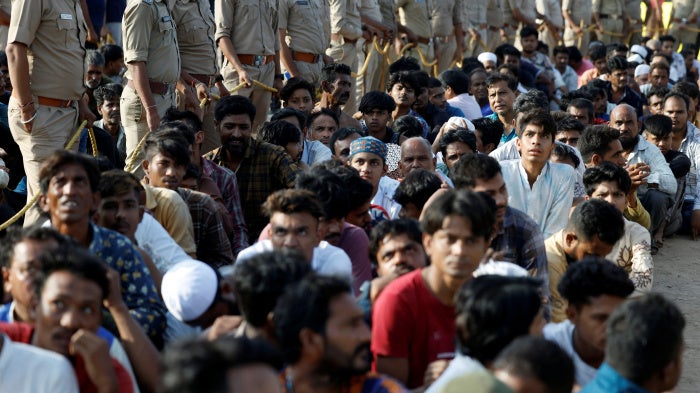
Starting in April, authorities expelled hundreds of Bengali-speaking Muslims from BJP-run states to Bangladesh without due process, claiming they were “illegal immigrants.” Many said they were threatened and beaten by Indian border guards. Bangladesh authorities reported that India expelled more than 1,500 men, women, and children in May and June. However, several of them turned out to be Indian citizens, mostly impoverished migrant workers from states bordering Bangladesh. During one such drive, authorities in Gujarat state demolished over 10,000 structures claiming they were occupied by “illegal Bangladeshi immigrants,” going against the Supreme Court’s November 2024 ruling that outlawed such arbitrary and punitive demolitions.
At least 300 of those forced into Bangladesh were expelled from Assam. BJP Chief Minister Himanta Biswa Sarma’s government conducted at least seven demolition drives in July and August displacing over 5,000 families, a majority of whom were Bengali-speaking Muslims. Authorities fatally shot a 19-year-old man in a violent clash with the protesters following one such eviction drive in Goalpara district in July.
In February, the central government imposed presidential rule in Manipur amid renewed clashes between ethnic groups despite the resignation of its divisive BJP chief minister. The state government did not end ethnic violence that since May 2023 had claimed at least 260 lives and displaced more than 60,000 people. In June, authorities imposed a curfew and shut down the internet after they arrested five people, including the chief of an armed vigilante group from the predominant Meitei community.
Security forces continued to escalate counterinsurgency operations against Maoist insurgents that began in January 2024, intensifying their presence across central and eastern India, particularly in Chhattisgarh’s Bastar district, home to many indigenous communities (Adivasis). In July, security forces claimed to have killed 460 alleged Maoists since the operations began; civil society groups alleged widespread abuses against Adivasi villagers, including extrajudicial killings. The authorities targeted human rights activists, including on politically motivated charges, accusing them of being Maoists or Maoist supporters. Hindu extremist groups targeted Dalit and tribal Christians in the state who faced violent attacks, social boycotts, and economic isolation.
Civil Society and Freedom of Association
Indian authorities used foreign funding laws such as the Foreign Contribution Regulation Act (FCRA), counterterrorism laws, trumped-up financial investigations, and other means to harass and prosecute activists and civil society groups. In March, Enforcement Directorate officials raided the premises of several organizations linked to foreign donors. In May, Indian authorities said nonprofits receiving foreign funds would not be allowed to publish or circulate any news content.
The Delhi High Court refused to grant bail to student activists Umar Khalid, Sharjeel Imam, Gulfisha Fatima, and six others who at time of writing had spent over five years in prison without trial. They were arrested under the counterterrorism law, Unlawful Activities (Prevention) Act, in relation to February 2020 violence in Delhi following peaceful protests against the discriminatory Citizenship (Amendment) Act.
Freedom of Expression
The government censored media freedom and peaceful expression online through criminal prosecutions, and arbitrary and disproportionate orders to take down content or suspend social media accounts. Reporters from small cities and towns working for regional publications faced a higher risk of getting arrested. In September, the Ministry of Information and Broadcasting ordered several news organizations, journalists, and content creators to take down 138 YouTube videos and 83 Instagram posts that allegedly defamed Adani Enterprises, owned by an Indian billionaire reportedly with close ties to Prime Minister Modi.
Amid escalating tensions between India and Pakistan in April following the deadly attack in Jammu and Kashmir, Indian authorities blocked the social media accounts and websites of several news organizations. It ordered X to block over 8,000 accounts on its platform, without providing “evidence or justification” for most of them, X said. Assam’s BJP chief minister described the police’s arrest of 97 people, mostly Muslim, for their social media comments as taking action against “anti-national and anti-Hindu culprits.”
In August, the Supreme Court protected the editors and journalists of the online news website Wire from arrest after authorities in Assam filed sedition charges in two cases. Several media bodies condemned the charges. The court also granted bail in May to Ali Khan Mahmudabad, a prominent Muslim academic arrested earlier that month over his social media post following the Kashmir attack.
Women’s and Girls’ Rights
Women and girls remained exposed to sexual violence and faced barriers when seeking justice and support services. In July, a 25-year-old tennis player was shot dead by her father in Gurugram, near the capital Delhi. In Karnataka, the state government set up a special team to investigate allegations of mass murder and rape of women and girls in Dharmasthala, a temple town. It was based on a complaint from a sanitation worker, claiming he buried several bodies in the area between 1995 and 2014, allegedly at the behest of temple administrators and staff.
In September, the Supreme Court dismissed a petition to include political parties as employers under the Sexual Harassment of Women at Workplace (Prevention, Prohibition and Redressal) Act, 2013, saying it would “open a Pandora’s box.”
Sexual Orientation and Gender identity
In May, the Madras High Court ruled that same-sex couples could form families, and “marriage is not the sole mode” for it, even though the Supreme Court of India refused to legalize same-sex marriage in 2023. In June, the Andhra Pradesh High Court recognized transgender women as women, entitled to the same protections under the law.
Refugee Rights
Indian authorities unlawfully expelled scores of Rohingya refugees, including at least 192 to Bangladesh despite their being registered with the United Nations Refugee Agency (UNHCR). Several alleged they were mistreated by Indian border officials. Hundreds more were arbitrarily detained and threatened with deportation, while several others fled from Delhi, Andhra Pradesh, and Jammu and Kashmir to avoid the crackdown.
In May, authorities put 40 Rohingya refugees on a navy ship. The crew allegedly beat and interrogated the refugees, gave them life jackets, and then tossed them into the sea near the Myanmar coast. They were forced to swim ashore, reaching Launglon township in Myanmar’s Tanintharyi Region. The UN special rapporteur on human rights in Myanmar said the incident demonstrated a “blatant disregard for the lives and safety of those who require international protection.”
International Actors and Foreign Policy Developments
India saw a sharp deterioration in ties with the United States after the Trump administration announced record high trade tariffs, accusing New Delhi of propping up Russia’s war on Ukraine through oil imports. The United States and others, however, did not call on the Modi administration to stem its deteriorating human rights record.
The Modi government did not publicly criticize human rights violations by other governments including Russia and Israel, but voted in support of a resolution in the UN General Assembly to seek a peaceful settlement of the Palestine issue and implementation of the two-state solution.
In September, the European Union unveiled its “New Strategic EU-India Agenda,” later unanimously endorsed by EU foreign ministers. The document sets out a range of areas for closer bilateral cooperation, hailing India as the “world’s largest democracy” and a “like-minded and trusted partner,” but deliberately overlooking India’s deepening human rights crisis. At time of writing, free trade negotiations between the two continued and it was unclear whether the agreement would include enforceable human rights obligations.
In a move seen as rapprochement between India and China, in August, Prime Minister Modi traveled to China, his first visit there in seven years, to meet Chinese President Xi Jinping and attend the Shanghai Cooperation Organisation summit. Both countries discussed easing tensions along the border.