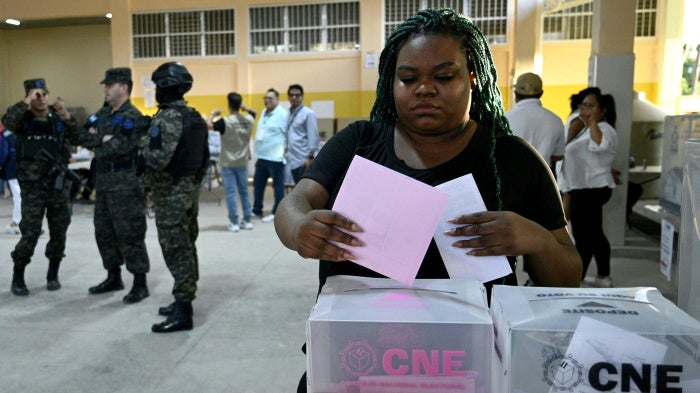
In November, Hondurans went to the polls to elect a new president and all 128 members of Congress.
Pressing ongoing human rights concerns include impunity for corruption, attacks against human rights defenders, violence against women, widespread poverty, and weak rule of law.
Free and Fair Elections
The 2025 electoral process in Honduras was marred by allegations of fraud among political actors, political pressure on electoral authorities, and significant delays in the organization of the elections and the counting of votes. There were inadequate safeguards against illicit campaign financing. At least 13 people were killed due to political violence in the lead-up to the elections, according to the University Institute for Democracy, Peace and Security. United States President Donald Trump sought to influence the outcome by supporting a presidential candidate and threatening to withhold US financial support to Honduras if he did not win.
The Organization of American States (OAS) and the European Union sent missions to monitor the elections; both reported a peaceful election day. However, delays in the publication of preliminary results undermined confidence in the process. President Xiomara Castro said the elections should be considered “null” and that her party would not recognize the preliminary results, in part because of President Trump’s intervention. The OAS urged political actors to refrain from disrupting public order while tallies were still being counted, warning that such actions represented a “clear attempt to obstruct the final phases of the electoral process.” At time of writing, the electoral authorities had not yet declared the winners, creating uncertainty and concerns about potential post-electoral tensions.
Corruption and Rule of Law
Public corruption, impunity, and political interference in judicial processes undermine the rule of law.
In 2022, President Castro’s government and the United Nations Secretariat signed a memorandum to create a UN-backed commission to investigate and prosecute corruption. UN experts indicated that legal reforms were necessary for the commission to operate effectively. Congress passed some of these reforms but at time of writing had yet to modify laws that currently limit accountability by barring sanctions against legislators for actions taken in their official capacity and granting amnesty to officials of Manuel Zelaya’s administration charged with or convicted of certain actions after the 2009 coup against Zelaya.
Honduras ranked 154 out of 180 nations in Transparency International’s 2024 Corruption Perceptions Index.
In 2024, Carlos Zelaya, Castro’s brother-in-law and a member of congress, resigned after admitting he had a meeting with drug traffickers in 2013. News outlets published a video purportedly showing Zelaya negotiating with drug traffickers over contributions to Castro’s 2013 presidential campaign. His son, José Zelaya, then-minister of defense, also resigned.
Former President Juan Orlando Hernández was extradited to the US on drug trafficking charges in 2022. He was convicted and sentenced to 45 years in prison in 2024. In December, US President Trump pardoned Hernández.
Economic, Social, and Cultural Rights
High rates of poverty and limited access to public services compromise the enjoyment of economic, social, and cultural rights. Per government data, 60.1 percent of households in 2025 had incomes below the national poverty line, down from 62.9 percent in 2024.
One in four children under five years old suffers from chronic malnutrition, according to the UN World Food Program. Many communities lack reliable access to education, health care, housing, and clean water.
The US company Honduras Próspera Inc. filed an investor-state dispute settlement (ISDS) claim seeking up to US$10.8 billion in damages (equivalent to roughly 60 percent of Honduras’ 2026 budget), following the 2022 repeal of a law that created special economic zones with broad self-governance powers. In October, Próspera reported an updated damages estimate of $1.6 billion. Many ISDS critics have argued that this case and its steep claim for damages illustrates how such cases risk punishing or deterring regulation in the public interest.
Land Rights and Attacks Against Human Rights Defenders
Honduras does not adequately protect collective land rights of Indigenous and Afro-descendant communities, leaving them vulnerable to forced displacement. Land and environmental defenders face persistent threats and attacks.
Global Witness documented five murders and one disappearance of land and environmental defenders in 2024, including three members of peasant communities in the Bajo Aguán. The UN Office of the High Commissioner for Human Rights (OHCHR) reported nine additional murders of peasants or their relatives in the Agúan between January and mid-July.
According to OHCHR, Afro-Indigenous Garífuna people face discrimination and land rights violations. Honduras has not fully implemented three Inter-American Court of Human Rights rulings in their favor. The Court heard a fourth case in May; a decision remained pending at time of writing.
In 2024 and 2025, Honduras’ Supreme Court upheld convictions of eight people for the 2016 murder of environmental rights defender Berta Cáceres. However, the Civic Council of Popular and Indigenous Organizations of Honduras (COPINH), an NGO founded by Cáceres, says not everyone culpable has been held accountable. In February, the Inter-American Commission on Human Rights launched an Interdisciplinary Group of Independent Experts to investigate Cáceres’ death.
Authorities charged three people for the 2024 murder of environmental rights defender Juan López; the case remained pending at time of writing.
A national protection system created by law in 2015 to implement protective measures for human rights defenders, journalists, and justice officials vulnerable to attacks remains ineffective due in part to insufficient funding and staffing.
Women’s and Girls’ Rights
Women and girls face high rates of violence and barriers to accessing justice and health care. According to the think tank MundoSur, Honduras’ femicide rate in 2024 was 4.75 per 100,000 women and girls, a significant decline from 7.73 in 2023, but still one of the highest rates in Latin America.
Honduras has a total abortion ban, even when the pregnant person’s life is in danger.
According to the human rights group Women’s Rights Center, the Attorney General’s Office received 3,350 complaints of sexual violence against women and girls in 2024, a 27 percent increase from 2023. Sixty-two percent of cases were perpetrated against girls.
Sexual Orientation and Gender Identity
Lesbian, gay, bisexual, and transgender people suffer high levels of violence and discrimination. Honduras has not complied with key measures ordered by the Inter-American Court of Human Rights in 2021, including to create a legal gender recognition procedure for transgender people. Honduras does not allow same-sex marriage and lacks comprehensive anti-LGBT discrimination legislation.
Public Safety
Honduras’ high homicide rate has reportedly declined in recent years. Police estimated the 2025 homicide rate would be 15.30 per 100,000 people, down from 26.07 per 100,000 in 2024.
A state of emergency declared in 2022 to address crime remains in place. OHCHR reports that it has led to arbitrary detentions, extrajudicial executions, and other abuses. As of April, the National Human Rights Commissioner, an independent government agency, had registered over 800 complaints against security forces for abuses under the state of emergency.