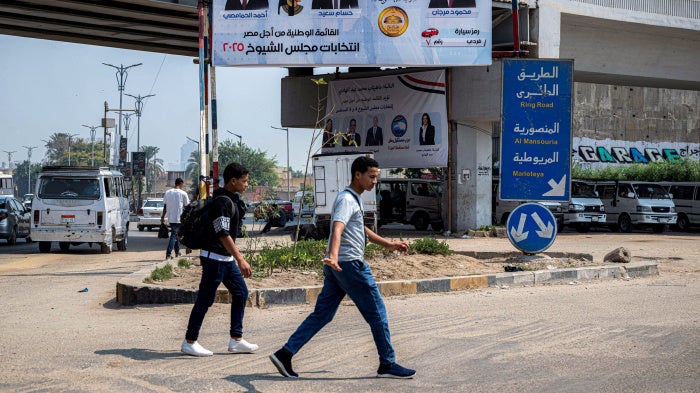
Egyptians continued to live under the authoritarian grip of President Abdel Fattah al-Sisi’s government. The authorities cracked down on peaceful critics and systematically repressed human rights defenders. Civic space remained severely curtailed as independent organizations operating under draconian laws faced continued judicial and security harassment. Thousands of detainees remained locked up in dire conditions in lengthy pretrial detention or serving sentences stemming from unjust trials. Parliamentary elections, held in August and November under a general state of repression, were criticized for absent genuine competition and reported violations.
The protracted economic crisis and the government’s response undermined people’s economic and social rights, including to food, health, and education. The government failed to adequately fund education and health care as required under the constitution and international human rights law.
Conduct of Security Forces
Security forces, including the National Security Agency (NSA), continued to subject individuals under investigation to forcible disappearance in various places of detention where they faced torture and ill-treatment.
Some detainees have been killed in extrajudicial executions. Ministry of Interior officers on April 10 apparently killed two men, Youssef El-Sarhani and Faraj Al-Fazary, hours after their arrest in Marsa Matrouh governorate in northwest Egypt. Evidence shows that the men had turned themselves in to the police hours before they were killed and were in police custody when they died.
Detention Conditions
Prisoners continued to be held in conditions that amount to ill-treatment and torture, including through denial of health care and prolonged solitary confinement. As of September, 44 detainees had died in custody in 2025, according to the Committee for Justice. Several prisoners detained on political grounds reportedly attempted suicide in Badr 3 prison due to severely deteriorating prison conditions. In July, a coalition of organizations warned of “mass suicide” attempts in the same prison.
Dr. Salah Soltan, an academic and a permanent US resident at the time of his arrest, faced a potentially life-threatening medical condition while detained in Egypt’s Badr 1 prison. Since his arrest in late 2013, Dr. Salah has faced well-documented and deliberate withholding of sufficient medical care, a violation which may constitute torture.
Houda Abdel Moneim, a lawyer and former member of the National Council for Human Rights, remained detained despite having completed an unjust five-year sentence in October 2023. In August 2025, 22 organizations said in a joint statement that she suffered two heart attacks and faced serious lack of medical care.
Freedom of Expression and Assembly
Peaceful protests and gatherings remained effectively banned in Egypt under draconian laws. Authorities continued to punish dissenting expression, targeting journalists, human rights defenders, and opposition politicians.
Journalists at independent media outlets continued to face security and judicial harassment. Egypt continued to rank among the worst 10 countries in the number of detained journalists according to the Committee to Protect Journalists.
Twenty-three journalists were in jail as of May 30 according to the head of the Journalists’ Syndicate, most of them in prolonged pre-trial detention. On September 24, security forces unlawfully detained independent journalist Ismail Iskandarani over Facebook posts. Prosecutors charged him in a State Security case alongside peaceful Sinai activist Said Eteik, detained since late August also over a Facebook post.
On September 22, President Sisi pardoned Egyptian-British activist Alaa Abdel Fattah who had been detained almost continuously since 2014. Abdel Fattah was in jail despite having fully served a five-year sentence in a case violating his right to freedom of expression. On November 11, he was prevented from leaving the country at Cairo International Airport.
On October 2, a minor offenses court sentenced economics expert Abdel Khaleq Farouk, detained since October 2024, to five years in prison over criticism of the government’s economic policies.
Between July and August, authorities launched a renewed wave of arrests and prosecutions against at least 29 online content creators, including one girl. Human Rights Watch recorded 21 more prosecutions in October. Authorities brought vague charges against those targeted, such as violating “public morals,” “undermining family values,” and “money laundering,” stemming from what they said were “indecent” videos posted on social media platforms. Most of those targeted were women, and some faced asset freezes.
Freedom of Association and Attacks on Human Rights Defenders
Civic space remained severely curtailed under Egypt’s draconian 2019 associations law.
The Association for Freedom of Thought and Expression, one of the very few remaining independent human rights groups inside Egypt, said that apparent security harassment prevented them from opening a bank account for 11 months even after registering under the 2019 law. In May, security officers at Cairo airport interrogated the group’s director, Mohamed Abdel Salam, and confiscated his passport for several days.
On January 19, the Supreme State Security Prosecution (SSSP) summoned leading human rights defender Hossam Bhagat for interrogation. It charged him with “involvement with financing a terrorist group” and “spreading false news,” and released him on bail.
Hoda Abdelwahab, a prominent human rights lawyer, remained arbitrarily barred from travelling abroad as part of Case 173, known as the “foreign funding” case. A judge announced in 2024 that the case was closed for lack of evidence.
On June 24, a Cairo terrorism court sentenced several peaceful activists, including US citizen and rights activist Mohamed Soltan, to life in prison in absentia in Case No. 1766 of 2022.
In October, authorities referred 168 defendants, including several peaceful activists, to a mass trial, over abusive terrorism charges.
National Elections
Egypt held its third parliamentary elections under Sisi’s government in August and November in the absence of real competition and under an environment of severe repression. The elections authority eliminated all party lists except one dominated by pro-Sisi parties. It has also disqualified almost 200 candidates for individual seats, under the justification that they did not meet candidacy requirements, including some for being excluded from military service decades ago.
Gender, Sexuality, and Women’s Rights
In the World Economic Forum’s Gender Gap Report 2025, Egypt ranked 139th out of 148 countries, placing it among the ten worst countries globally with regards to gender parity. Despite some efforts by the government on political participation and improved access to health care, women in Egypt still face systematic barriers. Gender based violence, pay-gap inequality, and discriminatory personal status laws persist.
Authorities continued to use vague, abusive penal code provisions, such as on “debauchery,” to criminalize consensual same sex conduct and imprison LGBT people.
Refugees, Asylum Seekers, and Migrants
Egypt hosted over 1 million refugees and asylum seekers registered with the UN refugee agency (UNHCR) as of August 2025, including over 770,000 who had fled the ongoing armed conflict in Sudan since April 2023. Many other Sudanese asylum seekers remained unregistered.
Many refugees and asylum seekers, including thousands of Sudanese people, were deported during 2025 according to media reports and rights groups, in violation of the principle of nonrefoulement. Rights groups also reported poor living conditions for migrants, asylum seekers and refugees in Egypt, and tens of thousands of refugee children remained out of school due to abusive policies barring access and financial burdens.
Economic Justice
Egypt’s government continued to prioritize spending public resources on large infrastructure projects despite the country’s recurring economic crises. Meanwhile, In 2025, price inflation for typical consumer goods and services reached 19.7 percent year over year, which together with rising poverty rates, undermined the right to food and an adequate standard of living among other economic, social and cultural rights.
In August, Mada Masr, an independent online news outlet, reported unpublished official data, which showed that a record 34 percent of the population were experiencing multidimensional poverty in 2021-2022, the highest nationally defined poverty rate found by the government’s Income, Expenditure, and Consumption Survey since its inception in 1999.
The government has severely undermined the right to education and health care in recent years by failing to allocate sufficient public resources from the national budget, falling below both constitutional requirements and international benchmarks. Human Rights Watch analysis of the state budget found that education was 1.5 percent of GDP (4.7 percent of government expenditure) in the 2025/26 budget, the lowest in over a decade. In 2025/2026, spending on health care was just 1.2 percent of the GDP (3.6 percent of government expenditure).
Justice System
Authorities continued the abusive practice, denounced by the UN human rights chief in August, known as “recycling” or “rotation,” wherein they bring new cases against detainees almost identical to their previous ones, in order to keep critics in detention.
Authorities also continued to use abusive video conference systems to conduct remote hearings for pretrial detention renewal, without bringing detainees before a judge. This system severely undermines due process, preventing a judge from assessing the legality and conditions of detention as well as the detainees’ wellbeing. And it violates several fair trial guarantees, including the right to legal counsel.
In May, trials began for some 6,000 people referred to criminal courts in “terrorism” cases over the past months. More than half of them had been in pretrial detention for months or years. Egypt’s judiciary routinely tries such cases in mass trials where defendants do not receive fair trial guarantees and may remain in pretrial detention indefinitely without material evidence of wrongdoing or establishment of individual criminal responsibility.
On September 21, in a rare and unexpected move, President Sisi rejected a deeply flawed draft Criminal Procedure Code bill. He returned it to Parliament to “review objections to a number of the draft law articles.” Instead of producing a new draft that upholds constitutional and international human rights obligations, parliament approved the flawed bill on October 16 after reviewing only eight articles and President Sisi signed it into law on November 12. Human Rights Watch analysisfound that the bill, without rigorous overhaul, will undermine Egypt’s already weak fair trial rights protections and further empower abusive law enforcement officials.