Prime Minister Mark Carney assumed office in April following national elections that month. He replaced fellow Liberal Party leader, Justin Trudeau, who had served as prime minister since 2015. Carney’s platform included a commitment to equality, protecting diversity, and championing rights, democracy, and the rule of law. In his first months in office, Carney focused largely on expanding Canada’s economy and creating new economic opportunities abroad. The Canadian government took positive steps on some human rights issues, including transnational repression (TNR), but significant domestic challenges remain. These include the rights of Indigenous people and the rights of refugees and asylum seekers, including those with disabilities.
Indigenous Peoples’ Rights
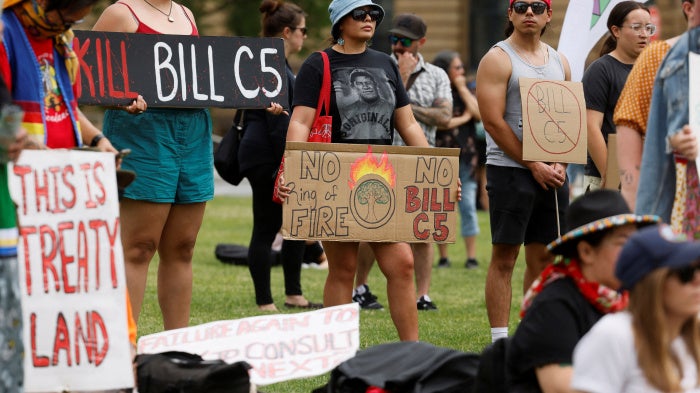
In June, Bill C-5, the Building Canada Act, was passed as a counter-measure to US President Donald Trump's tariffs on Canada. The legislation allows large projects, such as ports, pipelines, and dams, deemed beneficial to “national interest,” to bypass some federal laws to speed up the approval process. Indigenous and environmental advocates expressed strong concern that the legislation would weaken environmental protection and Indigenous Nations’ right to free, prior, and informed consent over building projects that affect their territories.
At the same time, legislation was introduced in Ontario (Bill 5) and British Columbia (Bill 15), giving provincial leaders the power to fast-track large infrastructure and mining projects deemed provincially significant. First Nations leaders have criticized both bills for lack of consultation during the drafting phase and potential violation of treaty rights once the bills are implemented.
Nine First Nations communities in Ontario asked a court to declare both the federal and Ontario laws unconstitutional and a similar legal challenge to British Columbia’s Bill 15 was expected at time of writing.
Refugees, Asylum Seekers, and Migrants
The Canada Border Services Agency (CBSA) has traditionally had broad latitude to place people in migrant detention centers, provincial jails, or other detention facilities, which has resulted in serious human rights violations. With no time limits on immigration detention, individuals, including those with disabilities, can be detained for months or years, including in solitary confinement.
In a major victory for migrant and refugee rights, in September, Ontario became the last province in Canada to block the CBSA from using provincial jails to incarcerate migrants and asylum seekers on administrative grounds. The border agency said that “as of September 15, there are no people detained in a provincial correctional facility.” Yet the federal government moved in the opposite direction. In July, CBSA announced it had begun incarcerating detainees at its “temporary designated immigrant station” at a federal prison in Sainte-Anne-des-Plaines, Quebec.
After a review of Canada’s disability rights record, the UN Committee on the Rights of Persons with Disabilities in March issued a bleak assessment of Canada’s immigration detention system, calling for Canada to protect the legal capacity rights of people with disabilities in detention and urging an end to immigration detention altogether. Similarly in August, the Working Group on Arbitrary Detention released its report on its visit to Canada, expressing “alarm” at reports of plans to use federal correctional facilities for immigration detention. It also expressed concern with infringements on legal capacity rights, noting that “substituted decision-making for persons with disabilities restricts their legal capacity and may negatively affect their proceedings.”
In 2025, the Canadian government also introduced immigration Bill C-2, the Strong Borders Bill. Under Bill C-2, a claim for refugee protection would be ineligible for referral to the Immigration and Refugee Board if protection is claimed more than one year after an individual’s first entry into Canada after June 24, 2020. The bill would also prevent people who cross the US border irregularly from claiming asylum if they have been in Canada for at least 14 days. Refugee experts criticized the bill’s proposed changes to immigration and asylum law, warning that dissidents and members of marginalized groups facing persecution abroad could find themselves unable to get asylum hearings in Canada. In June, over 300 civil society organizations demanded the complete withdrawal of Bill C-2, citing the threat it poses to human rights and at-risk populations.
Transnational Repression
Transnational repression (TNR) continues to pose a threat to diaspora groups and civil society organizations in Canada. In July, Hong Kong authorities issued international arrest warrants for 19 activists, including Canadian citizens and residents, for their activism promoting democracy in Hong Kong while living abroad. Authorities also offered rewards for information leading to their arrest. In August, several UN experts raised concerns about credible threats by Iran’s authorities to the lives and safety of 45 Iran International journalists in seven countries, including Canada, in what experts described as an effort to silence the journalists and deter critical reporting. The threats prompted the Canadian Security Intelligence Service to open an investigation into the threats.
The Canadian government issued several joint statements condemning acts of transnational repression, including statements on Iran and Hong Kong. G7 countries, including Canada, issued a joint statement on TNR in June, outlining a number of actions G7 countries pledged to take, including building global understanding of the threat; developing a TNR Resilience and Response Framework; launching a Digital TNR Detection Academy; and supporting those who may be targets of TNR.
Women’s and Disability Rights
In his first major move as Canada’s prime minister, Carney eliminated roughly a third of all cabinet positions, including the minister of women and gender equality and minister of diversity, inclusion and persons with disabilities. Carney reinstated the first position in May but opted not to reinstate the second. Disability advocates warned of the harm of losing critical representation in the cabinet, stressing the continuing need for concerted government action on disability rights, including to address high poverty rates among people with disabilities, which particularly impacts women. Carney later appointed a more junior role outside of cabinet, a parliamentary secretary for persons with disabilities under the minister of jobs and families.
Foreign Policy
In 2025, Canada held the G7 Presidency and hosted several heads of state at the G7 Leaders’ Summit in June in Kananaskis, Alberta. In addition to economic matters, the summit focused on agreements and coordinated action on countering transnational repression, support for a just and lasting peace for Ukraine, and commitment to peace and stability in the Middle East.
Following the G7 Leaders’ Summit, Canada announced new measures in support of Ukraine, including sanctions on individuals, entities, and vessels that continue to support Russia’s war in Ukraine. In August, Canada, as a member of the International Coalition for the Return of Ukrainian Children, reiterated its commitment to the protection of children affected by Russia’s invasion of Ukraine and called on Russia to facilitate the return of all unlawfully deported and forcibly transferred Ukrainian children.
In 2025, Canada increased its condemnation of Israel’s military operations in Gaza. In May, it issued a joint statement with France and the United Kingdom committing to taking further concrete action if Israel did not end its ongoing military offensive and lift restrictions on humanitarian aid. In August, Canada stated that “Israel, as the occupying power, is failing to fulfill its obligations under international humanitarian law by refusing to allow and facilitate the passage of humanitarian aid and by failing to ensure provision of adequate food and medical supplies to the civilian population in Gaza.”
In June, Canada imposed sanctions on two Israeli ministers, National Security Minister Itamar Ben-Gvir and Finance Minister Bezalel Smotrich, for allegedly inciting violence against Palestinians in the West Bank. In June, Canada joined other countries in recognizing the state of Palestine.
In February, Canada issued a joint statement on Syria “acknowledge[ing] and support[ing] the Syrian transitional government in their existing commitment to upholding human rights and fundamental freedoms for all Syrians.” In March, Canada eased some sanctions on Syria to allow funds to be sent through certain banks in the country to “enable the stable and sustainable delivery of aid, support local redevelopment efforts, and contribute to a swift recovery for Syria.”
In 2025, Canada again faced criticism that it had failed to take adequate steps to assist and repatriate Canadians unlawfully detained in northeast Syria in locked desert camps and prisons for Islamic State (ISIS) suspects and their families. In June, a complaint was filed with the Canadian Human Rights Commission on behalf of 12 Canadian men and children detained in Syria. The complaint claims that the government is discriminating against them by not assisting their return to Canada. To date, Canada has not repatriated any of the detained Canadian men in Syria, some of whom have been held since 2017 in dire and life-threatening conditions.