Five years after countrywide protests against the rigged 2020 presidential elections, politically motivated repression continued. The government targeted all forms of dissent and used politically motivated charges against rights activists and journalists.
In February, a UN group of experts on Belarus warned that widespread human rights violations continued and some of them amounted to crimes against humanity.
Belarus remains the only country in Europe to carry out the death penalty.
Torture and Ill-Treatment of Political Prisoners
Belarusian authorities continued politically motivated prosecutions related to the 2020 mass protests, as well as on fabricated “extremism” and other charges. In December 2025, at least 1,110 people remained behind bars on politically motivated grounds.
Since March 2025, the schedule of court hearings is no longer in the public domain, denying access to information about politically motivated trials.
Political prisoners continue to face ill-treatment, isolation, and torture. Some have been held incommunicado for extended periods of time, which amounts to torture and may constitute enforced disappearance.
Dozens of political prisoners in 2025 faced new, trumped-up “malicious disobedience” and other charges that prolonged their already hefty prison sentences.
Prison officials continued to deny political prisoners' access to appropriate health care. Dozens faced higher health risks due to health problems exacerbated by poor prison conditions. In 2025, at least two political prisoners, Andrei Padniabenny and Valiantsin Shtermer, died in prison of unknown causes. Three former political prisoners died within nine months of being released, their health affected by the dire detention conditions.
The authorities continued to target for malicious prosecution relatives of political prisoners and other supporters.
Release of Political Prisoners
Between January and September 2025, at least 74 political prisoners were released by presidential pardons. Fifty-two of them, whose release was apparently negotiated by US government officials, were forcefully expelled to Lithuania across the Belarusian border.
On September 11, opposition politician Mikalai Statkevich, who had spent five years in prison on bogus charges of “organizing riots,” escaped from the bus forcibly taking released prisoners to the border and refused to cross to Lithuania. Several hours later, Belarusian authorities took him back to Belarus. Government officials reportedly informed his wife that he has been returned to prison, but as of writing authorities have concealed details of his whereabouts and well being.
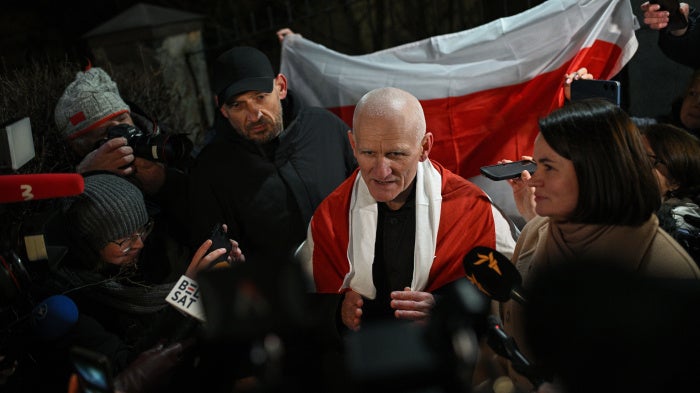
In December, 123 more prisoners, including prominent rights defenders from Viasna, Ales Bialiatski and Uladzimir Labkovich, were similarly expelled to Ukraine and Lithuania.
The authorities harassed former political prisoners who stayed in Belarus after their release by subjecting them to regular checks and new criminal charges, forcing many to leave the country.
Crackdown on Human Rights Defenders, Journalists, Lawyers, Opposition
Authorities continued to bring politically motivated charges against civil society actors, including rights groups, by falsely labeling them “extremist” or “terrorist.” During 2025, the authorities designated dozens of activists as “persons involved in extremist activities” or “terrorist activities.” Any interaction with such organizations or individuals is a prosecutable offense.
At least three prominent rights defenders remained behind bars at time of writing, including Anastasia Lojka, Valiantsin Stefanovic, and Marfa Rabkova. In March, the UN Working Group on Arbitrary Detention called on Belarusian authorities to immediately release Rabkova and provide her with compensation for arbitrary detention.
Authorities subjected independent journalists to searches, fines, seizures of their devices, and criminal prosecution in reprisal for their work. They also cracked down on exiled journalists and subjected their families to searches and other harassment.
At least 28 journalists and media workers were behind bars at time of writing. In 2025, at least twelve journalists were detained on politically motivated grounds.
Authorities continued to label critical and independent sources as “extremist,” including social media accounts of independent media, platforms for online petitions and letters to political prisoners, and a university in exile. Following, sharing, or reacting to such sources online is a prosecutable offense in Belarus, severely undermining freedom of expression and access to information.
Lawyers representing clients in politically motivated cases faced arbitrary license revocation and detention. At least six lawyers, Aliaksandr Danilevich, Vital Brahinets, Anastasiya Lazarenka, Yuliya Yurhilevich, Aliaksei Barodka, and Siarhei Khlystau, were serving prison sentences from six to ten years on politically motivated charges at time of writing. In November, a former lawyer, Katsiaryna Zhautanoha, stripped of her license for representing protesters in 2020, was sentenced to house arrest for “inciting hatred.”
Authorities also retaliated against companies and their workers that supported peaceful anti-government protests or spoke out about human rights violations.
In July, authorities labeled the United Transitional Cabinet of Belarus, the opposition government in exile, an “organization involved in terrorist activities.”
Politically Motivated Repression of Belarusians in Exile
In 2025, Belarusian authorities increasingly used their “special procedure” to conduct criminal investigations and trials in absentia against dozens of exiled activists. Law enforcement agents raided activists’ homes in Belarus, detained and questioned their relatives, and seized their property.
In February, legislative amendments increased the criminal code articles that can be investigated under the “special procedure,” adding “discreditation of the Republic of Belarus,” “insult or libel of the president,” “insulting an official,” and other articles commonly used for politically motivated prosecution.
In March, authorities launched an international search warrant against Aleh Aheyeu, a deputy chair of the Belarusian Association of Journalists, which had been declared “extremist.”
Authorities also increasingly checked and detained on politically motivated grounds Belarusians returning from abroad.
Presidential Elections
Presidential elections took place in January, resulting in Lukashenka claiming victory. Human rights defenders and international experts documented numerous violations of international standards on free and fair elections.
Crackdown on Individuals Opposing the Involvement of Belarus in Russia’s War in Ukraine
Belarus continued to allow Russian forces to use the country’s territory as it has since the beginning of Russia’s full-scale invasion of Ukraine in February 2022. Authorities continued to prosecute individuals for solidarity with Ukraine.
In February, law enforcement gained access to “Belaruski Hayun,” a Telegram chatbot created for reporting the movement of Russian troops in Belarus and charged at least 26 people with “aiding extremism” for sharing photos and information.
Migrants
Migrants, including children, continued to be stuck on the Belarusian side of the border with Poland and faced serious abuses by Belarusian officials. Rights groups continued to record deaths at the border.
In August, UN independent experts sounded alarm regarding the expulsion of a young Guinean woman from Belarus to the Republic of Guinea, while her newborn child remained in Belarus.
Sexual Orientation and Gender Identity
In April, the Culture Ministry amended its decree on “erotic materials” to classify “homosexualism, lesbian love,” and the “desire to live and be seen by others as a person of an opposite sex” as “non-traditional sexual relationship or behavior,” thereby raising concern that depictions of same-sex relationships and transgender people would be defined as pornography.
International Actors
In December 2024, the European Union put the chair of the Belarusian Republican Bar Association, Aleksei Shvakov, on its sanctions list because of his role in aiding and abetting the governmental crackdown on independent lawyers in Belarus.
In March, Belarusian and international human rights organizations made submissions to the International Criminal Court’s Office of the Prosecutor in the context of its preliminary examination into potential crimes against humanity committed in Belarus since 2020. Although Belarus is not an ICC member, Lithuania, which is, asked the prosecutor’s office to investigate crimes allegedly committed in part on its territory.
In May, Lithuania filed a case against Belarus at the International Court of Justice, alleging Belarus violated the UN Protocol against the Smuggling of Migrants by Land, Sea and Air by orchestrating the migrants’ crisis.
In June, the International Labour Organization’s (ILO) Committee on the Application of Standards adopted strong conclusions on Belarus’ violations of freedom of association and other freedoms, appointed a Special Envoy to Belarus, and created a working group of the ILO and other UN institutions on Belarus.
In a September conference room paper, the UN Group of Independent Experts on the Human Rights Situation in Belarus emphasized “that any initiative to fight impunity in Belarus [should not be] limited to legal measures, but […] carried out to ensure all the basic rights of victims to reparation, to the truth, and to guarantees of non-recurrence.