Summary
In October 2025, the Rapid Support Forces (RSF), one of the parties to Sudan’s conflict, took over El Fasher, the capital of the North Darfur state, following an 18-month siege that, along with continuous shelling and drone strikes, led to starvation among civilians in and around the city. The RSF unleashed mass killings and other abuses against civilians and hors-de-combat fighters–who were disarmed or injured–and trying to flee. They waited at a trench they had built–three meters deep, along a berm roughly two meters high–to ambush those trying to cross. “We met a group of RSF, and they stopped us,” recalled Amal, a 29-year-old woman:
We had … families with people with special needs, like deaf, and then children [with Down syndrome] … One RSF member called the other and said: “Come and see this mad [person]!” and finally they killed them … And after killing, they arrested some of the women ... And they said: “Kill the ambayat [slaves].”
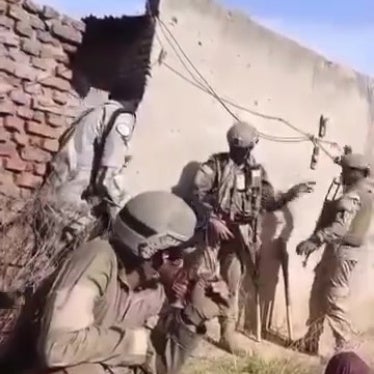
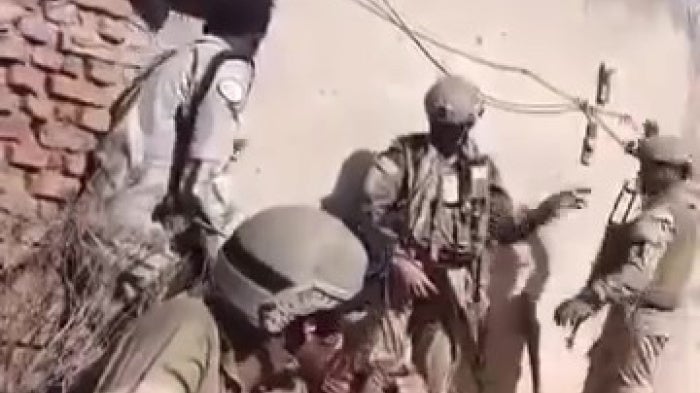
Amal said those doing the killing were Arab Sudanese, but standing next to them were white people, who she said were shorter than the Sudanese fighters, and, unlike them, wore fatigues and helmets. “They had sniper rifles, … small weapons with silencers. … They were wearing something around their chest, short sleeves, and insignia.”
Evidence collected by Human Rights Watch indicates that, since 2024, an Abu Dhabi-based security company–which is licensed to work for the Emirati government and has links to the ruling family and senior United Arab Emirates (UAE) officials–has appeared to hire Colombian private military contractors (PMCs) who were deployed to Sudan to fight alongside the RSF. Human Rights Watch believes that the white uniformed fighters described by Amal were most likely Colombian PMCs, who stood by while RSF fighters killed men and women, including people with disabilities.
This report adds to a growing body of evidence documenting UAE efforts to provide military support to the RSF, which the UAE steadfastly denies, and of which the provision of Colombian PMCs is but one component. Provision by the UAE of military support to the RSF, including the recruitment and supply of PMCs through a company acting as its proxy, despite the RSF’s grave and well-publicized abuses in Sudan, could constitute aiding and abetting in, or otherwise substantially contributing to, the RSF’s commission of war crimes and crimes against humanity.
The information in this report about the deployment of Colombian PMCs is based on interviews with two of those Colombians who were deployed to Sudan to assist the RSF; three informed sources with knowledge of Colombian private military recruitment companies and Emirati private security companies; six residents of El Fasher who saw foreign fighters Human Rights Watch believes were Colombians in the city; two El Fasher residents who identified Colombians who had been captured; and other informed sources. It also draws extensively on research on social media platforms to identify profiles of Colombian PMCs and to analyze and verify their content, including by geolocating videos and photographs; an analysis of satellite imagery of transit points; a review of documents, including two internal to the Global Security Services Group (GSSG) and four licenses issued by the UAE authorities; and publicly available reporting by media outlets and other research organizations.
At least 300 Colombians had been deployed as early as August 2024, media reports indicate. The RSF at the time was tightening its siege of El Fasher, the only remaining city in the region under the Sudanese Armed Forces (SAF) and allied forces’ control, and conducting escalating ground and air attacks. Evidence collected by Human Rights Watch indicates that Colombians took part in combat in and around El Fasher and, according to media reports, provided training to RSF recruits–including child soldiers.
Retired military personnel in Colombia first learned about the job through A4SI, a Colombia-based recruitment agency and their first point of contact. A4SI worked closely with Abu Dhabi-based Global Security Services Group (GSSG), which appears to have hired the contractors who were deployed to Sudan.
The recruitment effort was ostensibly private. But on their way to Sudan, this report shows, the contractors transited through at least two UAE military facilities in the UAE. Videos published by contractors on their social media and analyzed by Human Rights Watch, along with other content sent directly by interviewed contractors, identify the UAE military base in Ghiyathi and an apparent military facility in Al Wathba, both in the Emirate of Abu Dhabi, as transit points. A contractor said he received training by Emirati nationals in one such base. In addition, Human Rights Watch identified four additional contractors who made confirmed stopovers in the UAE prior to their deployment to Sudan.
One contractor told Human Rights Watch that he departed Abu Dhabi from a “smaller special airport” outside the city. Another told Human Rights Watch that when he arrived in the UAE on a private flight, he skipped immigration controls and, with other contractors, was immediately transferred to a UAE military base in Ghiyathi. “They didn’t stamp our passports. We went in and went out and there was a bus waiting for us to take us to a military base,” he said.
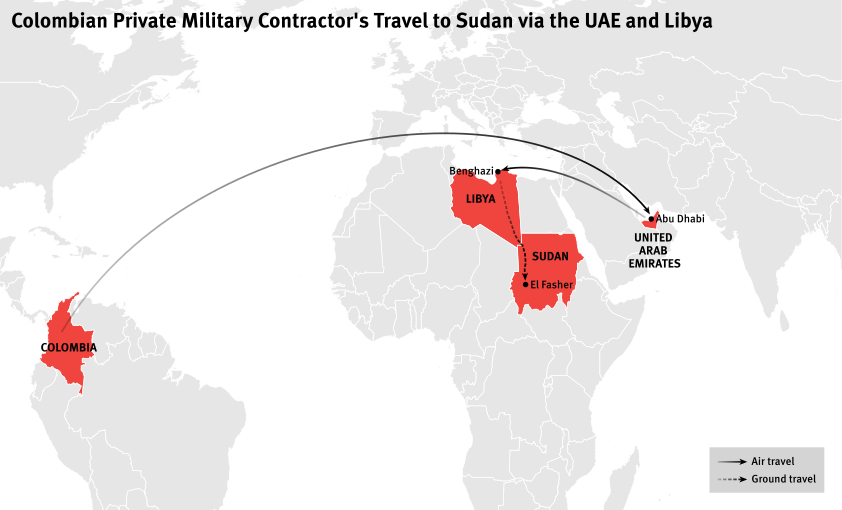
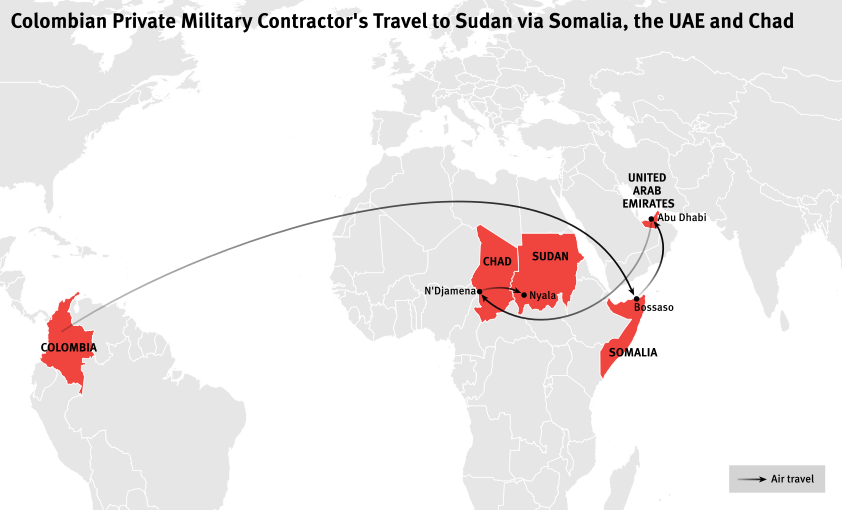
The contractors, Human Rights Watch found, then traveled to Sudan through a complex network of ostensibly private companies and transit points, using an air bridge spanning multiple countries. The transit points include eastern Libya, Bossaso–in the semi-autonomous region of Puntland in Somalia–and N’Djamena, the capital of Chad. Contractors who went the eastern Libya route traveled through the UAE and then to Benghazi, continuing overland to Darfur. One contractor who took the Bossaso route traveled via commercial airlines to the Puntland capital, where he stayed for roughly 10 days, before flying to the UAE. From there, he took a private flight to N’Djamena, in Chad, where he changed planes, flying to Nyala, the capital of South Darfur in Sudan.
The first public evidence of the Colombians’ presence came through videos posted on social media in November 2024, 19 months into the conflict in Sudan. In the desert of North Darfur, the Joint Force of Armed Struggle Movements (JFASM or Joint Forces), a coalition of armed groups allied with the Sudanese Armed Forces, had intercepted a convoy of vehicles that had entered Sudan from Libya. In one of the videos, a fighter films himself flipping through documents recovered from the convoy, including the passport, driver's license, and other identity documents of a man from Colombia. “We captured mercenaries,” says the man filming, “Look, not even one of them is Sudanese.”
In the video, stocks of munitions are also visible. These include Bulgarian-made mortar shells, that, France 24 would later reveal, had first been purchased for the UAE military–one of three instances Human Rights Watch is aware of equipment which appears to have been diverted from UAE military stockpiles to the RSF in violation of end-user agreements.
International media have reported that the UAE has been providing the RSF with military support since April 15, 2023, when the current war in Sudan began.
Since the war’s onset, the RSF have committed widespread violations and abuses across the country, including mass extrajudicial killings, rape, gang rape, sexual slavery, looting, and destruction of civilian infrastructure. In the regions of Darfur and Kordofan and in Gezira state, they laid towns and villages to waste, displacing millions of people. The RSF and allied militias have carried out a campaign of ethnic cleansing against the Massalit and other non-Arab communities of El Geneina, the capital of West Darfur state. They targeted civilians for killing based on their ethnicity, and the context of RSF abuses against the Massalit raises the possibility that they may have had the intent to commit acts of genocide in El Geneina. The RSF’s widespread sexual violence nationwide also constitutes crimes against humanity.
The impact of the conflict on civilians has been immense. It has created the world’s largest humanitarian crisis, and at least 150,000 people have likely died as a result. An estimated 12.9 million people have fled their homes. Half the country’s population faces acute hunger, and famine is spreading–a clear consequence of the denial of humanitarian access by both parties, and of the widespread looting and attacks on civilians and civilian objects notably by the RSF.
Support for the RSF from the UAE, or other sources, in the form of fighters and weapons would have contributed to the siege and assault on El Fasher. Media reports indicate that Colombian military contractors had deployed as early as August 2024, and that they were present in and around El Fasher since late 2024.
Videos geolocated by Human Rights Watch show PMCs fighting in El Fasher including one video from January 2025 which shows a contractor operating a mortar. Two Colombians told Human Rights Watch that they directly supported the RSF’s operations in Sudan, the first in late 2024 and the second in April 2025. One said he trained RSF recruits around April 2025 at boot camps around Nyala–the de facto RSF capital located in South Darfur–and that many recruits were “young children.” In November and December 2025, six El Fasher residents told Human Rights Watch they saw people they believed were Colombian in the city in October 2025, when mass killings were taking place.
GSSG appears to be the company hiring the contractors deployed to Sudan. According to third party corporate data reviewed by The Sentry, an investigative nonprofit organization, GSSG was founded in 2016 by Ahmed Mohammed al-Humairi, the secretary general of the UAE’s presidential court, who reports to UAE Vice President Sheikh Mansour bin Zayed Al Nahyan, the brother of UAE President Mohamed bin Zayed Al Nahyan. In 2017, The Sentry reported, al-Humairi transferred his shares in GSSG to Mohamed Hamdan al-Zaabi, a longtime business partner. Al-Zaabi, who has remained GSSG's CEO ever since, has extensive business and familial ties with the UAE authorities, Human Rights Watch has found.
The evidence indicates that GSSG has close ties to the highest levels of the UAE government and has continued to work closely with, and for the benefit of, the UAE government. It boasts of being “the first private security company in the United Arab Emirates to be awarded an armed security license.” Until recently, it also advertised having key Emirati ministries as its clients. A former GSSG employee interviewed by Human Rights Watch and a cache of leaked emails examined by Human Rights Watch also show that senior members of the ruling family were likely among the company’s clients.
The UAE is a highly centralized authoritarian state with few, if any, checks on the president’s state security apparatus backed by invasive mass surveillance. Emirati state authorities should therefore be fully aware of activities taking place on Emirati territory and especially on government property and military bases. Under UAE law, private security companies are required to coordinate their activities with UAE authorities and ensure that their activities are not in conflict with other security measures.
UAE support for the RSF would be consistent with their pattern of behavior in the Middle East and Africa for a decade and a half. Human Rights Watch has documented the UAE’s interventions in Yemen and Libya in support of abusive local armed forces and groups, including funneling vast amounts of money and weapons, and training fighters. The media reported that the UAE authorities recruited Colombian security and military personnel as far back as 2011, and that in 2015, they had deployed hundreds of Colombians to fight in Yemen. In Sudan, the UAE appears to be using the same playbook.
Despite mounting evidence, the UAE has continued to steadfastly deny that it provides any military support to the RSF. “We categorically reject any claims of providing any form of support to either warring party,” the UAE said in a statement to the Associated Press in November 2025. Instead, UAE authorities said it supported efforts to “achieve an immediate ceasefire, protect civilians and ensure accountability.”
Governments, including the United States, the United Kingdom and European Union member states, and international and regional bodies, such as the United Nations and African Union, are aware of the evidence of the UAE's support. Yet, in their statements on the conflict in Sudan, they have largely abstained from being explicit about the UAE’s support, or condemning such support for the RSF which carries out widespread rape and unlawful civilian killings. Instead, they have stuck to vague references condemning “external backers.”
The UAE’s allies and UN and AU security council members should publicly call for UAE authorities to immediately and urgently end the provision of weapons, equipment, personnel, and other assistance to the RSF. The UN Security Council should ask its Panel of Experts to investigate GSSG, as well as its CEO Mohamed Hamdan al-Zaabi, for the company’s role in providing PMCs to assist the RSF’s activities in Darfur in violation of the UN arms embargo established by the UN Security Council since 2004. Other actors, including private companies such as airlines, and UAE officials should also be investigated to determine if they are indeed involved in providing assistance to the RSF in Darfur in violation of the UN arms embargo. Based on the Panel’s findings, the Security Council should impose targeted sanctions on those aiding and abetting the RSF. Only when perpetrators and those aiding them pay the price of their actions will the cycle of abuse and atrocities end.
Recommendations
To the United Arab Emirates
- Immediately and publicly demand that the RSF end their attacks against civilians and other widespread violations.
- Immediately cease any form of financial and military assistance, including weapons, equipment, and personnel, to the RSF, including via ostensibly private companies.
- Immediately take action to halt and prevent private companies providing military or security assistance, including weapons, equipment, and personnel, to the RSF, including by investigating, and as appropriate, prosecuting and punishing private persons found responsible for their involvement in providing such assistance for aiding and abetting war crimes and crimes against humanity.
- Investigate, and discipline or prosecute, as appropriate, any security personnel responsible for coordinating, facilitating, or supporting the provision of weapons, equipment, personnel, and other assistance to the RSF, including on grounds of aiding and abetting war crimes and crimes against humanity.
- Support ongoing international and regional investigations into war crimes, crimes against humanity, and other serious human rights abuses and violations across Sudan, including investigations by the International Criminal Court (ICC), the UN Independent International Fact-Finding Mission (UN FFM) for the Sudan, and the African Commission for Human and Peoples’ Rights-mandated Joint Fact-Finding Mission to the Republic of Sudan (ACHPR Joint FFM).
- Support credible efforts to establish a fund to provide prompt and fair redress to victims, survivors, and communities affected by RSF violations including through delivering compensation, linked to ongoing independent international investigations.
- Support international efforts, particularly at the UN Security Council, to sanction individuals and entities responsible for violations, including breaching the arms embargo.
- Comply with existing UN and bilateral sanctions against individuals and entities responsible for violations in Sudan, including from the UN Security Council, the European Union, the United States, and other states.
- Support the expansion of the arms embargo on Darfur to cover the whole of Sudan.
- Ensure that any groups receiving any form of support do not engage in the use or recruitment of child soldiers.
To the RSF
- Publicly order all forces and allied militias to fully abide by international humanitarian law and adopt measures to end abuses, including unlawful killings, arbitrary detention, enforced disappearances, torture, rape, and other forms of sexual violence, looting, arson, and attacks on schools and hospitals.
- Immediately allow full, safe, and unimpeded access of humanitarian personnel and the urgent delivery of humanitarian assistance across Darfur.
- Ensure that all aid and health staff, as well as humanitarian and medical facilities and supplies, are protected from attacks and looting, and that health and aid staff and agencies can carry out their work free of harassment or other interference.
- Suspend civilian and military officials credibly implicated in serious violations in the conflict in Sudan, notably in Darfur, pending investigations into their actions including investigations by the ICC, the UN FFM, and the ACHPR Joint FFM for Sudan.
- Prohibit actions that could result in further destruction of evidence necessary to carry out investigations into serious human rights violations committed during the violence.
- Cooperate with and facilitate full and unfettered access to all areas for the ICC, as well as the UN FFM and ACHPR Joint FFM for Sudan.
- Provide prompt and fair redress to victims of violations or their relatives including through delivering compensation and the recovery and return of looted property.
- End all recruitment and use of children under 18 years of age.
To All Governments
- Publicly call for UAE authorities to immediately and urgently end the provision of personnel, arms, weapons, and all related equipment or assistance to the RSF in violation of the UN arms embargo on Darfur.
- Support ongoing international and regional investigations into war crimes, crimes against humanity, and other serious human rights abuses and violations across Sudan, including investigations by the ICC, the UN FFM, and the ACHPR Joint FFM.
- Investigate the role, if any, of Abu Dhabi-based Global Security Services Group (GSSG) in hiring private military contractors (PMCs) to support the RSF’s operations in Darfur, including on the basis of violating the UN Security Council arms embargo, with a view to imposing sanctions.
- Investigate Mohamed Hamdan al-Zaabi in his position as GSSG’s CEO and potential role, if any, in hiring PMCs to support the RSF’s operations in Darfur, including on the basis of violating the UN Security Council arms embargo, with a view to imposing sanctions.
- Investigate other actors, including private companies such as airlines and private operators of airports used for the transfers of PMCs, and UAE officials involved in providing assistance to the RSF in Darfur, with a view to sanctioning them as appropriate.
- Suspend any transfers of arms and other military equipment to the UAE, including arms, training, and maintenance agreements, given the risk of diversion to the RSF.
- Suspend any ongoing military training and cooperation with the UAE.
- Support, under the principle of universal jurisdiction and in accordance with national laws, the investigation and, as appropriate, the prosecution of those credibly implicated in serious crimes under international law and in breaches of end-user agreements or non-re-export agreements of weapons, ammunitions, or military equipment found manufactured in European states.
- Press for accountability for any senior Emirati officials credibly implicated in the provision of arms, weapons, equipment, personnel, and other related assistance to the RSF, and in the interim impose sanctions on Emirati officials credibly implicated in ongoing violations and violations of the Darfur arms embargo.
- Offer the necessary support to child protection activities, including support to nongovernmental organizations working to release children from forces and to prevent further recruitment, and the release, rehabilitation, and reintegration programs that include vocational training programs, education programs, and medical and psycho-social counseling activities for former child soldiers, including in displaced people or refugee camps.
To the European Union
- Investigate the role, if any, of GSSG and Mohamed Hamdan al-Zaabi in hiring private military contractors (PMCs) to support the RSF’s operations in Darfur, with a view to imposing sanctions through the EU’s 2023 sanctions regime on Sudan or its Global Human Rights Sanctions Regime.
- Adopt an EU-wide arms embargo against the UAE, in line with the criteria laid out in EU Common Position 2008/944/CFSP, and in consideration of risks of complicity in atrocity crimes.
- Publicly denounce the UAE’s provision of substantial assistance to the RSF that may amount to aiding and abetting atrocity crimes in Sudan, including during high-level bilateral engagements and in statements at the UN Human Rights Council and other international fora.
- Use the leverage provided by negotiations for partnership and trade agreements with the UAE to secure concrete, measurable human rights progress in the UAE’s domestic and foreign policy; conduct independent human rights impact assessments and thorough due diligence to ensure that bilateral trade and cooperation do not contribute to the abuses identified in this report; and consider putting negotiations on hold should the UAE authorities fail to adopt the reforms and policy changes necessary to comply with international law and to stop fueling atrocities in Sudan.
To the US Government
- Apply sanctions to the UAE under the 2008 Child Soldiers Prevention Act, which prohibits certain forms of US military assistance to governments that recruit or use child soldiers or support non-state armed groups that recruit or use child soldiers.
To the United Nations Security Council and the African Union Peace and Security Council
- Publicly call on the UAE authorities to immediately end the provision of personnel, arms, weapons, and all related equipment or support to the RSF in violation of the UN arms embargo on Darfur.
- Expand the jurisdiction of the ICC to cover all of Sudan and increase efforts to support ongoing investigations by the ICC prosecutor.
- Request that the UN Security Council’s Panel of Experts investigate the role, if any, of GSSG in hiring PMCs to support the RSF’s activities in Darfur, including on the basis of violating the UN arms embargo.
- Request that the UN Security Council’s Panel of Experts investigate the role, if any, of GSSG’s CEO Mohamed Hamdan al-Zaabi in hiring PMCs to support the RSF’s activities in Darfur, including on the basis of violating the UN arms embargo.
- Request that the UN Security Council’s Panel of Experts investigate other actors, including private companies such as airlines, and any UAE officials implicated in providing support to the RSF in Darfur, including on the basis of violating the UN arms embargo on Darfur and the arms embargo on Libya.
- Impose targeted sanctions on all those credibly identified as aiding and abetting the RSF in its violations of the UN arms embargo, in the commission of atrocities, or other abuses.
- Expand the arms embargo to make it a country-wide arms embargo on Sudan.
- Call on the UN Secretariat, in collaboration with the African Union Commission to:
- Urgently develop options for a civilian protection mission for Sudan, with a view to deploying a new mission.
- Include in the mission mandated to protect civilians, the monitoring of international human rights and humanitarian law violations, including obstruction of humanitarian assistance, and laying the groundwork for the safe returns of those displaced.
- Include a robust policing unit in the mission to focus on key locations where civilians are most at risk of deliberate attacks, including in Darfur.
- Insist on sufficient resources for the civilian protection mission with thoroughly vetted personnel and a civilian oversight mechanism to report on and mitigate abuses.
To the Colombian Government
- Take steps to prevent the recruitment of Colombian nationals as "mercenaries” including by criminalizing such activity under Colombian domestic legislation in line with Colombia’s international legal obligations.
- Investigate and prosecute, as appropriate, in accordance with domestic law, Colombian nationals complicit in atrocity crimes and other serious human rights violations documented in this report.
- Investigate the Colombian-based recruitment agency, A4SI, and other involved companies and individuals, for their role in recruiting Colombians apparently on behalf of the Abu Dhabi-based company, GSSG.
- Strengthen programs and efforts led by the Directorate for Veterans and Inclusive Rehabilitation of the Ministry of Defense, ensuring that service members have access to technical and professional training prior to retirement, and that after retirement they receive comprehensive support in employment, mental health, education, access to credit, among others, in order to reduce the economic vulnerability that makes recruitment attractive.
To the Sudanese Government
- Strictly observe Common Article 3 of the Geneva Conventions, which prohibits violence–particularly murder, cruel treatment, and torture–against captured fighters and those who have surrendered or become incapacitated, as well as outrages against their personal dignity and degrading or humiliating treatment, and the taking of hostages.
- Repatriate any captured Colombian nationals to their home country, where they should be investigated and, if appropriate, prosecuted for complicity in international crimes, in accordance with international fair trial standards.
- Ensure cooperation between the investigative authorities of the territorial, contracting, and home states in any criminal investigations into PMCs.
- In keeping with norms of customary international humanitarian law on respect for the dead, facilitate the return of the remains and personal effects of any deceased PMCs, if so requested by their next of kin.
Methodology
This report is based on interviews, open-source research, and an analysis of relevant company and government documents and records.
Between March and September 2025, researchers remotely interviewed two Colombian military contractors who were deployed to Sudan to support the RSF; three retired Colombian military officers who are in contact with Colombian contractors deployed in Sudan and who have knowledge of Colombian private military recruitment companies and Emirati private security companies; a former employee of the Global Security Services Group (GSSG); and several sources with knowledge of UAE activities in Bossaso (Somalia). A journalist at the Colombia-based news outlet La Silla Vacía facilitated the interviews with the Colombian military contractors. Researchers also drew from Human Rights Watch interviews with sources in and from El Fasher, including two residents who saw Colombians captured during the siege of El Fasher by the RSF (April 2024 – October 2025) and six who described seeing foreign fighters Human Rights Watch believes were Colombians in the city at sites of mass killings in October 2025 during the RSF’s takeover of El Fasher.
Researchers informed all interviewees about the purpose and voluntary nature of the interviews, and the ways in which Human Rights Watch would use the information, and obtained consent from all interviewees, who understood they would receive no compensation for their participation. Every effort was made to abide by best practice standards for ethical research and documentation, including all efforts to avoid re-traumatization of survivors. We preceded all interviews with a detailed explanation of informed consent to ensure that interviewees understood the nature and purpose of the interview and could choose whether to speak with researchers. In each case, we explained how we would use and disseminate the information and sought the interviewees’ permission to include their experiences and recommendations in this report. We informed all interviewees that they could stop or pause the interview at any time and could decline to answer questions or discuss topics. Human Rights Watch has withheld interviewee names for security reasons.
Human Rights Watch also conducted extensive research on social media platforms to find profiles of additional Colombian private military contractors (PMCs), analyze and, where possible, verify content they had posted, and geolocate relevant videos and photographs. Human Rights Watch concluded that the profiles are from Colombians if the person posted regularly from Colombia based on the metadata of the posts before traveling abroad and that they are PMCs if they can be seen with military equipment and weapons. While most identified profiles posted content from or geolocated in the UAE, this report only references material from four social media profiles of people who Human Rights Watch was able to verify as having been present at some point in Sudan.
Deep-learning detection models run on satellite imagery were used to geolocate content, and satellite imagery was used to analyze the different facilities and airports mentioned throughout the report.
Researchers also reviewed internal GSSG records (employee information forms, an employment offer, a confidentiality and non-competition agreement, and money transfer authorizations), UAE laws, UAE corporate records, UAE government statements, and UAE licensing documents.
On March 17, 2026, Human Rights Watch sent letters to the following companies, outlining the general conclusions of our research and seeking answer to specific questions: Dunarit Corp–BDIA, Lacroix Défense, and Yugoimport-SDPR.
On March 27, 2026, Human Rights Watch sent letters to the following entities and companies, outlining the general conclusions of our research and seeking answer to specific questions: A4SI, ADASI, ADQ, Edge Group, Fenix, the government of Puntland, the government of the United Arab Emirates, Global Security Services Group, International Golden Group, the Khalifa Bin Zayed Al Nahyan Foundation, the Rapid Support Forces, and Terminal Holdings LLC.
Also on March 27, 2026, Human Rights Watch sent letters to the following individuals, outlining the general conclusions of our research and seeking answers to specific questions: Ahmed Mohammed al-Humairi, Sheikh Hazza bin Zayed Al Nahyan, Khalifa Mattar al-Mazrouei, Khalifa Hiftar, Sheikh Mansour bin Zayed Al Nahyan, Sheikh Suroor bin Mohammed Al Nahyan, and Sheikh Tahnoun bin Zayed Al Nahyan. On April 21, 2026, Human Rights Watch wrote to Christian Lombana Moncayo, outlining the general conclusions of our research.
As of May 19, the entities and individuals cited above had not replied to Human Rights Watch.
Recruitment of Colombian Private Military Contractors
The evidence collected by Human Rights Watch, including media reports, indicates that Global Security Services Group (GSSG), an ostensibly private security firm based in Abu Dhabi but with strong links to UAE authorities, appears to have hired the Colombian private military contractors (PMCs) who were eventually deployed to Darfur.[1] A Colombia-based recruitment company, A4SI, first recruited the contractors in Colombia beginning as early as August 2024. As of September 2025, at least 300 Colombian PMCs had been deployed, according to the Colombia-based news outlet La Silla Vacía and a retired Colombian military officer who spoke with Human Rights Watch.[2]
On December 9, 2025, the US Department of the Treasury’s Office of Foreign Assets Control (OFAC) imposed sanctions on four individuals and four entities involved in a transnational network fueling the civil war in Sudan, including A4SI, that recruited former Colombian military personnel and trained soldiers to fight for the RSF.[3] In their statement, the Treasury said that A4SI “engaged in campaigns via its website, group chats, and townhalls to fill positions, including drone operators, snipers, and translators.”[4] On April 17, 2026, OFAC imposed sanctions on five more individuals and entities involved in the operation, including Fénix, a Colombia-based employment agency, “opened as a replacement for A4SI in February 2025.”[5]
Colombia offers a fertile recruiting ground for private security firms seeking to hire retired military contractors. This is linked to decades of internal armed conflict, an army with tactical and operational capacity for irregular warfare, soldiers who retire at a young age, and the absence of structured and sustainable veteran support programs.
The following research section includes information from remote interviews with two Colombian military contractors, retired from the Colombian military, who say they were deployed to Darfur to support the RSF. The interviews took place after their deployment ended. It is also includes remote interviews with the three retired Colombian military officers who are in contact with Colombian contractors deployed in Sudan’s western Darfur region and who have knowledge of Colombian private military recruitment companies and Emirati private security companies–one of whom has direct knowledge of the activities of A4SI–and a fourth interview with a former employee of GSSG.
Initial Recruitment of Military Contractors from Colombia
A4SI recruited retired military personnel in Colombia, while GSSG hired the private contractors who were deployed to Sudan, according to The Wall Street Journal, and to three sources who spoke to Human Rights Watch.[6] Colombian news outlet La Silla Vacía first reported on this.[7]
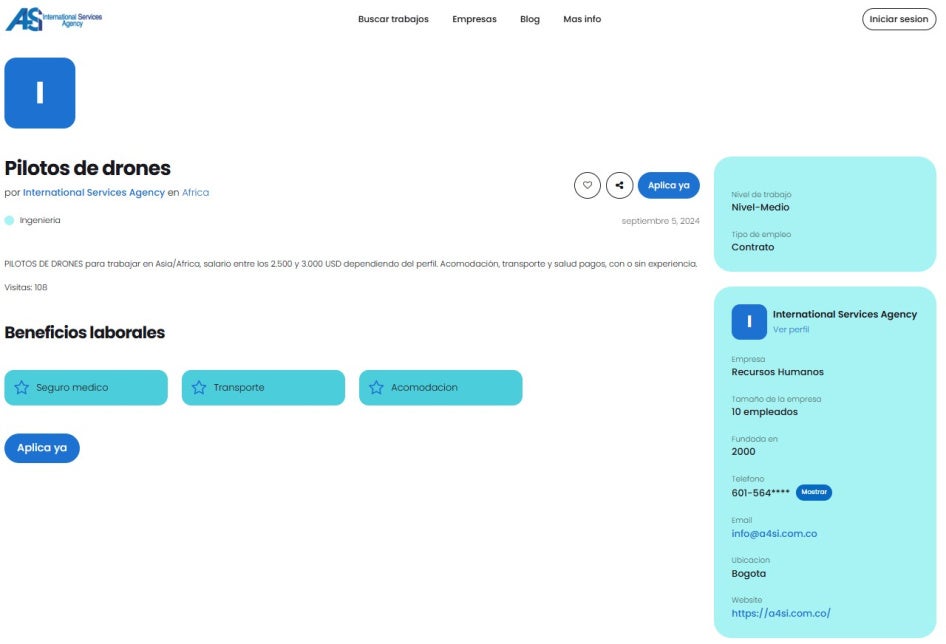
A4SI is a Colombian “private transnational employment management and placement agency” founded in 2010, according to the company’s website.[8] In September 2024, A4SI posted vacancies online for drone pilot work in Africa, with “salaries ranging from USD 2,500 to USD 3,000” and paid “accommodation, transportation, and healthcare.” The advertisement did not detail whether this pay was per week, month, or year.[9]
“We signed a contract to provide security for oil infrastructure that was owned by third parties,” one of the former contractors told Human Rights Watch.[10] The contract, signed in August 2024, was for one year with 30 days of vacation with an income of 3,400 USD. The man told Human Rights Watch that he was not informed that he would be traveling to a war zone in Sudan. “They told us that we were going to provide security in the Middle East and Africa.”[11]
News of A4SI’s ongoing recruitment spread between former Colombian military personnel and soldiers, the contractor said. A4SI sent the contractor his offer in August 2024, and he left Colombia at the end of September 2024.
A second Colombian PMC told Human Rights Watch that he was recruited by another Colombia-based military recruitment company called “Fénix” or “Pheonix.”[12] He told Human Rights Watch that the name of the company was changed to “Fénix” or “Pheonix” because “they had so many complaints against them under the previous name.”[13] La Silla Vacía also reported that the name of the company was changed to Fénix.[14]
Unlike the first contractor who spoke with Human Rights Watch, this individual said that he was informed that he would be traveling to a war zone. “They didn’t lie to us about what we were doing,” the second contractor told Human Rights Watch.[15] “They did tell us that we were going to a war.”[16]
Contracts and Paperwork
The evidence Human Rights Watch collected indicates that Global Security Services Group (GSSG), an Abu Dhabi-based security company linked to the Abu Dhabi ruling family and senior government officials, appears to have hired the Colombian PMCs who were eventually deployed to Sudan. (For more details, see section on GSSG below.)
A source with direct knowledge of the activities of A4SI told Human Rights Watch, that after the first initial recruitment by A4SI, GSSG has been responsible for paying the Colombian PMCs and facilitating their transfer from Colombia to Sudan.[17] After their initial recruitment by A4SI, dozens of PMCs signed contracts with the Abu Dhabi-based GSSG, according to media reports.[18] One contractor told La Silla Vacía that he signed a confidentiality clause with GSSG before traveling in a convoy of pick-up trucks overland from Benghazi in Libya to El Fasher in Darfur, Sudan.[19]
Human Rights Watch obtained copies of two employee information forms which appear to have been signed by GSSG employees and contractors. They show that both contractors were formerly professional soldiers in the Colombian army, with one listed as a former special forces operator.[20] One form, which was signed in August 2024, comes with an employment offer listing the work location as Libya and designating the individual as a “security guard” in the company’s operations department.[21] The employment offer is signed by GSSG’s managing director Jacques Du Toit. An undated roster obtained by Human Rights Watch indicates that this contractor worked as a driver in a 26-men combat platoon that included machinegun and anti-drone operators, consistent with a deployment to Sudan.[22] Human Rights Watch also reviewed documents, dated August 24, 2024 and signed by the 26 men in Benghazi, Libya, by which the contractors authorize GSSG to transfer their salaries via Global Staffing, a Panama-based company sanctioned by the United States, and set up, the US treasury department said, “to minimize A4SI’s legal exposure and obfuscate the links between A4SI and the company hiring the Colombian fighters.”[23]
The second employee information form obtained by Human Rights Watch was signed and dated in March 2025 and does not contain any employment offer specifying the location of deployment.[24]
The two Colombians who signed the employee information forms obtained by Human Rights Watch were deployed by the GSSG to Sudan, a source told Human Rights Watch.[25] They are not the same Colombian military contractors whom Human Rights Watch remotely interviewed and who were also deployed to Sudan to support the RSF.
The form signed in August 2024 includes a confidentiality and non-competition agreement barring the contractor from making any media statement or public or private comment.[26] It warns that the unauthorized disclosure of information would “cause definite and irreparable damages” to the company and that the contractor would be liable under UAE civil and criminal law for any such disclosures.
Deployment
After initial recruitment in Colombia, Human Rights Watch documented several routes for military contractors to reach Sudan’s Darfur region: through eastern Libya; through Bossaso, the semi-autonomous region of Puntland in Somalia; or through N’Djamena, the Chadian capital. All routes involved stopovers in the UAE.
On the eastern Libya route, contractors traveled to Benghazi by air after a brief stopover in the UAE. From Benghazi, they traveled overland to Darfur. The second route via Bossaso involved one contractor interviewed by Human Rights Watch traveling via commercial airline to Bossaso where he stayed for approximately 10 days before flying to the UAE. He then traveled via a private flight from the UAE to N’Djamena in Chad, and then on to Nyala, in Darfur, Sudan.
The following sections are based on Human Rights Watch’s remote interviews with two Colombian military contractors, retired from the Colombian military, who were deployed to Darfur to support the RSF. The interviews took place after their deployment ended. Human Rights Watch geolocated two videos recorded by one of the private military contractors (PMCs) during his deployment. It is also based on analysis of video metadata from the social media accounts of two other PMCs, as well as geolocated social media videos.
Travel From Colombia to Sudan
Via Libya
The Colombian PMC who says he was recruited by A4SI and given his employment offer in August 2024 left Colombia for Dubai in late September 2024. The man was driven from Dubai International Airport to Abu Dhabi where he stayed in a hotel for seven days while he waited for other contractors to arrive.
According to the contractor, A4SI then transferred the recruits via a chartered plane from Abu Dhabi to Benghazi, Libya. The flight carried approximately 160 other Colombian PMCs, all of whom had traveled to the UAE from Colombia as part of the recruitment drive, according to the contractor.
The contractor told Human Rights Watch that the flight from Abu Dhabi left from a “smaller special airport.” The airport, he said, was not a regular airport and was “used only to take staff and personnel to fly from Abu Dhabi to Benghazi, only the Colombians that were going there.”[27]
After arriving in Benghazi, Colombian PMCs were driven in a convoy overland to Sudan, according to La Silla Vacía.[28]
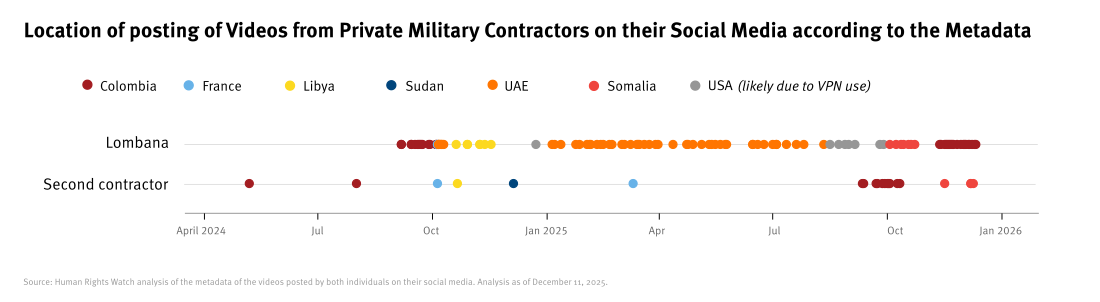
Geolocated social media videos, as well as an analysis of metadata from social media videos, also indicates that Colombian military contractors traveled to Sudan via the UAE and then Libya.
In November 2024, videos were posted on social media showing material seized by the Joint Force of Armed Struggle Movements (JFASM), or Joint Forces, a coalition of Darfuri armed groups allied with the SAF, after they had ambushed a convoy of Colombian military contractors. The material seized included Bulgarian-made 81mm munition diverted from the stocks of the UAE armed forces (see below).[29] One of the videos shows Joint Forces fighters discovering the Colombian passport and other identity documents of a military contractor named Christian Lombana Moncayo. According to a letter the Sudanese government sent to the UN Security Council, Lombana Moncayo’s passport also contains a UAE entry stamp apparently dated October 6, 2024.[30]
Bellingcat analyzed photos and videos posted by Lombana Moncayo to his social media accounts and geolocated a video he published on November 17, 2024, and took on the road in Libya, 110 kilometers north of Al-Jawf in southeastern Libya and approximately 300-400 kilometers from the border with Sudan.[31]
Bellingcat also found that Lombana Moncayo arrived in Abu Dhabi from Bogotá in early October 2024 and departed Abu Dhabi on October 11, 2024.[32]
Human Rights Watch analyzed the metadata of videos Lombana Moncayo and another Colombian PMC seen with him in photos geolocated to the UAE and posted to their social media accounts. Both accounts contain videos from the end of 2024, with metadata indicating that they were likely posted in Libya, and, in one case, Sudan, although the use of VPNs could alter this attribution. In late 2025, both accounts also posted content from Somalia according to the metadata.
Via Bossaso, Somalia
Colombian PMCs also traveled to Sudan in 2025 via Bossaso, Somalia. One Colombian PMC who spoke to Human Rights Watch said that he arrived in Bossaso from Colombia using commercial flights in mid-March 2025 and stayed on what he described as “a military base” in a bunker for approximately ten days with a group of around 40 other Colombian PMCs.[33] From Bossaso, he traveled to the UAE and then to Chad before arriving in Nyala, Sudan.
“[Bossaso] has a military base and that’s where everyone arrives. There are some people who stay there for a month, some for 20 days, others for eight days,” the contractor told Human Rights Watch.[34]
He said the base had “several bunkers underground. There were a lot of Colombians. I was with a group of about 40. But there were different groups who were staying in different bunkers.”[35]
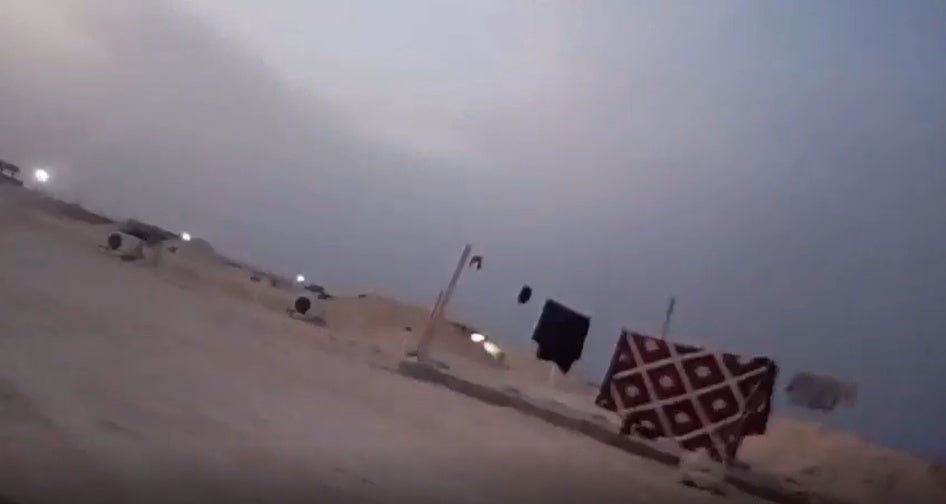
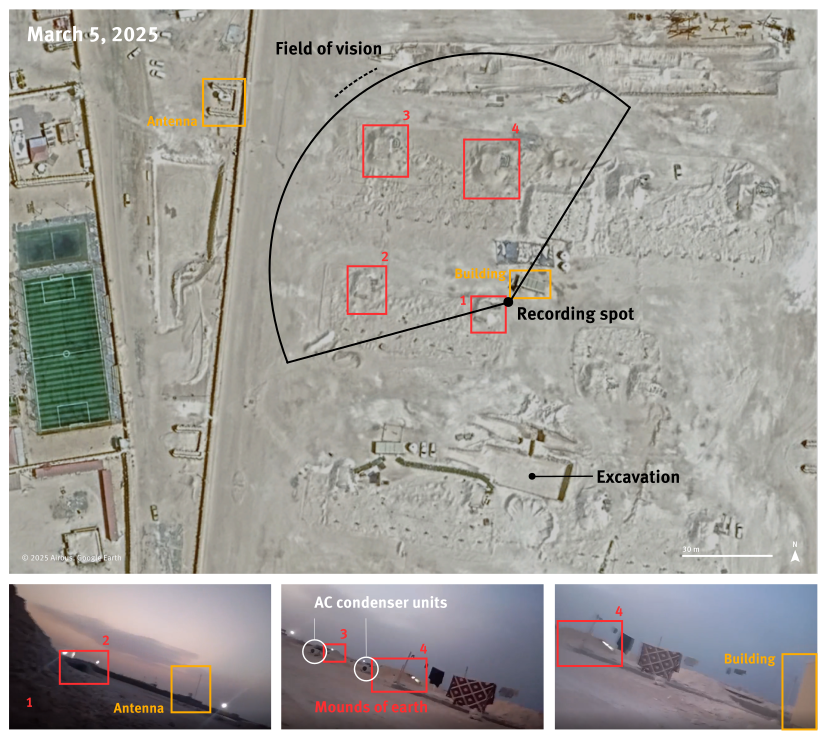
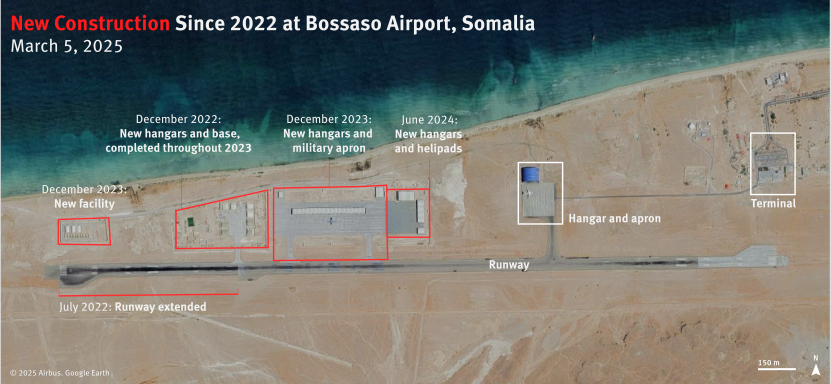
Human Rights Watch geolocated two videos[36] recorded by the PMC during his stay at the end of March 2025 to a newly developed area of a base for the Puntland Maritime Police Force (PMPF–an elite force reporting directly to Puntland’s president) in Bossaso, located west of the airport.[37] The videos show mounds of earth with air conditioning condenser units in front of them. Clothes are drying on a washing line. Satellite imagery captured on March 5, 2025, shows a large excavation at the site which by the end of August 2025 is re-covered by earth, an indication of underground facilities under construction.
From the PMPF base in Bossaso, the contractor took a private flight to Abu Dhabi.[38] On arrival in Abu Dhabi, “they didn’t stamp our passports,” he said. “We went in and went out and there was a bus waiting for us to take us to a military base.”[39]
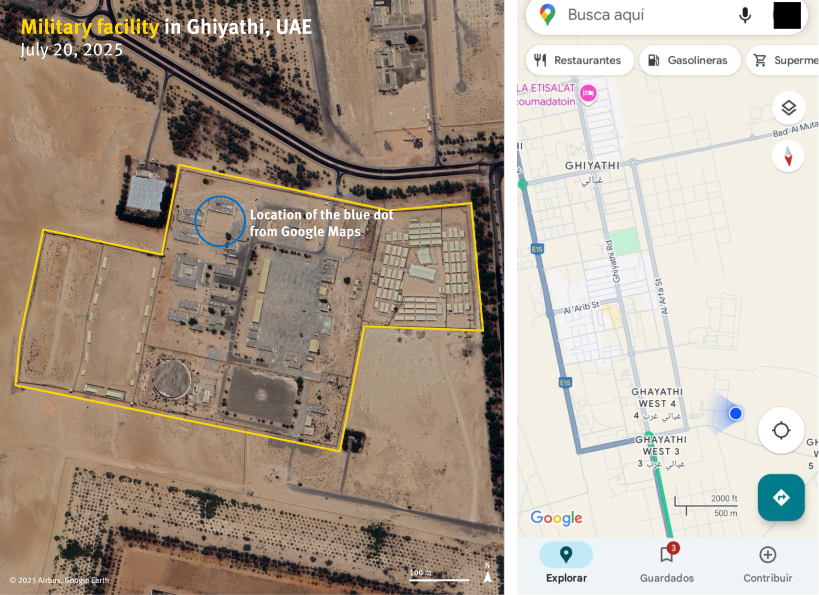
He reported that the group of approximately 40 contractors was taken to a UAE military facility in Ghiyathi, a town in the Al Dhafra region of the Emirate of Abu Dhabi, where they stayed for approximately 20 days and received military training.
From the Ghiyathi base, the recruits were transported via bus to a commercial airport. “They brought us in hidden, clandestinely, through the back of the airport, and we didn’t see anything,” he said.[40]
Bossaso Bossaso is the capital of Somalia’s semi-autonomous region of Puntland whose leadership is closely aligned with the UAE. The UAE has funded, trained, and supervised the Puntland Maritime Police Force—an elite force reporting directly to Puntland’s president—since its creation in 2010, support which has violated the Somalia sanctions regime.[41] Working together with the PMPF in military operations, the UAE has since 2025 carried out drones strikes against the Islamic State in Somalia, an armed group operating primarily in Puntland.[42] Bossaso airport is a dual civilian-military structure that has become a key hub in the UAE’s regional operations, including in Somalia. It is run by Transport Infrastructure Services Ltd (TISL) and the Bosaso International Airport Company (BIAC), two subsidiaries of the company Terminal Holdings LLC.[43] Terminal Holdings is a UAE company with opaque ownership; its subsidiaries have secured contracts to run, amongst others, the airports in Kabul (Afghanistan), Astana (Kazakhstan), Nouakchott (Mauritania), and Malabo (Equatorial Guinea) following high-level visits by UAE officials.[44] Bossaso airport has been significantly expanded and militarized since the end of 2022. Human Rights Watch analysis of satellite imagery shows that the runway was extended from 2,400 meters to 3,200 meters in July 2022. In December 2022, new hangars and a base started to be built to the north of the runway. Their construction continued throughout 2023. In December 2023, a large military apron, indicated by the regular presence of military planes on satellite imagery, and hangars were built north of the runway. A new compound was also built to the west of the facility. In June 2024, new hangars and helipads adjacent to the military apron appeared on satellite imagery. The UAE military is present at both the airport and the PMPF base located three kilometers to the west of the airport.[45] The United States military also maintains a presence in the PMPF base.[46] |
Via N’Djamena, Chad
From the UAE, some recruits flew to N’Djamena, the capital of Chad. One of the former contractors said they arrived in N’Djamena in the middle of the night and did not stay long. “Right away, we went on the next flight to Nyala within 30 minutes of arriving in Chad,” he said.[47]
Chad Air Bridge From mid-2023 to mid-2024, the airport in Amdjarass, a remote town in eastern Chad’s Ennedi Est province, served as a key transit point in the transshipment route for weapons and equipment destined to the RSF. The UAE’s Ministry of Foreign Affairs announced in July 2023 that the UAE had begun to build a hospital in Amdjarass with contributions from the Khalifa Bin Zayed Al Nahyan Foundation, the Zayed Bin Sultan Al Nahyan Charitable and Humanitarian Foundation, and the Emirates Red Crescent Authority.[48] The hospital was ostensibly set up for the benefit of Sudanese refugees.[49] At the time it was set up, roughly 300,000 Sudanese had crossed into Chad since the beginning of the war. The RSF was carrying out widespread attacks against civilians in West Darfur, just across the border, including crimes against humanity as part of a campaign of ethnic cleansing in El Geneina, West Darfur’s capital.[50] Yet, very few Sudanese refugees had come to Ennedi Est, which faces the North Darfur state of Sudan, when the UAE built the Amdjarass hospital. Most went to Ouaddaï, including near Adré, roughly 300 kilometers south of Amdjarass.[51] In December 2023, the UAE acknowledged that 122 cargo flights from the UAE had landed in Chad, and said these flights had carried 2,500 tons of humanitarian aid.[52] But humanitarian specialists told Human Rights Watch that the total cargo capacity of this many flights far exceeded the needs of such a small hospital.[53] In September 2023, The New York Times reported that the UAE was using the hospital to treat wounded RSF fighters.[54] The Emirates Red Crescent did not inform the International Federation of the Red Cross or the Chad national society that it was establishing the hospital, as is standard practice.[55] In January 2024, the UN Panel of Experts on the Sudan cited “local native and administrative leaders and armed groups” operating in eastern Chad and Darfur, who said weapons left the Amdjarass airport in convoys of trucks that delivered the weapons to the RSF at the Chad-Sudan border.[56] In September 2024, The New York Times reported that the Amdjarass airport had seen a dramatic expansion, with a “bustling, military-style airfield.”[57] US intelligence sources told The New York Times that the UAE had been flying long-range, Chinese-made, Wing Loong 2 drones in support of the RSF out of the Amdjarass airport.[58] The report cited a February 2024 confidential memo from the EU ambassador to Sudan, Aidan O’Hara, in which he wrote that “The delivery of drones, howitzers, multiple rocket launchers and MANPADS to the R.S.F. by the U.A.E. has helped it neutralize the air superiority” of the SAF.[59] The New York Times reported that two of the UAE charities that funded the Amdjarass field hospital are “controlled or overseen” by Sheikh Mansour bin Zayed Al Nahyan, the vice president, deputy prime minister and chairman of the Presidential Court of the UAE, and owner of Manchester City F.C.[60] Sheikh Mansour is the chairman of the Khalifa Bin Zayed Al Nahyan Foundation. In December 2024, Reuters reported that three quarters of the 86 flights it had recorded between the UAE and Amdjarass since the beginning of the conflict used airlines that the UN Security Council’s Panel of Experts on Libya said had been involved in the UAE’s efforts to provide weapons to the Libyan Arab Armed Forces, the armed group led by Khalifa Hiftar that controls the east and south of Libya.[61] Since mid-2024, as Nyala and southern Libya emerged as key transit points for the UAE’s support to the RSF, Amdjarass declined in importance as a transit hub. The hospital reportedly closed down in February 2026.[62] It was not clear, at the time of writing, whether Amdjarass remained a transshipment hub.[63] |
Nyala (South Darfur)
Activity at the Nyala Airport
Since late 2024, regular nighttime flights have brought equipment to the RSF-held city of Nyala. These deliveries led to a surge in airstrikes by the SAF on and around the airport. The SAF and sources affiliated to them said on several occasions that it had targeted planes supplying equipment and “mercenaries” at the Nyala airport.[64]
Planes have regularly landed at the airport since the RSF reopened it for the first time since the beginning of the conflict in September 2024, according to a local source.[65] UN reporting found that RSF activity at the Nyala airport “could be a way for [the] RSF to take delivery of supplies more quickly than by the longer land routes from southern Libya and eastern Chad.”[66]
Sources in Nyala told both Human Rights Watch and the UN Panel of Experts on Sudan that planes landed at night and took off before sunrise.[67] The flights occurred “practically every night,” a source told Human Rights Watch in January 2025.[68] Witnesses told the UN Panel that trucks left the airport shortly after planes landed. In April 2025, local Sudanese media outlet Darfur24 reported that it had “verified the landing of 130 aircraft at Nyala Airport between September 21 [2024] and March 14 [2025],” that aircraft stayed from 40 minutes to four hours before leaving, and that access to the airport was now restricted for civilians.[69]
Because the aircraft operate at night, they do not appear in satellite images, which are usually captured in the morning. The area is also not covered by flight tracking services such as FlightRadar24.[70]
Plane wrecks have appeared at the airport since its reopening, further confirming that it is operational. Analysis by the Yale Humanitarian Research Lab in May 2025 revealed debris from the wreck of a plane on the apron of the airport.[71] Human Rights Watch analysis of satellite imagery captured over the airport shows the wreckage appeared between the mornings of May 2 and May 3, 2025.
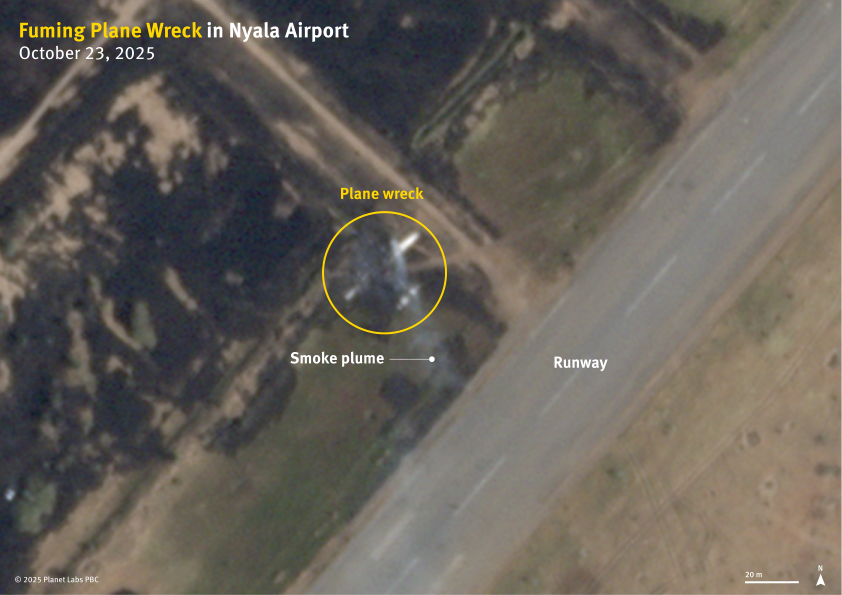
In another incident analyzed by Human Rights Watch, satellite imagery from October 23, 2025, captured at 8:01 a.m. local time, shows a still fuming plane wreck a few dozen meters from the runway of the airport. Fire detection data recorded a fire at the same location at 2:47 a.m. local time.
Private Military Contractors’ Presence around the Nyala Airport
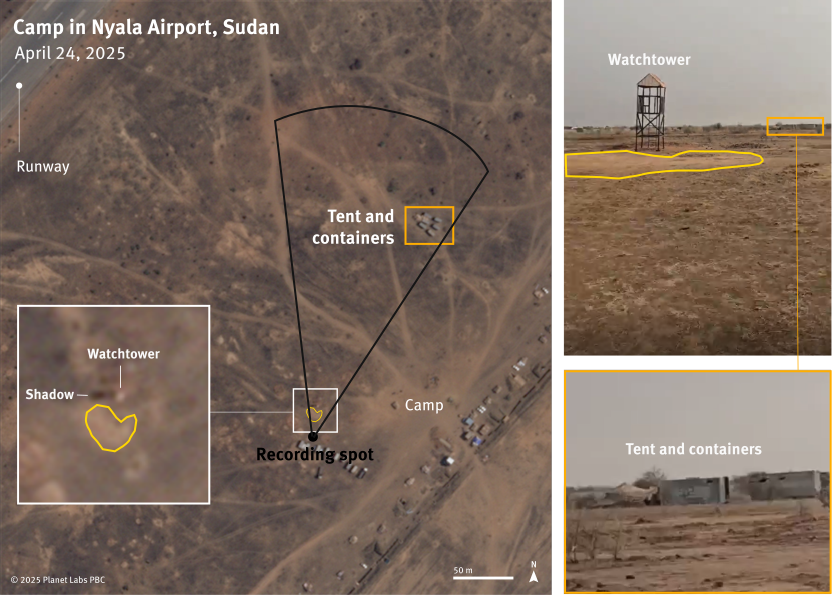
A new camp was established at the Nyala airport in early 2025. The camp, made of tents and containers, started to appear on satellite imagery inside the airport perimeter four hundred meters east of the runway at the beginning of March 2025. In April 2025, a Colombian PMC who passed through the UAE (see Links with UAE Authorities section), posted a video showing a watchtower, a tent, and containers which Human Rights Watch geolocated in the Nyala airport camp.
Using satellite imagery, the Yale Humanitarian Research Lab also found that the Nyala airport had sustained significant damage from airstrikes in the second part of September 2024. At least twelve munitions’ impacts are visible on satellite imagery from September 28, 2024, on a building, the runway, and a taxiway of the airport. On imagery from April 21 and 24, 2025, long-range RSF drones are visible on the airport’s tarmac. Dozens of one-way attack drones and launchers appear in the vicinity of the airport on imagery from September 26 and 29, 2025.[72]
Links with UAE Authorities
Several types of evidence indicate the deployment of Colombian private military contractors to Sudan in support of the RSF appears to be a UAE state-backed operation. This includes the apparent use of, and reliance on, UAE state and state-controlled infrastructure to transfer the Colombian military contractors to Sudan, and the close ties between the Global Security Services Group (GSSG) and the highest levels of the UAE government. There are also extensive political, business, and familial links between GSSG’s CEO and the UAE authorities.
As described in more detail below, Human Rights Watch's sources indicated that Colombian private military contractors (PMCs) received training at UAE state infrastructure and that one contractor bypassed UAE border control. Human Rights Watch also independently confirmed that contractors were present on what appear to be sensitive government sites within the UAE.
The GSSG was initially set up by the secretary general of the UAE Presidential Court, and continues to work closely with and carry out work through the UAE authorities, according to one Colombian PMC deployed to Sudan, two informed sources with knowledge of Colombian private military recruitment companies and Emirati private security companies, and reporting by La Silla Vacía and The Sentry. The UAE authorities awarded what GSSG claims is the first armed security license in the UAE, and the UAE government agencies and senior members of the ruling family are regular company clients.[73]
Emirati state authorities, which have built a pervasive surveillance apparatus, should be fully aware of activities taking place on Emirati territory, especially on government property and military bases.[74] The UAE’s State Security Apparatus (SSA) reports directly to the president and enjoys broad and unconstrained powers. Under Federal Law No. 2 of 2003, the SSA can act without any institutional, judicial, or financial oversight and may take any action inside or outside the state to protect state security within the limits of the law and other legislation.
The UAE’s Federal Law No. (37) of 2006 Concerning Private Security Companies, which governs the activities of private security companies in the UAE, requires private security companies in the country to coordinate their activities with UAE authorities.[75] The law requires security companies to obtain security approval from the competent authority and limits their services to those set out in the license.[76] Companies are required to “coordinate with the Competent Authority to ensure that its activities are not in conflict with any established security measures.”[77]
Colombian Contractors’ Use of UAE State Infrastructure
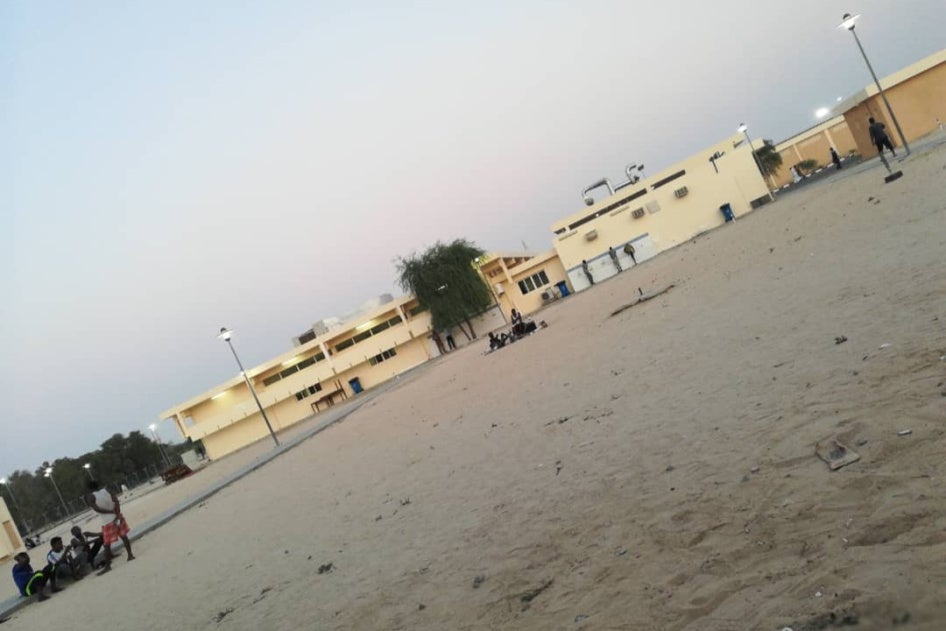
Evidence provided by Colombian military contractors indicates that they were hosted in and transited through official UAE government sites and sites controlled by the UAE government. This includes the Ghiyathi military base in the UAE and a government facility in Al Wathba, UAE, that displays features characteristic of UAE military bases in the country.
Ghiyathi Military Base
A Colombian military contractor interviewed by Human Rights Watch received training at a base in Abu Dhabi for approximately 20 days before traveling to Chad and Sudan.
The contractor shared with Human Rights Watch a screenshot that he had taken with the location function activated, showing his phone’s position on Google Maps. The blue dot indicates the phone was located inside a military facility in Ghiyathi, a town in the Al Dhafra region of the Emirate of Abu Dhabi, where he said that he received military training for approximately 20 days from March 2025 until early April 2025.[78]
He said that the staff providing the training appeared to be Emirati nationals. “The staff that I saw there were Emirati staff [and] were always in plain clothes or were wearing the long typical Emirati white robe,” he said.[79]
Human Rights Watch previously documented the use of the Ghiyathi facility in a similar scheme in 2020, when another Emirati security services company, Black Shield Security Services, recruited over 200 Sudanese men and deceived them into working in Libya.[80] Black Shield brought the men to the Ghiyathi compound, where they underwent months-long military training provided by the Emirati Armed Forces.[81] In September 2020, Human Rights Watch wrote to representatives of Black Shield, the Emirati Armed Forces, the UAE’s Ministry of Defense, and the Libyan Arab Armed Forces to inquire about the allegations brought by the Sudanese men, but has never received a response.
Al Wathba
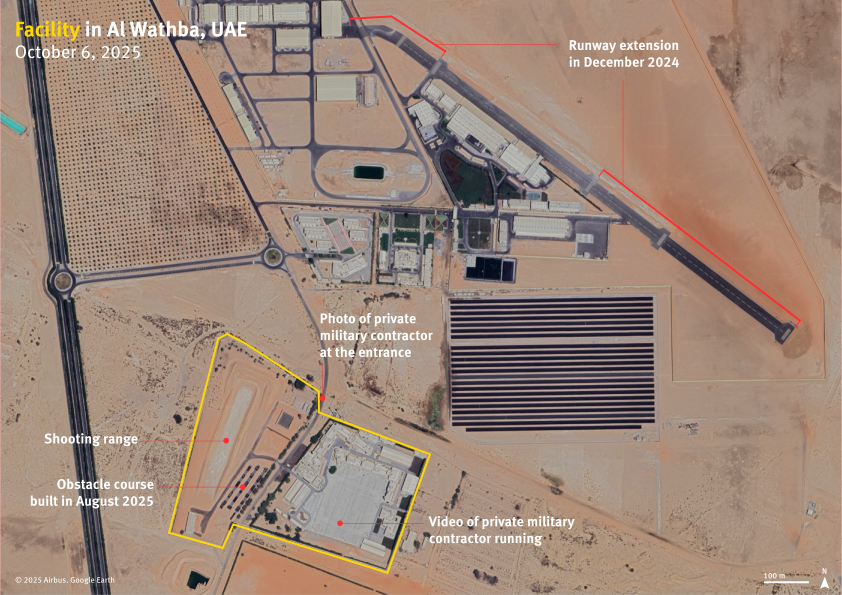
Human Rights Watch geolocated a video posted to social media by a Colombian PMC who later posted the content that Human Rights Watch geolocated at Nyala airport in Sudan. This video shows an apparent UAE military facility located in Al Wathba, a suburb of Abu Dhabi. The video, posted in March 2025, was recorded by the contractor while he was jogging inside the courtyard of the facility.
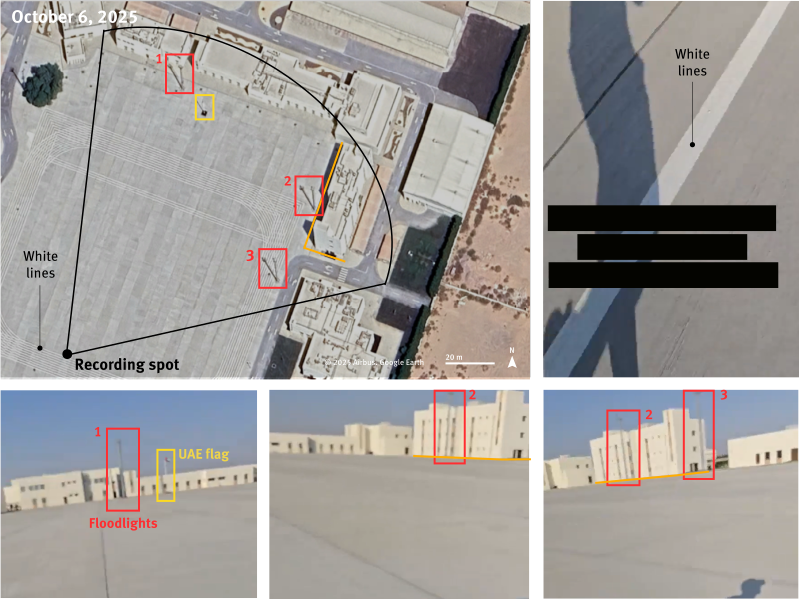
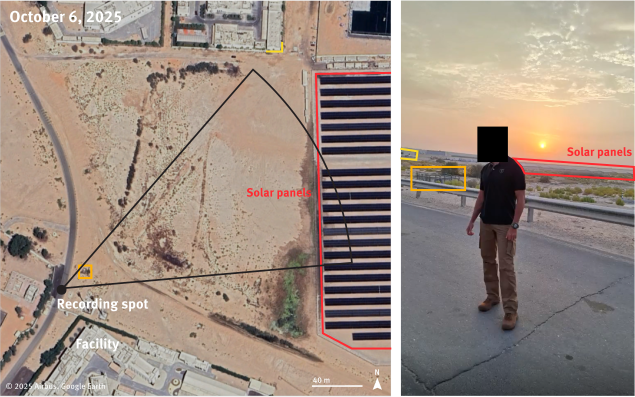
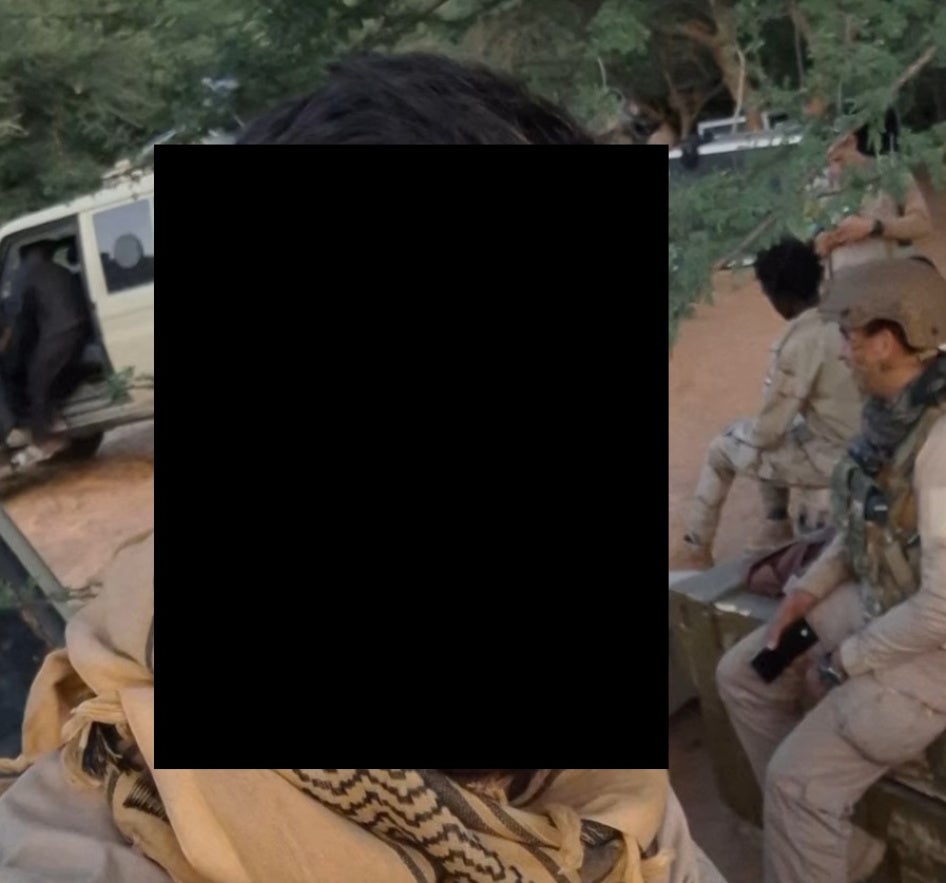
Another Colombian PMC posted on his social media in August 2025 a picture geolocated by Human Rights Watch to the entrance of the same facility. In December 2025 and January 2026, he posted videos from Sudan, metadata reveals. The contractor in December 2024 had posted a photograph of himself alongside a man wearing a sand color uniform consistent with those of RSF fighters. Human Rights Watch could not independently geolocate that image.
The facility in Al Wathba, built between 2020 and 2022, satellite imagery shows, is called “Al Wathba Palace” in the official dataset of buildings from the UAE’s Federal Geographic Information Center and is labelled “Presidential Court Accomodation” [sic] on Google Maps.[82] It contains tall floodlights, a running track marked out by rows of parallel white lines on the ground, as well as a flagpole flying a UAE flag in the courtyard. Satellite imagery analysis by Human Rights Watch shows that these features and the architectural style of the buildings are characteristic of military bases in the UAE.
An obstacle course was built in August 2025 on the western side of the facility, close to a shooting range. The facility is also located less than one kilometer south of an airstrip that was extended from 450 meters in length to one kilometer in December 2024.
Global Security Services Group
Company Agreements with UAE Authorities
Human Rights Watch obtained five licensing documents for GSSG issued by different UAE government agencies.[83] In 2017, the Department of Economic Development in Abu Dhabi issued a commercial license to the company and lists Mohamed Hamdan al-Zaabi as GSSG’s owner. In 2018, the UAE’s General Directorate for Security Support in the Ministry of Interior issued a two-year security license to GSSG, licensing the company for “general security.” Another document from the same entity licenses GSSG for two-years for “armed security guards” in 2019. GSSG’s website claims that the company is the first to have obtained an armed security license in the UAE. Until recently, it also advertised having key Emirati ministries as its clients and claimed to be “the only armed private security services provider for the UAE government.”[84]

One Colombian military contractor who says he traveled to Sudan told Human Rights Watch that “the [Emirati nationals] commanded everything.” In Abu Dhabi, he said, there was a meeting with top officials where the Emiratis were seen in the meeting and were present as hosts.”[85] The contractor was not allowed to attend the meeting himself.[86] In June 2024, GSSG provided training to the Ugandan Peoples’ Defence Forces. When asked about the training operation, a Ugandan army spokesperson told The Wall Street Journal that “the company presented itself as acting on behalf of the Emirati government.”[87] A statement about the training released by the Uganda Peoples’ Defence Forces “praised the strong bilateral relations between Uganda and the United Arab Emirates, expressing gratitude to the GSSG for supporting the Uganda Peoples’ Defence Forces (UPDF).”[88]
Links Between GSSG and the Abu Dhabi Ruling Family
GSSG was first set up in 2016 by Ahmed Mohammed al-Humairi, who was at the time, and remains at the time of publication, the secretary general of the Presidential Court, a ministry providing services to the President of the UAE, according to a November 2025 report based on corporate records by The Sentry, an investigative and policy organization focused on violent conflict, repression, and kleptocracy.[89] The UAE’s Presidential Court is overseen by Sheikh Mansour, who is the brother of UAE President Mohammed bin Zayed and serves as its chairman.[90]
Corporate data from a third-party corporate data provider obtained by The Sentry show that al-Humairi transferred all of his GSSG shares to Mohamed Hamdan al-Zaabi, a longstanding business partner, in July 2017.[91] GSSG’s website and primary documents obtained by Human Rights Watch show that al-Zaabi remains GSSG’s owner, CEO, and authorized signatory.[92]
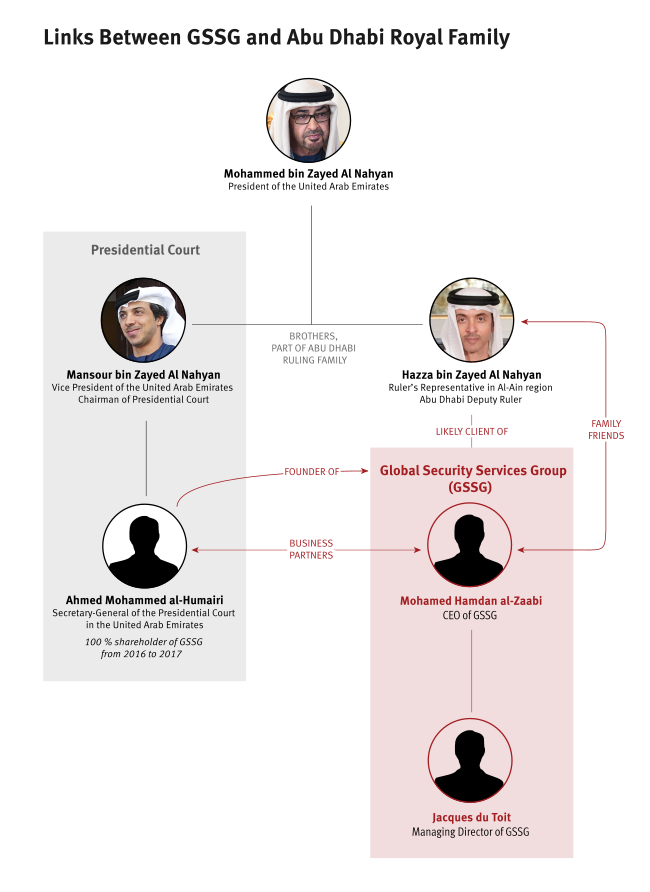
A cache of 24 leaked emails and a leaked security consulting and services agreement, made available via the Organized Crime and Corruption Reporting Project’s (OCCRP) platform Aleph, show that in 2019 the Office of Deputy Ruler of Abu Dhabi Hazza bin Zayed Al Nahyan, who is a younger brother of President Mohamed bin Zayed Al Nahyan, maintained business relationships with GSSG, attesting to the company’s continued relationship with the Emirati leadership, in spite of al-Humairi’s divestment from GSSG.[93] The leak also included forwarded internal GSSG email exchanges with Hazza’s office.[94]
The armed security consulting and services agreement obtained shows that GSSG, upon request from Hazza’s office, offered to provide 12 armed security guards to Hazza’s office. The agreement, which is unsigned and dated March 17, 2019, specifies the guards would be military trained and qualified in the use of weapons.[95] It lists the director of the Office of His Highness Sheikh Hazza bin Zayed Al Nahyan and Mohamed Hamdan al-Zaabi, representing the Global Security Services Group, as the contracting parties.[96]
The cache of 24 leaked emails show correspondence dated between March and May 2019 between Jacques Du Toit, GSSG’s managing director, and Mohamed Hamdan al-Zaabi that had been forwarded to Hazza’s office.[97] The emails contain curricula vitae and the personnel details of candidates for armed services positions and individuals with special forces, ranger, commando, and parachute qualifications.
One former GSSG employee told Human Rights Watch that he worked in maritime protection on a superyacht owned by Suroor bin Mohammed, the maternal uncle of President Mohammed bin Zayed.[98] He said GSSG mainly works with the UAE government and members of the ruling family.[99]
Human Rights Watch makes no claims that these named individuals have specific knowledge of or involvement in the hiring and deployment of Colombian PMCs to support the RSF in Sudan.
Mohamed Hamdan al-Zaabi
The links between Mohamed Hamdan al-Zaabi, the owner and CEO of GSSG, and the political and the military leadership of the UAE extend beyond GSSG and include other business ties as well as close personal and family ties.
Corporate records obtained by The Sentry show that al-Zaabi and al-Humairi, the secretary general of the UAE Presidential Court, have remained business partners even after al-Humairi transferred all of his GSSG shares to al-Zaabi in 2017.[100] Al-Zaabi and al-Humairi together “currently own the majority of shares in one security company, as well as shares in two others,” according to the report.[101] The report also found that the pair “previously owned shares in three other security firms together.”[102]
Deputy ruler of Abu Dhabi Hazza bin Zayed Al Nahyan, who is President Mohamed bin Zayed Al Nahyan’s younger brother and requested GSSG’s services in 2019, attended al-Zaabi’s wedding in 2014.[103]
Al-Zaabi married the daughter of retired Major General Khalifa Mattar al-Mazrouei, who is a veteran founding officer of the UAE armed forces with strong ties with the UAE’s President Mohammed bin Zayed.[104]
Private Military Contractors’ Links with Abuses
Two Colombian private military contractors (PMCs) told Human Rights Watch that they had been deployed alongside the RSF to support operations in Sudan.[105] One said that he directly supported the RSF’s training operations.[106] The Colombian foreign fighters “carry out joint operations with the RSF,” another informed source told Human Rights Watch.[107]
Human Rights Watch research into events in the North Darfur capital of El Fasher, which fell under RSF control in Darfur in late October 2025, found that foreign fighters were deployed alongside RSF fighters in and around El Fasher during its takeover of the city. Human Rights Watch believes those fighters to be Colombian PMCs.
Videos posted online or sent directly to researchers in August and September 2025, prior to the takeover, and geolocated by Human Rights Watch show Spanish-speaking PMCs fighting in El Fasher.
In El Fasher, the RSF carried out systematic abuses, including mass killings and rape during ground attacks while they took control of the city and after their victory.[108] For example, evidence shows that on October 26-27, 2025, while civilians were trying to flee the city, the RSF ambushed them near the trench that they had built around El Fasher to block entry to and exit from the city, and killed and assaulted large numbers.[109]
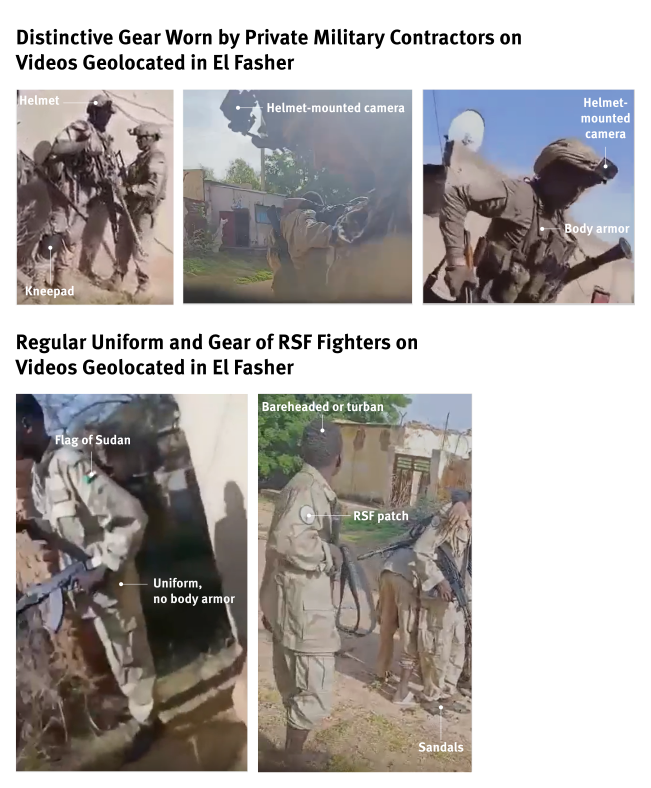
Human Rights Watch spoke with six witnesses from El Fasher who said they saw white fighters fitting the descriptions of Colombian PMCs during the takeover of the city.[110] People said the fighters did not speak Arabic and wore body armor, kneepads, helmets, and helmet-mounted cameras, consistent with the equipment that Colombians can be seen to be wearing in videos shot in and around El Fasher. This is in contrast with RSF fighters, who largely eschew protective equipment. Human Rights Watch also interviewed three sources who spoke about the presence of Colombian contractors during the RSF’s 18-month-long siege of the city.
Private Military Contractors In El Fasher
During the Siege
The mass atrocities in October 2025 marked the climax of an 18-month-long siege by the RSF on the city, which led to starvation among the civilian population, and during which RSF forces carried out continuous artillery and drone attacks, including on populated areas.
Human Rights Watch spoke with two sources from El Fasher who saw Colombians during that period, including one journalist, and a fighter from the Joint Force of Armed Struggle Movements (JFASM or Joint Forces). Human Rights Watch also geolocated 10 videos posted to social media in 2025 or received directly from trusted sources showing Spanish-speaking military contractors in El Fasher and the Zamzam displacement camp south of El Fasher, Darfur’s largest internally displacement camp, often participating directly in frontline fighting alongside RSF fighters.
One fighter from the Joint Forces said Colombians had been present in El Fasher as early as December 2024, when the Joint Forces arrested a group of nine Colombians who had participated in an RSF offensive and had remained behind even as the RSF withdrew from the city at the time.[111]
The siege began in May 2024 and tightened further over time. The RSF prevented food and medication suppliers and humanitarian aid groups from accessing the city, contributing along with its attacks on the city to starvation among civilians.[112]
In mid-April 2025, the RSF carried out a large-scale attack on the Zamzam displacement camp which hosted prior to this attack an estimated 400,000 people. During the attack, the RSF killed civilians, both targeted and indiscriminate, including healthcare workers, burned civilian buildings, detained civilians, and carried out widespread pillage, forcing hundreds of thousands of civilians to flee. In July, Médecins Sans Frontières (Doctors without Borders or MSF) reported that civilians in El Fasher and in Zamzam had faced “systematic patterns of violence that includes looting, mass killings, sexual violence, abductions, starvation and attacks against markets, health facilities, and other civilian infrastructure” since April 2024.[113]
A journalist who was based in El Fasher said he saw “three or four” foreigners who had been detained in a vehicle of SAF-aligned forces, in July 2025. The foreigners, he said, were clean shaven and “their features were similar to Latin Americans ... They were not Sudanese and didn't speak Arabic, and the other hostages who were with them, the Sudanese ones, confirmed that those are Colombians.” The forces who detained the Colombians, the journalist said, alleged that the Colombians had been operating drones and artillery.[114]
Videos geolocated by Human Rights Watch show PMCs in combat operations in the El Fasher area, including one which was likely recorded in January 2025, showing a contractor operating a mortar. Researchers collected and received these videos in August and September 2025 but were unable to determine the date of recording in all circumstances.
Human Rights Watch interviewed over 65 survivors from the siege of El Fasher and everyone said that the use of explosive weapons by the RSF side was extremely intense and killed many civilians.[115] The use of artillery and drones in particular grew in frequency and density in the weeks preceding the takeover of El Fasher by the RSF, culminating in what several witnesses described as “continuous” bombing during the daytime in the last days of the siege.[116]
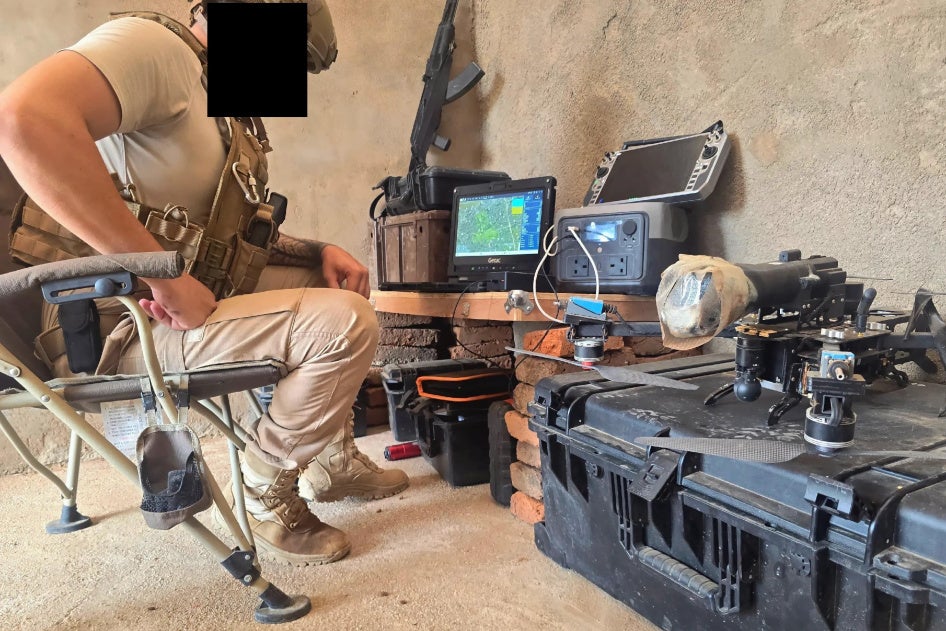
Evidence of Drone Use by Sudan-linked Colombian Private Military Contractors Job postings by A4SI, interviews gathered by Colombian news outlet Semana, and the social media posts of a Colombian contractor who deployed to Sudan all indicate that Colombians with drone expertise were recruited to be deployed in Sudan.[117] RSF commander Mohamed Hamdan Dagalo, commonly known as “Hemedti,” even appeared to admit, in a February 2026 speech, that Colombian drone technicians had supported the RSF. In December 2025, the US Department of the Treasury’s Office of Foreign Assets Control (OFAC) imposed sanctions on individuals and entities for their involvement in a transnational network sending Colombian military personnel to Sudan to fight alongside the RSF. OFAC found that the “Colombians provide the RSF with tactical and technical expertise, serving as infantry and artillerymen, drone pilots, vehicle operators, and instructors.” A photograph posted in June 2025 on the social media account of the Colombian PMC also seen jogging inside the facility in Al Wathba, UAE and filming in Nyala airport, Sudan, shows the contractor sitting in a room in front of a quadcopter drone and a monitor. Human Rights Watch could not confirm when or where the photograph was captured. Semana reported that retired Colombian corporal Diego Edison Hernandez died in October 2024 in an attack in Sudan.[118] The family member told Semana that Hernandez was “recruited by a company that presents itself as a ‘private transnational employment management and placement agency.’” “He said he was going [to work] as a drone operator, that he had arrived in Dubai, and then he told me he was in Sudan,” the relative told Semana.[119] |
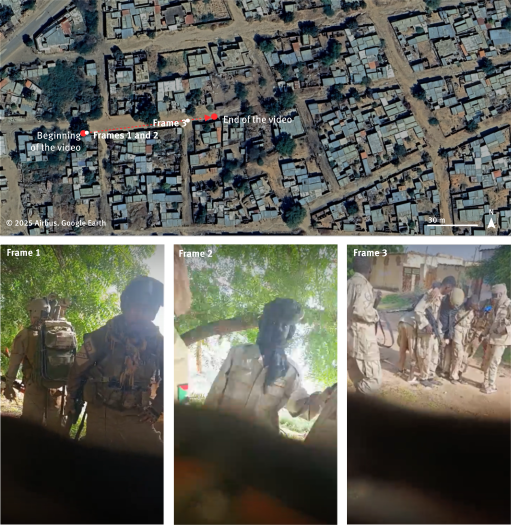
A series of videos geolocated to around 500 meters north of the Old Mosque in a residential neighborhood of El Fasher shows a group of a dozen military contractors and RSF fighters. Gunfire can be heard as they retreat from the frontline carrying a wounded contractor into a courtyard while orders are yelled in Spanish. In another video recorded just a few dozen meters east, a group of contractors and RSF fighters can be seen resting in a residential street.
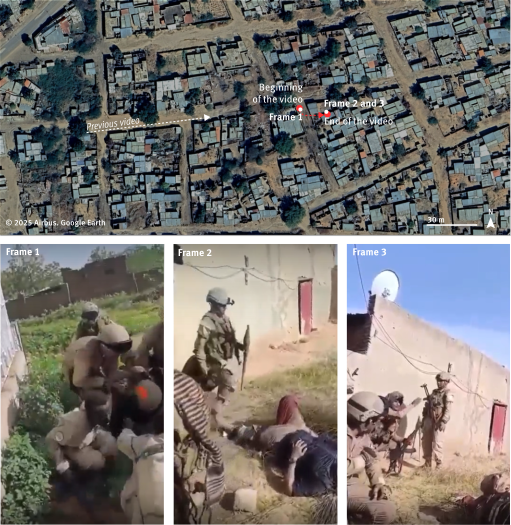
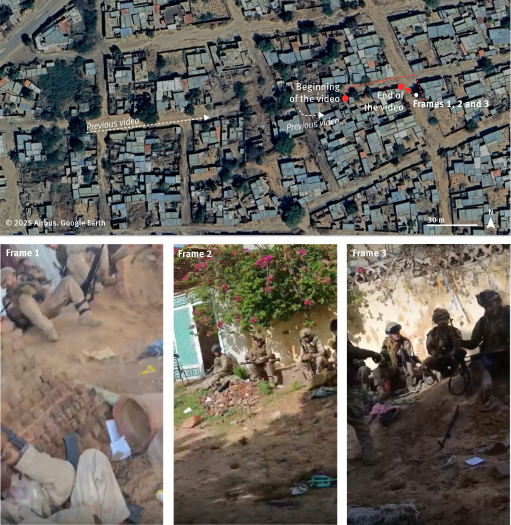
Another geolocated video captures military contractors fighting by the Old Mosque in central El Fasher, while a separate clip shows a contractor firing a mortar westward from a neighborhood in the city’s eastern part. A watermark on that clip indicates the coordinates of the location and the date in Spanish when it was recorded: January 11, 2025.
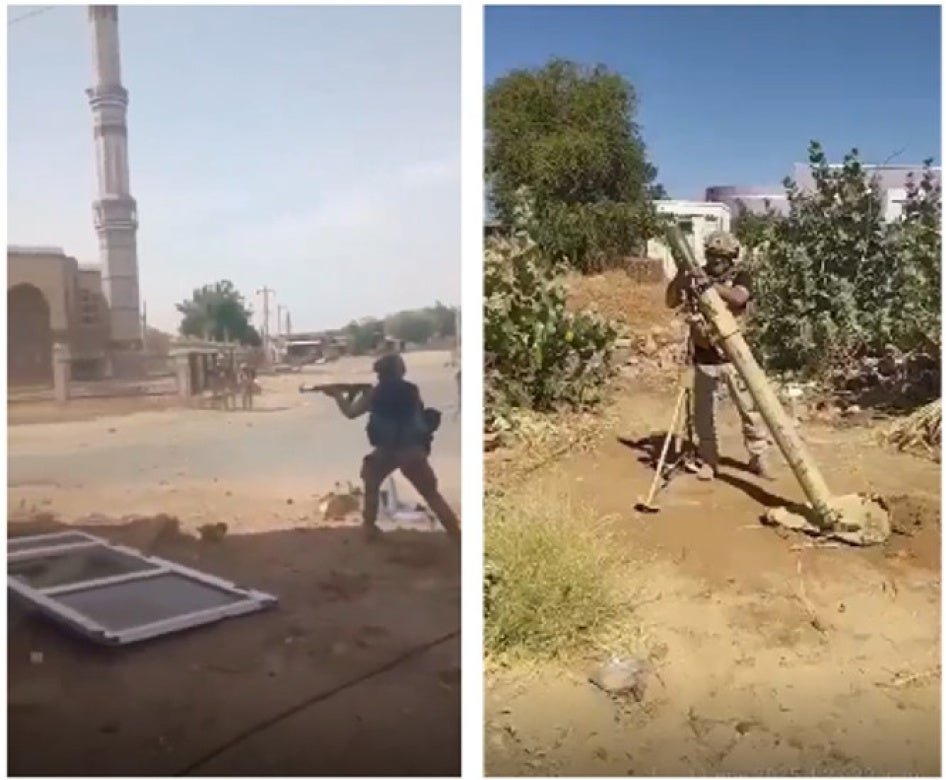
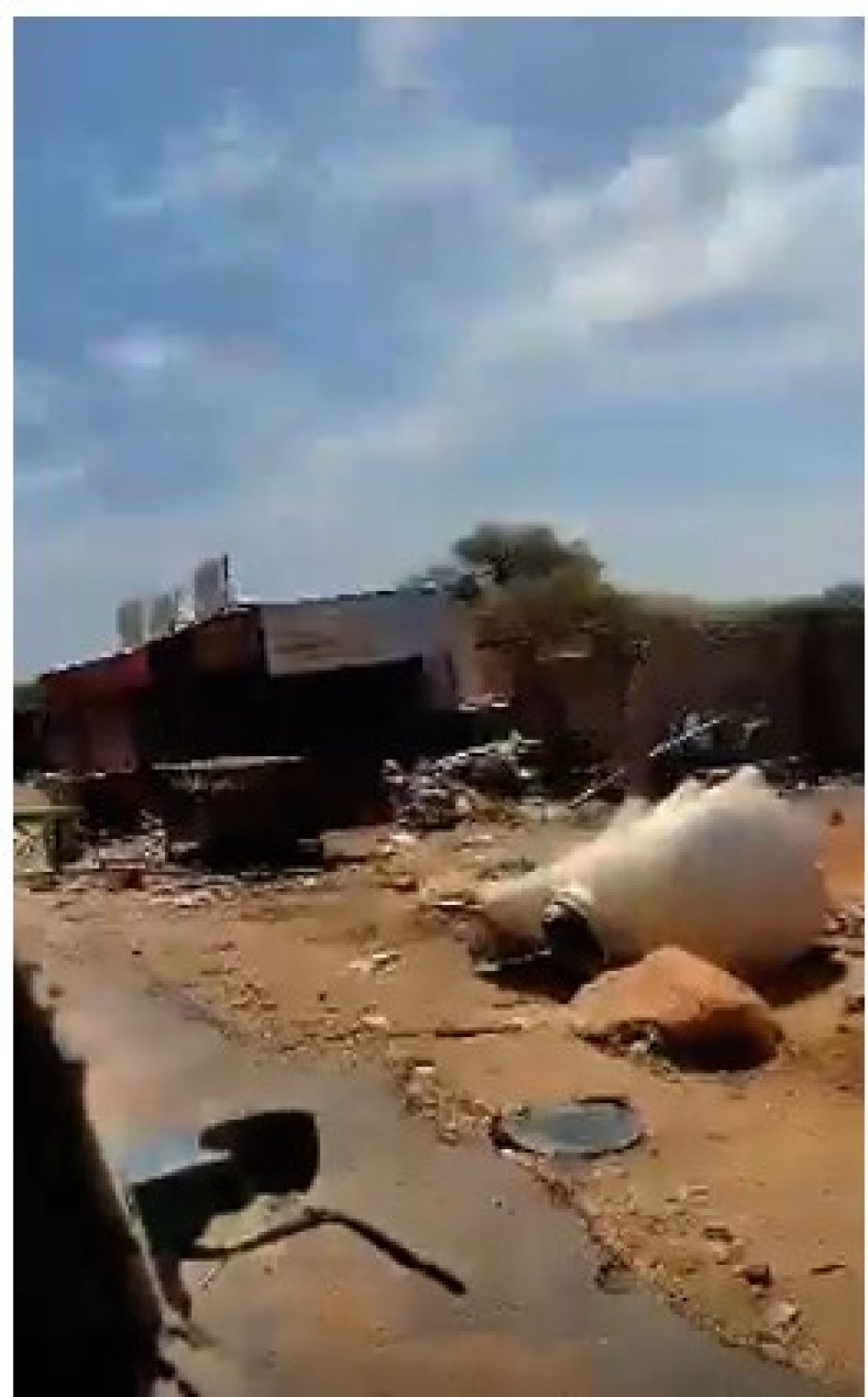
Finally, a video received on August 3, 2025, shows a contractor inside a car driving across the devasted Zamzam displacement camp, 10 kilometers south of El Fasher, that the RSF had previously attacked in April 2025. The same car is then seen driving in a residential neighborhood in the southeast part of El Fasher in two other videos.
Evidence Indicating Colombian Presence at the Fall of El Fasher
El Fasher fell to the RSF on October 26, 2025, ushering a wave of mass killings of civilians in and around the city, as well as other abuses including widespread rape of women and girls and abductions for ransom of men and adolescent boys.[120] Six witnesses described white fighters wearing protective equipment whom Human Rights Watch believes were Colombians. Witnesses identified them as present on October 26 and 27 just outside of El Fasher, including near a trench–three meters deep, abutted by a berm two meters high–that the RSF had built around El Fasher to block entry to, and exit from the city, and where many of these abuses took place.
By the Trench
A 42-year-old survivor said different groups of RSF and allied militias were positioned near the trench and opened fire at fleeing civilians on sight.[121] He and the people he was traveling with were stopped a total of nine times along the roughly 16 kilometer walk that separated El Fasher from the village of Garni, 14 kilometers to the northwest. During each encounter, he said, fighters beat and killed members of the group, and looted and used ethnic slurs against them.
In one such encounter, he said foreigners whom he believed to be Colombian were present. Four RSF vehicles stopped his group of unarmed people fleeing:
They put us on the floor and started searching us, they took our phones and then started to ask us whether we are soldiers or not. They would just put the gun to your head and threaten you and keep telling you that you are soldier.
In the group of around 40 fighters who stopped them he said there were 11 people he believed were Colombians–“I counted them twice to make sure.” He said the men appeared to be neither African nor Arab, had a different complexion, wore different insignia than the RSF, and, unlike the RSF, wore helmets. “They were somehow trained, not like a militia,” he said. And they didn’t speak. During the encounter, he said, the RSF executed a man:
There were three people who put the weapon to my head and kept saying "You are a soldier!” I told them I'm not a soldier but a teacher ... And they killed one of us. While they were searching in our pockets for whatever they could get, they put their hands inside the pockets of one of us and found a ... communication device which belongs to soldiers. They didn't speak much with him. They just pointed the gun to his head and killed him ... immediately.
The foreigners, the survivor said, “were just standing away looking ... not doing anything. They had their hands on their weapons ready.”
Amal, a 29-year-old woman, said she saw foreign fighters wearing helmets near the trench when RSF fighters killed men and women, including people with disabilities, and raped women.[122] The abuses took place as crowds of civilians and fighters tried to cross the trench and the parapet while fleeing El Fasher:
In our group, as we were going, we met a group of RSF and they stopped us. We had … families with people with special needs, like deaf, and then children [with Down syndrome] … You find someone who is over 20, 25 years old but he looks like a baby, he is very small, so the families carried them on their backs, there were three of them like that. One RSF called the other and said: “Come and see this mad [person]!” and finally they killed them … And after killing, they arrested some of the women ... And they said: “Kill the ambayat [slaves].”
The RSF, Amal said, killed a woman and her daughter who couldn’t walk, a man with Down syndrome, and a blind teenage boy. She said that those doing the killing were “Arab Sudanese,” but that the perpetrators were “mixed”: there were foreigners who were white and shorter than Sudanese people and who wore fatigues and helmets. “They had sniper guns, …small weapons with silencers …They were wearing something around their chest, short sleeves, and insignia.” She also saw the RSF rape five women there and kidnap girls.
An 18-year-old man described mass killings and rape by the RSF near the trench, in the presence of people he believed were Colombians on October 27:
They divided us into groups. They put the youth [young men] in one group and girls … between 15 and 21 [years old] … in another group and also the elderly people, including elderly men, in one group … [RSF] youth under the age of 14, 15, 16 were ordered to lash elderly people with whips …
I heard [the RSF] say that for the girls, they will sell them. And for the youth, they said: “These youth we don’t want here. They should be killed! You are zurga [racial slur]! We don’t want to see you!” and someone ordered: “Kill them!” and then they opened fire on us.[123]
An unknown number of young men were killed. The witness survived by hiding under a pile of bodies. RSF fighters, he said, raped two of the young women, around 17 to 20 years old, behind a car. They also shot dead a mother who protested at her daughter being taken away and then drove away with a group of girls and young women they had detained.
All along, there were foreigners alongside the Sudanese RSF fighters, he said: South Sudanese, whom he recognized by their language and features, and “white people” whom he thought were Colombians. “There were more than 50 to 60 armed vehicles. 15 or 16 of these were Colombians’ [vehicles]” he said.
On the Way to Garni village and Jebel Wana Mountain
The foreign fighters were also deployed alongside the RSF in the open area stretching from the outer side of the trench to Garni, attacking and detaining civilians who tried to pass Garni village on their way towards Jebel Wana Mountain further to the north.
A 36-year-old man said that he saw foreign fighters wearing helmets while the RSF detained him between the trench and Garni on October 26.[124] He said the RSF separated the men from women and children and then interrogated the men all night. During that time, RSF vehicles passing by would open fire on the crowd, killing many of the detainees–he estimated between 80 and 90. The foreigners, he said, just looked on and remained silent.
Another civilian, a 26-year-old man, who survived mass killings at the trench by hiding in a pile of bodies in the morning of October 27, said he was detained by the RSF and that he saw white fighters at a RSF checkpoint near Garni.[125] He said the fighters were stocky and carried backpacks.
A 26-year-old fighter from the Joint Forces who spoke to Human Rights Watch mentioned “white” fighters alongside the RSF who detained a group of 19 (and killed three of them–two fighters, one civilian) near Jebel Wana.[126] The white fighters did not speak Arabic and wore a “different uniform and headwear,” including cameras on their helmets. “They had cameras and laptops with them.” “They were there when the executions happened, but they didn’t execute.”
Training of Child Soldiers
Colombian PMCs deployed to Sudan to support the RSF may have been involved in the RSF’s training of child soldiers. One Colombian PMC described providing training to RSF recruits, at RSF training camps in areas around Nyala.[127] On December 9, 2025, the US Department of the Treasury’s Office of Foreign Assets Control (OFAC) imposed sanctions on individuals and entities for their involvement in a transnational network that “recruits former Colombian military personnel and trains soldiers, including children” to fight for the RSF.[128]
The Colombians taught the recruits “how to be in combat, how to take cover, how to take protection to avoid dying,” the contractor said.[129] They also “taught them how to build and unbuild weapons, and take different types of weapons apart.”[130] While some of these recruits, including those who the contractor described as children, “were sent to peaceful areas just to provide security, there were others who were sent to the front lines, to El Fasher to fight, to be in combat,” he said.[131]
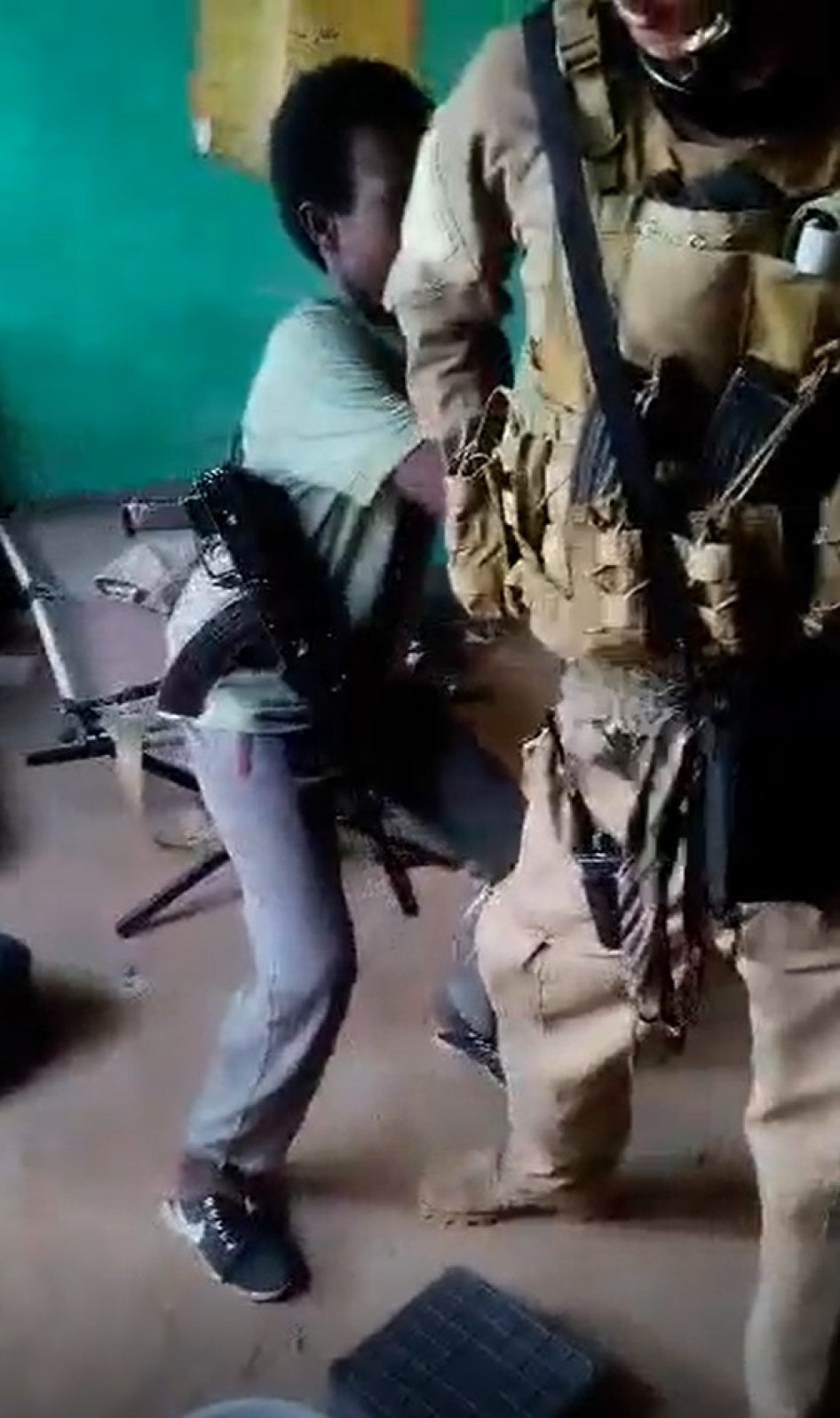
On August 3, 2025, Human Rights Watch received a video recorded inside a house, allegedly in El Fasher, from an informed source connected with Colombian contractors who were previously in Sudan. Human Rights Watch could not independently confirm the location. The man filming the video, speaking in Spanish with a Colombian accent, points towards another PMC and asks a boy carrying an automatic rifle to “help him.” The child walks towards the second man and proceeds to help him tighten some gear on his back while the man says in Spanish, “Tighter? Is it straight there?”
A photograph shared widely online in August 2025 shows a PMC together with a group of armed men, and an apparent child in military camouflage. Researchers were unable to determine the location or date of the image, but Human Rights Watch confirmed the PMC was in El Fasher sometime between April and August 2025 based on the verification of other videos posted to social media around the same period.
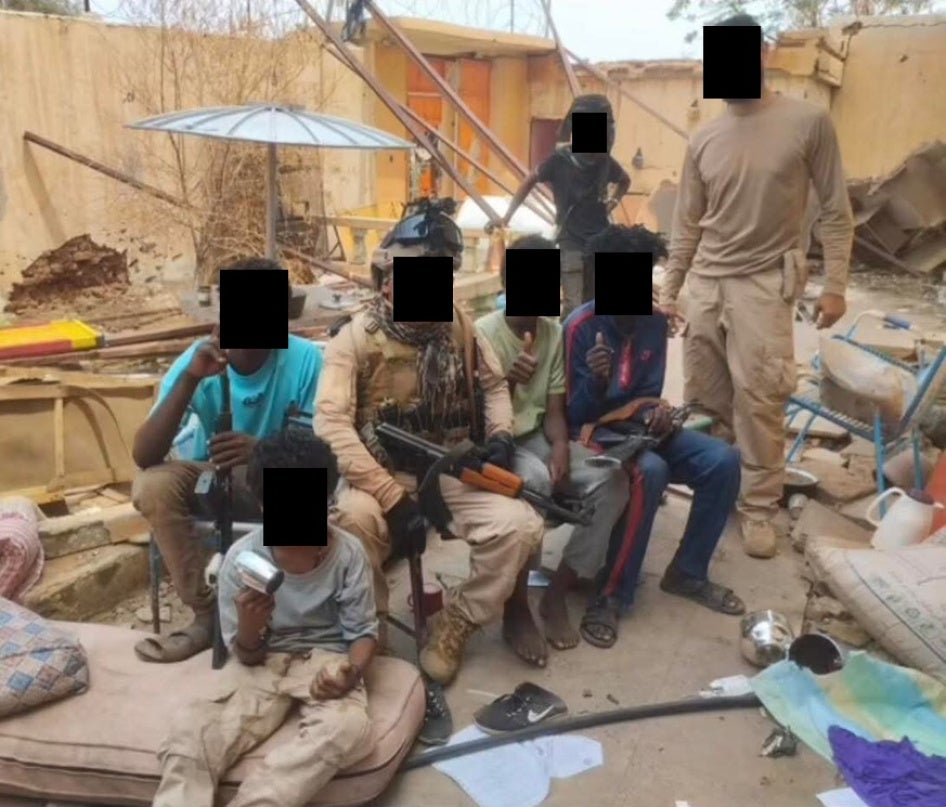
In another video uploaded to a pro-RSF social media account and geolocated by Human Rights Watch to the University of Nyala, two apparent children are in a ring practicing a fighting technique. Men stand around them watching. The video is captioned: “The Cobra Cubs of Readiness,” a slogan used on other pro-RSF videos showing apparent children. Satellite imagery analysis shows that the ring was built in late June 2025.
RSF Recruitment of Child Soldiers The UN recorded an increase in reported child recruitment in Sudan, particularly by the RSF and one of its allied armed groups in West Darfur, Third Front-Tamazuj, at the beginning of the conflict.[132] The large majority of this recruitment, according to the UN, has been in Darfur.[133] In June 2024, the UN secretary-general formally added the RSF to his annual list of perpetrators of grave violations against children for recruiting and using children.[134] The RSF have used children in different capacities. Human Rights Watch received several accounts of children on both sides associated with fighting forces during the RSF and allied militias’ ethnic cleansing campaign in West Darfur’s capital, El Geneina, in 2023. A lawyer, for example, saw armed Arab boys linked to the RSF, some as young as 11, manning checkpoints in the city.[135] In an April 2025 report, the UN Office for the High Commissioner for Human Rights (OHCHR) found that the RSF had been using children as young as 14 as armed guards in detention facilities in Khartoum between April 2023 through June 2024.[136] In the first half of 2025, OHCHR reported on large recruitment drives throughout Darfur, especially notable in West Darfur state, where the RSF exerted extreme pressure on communities to hand over men and boys.[137] OHCHR found that in May 2025 alone, “credible sources from El Geneina [capital of West Darfur] reiterated concerns about the ongoing recruitment of children, and alleged that more than 300—most of them below the age of 16—had been undergoing military training at a recently established RSF camp near El Geneina airport.”[138] Following the fall of El Fasher, Human Rights Watch reviewed one video showing a person holding a camera asking young RSF fighters who are sitting on the ground how many people they have killed. The fighters brag about the number of people they have killed in various locations in Sudan, including during the takeover of El Fasher. All talk about having killed dozens. “I killed around 70, including the ones who ran,” says one of them. Another says he killed 214. A third says he killed 74 after the fall of El Fasher. The camera regularly zooms onto the face of one fighter who appears under the age of 18. Human Rights Watch was unable to determine when or where the video was filmed. A survivor from El Fasher who said his group was stopped and abused nine times while fleeing between El Fasher and Garni, said that on one occasion an RSF fighter he believed was 11 or 12 years old and wearing a whip and an AK-style rifle searched the pockets of civilians, looking for money to loot.[139] |
Evidence of the RSF's Use of Equipment Diverted from the UAE Military
Research from Human Rights Watch, Amnesty International, and France 24 shows that at least three different types of military equipment that had been sold by manufacturers to the UAE military ended up in the hands of the RSF in violation of end-user agreements.[140]
In a September 2024 report, Human Rights Watch found that the RSF used 120mm thermobaric munitions made by Serbian state-owned arms manufacturer Yugoimport.[141] A shipping crate of two of these munitions bore markings indicating they were manufactured in 2020 and sent from Belgrade by Yugoimport to the UAE Armed Forces Joint Logistic Command in Abu Dhabi. The contract number visible on one crate indicated that the delivery to the UAE took place as part of a purchase order for a contract involving Adasi, a subsidiary of state-owned Emirati weapons manufacturer Edge Group.[142] A source who has access to the contract and asked to remain anonymous because of the sensitivity of the issue told Human Rights Watch that the munitions were shipped to the UAE before the outbreak of the conflict in Sudan as part of a consignment whose end-user certificate prohibited re-exports.[143]
France 24 found that 81mm munitions made by Dunarit, a Bulgarian manufacturer, and captured by the Darfuri Joint Forces following clashes with a convoy of Colombians in Darfur in November 2024, had first been purchased in a deal where the end user was the UAE armed forces.[144] Statements from the Bulgarian Interministerial Commission on Export Control and the CEO of Dunarit confirmed that the terms of the purchase did not allow for re-exports.[145] The deal involved the International Golden Group, a UAE-based private company mentioned in a 2013 UN Security Council’s Panel of Experts report on Libya as acting as a representative of the UAE armed forces in a deal that led to the delivery of munitions to Benghazi, under the control of the Libyan Arab Armed Forces (LAAF).[146]
In November 2024, Amnesty International found that the RSF was using the Nimr Ajban, an armored personnel carrier manufactured by Edge Group, equipped with Galix, a passive countermeasure system made by French company Lacroix Defense and designed jointly with Nexter (now KNDS).[147] Lacroix Defense confirmed to Politico in November 2025 that it had sold Galix to the UAE armed forces and said that it had acted “in strict compliance with the export licenses granted to Lacroix and the associated non-re-export certificates.”[148]
In all three cases, the exact chain of custody of the equipment is unknown. The 81mm munitions, intercepted in Darfur in the convoy entering from Libya in November 2024, appeared to have been transferred after the conflict started. But the timing of the transfers to the RSF of the Serbian-made munitions and of the Nimr Ajban and associated Galix systems is unknown, and it cannot be ruled out that some of this equipment may have been transferred to the RSF prior to the outbreak of the conflict that began in April 2023, at a time when the RSF was part of the Sudanese government, and already benefited from UAE support, including the provision of vehicles.[149] In June 2024, the UAE argued as such in a statement to the UN, stating that “military cooperation and assistance from the UAE Government to Sudan prior to the outbreak of the conflict was provided at the request of the Government of Sudan” and that “the Sudanese Government received 30 unarmed armoured vehicles from the UAE, which were delivered to Sudan two months before the start of the conflict.”[150]
But all three cases show concrete evidence that military equipment destined to the UAE armed forces was diverted in violation of end-user agreements which led to the supply of that equipment to the RSF, despite RSF responsibility for war crimes and other atrocities.
Legal Liability for Assisting the RSF
GSSG Liability for Apparent Hiring of Contractors for the RSF
A company that knowingly assists a party to a conflict in the commission of serious laws-of-war violations can and should be held legally complicit for aiding and abetting those violations.[151] Liability for aiding and abetting requires the provision of assistance, encouragement, or means which has a “substantial effect” on the commission of a crime; and knowledge that the conduct would assist the commission of that crime.[152]
The Statue of the International Criminal Court provides that criminal responsibility arises not only for aiding and abetting, but also when there is an intentional contribution to the commission of a crime by a group of persons acting with a common purpose. The contribution should be made either with the aim of furthering the criminal activity of the group or in the knowledge of the intention of the group to commit the crime.[153] The contribution needs to have been “significant”; and the contributor should know or has reason to know that the contribution has a “substantial likelihood” of facilitating the commission of crimes.[154]
The RSF’s systematic commission of war crimes and crimes against humanity in Darfur has been widely documented by many, from the UN to NGOs. The Independent International Fact-Finding Mission for Sudan (FFM) publicly concluded that the RSF is committing atrocities including war crimes on a large scale, that some acts may also amount to crimes against humanity, including persecution and extermination, and that RSF violence in El Fasher bore “the hallmarks of genocide.”[155] The prosecutor of the International Criminal Court has also publicly concluded that there are “reasonable grounds to believe” that the RSF is committing war crimes and crimes against humanity in Darfur.[156]
The evidence set out in this report indicates that the GSSG appears to have provided private military contractors (PMCs) to the RSF in significant numbers, and those contractors contribute skill sets that enhance the capacity of the RSF to persist with their abusive conduct of hostilities. Colombian PMCs have been identified on the ground in Darfur including as part of the RSF operation in and around El Fasher. Such assistance is substantial and was apparently provided by GSSG notwithstanding that they knew or should have known about the RSF’s systematic commission of war crimes and crimes against humanity.
The GSSG should be investigated to determine if they are responsible for aiding and abetting, or otherwise contributing to, war crimes and other serious violations by providing assistance to the RSF, while aware of the substantial likelihood that it would be used to assist the RSF in committing unlawful attacks.
UAE State Responsibility for Provision of Assistance to the RSF
Attribution of Wrongful Acts by the GSSG to the UAE
The responsibility of a state for the unlawful acts of a non-state actor, whether a private entity such as a security company or a paramilitary group such as the RSF, may be established on a number of grounds in international law.
The unlawful acts of a non-state actor may be attributed to a state if it is carrying out the conduct on the instructions, under the direction, or under the control of the state.[157] To the extent that the GSSG is acting on the instructions, direction, or control of the UAE authorities in providing the RSF with Colombian or other PMCs, the wrongful acts of the GSSG can be attributed to the UAE.
International jurisprudence sets out two tests for “control”–effective control and overall control–to determine if a person’s or group’s actions can be attributed to a state. The International Court of Justice (ICJ), in assessing whether a group’s wrongful conduct can be attributed to a state, requires the state to exercise “effective” control over the particular conduct that violated international law.[158] By contrast international criminal tribunals, such as the International Criminal Tribunal for the former Yugoslavia and the International Criminal Court, when assessing attribution for the purposes of applying international humanitarian and criminal law, have articulated a test of “overall control,” under which it is sufficient for a state to exercise overall control over a group, rather than particular operations, in order for the conduct of that group, or unit, to be legally attributed to the state.
Given the multiple links between the GSSG and the UAE state–including that the GSSG holds a rare armed security license granted by the government, identifies as “the only armed private security services provider for the UAE government,” has multiple contracts with the authorities, and has close ties to senior Emirati leaders–there appears to be a level of integration of the GSSG into the government system that could plausibly mean the company is under the overall control of the UAE authorities.[159]
While lack of transparency makes it difficult to conclude the extent to which the UAE may exercise effective control over particular GSSG operations, factors such as apparent use of UAE military infrastructure to facilitate the training, transport, and deployment of the PMCs, suggest that the UAE authorities could be directly involved in the planning and direction of any operation to provide contractors to the RSF. If further evidence were to establish such direct involvement by UAE authorities, then acts of the GSSG in aiding and abetting the RSF, or otherwise making a contribution to the commission of crimes, could be attributed to the UAE.
State Responsibility for Providing Assistance to the RSF
While the evidence does not suggest that the UAE exercises control over the RSF, drawing on article 16 of the International Law Commission’s Articles of Responsibility of States for Internationally Wrongful Acts, if a state knowingly aids or assists an armed group in the commission of wrongful acts, it can be accountable for them. Assistance can trigger state responsibility if it contributes “significantly” to the commission of a wrongful act, and the state provides material assistance that is subsequently used to commit violations.
The evidence, albeit staunchly disputed by the UAE, indicates that the UAE provides the RSF with substantial assistance through the supply of weapons and material military logistical and related support. The UAE knows or should know that such support would be used as a significant contribution by the RSF to commit wrongful acts.[160] While the criminal conduct of the RSF may not be attributed to the UAE, the UAE bears responsibility for its own wrongful actions in assisting an armed group that is committing systematic violations.
Acknowledgments
This report was researched and written by Joey Shea, senior researcher on Saudi Arabia and the UAE in the Middle East and North Africa division, and Jean-Baptiste Gallopin, senior advisor in the Crisis, Conflict and Arms division. Open-source research and geospatial analysis were carried out by Léo Martine, senior geospatial analyst in the Technology, Rights and Investigations division. Leila Saad, senior research assistant in the Middle East and North Africa division, Robin Taylor, senior research assistant in the Crisis, Conflict and Arms division, Juan Pappier, Americas deputy director, and Nelson Gonzalez Sanchez, research assistant in the Americas division, contributed research support.
Laetitia Bader, deputy director in the Africa division, Ida Sawyer, director of the Crisis, Conflict and Arms division, and Michael Page, deputy director in the Middle East and North Africa division, edited the report. Aisling Reidy, senior legal advisor, provided legal review, and Sarah Jackson, deputy program director, provided programmatic review.
Specialist reviews were provided by Sam Dubberley, director of the Technology, Rights and Investigations division; Mohamed Osman, Sudan researcher; Juan Pappier, Americas deputy director; Nelson Gonzalez Sanchez, research assistant in the Americas division; Jim Wormington, associate director in the Economic Justice and Rights Division; Tamara Aburamadan, counsel in the International Justice program; Lewis Mudge, associate director in the Africa division; Hanan Salah, associate Middle East and North Africa director; Niku Jafarnia, researcher in the Middle East and North Africa division; Jo Becker, children’s rights advocacy director; Yasmine Ahmed, United Kingdom director; Louis Charbonneau, United Nations advocacy director; Philippe Dam, European Union advocacy director; Claudio Francavilla, European Union associate advocacy director; Akshaya Kumar, director of crisis advocacy; Allan Ngari, Africa advocacy director; and Nicole Widdersheim, deputy Washington director.
Allison Deger, associate director for communications, and Ahmed Benchemsi, advocacy and communications director in the Middle East and North Africa division, advised on media strategy. The arms associate assisted with proofreading and formatting. Amu Mnisi, senior associate in the Africa division, supported on report production. Travis Carr, publications manager, prepared the report for publication. Delphine Starr and Valentina Gomez coordinated the translation of the report into Spanish and vetted the translation. Katherine La Puente, senior children’s rights coordinator, provided Spanish interpretation for some interviews in the report.
Sarah Giles, senior producer, and Ifé Fatunase, creative multimedia director, directed and produced the video for the report. Win Edson, senior motion graphic designer, produced the motion graphics.
We are grateful to the journalist at the Colombia-based news outlet La Silla Vacía who facilitated key interviews. Human Rights Watch would also like to thank those who, for security reasons, cannot be mentioned by name.
And the survivors from El Fasher, who saw their lives upended and face dire conditions in Sudan and Chad, and yet took the time to sit with researchers and tell their stories. To them—thank you.
Annex I: UAE Support for Abusive Armed Groups in Libya and Yemen
The findings of this report, linking the provision of private military contractors and other assistance to the RSF through a complex operation involving ostensibly private companies, several transit points and military bases across multiple countries, mirror UAE practices in neighboring conflicts.
For a decade and a half, Human Rights Watch has documented the UAE’s interventions in Yemen and Libya to support abusive local armed forces. In addition to funneling vast amounts of money, military equipment, and weapons to these abusive groups, the UAE has hired foreign fighters to help wage proxy wars in the region. Human Rights Watch has documented the UAE conducting scores of unlawful attacks in both countries. UAE-based private companies have reportedly been involved in the shipment of supplies and personnel to support abusive local forces.
Given Human Rights Watch’s extensive documentation of the UAE’s repeated unlawful attacks in Yemen and Libya and its direct support for abusive local forces in both countries, Human Rights Watch has called on the United States and other countries to halt weapons sales to the UAE. Human Rights Watch called on weapons sales to be halted until the UAE curtails unlawful airstrikes in Yemen and Libya that resulted in civilian casualties and destruction of civilian properties, halts support and weapons transfers to abusive local forces, and credibly investigates previous alleged violations in both countries.[161]
UAE Recruitment of Colombian Military Contractors since 2011
UAE authorities have reportedly recruited retired Colombian security and military personnel as far back as 2011. That year, The New York Times reported that then Crown Prince Mohammed bin Zayed was forming an 800-member battalion of foreign troops, largely comprised of retired Colombian military personnel, intended to conduct special operations inside and outside the UAE.[162]
The Colombian troops recruited at that time were part of an official recruitment drive by the Emirati government to form a foreign battalion within the UAE armed forces. “We were not part of a clandestine force; we were part of the UAE army. We arrived to Dubai with a two-year work visa and had a residency permit,” one retired Colombian military officer who was recruited as part of this scheme told Human Rights Watch. He said that he worked in the UAE from 2014 to 2015, and then again in 2018.
In 2015, the UAE deployed hundreds of these Colombians to fight in Yemen, according to The New York Times.[163] The New York Times reported that Colombian troops were preferred given their decades of experience battling the Revolutionary Armed Forces of Colombia (FARC) guerrillas in Colombia. The retired officer who spoke to Human Rights Watch said that he was deployed by the UAE to Yemen from 2013 to 2014 as part of this operation.
Yemen
Beginning in March 2015, the UAE played a prominent role in a coalition of countries that conducted military operations in Yemen, including by committing over 30 fighter jets to carry out airstrikes, providing naval ships to enforce the coalition’s maritime blockade, and supporting abusive local forces. Human Rights Watch documented how the UAE financed, armed, and trained abusive Yemeni security forces that arbitrarily detained, forcibly disappeared, tortured, and abused dozens of people during security operations.[164]
At this time, the UAE pumped billions of dollars into Sudan in exchange for the struggling country’s participation in the UAE and Saudi-led coalition fighting in Yemen. Since 2015, Sudan has also sent troops to Yemen, including members of the RSF.[165]
In 2018, BuzzFeed News reported that the UAE had hired American ex-soldiers to kill prominent clerics and Islamist political figures in Yemen.[166] In 2024, the BBC also reported that the UAE had funded American mercenaries to carry out politically motivated assassinations in Yemen.[167]
In a September 2020 report on the human rights situation in Yemen, the UN Group of Eminent International and Regional Experts on Yemen identified senior UAE military officials, as well as armed groups in the South and along the western coast that are directly supported by the UAE, in its “mapping of main actors” in the conflict, alongside military officials from Saudi Arabia, the Yemeni Government, and the Houthis.[168]
Despite removing UAE ground forces from southern Yemen in late 2019, the UAE continued to support abusive local forces that have arbitrarily detained, forcibly disappeared, tortured, and abused dozens of people during security operations, including by transferring weapons to these forces. According to the Group of Experts, despite the withdrawal of ground forces, the UAE “continued its air operations, and some 90,000 United Arab Emirates-backed Yemeni fighters remain on the ground in Yemen.”[169]
In 2019, CNN reported that US-made weapons sold to the UAE were later transferred to abusive local forces in Yemen, including a half dozen Mine-Resistant Ambush Protected (MRAP) all-terrain vehicles manufactured in Texas that were transferred to the “Giants Brigade,” an abusive local militia allied with UAE-backed forces fighting on the west coast of Yemen.[170]
Libya
The UAE was a party to the conflict in Libya between 2019-2020, providing military and political support to abusive local forces in eastern Libya, and was one of three countries that routinely and systematically violated a 2011 UN arms embargo during that conflict, according to UN experts’ reports.[171]
UAE authorities conducted airstrikes and drone strikes, established a forward operating base in Libya, and provided direct support to the Libyan Arab Armed Forces (LAAF), an armed group and family military enterprise led by Khalifa Hiftar, through transfers of weapons, ammunition, armored vehicles, and other military equipment. The UAE intervened in Libya as early as the 2011 revolution and started to support Hiftar and his LAAF militarily and financially in 2014.[172]
The Benghazi-based LAAF is one of two entities vying for control over resources, territory, and legitimacy in Libya. It controls the east and south of the country–the vast majority of territory–with an affiliated civilian administration known as the “Libyan Government.” Its rival, the Tripoli-based Government of National Unity, appointed as an interim authority in 2021 through a UN-led process, controls parts of western Libya with the support of militias and armed groups.
In 2020, Human Rights Watch found that more than 200 Sudanese men were recruited by the Emirati security services company Black Shield Security Services for what they believed were security guard positions in the UAE.[173] The men were ultimately deceived by the company and were taken to work in conflict-ridden Libya instead.[174] The Sudanese men were taken by Black Shield to a compound in Ghiyathi, where they were subjected to a months-long military training. The compound in Ghiyathi is the same base where one of the Colombian PMCs interviewed by Human Rights Watch for this report was taken for military training in April 2025. The Sudanese men were then unwittingly transferred to guard oil facilities controlled by the LAAF, during ongoing armed hostilities, they said. Human Rights Watch wrote to representatives of Black Shield, the Emirati Armed Forces, the UAE’s Ministry of Defense, and the LAAF in September 2020 to inquire about the allegations brought by the Sudanese men but did not receive a response from any at the time of publication.
In 2020, UAE-based private companies were reportedly used to transport military supplies or personnel to Libya in support of Hiftar’s forces. In April 2020, The Financial Times reported that at least two UAE-based companies had shipped nearly 11,000 tons of jet fuel to Hiftar’s forces.[175] In May 2020, Bloomberg news service reported on a leaked confidential UN report that alleged there had been a short-lived mission in which a group of foreign fighters reportedly linked with Dubai-based companies was briefly deployed to Libya under the guise of coming to guard the oil and gas facilities.[176] The mission was apparently aborted after disagreements with Hiftar.
In April 2020, Human Rights Watch identified an unlawful drone attack operated by the UAE that targeted the Al-Sunbulah biscuit factory in Wadi al-Rabie on November 18, 2019, killing eight civilians and wounding 27.[177] In July 2019, an apparently unlawful airstrike by the UAE on a detention center for migrants under the control of the former Tripoli-based Government of National Accord’s Interior Ministry killed over 53 people, mostly African migrants.[178]
The UN Panel of Experts on Libya found in multiple reports between 2015 and 2024 that the UAE “routinely and sometimes blatantly supplied weapons” to the abusive armed group LAAF in violation of the two-way UN arms embargo on all parties involved in the Libya conflicts, since 2011.[179] The UAE weapons transfers to the Hiftar forces identified by the Panel of Experts include an offshore patrol vessel, armored personnel carriers, high explosive laser-homing projectile rounds, air defense systems, and drones. The panel found that the UAE conducted drone strikes in Libya on behalf of the LAAF, which have unlawfully killed civilians and violated the principles of distinction and proportionality under international humanitarian law. The UAE’s support to the LAAF with armed drones and airstrikes during the 2019-2020 conflict in Libya, massively increased the LAAF’s
air power.