After polls closed on July 28, 2024, Venezuela’s Electoral Council declared that Nicolás Maduro had been re-elected as president despite substantial evidence to the contrary. International observers denounced lack of transparency in announcing the results and questioned them.
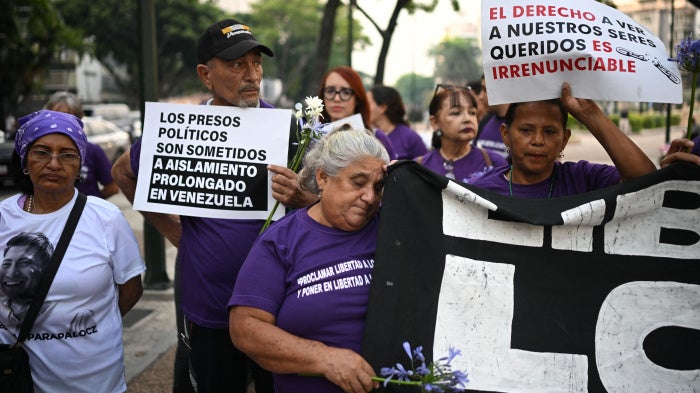
Venezuelan authorities carried out brutal repression against those who protested the results and stepped-up arbitrary arrests, enforced disappearances, and other violations of the rights of political opponents, critics, and foreign nationals.
A significant portion of the country’s population experiences multidimensional poverty, having inadequate access to rights-essential goods and services, including food and medicines. The harsh economic conditions and government persecution have forced 8 million to flee since 2014.
Post-Electoral Repression
After the July 28, 2024 presidential elections, authorities and pro-government armed groups, known as colectivos, carried out widespread abuses. As thousands protested Maduro’s claimed re-election, mainly in low-income neighborhoods, the government launched “Operation Knock Knock” (Operación Tun Tun), a nationwide campaign of intimidation and repression. Twenty-four protesters and bystanders died, in many cases at the hands of Venezuelan security forces and colectivos.
Thousands of critics, including children, political opponents, and foreign nationals, have been arbitrarily detained and charged in virtual hearings with vague offenses such as “incitement to hatred” and “terrorism.”
Venezuelan authorities have frequently denied carrying out arrests or hidden detainees’ whereabouts, in what amount to enforced disappearances under international law. Families have been left searching for their loved ones for days or weeks.
Many detainees have been held incommunicado, some since the day of their arrest, denied visits, phone calls, and access to private legal counsel or their case files.
Some detainees have been subjected to ill-treatment and torture, including beatings, electric shocks, asphyxiation with plastic bags, sexual torture, solitary confinement, and detention in tiny, dark, overcrowded punishment cells. According to the Independent International Fact-Finding Mission on the Bolivarian Republic of Venezuela (FFM), women in detention have been subjected to sexual and gender-based violence including coercive transactional sex, reproductive violence, forced nudity, and “possible acts of sexual slavery and/or forced prostitution.”
The Attorney General’s Office released hundreds of detainees, though many remain under criminal investigation. Many have been forced to sign documents prohibiting them from disclosing information about their arrest or legal proceedings, and some have been compelled to record videos stating that their rights were respected during detention.
In July 2025, Venezuelan authorities announced the release of 80 nationals and 10 US citizens and residents in exchange for the release and repatriation of 252 Venezuelan migrants held incommunicado in El Salvador’s notorious Center for Terrorism Confinement (Centro de Confinamiento del Terrorismo, CECOT) prison. The Venezuelans had been removed from the United States to El Salvador and detained at CECOT pursuant to an agreement between the two countries. In August, 13 political prisoners, including Maracay city officials, were also freed.
Other critics were arrested following the releases, in what Venezuelan human rights groups describe as a “revolving door” pattern. As of November 3, pro-bono group Foro Penal reported 884 political prisoners remained behind bars, including 85 foreigners.
The FFM’s September report reiterated its conclusion that “acts of extreme cruelty” committed before and after the 2024 presidential election in Venezuela, including arbitrary detentions, torture, and sexual violence, amount to crimes against humanity.
Human Rights Defenders
Attacks on human rights defenders continued throughout 2025. The Center for Defenders and Justice (CDJ) reported over 321 registered in the first half of 2025 alone, including cases of intimidation, harassment, and arbitrary arrests.
On January 7, hooded men forced Carlos Correa, the head of the leading free speech NGO Espacio Público and member of the Americas Advisory Committee at Human Rights Watch, into an unidentified vehicle and arrested him. Correa was released days later after strong international pressure.
According to Venezuelan Program for Education and Action on Human Rights (Programa Venezolano de Educación Acción en Derechos Humanos, PROVEA), as of September 5, five human rights defenders were behind bars: Javier Tarazona, the head of the organization Fundaredes, detained in July 2021; Rocío San Miguel, a renowned security expert and human rights defender, detained in February 2024; Carlos Julio Rojas, a journalist and social activist, detained in April 2024; Kennedy Tejeda, a lawyer with Foro Penal, detained in August, 2024; and Eduardo Torres, a member of PROVEA, detained on May 9, 2025.
Between August and November 2024, the National Assembly, controlled by Maduro’s party, passed legislation that severely restricts the work of civil society groups and penalizes people who advocate for sanctions, whether targeted or broad, with penalties of up to 30 years in prison.
US funding cuts under President Donald Trump forced some human rights organizations to restrict or stop their work. The US administration’s justifications for cutting foreign aid echoed Venezuelan government narratives that delegitimize international efforts to promote and advance human rights.
Freedom of Expression
Authorities have stigmatized, harassed, and repressed independent media, often closing critical outlets.
Between January and August, Espacio Público documented what it said were 167 violations of freedom of expression, including censorship, intimidation, and administrative restrictions. The National Telecommunications Commission (Comisión Nacional de Telecomunicaciones, CONATEL) reportedly ordered the closure of four radio stations, and 21 websites were blocked, mainly by the national telephone company CANTV, though private companies allegedly also enforced some restrictions.
Authorities used online platforms to intimidate, stigmatize, and surveil presumed critics, facilitating arrests. They published people’s personal data to threaten them.
At least 15 journalists remained behind bars as of August 5, according to the Press and Society Institute of Venezuela (Instituto Prensa y Sociedad de Venezuela, IPYS Venezuela).
US cuts to foreign aid undermined the work of independent media outlets; some are struggling to survive.
Impunity
The judiciary stopped functioning as an independent branch of government in 2004, when then-President Chávez passed a raft of legislative changes and packed the Supreme Court with his supporters. The court has since supported the executive branch in repression of critics.
The Office of the UN High Commissioner for Human Rights (OHCHR) reported government “delays” in investigating and prosecuting killings, including protest-related deaths occurring in 2014, 2017, and 2019, and killings by security forces. The Attorney General’s Office and the Ombudsperson’s Office have been complicit in grave human rights violations.
In November 2024, OHCHR was allowed to resume limited activities in Venezuela; authorities had suspended its operations in February of that year. By 2025, only one international staff member had been allowed to return, and the office had very little access in the country. On July 1, 2025, following a report on Venezuela by the OHCHR high commissioner, the National Assembly declared the high commissioner persona non grata.
The International Criminal Court prosecutor’s office continued its investigation of alleged crimes against humanity in Venezuela.
A senior former commander of the Bolivarian National Guard challenged an Argentinian court’s use of the principle of universal jurisdiction to issue a 2024 arrest warrant against him for crimes against humanity. His challenge was rejected on appeal in March, and the case remains under investigation. The Argentinian court has also issued arrest warrants against other Venezuelan government officials and members of the security forces, including Nicolás Maduro and Diosdado Cabello.
Humanitarian Emergency
A significant portion of the country’s population experiences multidimensional poverty, with inadequate access to rights-essential goods and services including food and medicines. According to HumVenezuela, an independent platform of civil society organizations, by November 2023, the most recent date for which data was available, 14.2 million people faced severe humanitarian needs.
Since March 2022, the legal minimum wage has been 130 bolivars (approximately US$1) per month.
Almost 18 percent of Venezuelans face undernourishment due to insufficient food consumption, according to the UN Food and Agriculture Organization. According to HumVenezuela, food insecurity has forced some families to reduce their daily calorie intake, scavenge for food in refuse, and seek additional sources of income, including an increase in informal jobs and jobs under exploitative conditions.
Public healthcare facilities continue to lack essential medicines and medical equipment. According to the independent National Hospital Survey, conducted by doctors nationwide, shortages of emergency medical supplies in 2024 reached 36 percent. Many people have turned to self-medication and personal support networks to obtain treatment given their limited access to medicines and doctors. Access to contraceptives is very limited for women and men living in poverty.
Limited availability and accessibility of potable water, electricity, domestic gas, and fuel continue to harm people’s enjoyment of rights. Many households must collect rainwater for daily use and rely on wood-burning stoves for cooking.
In June 2025, OHCHR reported that access to food, health care, and other rights-essential goods and services had been affected by the suspension of humanitarian funding from some foreign donors, as well as by overcompliance with US sectorial sanctions.
Refugees, Asylum Seekers, and Migrants
Nearly 8 million Venezuelans have left the country since 2014. Roughly 6.9 million relocated within Latin America and the Caribbean. According to HumVenezuela, by August 2025, 15.1 percent of Venezuelans surveyed expressed their intention to emigrate.
A mix of factors cause Venezuelans to leave, including harsh economic conditions and persecution. Many people have left the country since the post-electoral crackdown seeking protection abroad, including elected officials, members of the opposition, people who worked at polling stations or were pivotal to secure the electoral tally sheets, and former security force members. They face inefficient asylum systems in Latin America and abusive migration policies in the US.
In the first half of 2025, the Trump administration ended resettlement and parole programs benefiting tens of thousands of Venezuelans, and canceled their CBP One and Safe Mobility Offices appointments. In October, the Supreme Court rejected a challenge to the administration’s termination of Temporary Protected Status (TPS) for Venezuelans. The administration had cited alleged improvements in the human rights situation in Venezuela as justification for termination.
The Trump administration reinstated deportation flights to Venezuela, with 6,835 people returned between February and July. The US also removed eight Venezuelan women to El Salvador, only to later return them to the US, and transferred 252 men to El Salvador’s maximum-security prison CECOT, where they suffered arbitrary detention, enforced disappearances, and systematic torture. El Salvador later sent the men back to Venezuela. The US government accused them, without providing evidence, of being members of Tren de Aragua, an organized crime group that the US government has designated as a foreign terrorist organization.
The Trump administration also removed Venezuelan nationals to US facilities at Guantanamo Bay, where they were held incommunicado and in isolation.
Women’s and Girls’ Rights
Venezuela continues to have one of the highest maternal mortality rates in the region. Abortion is criminalized except when the life of the pregnant person is at risk. Safe abortion and post-abortion care is limited.
Access to sexual and reproductive health services for women and girls, including maternal care, family planning, and access to contraception, remains inadequate and unaffordable to many.
The government has not released data on femicides since 2016. The NGO Utopix registered 75 femicides during the first six months of 2025.
Indigenous People’s Rights
Indigenous peoples continue to “lack resources and access to adequate food,” according to a UN expert on the right to food, and face disproportionate malnutrition and extreme poverty. The OHCHR received reports on maternal morbidity and deaths among the Ye’kwana and Sanemá, as well as too few healthcare centers and shortages of medicines and equipment.
Indigenous people face major challenges in the demarcation of their territories, leaving them vulnerable to dispossession by cattle ranches, illegal gold mining, and plantation agriculture, which are significant drivers of deforestation in the Venezuelan Amazon. These conditions also facilitate the presence of armed or criminal groups and contribute to the forced displacement of many Indigenous communities.
Armed and Criminal Groups
Armed groups operate mainly in border states, and brutally enforce rules that govern people’s daily life. “Colectivos” and other criminal and armed groups reportedly intimidate people in border and mining areas.
The US designated Venezuelan criminal groups Tren de Aragua and Cartel de los Soles as foreign terrorist organizations, a move followed by other countries in the region.
International Actors
In June, OHCHR highlighted Venezuela’s worsening human rights situation, including enforced disappearances, which UN experts also addressed. The Inter-American Commission on Human Rights concluded that Venezuela’s post-election abuses were aimed to “instill fear” and “suppress social protest” to “consolidate power” following allegations of electoral fraud.
In January, the European Council renewed and expanded its list of sanctions on Venezuelan individuals, including members of the electoral authority, judiciary, and security forces, bringing the total number subject to asset freezes and travel bans to 69. In March, in a statement at the UN Human Rights Council, the European Union condemned the Venezuelan government’s “acts of repression against dissenting voices” and urged authorities to uphold their consular obligations to detained foreign nationals.
In early 2025, the Trump administration engaged directly with Nicolás Maduro. US Special Envoy Richard Grenell visited Caracas on January 31 to secure the release of six American detainees, while Maduro agreed to assist the US government with deportations. In its first weeks in office, the administration made deep cuts to foreign assistance and USAID programs that directly impacted Venezuelans and groups working to combat rights violations. In March, Trump revoked Chevron’s license to operate in Venezuela.
At time of writing, the US military was conducting strikes against speed boats in international waters coming from Venezuela that it alleged were carrying drug traffickers, in what amounts to extrajudicial killings. In October, the Trump administration authorized the CIA to conduct covert action in the country.