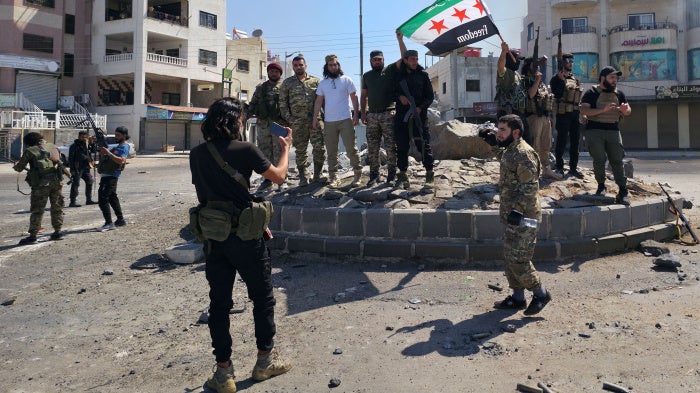
On December 8, 2024, a coalition of armed opposition groups led by Hay’at Tahrir al-Sham (HTS) overthrew the government of Bashar al-Assad, ending over 50 years of Baath party rule in Syria. On March 29, authorities announced a new transitional government led by former HTS leader Ahmed al-Sharaa to administer the country for five years until a permanent constitution is adopted and national elections are held.
Earlier in March, transitional authorities approved a constitutional declaration, meant to govern the country’s transitional phase, that concentrates power in the executive and grants the president significant authority over judicial and legislative appointments without checks or oversight. The declaration justified these extraordinary powers as necessary for Syria’s transitional phase.
Identity-based killings, including massacres of Alawite and Druze civilians in March and July 2025 by government and allied forces, have marked the transition, raising fears of further violence. Severe economic and humanitarian challenges and ongoing mass displacement continued to strain Syrians as the country began to rebuild and chart a new future. More than a decade of conflict has also left Syria extensively contaminated by landmines and explosive remnants of war, a major barrier to safe returns and reconstruction.
Accountability for Serious International Crimes
In 2025, Syria’s transitional authorities signaled an intention to advance accountability for serious crimes. In addition to explicit references to transitional justice in the country’s constitutional declaration, presidential decrees issued on May 17 established two new government bodies: the Transitional Justice Commission and the National Commission for the Missing. The Transitional Justice Commission’s mandate only includes abuses by the former government, excluding violations by other actors and leaving many victims without recourse. As of September 2025, both commissions had taken only limited steps to consult victims’ groups and civil society or publicize and implement their activities.
In January 2025, the ICC prosecutor travelled to Damascus at the invitation of Syrian President al-Sharaa and in March, Syria’s Foreign Minister Asad al-Shaibani met the prosecutor in The Hague, signaling openness to the court playing a role in Syria’s justice response.
The International, Impartial and Independent Mechanism for Syria (IIIM), Independent Institution on Missing Persons in Syria (IIMP), Commission of Inquiry on the Syrian Arab Republic (COI) have gained access to Syria, but they lack the authorization needed to establish operations within Syria, a crucial step for fulfilling their mandate.
The transitional authorities welcomed in June a case brought by the Netherlands and Canada in 2023 before the International Court of Justice over torture by the former government. At the UN Human Rights Council and the UN General Assembly, they committed to combat impunity, cooperate with international monitors, and ensure victims’ participation in accountability efforts.
Abuses Involving Government Forces
In early March 2025, deadly insurgent attacks on government forces in Syria’s Hama, Latakia, and Tartous governorates triggered a wave of identity-based violence across the region. Government forces, affiliated armed groups, and armed volunteers swept through Alawi-majority areas of Tartous, Latakia, and Hama governorates, killing at least 1,400 people and leaving behind torched homes, mass graves, and shattered communities. The UN Commission of Inquiry for Syria determined that the attacks may have amounted to war crimes. A joint report by Human Rights Watch, Syrians for Truth and Justice, and Syrian Archive documented widespread abuses carried out by these forces, including summary executions, deliberate destruction of property, and abuse of detainees. The findings showed that these crimes unfolded during a centrally coordinated military operation directed by the Ministry of Defense. The Syrian transitional government promised accountability for violence, but by the end of 2025 it had provided little transparency on whether its investigation examined the role of senior military or civilian leaders, or what steps it would take to hold those with command authority to account.
In mid-July, clashes erupted in Syria’s southern Sweida governorate, with fighting between armed groups aligned with a spiritual leader of Sweida’s Druze community, and pro-government Bedouin fighters. As violence spread, the Syrian government announced it would intervene, deploying Interior and Defense Ministry units and imposing curfews on July 14. While the authorities claimed the deployment was to restore order, residents reported looting, home burning, sectarian abuse, and summary executions, including of women and children. Bedouin armed groups and Druze militias were also implicated in serious abuses. UN experts reported on August 21 that the violence had killed around 1,000 people, including at least 539 Druze civilians, among them 39 women and 21 children, while there were documented extrajudicial executions of at least 196 people and over 33 villages burned.
Transitional authorities carried out arbitrary detentions, with reports of torture and ill-treatment in detention centers and prisons, brief detentions of journalists and activists, and deaths in custody.
Northeast Syria
In 2025 the Kurdish-led Syrian Democratic Forces (SDF) continued to control and administer much of the country’s northeast. On March 10, the SDF signed a deal with the transitional government in Damascus to incorporate its institutions into the Syrian state, but the fate of the SDF itself remained unclear, and by the end of 2025 little progress to implement the agreement had been made.
In 2025 Human Rights Watch documented that former Syrian National Army (SNA) factions that fought the Assad government with backing from Türkiye continued to detain, mistreat, and extort civilians in northern Syria. Some SNA commanders involved in past abuses were appointed to influential posts in the new Syrian military.
A March 16 drone attack by Türkiye or Turkish-backed Syrian factions on a farm near villages controlled by the SDF south of Kobane killed seven Kurdish children, their 18-year-old sister, and their parents, apparently all civilians.
The Turkish military continued to effectively occupy and control vast swathes of northern Syria. They also continue to pay the wages of some factions of the former Syrian National Army (SNA) now integrated into the new Syrian military.
In 2025, the SDF carried out arbitrary detentions, including of individuals accused of dissent, amid broader concerns over restrictions on expression and due process in areas under their control. The SDF and Asayish regional security forces continued to arbitrarily detain over 40,000 ISIS (Islamic State) suspects and their family members from Syria and nearly 60 other countries in degrading conditions in al-Hol and Roj camps.
Israeli Abuses in Southern Syria
Following the former Syrian government’s collapse in December 2024, Israeli forces pushed deep into the UN-monitored demilitarized zone separating the Golan Heights – Syrian territory which Israel has occupied since 1967 – from the part of Quneitra governorate that remained under Syrian control, and rapidly established nine military posts stretching from Mount Hermon through Quneitra city to parts of western Daraa.
Israeli forces occupying these areas carried out a range of abuses against residents, including the war crime of forced displacement, implemented through home seizures and demolitions, alongside denial of access to livelihoods, and unlawful transfer of Syrian detainees to Israel. In one village, Israeli forces demolished at least 12 buildings on June 16 on the pretext that they were too close to a newly established military installation, displacing eight families whose homes had been seized in December 2024. In a nearby village, forces constructed another military installation, razed large swathes of a century-old forest, and blocked residents’ access to their agricultural land and grazing pastures near the installation.
Since February, Israeli officials repeatedly stated an intention to “completely demilitarize” southern Syria, and, on multiple occasions, declared that forces would remain indefinitely in the newly seized territory.
Israeli forces in also intensified airstrikes on Syrian military infrastructure, carrying out 277 strikes targeting arms depots, missile facilities, and air defense batteries between December 2024 and September 2025, according to ACLED, an independent conflict monitor.
Israel has barred tens of thousands of displaced Syrians from returning to the occupied Golan Heights since 1967.
Economic Crisis and Obstacles to Humanitarian Aid
In 2025, over 90 percent of Syrians lived below the poverty line. Approximately 14.56 million people – over half the population – struggled to access adequate food, and at least 16.5 million required aid. By September, UNHCR stated that only 24 percent of required funds were available.
Over 12 years of war has decimated civilian infrastructure, severely affecting access to shelter, health care, electricity, education, public transportation, water, and sanitation. Severe fuel shortages and rising food prices compounded hardship.
The United States and European Union countries lifted draconian sanctions on Syria in 2025 that had largely isolated Syria from the international banking system and global economy, and efforts to revive international trade and banking were underway by year’s end.
Early in the year, the transitional government maintained Assad-era restrictions on aid groups, including requirements that international NGOs coordinate through state-affiliated organizations, hampering their ability to expand operations. Aid workers told Human Rights Watch that later in the year authorities dropped this requirement and engaged in constructive dialogue with humanitarian actors.
Refugees and Internally Displaced Persons
Displacement remained one of the most dire and protracted consequences of the war. In October, the International Organization for Migration (IOM) stated that around 581,000 Syrian refugees had returned home following the ouster of the Assad government in December 2024, but more than 4.5 million refugees remained abroad according to UNHCR. Over 7 million Syrians remained internally displaced.
After the fall of the Assad government in December 2024, many European countries announced that they were halting processing of Syrian asylum claims. In September, US authorities announced an end to Temporary Protected Status (TPS) for Syrians, giving Syrians admitted under TPS 60 days to leave the country or face arrest and deportation. Türkiye and Lebanon also continued to deport Syrians, often summarily and without adequate safeguards.
Women’s and Girl’s Rights
The years of conflict in Syria exacerbated gender inequalities, exposing women and girls to increased violence, displacement, and discriminatory laws limiting their rights. Women also continue to be largely excluded from transitional decision-making and political processes, in spite of their right to inclusion under Security Council resolution 1325 and strong demands for inclusion from Syrian women’s groups, limiting their role in shaping the country’s future.
Sexual Orientation and Gender Identity
Under article 520 of the penal code, “unnatural sexual intercourse” is punishable by up to three years in prison.
Key International Actors
In 2025, the United States and European Union terminated longstanding sanctions on Syria, a critical step toward improving Syrians’ access to fundamental economic rights and encouraging efforts to rebuild a country devastated by years of grueling conflict.
In June, the EU reaffirmed support for human rights and accountability efforts, and EU foreign policy chief Kaja Kallas condemned the identity-based atrocities in March and July.
The EU hosted the ninth Brussels donor conference in May and announced in July a 175 million Euro financial package to support among other sectors Syria’s public institutions on efforts on transitional justice, accountability, and human rights programs.
In August, Türkiye signed a memorandum of understanding on military cooperation with the Syrian transitional authorities. Gulf states resumed high-level contacts and expanded economic engagement with Damascus. The International Monetary Fund and World Bank also re-engaged with Syria, opening technical discussions on macroeconomic stabilization and post-conflict recovery.