Conflict between the Sudanese Armed Forces (SAF) and the Rapid Support Forces (RSF) continued for a third year, with all warring parties committing war crimes and other violations of international humanitarian law.
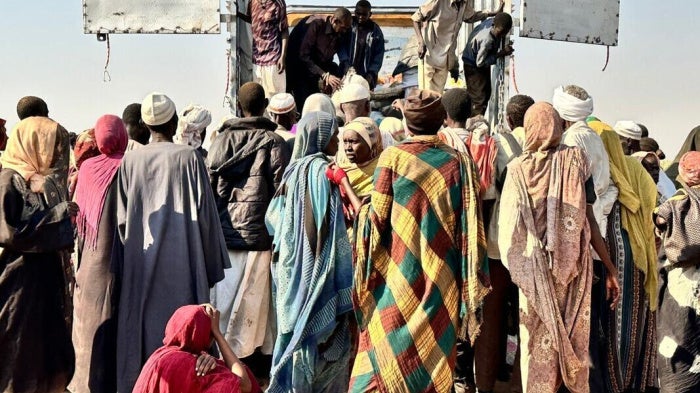
The warring parties’ actions made Sudan the worst global humanitarian crisis. The United Nations’ World Food Programme reported that 24.6 million people suffer from acute hunger and 2 million face famine or risk of famine. Over 11.8 million were displaced by the conflict as of September, including 7.4 million internally displaced and 4.2 million in neighboring countries.
While the SAF retook the capital, Khartoum, and other cities and villages including in central Sudan, by the end of October El Fasher, North Darfur’s capital, fell to the RSF and immediately there were reports and images of RSF extrajudicial killings and other serious violations against people fleeing. The SAF carried out indiscriminate airstrikes in South Darfur as well other parts of the country.
Both parties continue to wilfully obstruct aid despite the population’s desperate needs, and to detain and harass humanitarian workers and local volunteers.
In July, the RSF and their allies announced the creation of a parallel government, based in Darfur.
The United States rolled out designated sanctions against individuals and entities in relation to the conflict. In July, the European Union (EU) adopted more targeted sanctions for serious human rights violations, including against the Sudan Shield Forces leader Abu Aqla Keikel. In Conclusions adopted by EU foreign ministers, the EU stated its grave concerns over violations across Sudan, called for accountability and committed to advance concrete measures for the protection of civilians. The International Criminal Court (ICC) investigations in Darfur continued. In September, the UN Security Council renewed the Sudan sanctions regime for another year. They did not expand it to cover the whole of Sudan nor designate new individuals under the existing regime. The mandate of the UN Independent International Fact-Finding Mission (FFM) was extended by the UN Human Rights Council in October.
Conflict and Abuses in Khartoum
In March, as the SAF regained control of Khartoum, they uncovered evidence of serious violations by the RSF, notably in Omdurman. The SAF committed retaliatory attacks against local volunteers accused of collaborating with the RSF.
Civilians faced ongoing indiscriminate shelling and air attacks. Local volunteers said in January that the SAF carried out indiscriminate airstrikes in southern Khartoum, including on a market, killing, and injuring dozens of civilians.
In February, local medical authorities and activists said the RSF shelling resulted in 54 people being killed and over 100 injured at a market in Omdurman. In March, media reported that around 500 people may have been buried in mass graves in northern Khartoum near an RSF base, where detainees reported torture and starvation. The RSF drone strikes reportedly continued to target installations in Khartoum vital for civilians, even if also used by the military, including on September 9 when media reported RSF attacks hit power stations and an oil refinery.
In March, the UN Human Rights Office noted credible reports that the RSF and allied forces looted houses in eastern Khartoum, carrying out summary killings, arbitrary detentions, and looting. They said that SAF-allied fighters were reported to have carried out similar abuses.
Conflict and Abuses in Darfur
On October 26, the RSF captured El Fasher, the culmination of a siege on the city since May 2024, and relentless attacks by the armed group that triggered famine in displacement camps in and around the city. The RSF carried out mass killings of people fleeing, as well as sexual violence.
Prior to the fall of El Fasher, both parties carried out attacks impacting civilians and civilian infrastructure, including the city’s few remaining health facilities. The UN FFM reported that the RSF damaged water facilities and supply lines in February and in mid-April, RSF large-scale attacks on Zamzam killed between 300 and 1,500 and injured over 157, the majority women and children.
The SAF shelled and bombed residential areas, including bombing a market north of El Fasher on March 24 and in early February also killed scores of civilians in attacks on residential and commercial neighbourhoods in Nyala, South Darfur, using unguided air-dropped bombs.
Conflict and Abuses in Other Locations
On January 10, the Sudan Shield Forces, an armed group currently allied with the SAF, and led by Abu Aqla Keikel, targeted civilians in Tayba village, killing at least 26 civilians. The fighters looted property, burned homes, and terrorized residents, forcing many to flee. The attack took place in the context of a SAF offensive to retake Gezira state.
In West Kordofan, the SAF bombed a mosque on June 21, killing 41 and wounding dozens. The UN reported that around 300 people were killed in RSF-led attacks in July on a Barra locality in North Kordofan. The SAF also carried out airstrikes in July in West Kordofan that reportedly left at least 23 civilians killed.
Willful Obstruction of Humanitarian Assistance, Attacks on Aid
The warring parties continue to wilfully obstruct aid movement, while also attacking humanitarian workers and local volunteers, violating international humanitarian law. The UN FFM concluded that the RSF and their allied forces used starvation as a method of warfare, a war crime.
Cuts to international aid by the US and others, combined with attacks by the warring parties, have led to the closure of many emergency food kitchens, a vital source of food.
At a conference in London in April, international actors pledged over €500 million in aid.
Even to the extent aid remained available, fighting and attacks on humanitarian aid agencies resulted in suspension of services in some parts. In February, WFP temporarily paused food distribution to Zamzam camp in North Darfur.
In June, a WFP convoy was attacked in North Darfur killing five staff members. A drone strike also hit another UN convoy in the same region in August.
An armed attack in August forced Doctors without Borders (MSF), a medical charity, to suspend their operations in Zalingei hospital, central Darfur in the midst of a Cholera outbreak.
The Office for the Coordination of Humanitarian Affairs reported that in May only 110 visas for the UN and international NGOs were approved out of the 355 pending requests, and the backlog was increasing.
Conflict-Related Sexual Violence
Sexual violence has been routinely perpetrated primarily against women and girls by combatants on both sides of the conflict. Evidence of rape, gang rape, and sexual slavery indicate that these acts are numerous and often widespread. In May, UN experts said at least 330 cases of conflict-related sexual violence have been documented. But with severe restrictions on access to services, attacks on medical personnel, survivors facing deep stigma, and ongoing restrictions on independent monitoring, the documented cases are likely a small proportion of the actual number.
As of June, the UN Population Fund (UNFPA) said recent cuts to aid funding have forced the agency to withdraw from more than half of the 93 health facilities it was supporting.
Detention, Torture, and ill-Treatment
Both parties have unlawfully detained, tortured, and executed civilians. The UN FFM said RSF fighters beat and shot detainees in April in Omdurman. The mission also said both parties held detainees in inhumane conditions. The SAF unlawfully detained people accused of collaborating with the RSF, often along ethnic lines.
In April, activists raised concern over the lack of due process for over 25 women charged by SAF authorities with collaborating with the RSF, who face possible death sentences. A local rights group said in September that the SAF and their allies were detaining over 3,000 people in Gezira state, most of them political activists.
Accountability
Impunity remains a key factor fuelling the violence and emboldening perpetrators of grave crimes, as often both parties deny allegations or fail to take credible steps to investigate. All parties to the conflict continued their refusal to cooperate with the UN FFM and the AU Joint Fact-Finding Mission, by blocking access to territories under their control, dismissing their findings and concerns, and not responding to any of their communications or requests.
On October 6, ICC judges convicted former Janjaweed militia leader, Ali Muhammad Ali Abd-Al-Rahman (Ali Kosheib), of charges of war crimes and crimes against humanity in Darfur in 2003-04 and 2013, the first trial arising out of the court’s Darfur investigation. However, the ICC’s mandate remains limited to Darfur, leaving no independent judicial mechanisms to investigate and prosecute individuals responsible for grave crimes committed across Sudan.
The UN Human Rights Council decided to extend the mandate of the UN FFM, to ensure robust continued investigations into ongoing grave abuses, and to support efforts to hold perpetrators of international crimes to account.
Sexual Orientation and Gender Identity
Same sex sexuality and gender non-conforming expression are criminalized in Sudan under sections 148 and 151 of the penal code. The law penalizes those convicted of “sodomy” and “indecent acts” with one year to life imprisonment.