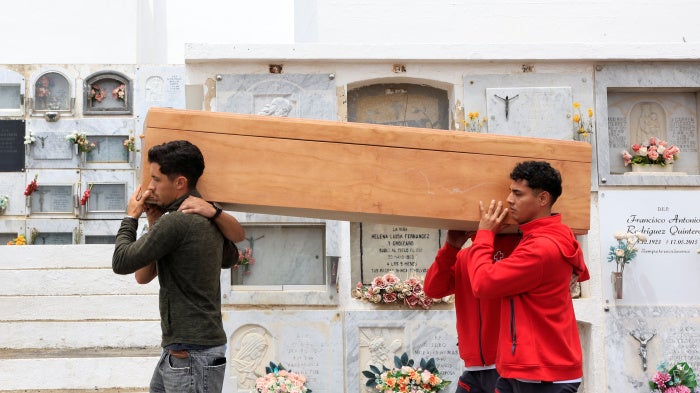
Migrants and asylum-seekers continued taking dangerous sea routes to reach Spain, with a sharp increase in estimated child deaths at sea. Asylum-seekers had inadequate access to protection in Spain’s enclaves in north Africa. Despite improvements to the main social assistance program, take-up rates among low-income households remained low. Racism, xenophobia, and hateful online content contributed to anti-migrant violence.
Migration and Asylum
According to the United Nations refugee agency (UNHCR), by mid-November, 30,663 people had arrived irregularly by sea to Spain. Despite fewer people crossing the Atlantic from northwest Africa towards the Canary Islands compared to the previous year, hundreds of people still died at sea, highlighting the inadequacy of search-and-rescue operations. A migrant rights group estimated that 1,865 people including 342 children had died at sea between Africa and Spain as of May.
Investigations documented abuses facing unaccompanied migrant children in the Canaries, including overcrowded accommodation, failures in age determination processes, a general lack of individualized assessment of protection needs, difficulties accessing education, and a lack of follow-up care after turning 18.
Around 800 people had arrived irregularly by land to Melilla and Ceuta, Spain’s enclaves in north Africa, by mid-November. In Ceuta, many people faced obstacles when making asylum applications once in the enclave, and only one person could apply at a border post during the first five months of the year. Civil society groups raised concerns that Moroccan asylum seekers in Melilla were left destitute and unable to access the Temporary Stay Center for Immigrants or make asylum applications.
Spanish security forces continued to cooperate with Mauritanian and Moroccan authorities. Spain assisted Mauritania with border control, migration management, and anti-smuggling operations, including through financial and material support, and deployment of some Spanish forces in Mauritania, despite ongoing migrants’ rights violations by local authorities. Spain increased financial and material support to Morocco for border surveillance.
Spanish authorities took some positive steps to expand legal migration pathways, although plans for a wider regularization program stalled. The human rights ombudsperson criticized administrative practices relating both to unaccompanied children and children arriving with family for failing to consider the best interests of the child, warning that lack of coordination between immigration, education, and care administrations could lead to the loss of legal status.
Poverty
Official data for 2024 published in February found 26.1 percent of the population was “at risk of poverty or social exclusion” and 8.4 percent faced “severe material and social deprivation.” Both rates decreased slightly compared to the previous year.
In June, the Ministries of Social Rights and Inclusion announced plans to improve access to the Minimum Vital Income (IMV) social security program, including easy-to-read guides and help with digital applications. Lack of clear and accessible information was cited as the reason for an estimated 55 percent of eligible households not applying for the IMV. Although the Ministry of Inclusion claimed that people in more than 750,000 households were receiving the IMV by July 2025, an April investigation by independent journalists suggested it was closer to 450,000 households.
Right to Housing and Energy
In February, the European Committee of Social Rights published a landmark decision against Spain about electricity supply being shut off since October 2020 in parts of the Cañada Real informal settlement near Madrid. The committee found violations of the European Social Charter relating to housing, education, health, energy, and specific failures relating to children, young people, older people, and people with disabilities. The decision established access to energy as a key part of the right to protection from poverty and social exclusion. At time of writing, power had not been restored to the affected community, nor had the government provided acceptable alternative housing.
In September, following legal challenges by transparency campaigners, the Supreme Court ruled that the government had to disclose the source code for an algorithm it used to decide which low-income households receive the social grant for electricity.
There were widespread demonstrations in Spanish cities in April against high prices for and low availability of housing. Parts of a 2023 housing reform law were implemented, including caps on annual rent increases, but other promised protections remained pending. Seventy-seven percent of evictions in the first quarter of 2025 were for non-payment of rent.
Meanwhile, the human rights ombudsperson took action seeking information from 30 national and autonomous community authorities on steps taken to ensure the right to housing, affordable rent, and adequate public housing stock.
Right to Health
In July, the Health Ministry began investigating obstacles to accessing abortion and the unevenness of the availability of abortion services in the public health care system across Spain’s autonomous communities. Public facilities in Ceuta and Melilla provided no abortion services. The ministry wrote to regional authorities reminding them of their obligations and promising further action if existing obstacles remained.
In March, a court in Galicia issued a first-ever ruling ordering a local government to pay damages for obstetric violence during childbirth. In June, the European Court of Human Rights found Spanish authorities had violated the rights of a 56-year-old woman who was subjected to surgery for breast cancer without her full consent, adding to existing concerns from campaigners about the legal regime governing autonomy and informed consent in women’s health care.
Sexual and Gender-Based Violence
Twenty-two women and three children were killed as a result of domestic or gender-based violence in the first half of the year, according to Equality Ministry data.
Interior Ministry data showed a 5.3 percent increase in reported instances of crimes considered sexual violence in the first six months of the year, compared to the same period in 2024.
A high court reduced the sentences of two men convicted of a 2016 gang rape due to a loophole in sexual consent legislation passed in 2022. The equality minister apologized for the “error” in the wording of the law, insisting the loophole had been corrected.
In October, the European Court of Human Rights ruled that Spain had violated the rights of two women by failing to adequately investigate their allegations of being drugged and raped in 2016, finding the shortcomings to have gone beyond “isolated errors.”
Racism and Discrimination
The Council of Ministers declared 2025 the “Year of the Gitano People,” to celebrate gitano contributions to Spanish culture and to address structural exclusion and anti-gitano racism.
In May, the government appointed the first postholder to the role of Independent Authority for Equal Treatment and Non-discrimination. The appointee assumed office in June, more than two years after the deadline set out in the 2022 Equal Treatment Law.
Racism, far-right extremism, and xenophobia contributed to civil unrest in July in Torre-Pacheco, Murcia, as vigilantes attacked people perceived to be foreigners. Far-right groups had called for anti-migrant violence following an assault on an older man by three men reportedly of north African origin. The minister of inclusion noted a surge in hateful online content targeting migrant men and boys, particularly of north African origin, calling on technology platforms to take more action to tackle online hate, and supported the government's use since 2020 of an automated online content monitoring system.
Rule of Law
The European Commission’s yearly Rule of Law report recommended actions to ensure independence of the judiciary, address corruption and conflicts of interest, and strengthen access to information.
Ill-treatment
The Council of Europe’s Committee for the Prevention of Torture raised concerns about ill-treatment by the Mossos d’Esquadra, Catalonia’s regional police force, and called on Spanish authorities to stop using “mechanical fixation” as a restraint technique in prisons.