President Lee Jae-myung of the Democratic Party took office in June 2025 after winning presidential elections following the impeachment of President Yoon Suk-yeol.
The new government faces persistent human rights challenges, including pervasive discrimination against women and girls, lesbian, gay, bisexual, and transgender (LGBT) people, older people, migrants, people with disabilities, and people of low socioeconomic status.
Freedom of Expression and Assembly
In April, the Constitutional Court upheld Yoon’s impeachment for imposing martial law in December 2024. If enforced, martial law would have gravely threatened rule of law and human rights, including freedom of expression and assembly.
Discrimination and Treatment of Minorities
South Korea remains one of the two countries in the Organisation for Economic Co-operation and Development (OECD) without a comprehensive anti-discrimination law. Legislative efforts face strong resistance as the issue is heavily politicized across party lines.
Women’s and Girls’ Rights
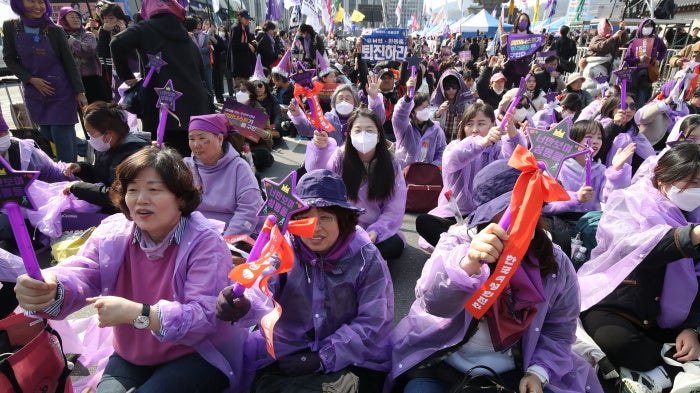
President Lee Jae-myung’s May pledge to expand the Ministry of Gender Equality and Family departed from his predecessor’s efforts to phase it out. Yet, discrimination against women and girls remains pervasive and systemic. The Economist’s annual “Glass Ceiling Index” found that South Korea has the widest gender wage gap among OECD countries, with women earning approximately 29 percent less on average than men.
Digital sex crimes, particularly sexually abusive artificial intelligence (AI) deepfakes, continued to surge in 2025. Women and girls comprised 97 percent of those who reached out to the government-funded Women’s Human Rights Institute of Korea between August 2024 and August 2025 seeking support, including mental health and legal counseling. Nearly half of all victims who sought support were girls and young women under 20 years old, reflecting the prevalence of deepfake sexual content targeting girls in elementary, middle, and high school.
Though abortion was decriminalized in 2021 by the Constitutional Court, South Korea still lacks legislation guaranteeing access to safe, affordable abortion care. Mifepristone, a medication used for abortion, remains banned despite its inclusion on the World Health Organization’s list of essential medicines. In August, the Lee administration identified the legalization of such medication and other abortion-related legislation as priorities.
Older People’s Rights
South Korea has the highest relative poverty rate among older people in the OECD, with older women disproportionately affected. Inadequate social security programs, combined with discriminatory age-based employment laws, often push older workers into lower-paid, precarious work. These include mandatory retirement at age sixty or older, the “peak wage” system under which employers can reduce older workers’ wages during the three to five years prior to mandatory retirement, and re-employment under unfavorable conditions.
Older women face higher poverty rates than older men, an issue compounded by a gender wage gap that widens with age, and a substantial gender gap in pension payments. Gender-based occupational segregation further marginalizes older women, often forcing them into under-valued, physically demanding, and low-paid work.
Sexual Orientation and Gender Identity
LGBT people face widespread discrimination, and lack the same legal recognition and protection as their heterosexual, cisgender counterparts. In May, the Supreme Court overturned the acquittal of a soldier under article 92-6 of the Military Criminal Act for engaging in consensual same-sex sexual acts while on base. The Military Criminal Act criminalizes all same-sex sexual acts involving military personnel, whether consensual or not.
Technology and Rights
Easily accessible generative AI technology minimally regulated by the government and hosting platforms fueled an upswing in non-consensual deepfake sexual content. Although President Lee made his pledge to fund AI-based technology a cornerstone of his campaign, at time of writing he had not proposed safeguards against exploitation, deepfake sexual abuse, and digital privacy violations.
Policy on Human Rights in North Korea
President Lee’s administration has weakened policies that promote human rights in North Korea, prioritizing dialogue and engagement with North Korean leader Kim Jong Un. In September, the Ministry of National Defense cut radio broadcasts on news and pop culture into North Korea, severing a vital source of outside information for North Korean listeners. In August, the Ministry of Unification canceled its annual report on human rights conditions in North Korea. Though a 2023 Constitutional Court verdict struck down a law that banned sending leaflets to North Korea, starting in June 2025 the government began cracking down on activists who sent balloons with leaflets and other materials into North Korea under a disasters and safety law that prevents unauthorized access to border regions.
Multiple brokers who facilitated remittances from North Korean escapees to their family members in North Korea faced prosecution for violating the Foreign Exchange Transactions Act. Investigations into around a dozen North Korean escapees under suspicions of espionage began in 2023 when South Korea’s counterintelligence mandate was transferred to the police. In September, the Database Center for North Korean Human Rights said that the majority of the remittances sent to relatives are spent on food and daily necessities.