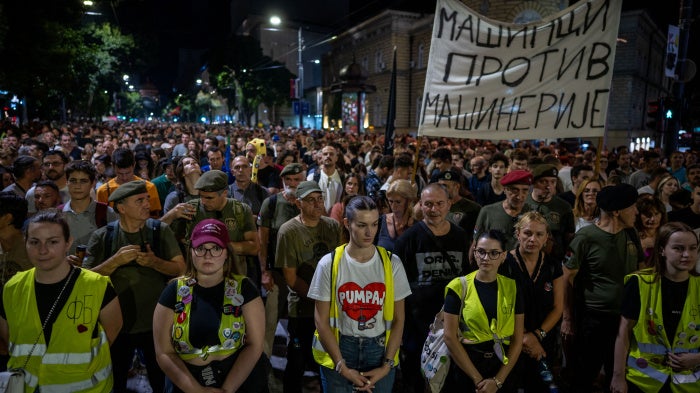
Authorities responded to nationwide protests with excessive force, arbitrary arrest, curbs on civil society, and attacks on journalists and independent media, the latter part of wider interference with media freedom. Justice for war crimes remains slow, with cases plagued by delays. People with disabilities remain confined to overcrowded institutions with inadequate care.
Civil Society and Protests
Nationwide protests occurred throughout the year following the November 2024 collapse of a train station canopy in Novi Sad that left 16 people dead, amid allegations that corruption had contributed to the collapse, spreading to widespread concerns over the dismantling of democratic institutions. Authorities at times used excessive force against protesters, including tear gas.
Non-governmental group CIVICUS reported that activists and civil society groups faced intimidation, surveillance, and prosecutions connected to the protests, noting that more than 400 people were detained in early July, with credible allegations of ill-treatment in custody.
The crackdown was criticized by UN experts, the Council of Europe’s Human Rights Commissioner, and EU officials.
Freedom of Media
Attacks on journalists surged during the year. Between January and September, the Independent Association of Journalists of Serbia (NUNS) recorded 84 physical attacks and 113 threats. According to NUNS, the organization recorded 59 cases where police arrested journalists, used physical force, threatened their safety, or refused to act to protect them when obliged to do so.
In August, uniformed police at anti‑government protests shoved and hit journalists, despite visible press vests and IDs, confiscating or smashing cameras and phones. Media groups condemned the actions as a deliberate obstruction of press freedom.
For example during an anti-government protest in Belgrade, police beat photojournalist Marija Čolaković with telescopic batons, although she was clearly marked as a journalist, leaving her with visible injuries on her legs and arms.
In September, during protests in Novi Sad against police brutality, riot police used excessive force against and detained journalists despite their visible press markings.
In February, identical Viber messages from the same Serbian number targeted two BIRN journalists with Pegasus spyware. At this writing, it was unclear whether authorities were investigating.
The use of vexatious lawsuits known as SLAPPs (strategic lawsuits against public participation) against journalists by public officials to silence their reporting remained a problem. In response, investigative outlets in May launched a media solidarity network to combat SLAPPs.
Women’s Rights
While legal protections for women exist, including the Gender Equality Strategy 2021-2030, implementation is weak; gender-based violence remains common, pay gaps and economic inequalities persist, and women from marginalized groups, especially Roma, face compounded discrimination and uneven access to healthcare.
Accountability for War Crimes
Between January and September, the War Crimes Prosecutor’s Office launched eight new war crimes investigations involving named suspects, and 15 other investigations. As of September, 20 cases against 44 defendants were pending before Serbian courts. Ongoing proceedings were marred by significant delays.
In September, the Belgrade Higher Court acquitted former Bosnian Serb Army Drina Corps Commander Milenko Zivanovic of ordering and participating in the forcible relocation of Bosniak civilians from Srebrenica in July 1995, which ended in the genocide of over 8,000 Bosniak men and boys and the expulsion of some 40,000 women, older people, and children.
Also in September, the Belgrade Court of Appeal increased Danko Vladičić’s sentence from nine to 12 years following an appeal by the prosecution. He was found guilty in 2022 of having killed two Bosniak civilians in Brod na Drini in 1992; the victims’ bodies remain missing.
Refugees, Asylum Seekers and Migrants
Between January and August, Serbia registered 320 asylum seekers (down from 511 during the same period in 2024) and allowed 82 asylum applications to be lodged (down from 156).
The asylum system continued to face serious shortcomings, including obstacles to accessing procedures, low recognition rates, and delays. Between January and August, Serbia granted refugee status or subsidiary protection to only three people. Serbia granted temporary protection to 925 people, all from Ukraine.
By August, Serbian authorities had registered 18 new unaccompanied migrant children. The country lacks formal age assessment procedures, leaving older children at risk of being treated as adults rather than receiving the protections children need.
Sexual Orientation and Gender Identity
Lesbian, gay, bisexual, and transgender (LGBT) people continue to face threats and violence. Between January and September, Da Se Zna! recorded 81 hate-motivated incidents against LGBT people, including 14 physical attacks. The Belgrade Pride march took place under increased security measures in September.
People with Disabilities
Serbia has made little progress in deinstitutionalization, leaving nearly 18,000 adults with disabilities in underfunded state institutions with reports of neglect and abuse. Supported living is rare, reaching only 27 people in the country. The government provided little support to the over 350,000 families with children with disabilities, and many children remain in segregated institutions.
Kosovo
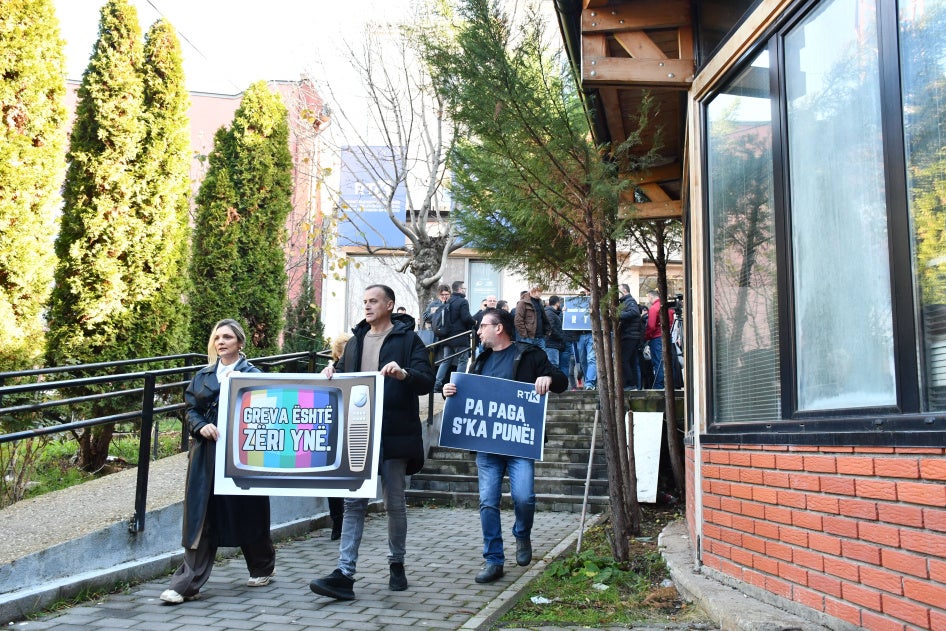
February general elections failed to produce a clear majority leading to a months-long deadlock in the parliament. Attacks on media freedom continued, with journalists subjected to threats, attacks, and harassment. The Kosovo Specialist Chambers continued its work alongside the national court responsible for war crimes prosecutions. Tensions persisted in northern Kosovo, with police raids on Serb-majority institutions, sparking protests. The European Commission’s November Enlargement Report raised concerns about undue political influence over the judiciary and noted that the media landscape continues to face challenges regarding ownership transparency and financial sustainability.
Accountability for War Crimes
The Pristina Basic Court in July convicted Milos Pleskovic, a former Serbian paramilitary, of war crimes for the 1999 killing of three ethnic Albanians near the town of Gjakova, sentencing him to 15 years in prison. The court found that Pleskovic had detained and then executed the victims.
In July, the Pristina Basic Court convicted two Serbian nationals in absentia for the wartime rape of an ethnic Albanian woman, sentencing each to 20 years’ imprisonment. Earlier the same month, the court convicted a former member of Serbia’s security service in absentia to 15 years in prison for the 1998 disappearance of an ethnic Albanian doctor.
The Kosovo Specialist Chambers in The Hague in February upheld the 15-year prison sentence of former Kosovo Liberation Army (KLA) Commander Salih Mustafa, affirming his conviction for war crimes committed during the 1999 Kosovo War. Mustafa was found guilty of arbitrary detention, torture, and the murder of a detainee at a KLA-run facility in Zllash.
In July, the Kosovo Specialist Chambers reduced the sentence of former KLA fighter Pjeter Shala from 18 to 13 years, upholding his convictions for arbitrary detention, torture, and murder of at least 16 detainees during the 1999 Kosovo War. The court found Shala lacked a commanding role in one murder and that his original sentence was disproportionate.
The Kosovo Specialist Chambers in February sentenced three former Kosovo Liberation Army (KLA) fighters, Haxhi Shala, Sabit Januzi, and Ismet Bahtijar, to two-year prison terms for obstruction of justice and witness intimidation. Also in February, the chambers granted two of the convicted conditional release based on time served. The negative impact of witness intimidation on accountability efforts in Kosovo was an important factor in the establishment of the Specialist Chambers.
Freedom of Media
Journalists continued to be subjected to threats and obstruction of their work. Between January and September, the Association of Journalists of Kosovo recorded 54 incidents against journalists, including one physical attack, one death threat, and 15 cases of harassment, hate speech, or smear campaigns, predominantly by political figures.
Reporters Without Borders (RSF) ranked Kosovo 99th of 180 countries in its 2025 Press Freedom Index, down 24 places from the previous year, making it the lowest in the EU-Balkans area. RSF noted growing political interference, smear campaigns, restricted access to information, abusive regulation, and weak protections for journalists.
In February, Prime Minister Albin Kurti’s security detail physically obstructed T7 journalist Genc Godanci as he attempted to ask Kurti about the RSF Media Freedom Index.
Women’s Rights
In April, Kosovo extended until May 15, 2028 the mandate of the commission responsible for recognizing survivors of wartime sexual violence, and pushed back the application deadline to May 15, 2027. President Vjosa Osmani and survivors’ rights groups had instead called for an open-ended application period to better accommodate survivors. Recognized survivors are entitled to a monthly pension of €230, free health care, and employment benefits, but only around 2,000 individuals have received this status out of an estimated 20,000 survivors. The April 14 observance of the Day of Survivors of Sexual Violence during the War also featured the first public testimony by a male survivor.
Sexual Orientation and Gender Identity
The government failed to adopt announced plans in May 2024 to legalize same-sex civil unions.
During Kosovo’s February 2025 parliamentary elections, political parties frequently used discriminatory and denigrating rhetoric about lesbian, gay, bisexual, and transgender (LGBT) people, and largely ignored issues of concern to them.
Asylum Seekers and Migrants
Between January and August, the Kosovo Ministry of Internal Affairs registered 184 returns of children to Kosovo. The Ministry did not provide numbers on returns of adults. During the same reporting period, the ministry registered 39 voluntary returns to Kosovo and 107 applications for asylum in Kosovo, the majority from Syria.
In June, the Kosovo government agreed to take up to 50 third-country nationals expelled from the United States each year. At time of writing, no information was available as to whether transfers had taken place.
Accountability of International Institutions
No progress was made in providing reparations or apologies to Kosovo Roma resettled by the UN to now-closed, lead-contaminated camps after the 1999 war. The flawed UN compensation mechanism had only received one $10,000 contribution at time of writing.