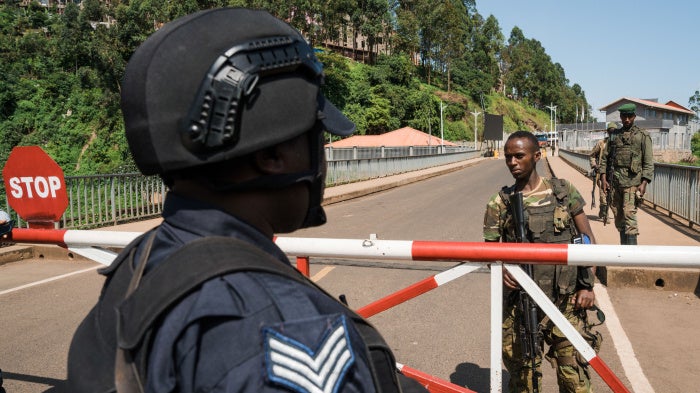
In 2025, Rwanda continued to repress the political opposition domestically and its military support to, and control over, the M23 armed group was linked to serious abuses. With Rwanda’s support, the M23 captured key cities in eastern Democratic Republic of Congo. Few journalists, civil society activists, or opposition members dare speak out publicly against the government, its policies, or its intervention in eastern Congo.
Freedom of Expression and Association
On June 19, Victoire Ingabire, leader of the unregistered opposition party Development and Liberty for All (DALFA-Umurinzi), was arrested at her home in Kigali in connection with an ongoing trial of party members. Ingabire faces charges including forming a criminal group and planning activities aimed at inciting public disorder.
In April, retired Brigadier General Frank Rusagara, a former senior officer in the Rwanda Defence Force (RDF), died in prison after over a decade of incarceration. Arrested in 2014 alongside Colonel Tom Byabagamba on politically motivated charges, Rusagara had consistently been denied family visits. His family was informed of his illness after his death.
Politicized Judiciary
There was no significant progress in investigations into the suspicious deaths or disappearances of critics, journalists, and opposition activists. Several journalists and opposition members remain behind bars.
In April, a senior prison official was convicted of assault and murder during an appeal that followed his acquittal in a 2024 trial.
In September, blogger and commentator Aimable Karasira was convicted on charges of incitement to divisionism and handed a five-year sentence. The court also ordered his accounts be frozen. The prosecution appealed and reiterated its request for a 30-year sentence. Karasira has been jailed since May 2021 and was subjected to torture in detention. Before his arrest, he had spoken about losing family members to both Hutu extremists and the RPF during and after the 1994 genocide.
Refugee and Migrant Rights
In June, the Rwandan government signed an agreement to accept third-country nationals expelled from the United States in exchange for roughly US$7.5 million in US financial support. A Rwandan government spokesperson reportedly said in August that the country would accept up to 250 people. Human Rights Watch and other groups opposed the deal, which could put deportees at risk of arbitrary detention, ill-treatment, and refoulement.
Sexual Orientation and Gender Identity
Although Rwanda does not criminalize consensual same-sex conduct or non-normative gender expression, lesbian, gay, bisexual, and transgender (LGBT) people report significant stigma and discrimination.
Justice for the 1994 Genocide
Recent developments in Europe and the US highlight both progress and persistent challenges in achieving accountability for crimes committed during the 1994 Rwandan genocide. In August, French investigating judges dismissed a long-running case against Agathe Kanziga Habyarimana, the former first lady of Rwanda and wife of former president Juvénal Habyarimana, citing insufficient and unreliable evidence. Accused of aiding and abetting genocide, Habyarimana was under judicial investigation for over a decade.
Norwegian authorities extradited François Gasana to Rwanda in August after years of legal proceedings. Gasana stands accused of the murder of a child and inciting attacks on Tutsi civilians.
In the US, federal authorities arrested Vincent Nzigiyimfura in Ohio in June on immigration fraud charges for allegedly concealing his role in the genocide when applying for US immigration status. According to the indictment, Nzigiyimfura, using the alias Vincent Mfura, participated in killings, helped organize roadblocks, and facilitated the delivery of weapons and fuel for attacks on Tutsis.
In November, in the case of Félicien Kabuga, one of the alleged masterminds of the genocide arrested in France in 2020, the International Residual Mechanism for Criminal Trials (IRMCT) trial chamber rejected the prosecution’s request to decide on Kabuga’s provisional release to Rwanda, finding that he was not fit to travel. The prosecution has appealed again. Kabuga remains detained in The Hague at time of writing, with his case indefinitely stayed before the court since a team of medical experts found him unfit to stand trial in 2023.
Support to the M23 Armed Group
In January and February, the RDF and the M23 armed group seized control of Goma and Bukavu, the capitals of North and South Kivu provinces respectively, in eastern Congo. The M23, at times with the support of Rwandan forces, carried out mass summary executions, arbitrary detention, torture, forced labor, forced recruitment including child recruitment, forced deportations, sexual violence, and intimidation of journalists and activists. Rwanda’s role in illicit exploitation of natural resources in eastern Congo was documented by UN experts.
Rwanda’s effective control over parts of eastern Congo through its own armed forces and the M23 appears to meet the international humanitarian law standards for a belligerent occupation.
Rwandan military personnel have directed and led operations during offensives, including those that captured Goma and Bukavu. Military sources said that several hundred Rwandan troops, operating modern weaponry such as armored drones and GPS-guided mortars, led the advance on Goma. Geospatial analysis shows a large increase of graves in Kanombe Military Cemetery in Kigali, Rwanda’s capital, during and after the offensive on Goma and Bukavu. Between December 2024 and April 2025, the average number of new graves weekly reached 22.
Human Rights Watch research found that Rwandan soldiers have commanded patrols in Masisi and Rutshuru territories. Rwandan military commanders were present during the training of recruits in at least two training centers in Congo in 2025, according to former recruits.
Rwandan officials issued statements seeking to justify or defend the actions of the M23. These include statements regarding the M23’s forcible transfer in May of over 1,500 people from eastern Congo to Rwanda, which violated the Geneva Conventions and constitutes war crimes under international law. The United Nations High Commissioner for Refugees was involved in facilitating the transfers.
In July, M23 fighters summarily executed over 140 civilians in Rutshuru territory near Virunga National Park. Victims were killed with guns or machetes in fields and near the Rutshuru river.
A UN fact-finding report published in September identified grave and widespread violations and abuses committed by all parties, “including acts that may constitute war crimes and crimes against humanity”. It also noted that Rwanda appeared to have failed to prevent the recruitment and use of children by the M23.
International Actors
In February, the US imposed financial and property sanctions on Rwanda’s then-minister of State and current senior defense and security advisor to the president, General James Kabarebe. In March, the European Union sanctioned several M23 leaders, as well as key Rwandan officials, and a gold company for their role in supporting abuses in eastern Congo. In response, Kigali cut diplomatic ties to Belgium.
A US-brokered peace deal, signed on June 27 between Congo and Rwanda, linked economic integration and respect for territorial integrity with the promise of Western investment. However, fighting and abuses by all parties continued in the second half of the year. A ceasefire and economic-integration pact between Congo and Rwanda brokered in Washington in December did not include effective measures to ensure justice or accountability for past atrocities.
In February, the UN Human Rights Council held a special session on the crisis in eastern Congo, and decided to launch an urgent fact-finding mission and independent commission of inquiry into atrocities being committed by all parties to the conflict. While the fact-finding mission presented its final report in September, at time of writing, the independent commission of inquiry had yet to be fully operationalized by the UN Human Rights Office.
In September, the European Parliament adopted a resolution calling for the release of Victoire Ingabire and other opposition members.
Sportswashing
In September, Rwanda hosted the UCI Road World Championships in Kigali. The event drew criticism due to concerns over “sportswashing” of Rwanda's human rights record and its support for the M23 in Congo.
In August, football team FC Bayern Munich announced it would no longer advertise “Visit Rwanda” to promote tourism and investment in Rwanda, following mounting pressure from human rights groups and fans. In November, Arsenal ended its 8-year partnership with “Visit Rwanda.”