The government of Daniel Ortega and Rosario Murillo tightened its authoritarian hold over Nicaragua. A sweeping constitutional overhaul further concentrated power in the executive, while authorities continued systematically repressing dissent through arbitrary arrest and prosecution, enforced disappearance, forced exile, revocation of citizenship and confiscation of assets.
Concentration of Power
In January, the ruling-party-controlled National Assembly passed a sweeping constitutional change. The amendment named Murillo, Ortega’s wife and then vice-president, as “co-president,” and empowered their presidency to “coordinate” the judiciary and legislative branches of government. Ortega has been in power since 2007. A constitutional amendment approved by the Assembly in 2014 abolished presidential term limits.
Persecution of Critics
The government continues to target all forms of dissent and in 2025 expanded the repression to include some government supporters. As of October, a human rights organization reported that at least 77 remained behind bars as political prisoners. Security forces sustain a climate of fear through surveillance, harassment, and arbitrary detention.
In August, lawyer Carlos Cárdenas and opposition figure Mauricio Alonso died in custody following weeks of enforced disappearance, according to the media outlet Confidencial. At least six political prisoners have died in custody since 2019.
The new Constitution allows authorities to revoke the Nicaraguan nationality of people deemed responsible for “treason,” a provision that provides domestic legal cover for a practice that began in 2023. At least 452 Nicaraguans have reportedly been arbitrarily deprived of their nationality, leaving many stateless; authorities have also seized their assets. Over 200 members of the Catholic clergy have been forced into exile, deported, or denied re-entry since 2022.
Transnational Repression
According to UN experts, government critics abroad face surveillance and harassment by Nicaraguan authorities, and, at times, violent attacks.
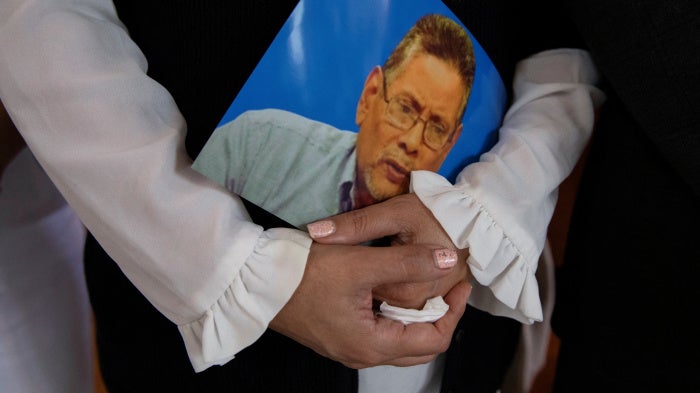
In June, Roberto Samcam, a retired army major and outspoken critic of Ortega, was killed at his home in San José, Costa Rica. He had previously received death threats linked to Nicaraguan security agents. In September, Costa Rican authorities detained four people in connection with the case; three are currently held in pretrial detention.
Since 2018, at least seven Nicaraguan critics in exile have been killed or attacked, according to Nicaraguan human rights groups. In September, the Group of Human Rights Experts on Nicaragua (GHREN) called for “robust protection mechanisms for exiled populations and comprehensive investigations into the transnational dimension of the threats they face.”
Freedom of Expression and Association
Authorities have largely dismantled civil society, cancelling the legal registration of thousands of NGOs since 2018. As of November, over 5,500 organizations, roughly 80 percent of active groups, had been shut down by the government, including human rights groups, humanitarian organizations, charities, and universities. At least 58 media outlets have been closed.
In November, a new telecommunications law entered into force, requiring public telecommunication and audiovisual providers to hand over location data and unrestricted system access to regulators, posing a threat to privacy, data protection, and freedom of expression.
Between 2018 and mid-2025, 293 journalists fled the country—the second-highest figure in the region.
Indigenous People’s Rights
Indigenous and Afro-descendant leaders have faced systematic persecution, including surveillance, arbitrary detention, prosecutions, and entry bans. In 2023, police arrested Brooklyn Rivera and Nancy Henríquez, two leaders of YATAMA, an Indigenous political party. Henríquez was sentenced in late 2023 to eight years in prison for “undermining national integrity,” Rivera’s whereabouts remained unknown at time of writing.
Access to Abortion
Nicaragua has prohibited abortion under all circumstances since 2006. Those who have abortions face up to two years in prison, and medical professionals who perform them face up to six. The ban forces women and girls to continue unwanted pregnancies, putting their health and lives at risk. In January, the UN Human Rights Committee found Nicaragua violated the rights of 12- and 13-year-old rape survivors by forcing them into pregnancy and motherhood, amounting to torture and violating their rights to life and dignity. The committee urged Nicaragua to “review its legal framework and ensure access to pregnancy termination services for all women and girls who are victims of sexual violence….”
Refugees, Asylum Seekers, and Migrants
Between 2018 and mid-2025, more than 342,000 Nicaraguans had sought asylum abroad, primarily in Costa Rica, the United States, Mexico and Spain. An additional 31,000 had been formally recognized as refugees. In July, the US government announced the termination of Temporary Protected Status (TPS) for Nicaraguans, ending protections for roughly 4,000 people. The measure entered into force in September; a court challenge to the termination was pending at time of writing.
During the first half of the year, US authorities returned over 2,100 Nicaraguans to Managua.
Justice and Accountability
In April, the UN Human Rights Council extended the mandate of the GHREN for two years. The group has found reasonable grounds to believe that authorities have committed crimes against humanity, including murder, imprisonment, torture, sexual violence, forced deportation, and persecution on political grounds. It has called on states to bring a case against Nicaragua at the International Court of Justice for violations of the UN Conventions on Statelessness.
In 2025, the government continued isolating itself from multilateral oversight. Between February and June, Nicaragua announced or formalized disengagement with the UN Human Rights Council, the Food and Agriculture Organization, the International Labor Organization, the International Organization for Migration, UNESCO, and the UN Refugee Agency. In March, Nicaragua also decided to not participate in the adoption of its UN Universal Periodic Review outcome. The government withdrew from the Organization of American States in 2023.
No international rights monitoring bodies have been allowed to enter Nicaragua since 2018.
Sanctions
In April, the US imposed visa restrictions on more than 250 Nicaraguan officials for undermining fundamental freedoms; in total, US visa bans now cover over 2,000 current or former officials. The US also maintains targeted financial sanctions on senior officials and state-linked entities.
In October, the European Union renewed sanctions against 21 individuals and three state-linked entities who it determined had undermined human rights, democracy and rule of law. The United Kingdom and Canada have sanctioned 17 and 35 individuals, respectively, for serious human rights violations.