The human rights situation in Mali deteriorated in 2025, as attacks against civilians by Islamist armed groups and abusive counterinsurgency operations by Malian armed forces and associated foreign fighters continued.
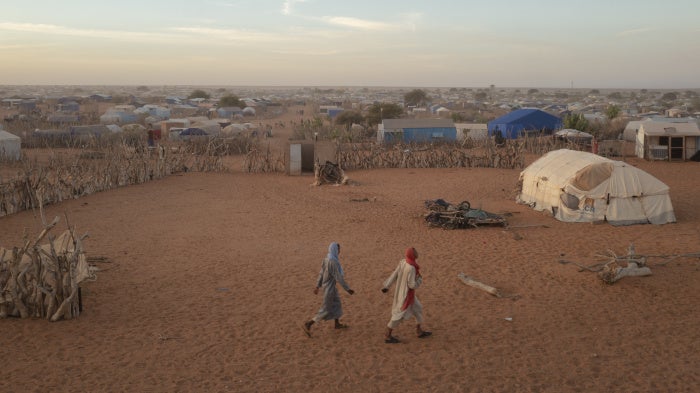
By late August, over 737,000 Malians were displaced within and outside of the country and 1.5 million people faced acute food insecurity.
The military junta, which came to power in a 2021 coup, cracked down on media, dissent, and the political opposition, narrowing civic space. Between April and July, the junta banned all political parties and elevated Gen. Assimi Goïta as president until 2030 without elections, formalizing a power grab to avoid a transition to civilian rule and denying Malians the right to freedom of expression.
In June, the Russia-linked Wagner Group announced that it was withdrawing from Mali after having “accomplished” its mission. Wagner fighters were replaced by the Africa Corps, a paramilitary group under the direct control of the Russian government that was created after the Wagner Group founder, Yevgeny Prigozhin, died in 2023.
In January, Mali, Burkina Faso, and Niger left the Economic Community of West African States (ECOWAS), limiting opportunities for citizens to seek justice for human rights violations before the ECOWAS Community Court of Justice. In September, the three countries announced their planned withdrawal from the International Criminal Court (ICC) treaty. Iyad Ag Ghaly, JNIM’s head, wanted by the ICC on charges of war crimes and crimes against humanity committed in Mali, remained at large.
Mali’s penal code punishes same-sex relations with up to seven years’ imprisonment.
Atrocities by Islamist Armed Groups
Several attacks by Islamist armed groups targeted communities or individuals that they accused of collaborating with the Malian armed forces.
On February 7, unidentified Islamist fighters attacked a civilian convoy escorted by Malian soldiers in northeastern Mali, killing at least 34 civilians. The fighters opened fire on the convoy when it reached Kobe village, and the soldiers returned fire. The attack occurred in an area where the armed group Islamic State Sahel (IS Sahel) had operated for over three years.
The Islamist armed Group for the Support of Islam and Muslims (Jama’at Nusrat al-Islam wa al-Muslimeen, or JNIM) has increasingly targeted Mali’s economic infrastructure to weaken government authority by blocking the delivery of services and access to key roads. JNIM has carried out sabotage operations on construction equipment along roads. Since September, the armed group has laid siege on the capital, Bamako, and cut fuel supplies. The siege disrupted transportation and access to electricity, forcing the junta to temporarily shut down all schools and universities.
On November 7, presumed JNIM fighters executed Mariam Cissé, a social media influencer in Tonka, Timbuktu region, accusing her of supporting the Malian army.
Abuses by State Security Forces and Allied Forces
Malian forces and fighters associated with the Russia-linked Wagner Group and Africa Corps were implicated in unlawful killings of civilians and destruction of civilian property during counterinsurgency operations. Many of the victims were ethnic Fulani. Islamist armed groups have concentrated their recruitment efforts within the Fulani community and government forces have long conflated the Fulani with Islamist fighters, targeting them for killings and other abuses.
On January 23, Malian soldiers entered Kobou village, Douentza region, searching for Islamist fighters. They killed three Fulani men, including two whose bodies were found blindfolded with their hands tied behind their backs. The soldiers also burned 30 homes.
On March 19, Malian soldiers and Wagner fighters beat and arrested 12 Fulani men at the cattle market in Kourma village, Segou region, accusing them of collaborating with JNIM. The military reportedly took the 12 men to their base in Sokolo. The following day, relatives of those arrested reported the incident to gendarmes in Sokolo, but no investigation has been opened, and the 12 men remain missing.
On March 30, Malian soldiers and Wagner fighters entered Belidanédji village, Segou region, and summarily executed six Fulani men to punish the local community for its presumed collaboration with JNIM. The same day, soldiers deployed outside the village arrested two Fulani men, tortured them with severe beatings, and took them to Molodo military base, where they were held incommunicado in a container for two weeks.
On April 12, Malian soldiers and Wagner fighters arrested about 100 Fulani men in the village of Sebabougou, Kayes region, accusing them of collaborating with Islamist fighters. The soldiers took the villagers to the Kwala military camp, about 30 kilometers away, where they apparently executed many. A United Nations report corroborated these findings.
On May 12, Malian soldiers conducted an operation in Diafarabé, along the Niger River in Mali’s central Mopti region, detained at least 27 Fulani men, and took them across the river. On May 15, a delegation of Diafarabé residents escorted by the military went to the site across the Niger River where the men had been taken and found 22 bodies in two mass graves. A survivor confirmed the executions and said the soldiers accused the victims of collaborating with JNIM.
On May 14, Malian soldiers, accompanied by Wagner fighters and Dozo militiamen (a predominantly ethnic Bambara militia), conducted a search operation in Sikere village, Segou region. They rounded up all ethnic Fulani people near the mosque, accused them of collaborating with JNIM, and shot four men dead.
On October 2, Malian soldiers and members of the Dozo killed at least 21 men, and possibly more, and burned at least ten homes, in Kamona village, Ségou region. Eleven days later, they killed nine men and a woman in Balle village, in the same region. Witnesses said soldiers and Dozo committed the abuses after accusing villagers of collaborating with JNIM.
Attacks on Civil and Political Rights
The junta cracked down on dissent, political opposition, and the media, shrinking the country’s civic and political space. Security forces arbitrarily arrested and forcibly disappeared several political opponents. Coup leader Assimi Goita has solidified his power, delaying the return to civilian rule.
In May, the junta adopted a bill abolishing multiparty politics across the country. The new law banned all opposition political meetings, speeches, and organizations. In July, the transitional parliament passed a law granting Goita a five-year presidential mandate, renewable “as many times as necessary” without an election.
On February 5, men in civilian clothes abducted Daouda Magassa, a critic of the junta, in Bamako. Magassa’s family and colleagues did not hear from him, despite requesting information from the authorities, until he was released on March 11.
Between May 8 and 11, three political opposition leaders and critics of the junta, Abba Alhassane, El Bachir Thiam, and Abdoul Karim Traoré, went missing in Bamako, sparking fears they may have been forcibly disappeared. Alhassane and Traoré were released in early June, while Thiam remains missing.
On August 1, security forces arrested former prime minister Moussa Mara after he published a tweet declaring his solidarity with political prisoners following his visits to several detained politicians. Charged with "undermining the credibility of the state" and "opposition to legitimate authority," he was sentenced to two years in prison on October 27.
On October 26, gendarmes in Bamako arrested and disappeared Cheick Oumar Diallo, former trade union member and prominent critic of the junta.
Accountability for Abuses
There was no progress in government investigations into several incidents of reported abuse.
Authorities have ignored calls for accountability and failed to uphold their international legal obligations to investigate serious rights violations by their security forces and Islamist armed groups and hold those responsible accountable.