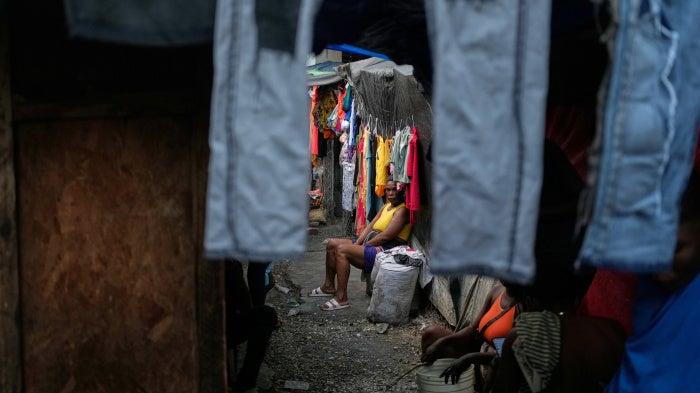
Haiti’s multidimensional political, economic, humanitarian, and human rights crisis deteriorated further in 2025. Criminal groups, allied under the “Viv Ansanm” coalition, consolidated their control over most of the capital and its metropolitan area, and expanded into three of the country’s ten departments.
They continued to commit widespread abuses, including massacres, killings, sexual violence, and child recruitment, significantly contributing to internal displacement, which totaled 1.4 million people in September. Haiti has the highest homicide rate in the world, according to some analysts.
Criminal groups’ control and attacks severely disrupted access to essential goods and public services. Over half of Haiti’s population (5.7 million people) experiences high levels of acute food insecurity and more than 6 million, including 3.3 million children, need urgent humanitarian assistance. The cancellation of most United States aid funding further weakened the humanitarian response.
Abuses by so-called self-defense groups also fueled violence, while the United Nations reported that by the end of September, more than half of all killings occurred during security operations.
Political instability persisted. Haiti’s transitional authorities, led by the prime minister and Transitional Presidential Council (TPC), established a “Task Force” that conducted armed drone operations against criminal groups. They also initiated a constitutional reform process and allocated funds for elections. In December, the TPC approved an electoral decree and calendar, scheduling a first round of elections for August 2026, a second round for December 2027, and definitive electoral results by January 20, 2027, contingent on an improvement in the security situation.
The UN-authorized Multinational Security Support (MSS) mission and the Haitian National Police continued to face significant staffing and funding challenges, which have prevented them from fully carrying out their mandate.
In September, the UN Security Council authorized the transformation of the MSS into a “Gang Suppression Force” (GSF) and established the UN Support Office in Haiti (UNSOH) to provide logistical and technical support to the GSF.
In October, hurricane Melissa flooded several regions of Haiti, killing 43 people, including 10 children.
Violence by Criminal Groups
Criminal groups control around 90 percent of Port-au-Prince and its metropolitan area and have expanded into previously secure areas and key regions in the Artibonite, Centre, and Northwest departments. They continue to control major roads, severely disrupting the delivery of essential services and humanitarian assistance.
The Office of the UN High Commissioner for Human Rights in Haiti reported that criminal groups killed at least 4,384 people between January and September 2025. They also injured 1,899 and kidnapped 491 people. By the end of September, they had carried out at least 13 massacres in the West, Centre and Artibonite departments, according to the National Human Rights Defense Network (RNDDH).
Between January and September, 1,270 cases of sexual violence, mostly attributed to criminal groups, were reported. Survivors had little to no access to protection and services. US funding cuts deprived approximately 750,000 women and girls of access to health care, psychosocial support, and emergency services, further limiting access that was already available to only a small fraction of survivors.
The annual report of the UN secretary-general on children and armed conflict covering developments in 2024 found that children in Haiti are subjected to some of the world’s highest rates of rape and sexual abuse, and of grave violations more broadly. Haiti is top five globally in those categories. Most children affected by grave violations were girls. At time of writing, at least 30 percent of criminal group members were children, who are used in criminal activities ranging from extortion to severe acts of violence, including killing and kidnapping.
Violence by Security Forces and Self-Defense Groups
Despite support from the US, Canada, France, and the UN in training, funding, and equipment, the police continue to face financial, logistical, and staffing constraints. Police officers have also been responsible for excessive use of force and other serious human rights violations during their operations against criminal groups.
At least 3,199 people were allegedly killed during police operations between January and August, 17 percent of whom were not involved in the clashes, according to the UN.
According to the UN, some police units allegedly conducted 174 summary executions between January and September 2025. As of September, the police internal affairs office had opened 90 investigations involving potentially excessive use of force by the police. None of these investigations had been completed at time of writing.
The prosecutor in Miragoâne continued carrying out and ordering extrajudicial executions, with at least 43 reported cases by September, which authorities have yet to investigate.
The government’s Task Force, reportedly led by the prime minister, began conducting drone operations with explosives in areas controlled by criminal groups in March, according to the UN. It killed at least 547 people, including 20 people with no criminal affiliation, and 9 of whom were children, by September 20.
Amid police failure to contain rising violence, self-defense groups have proliferated, sometimes reportedly operating alongside police units. As of September, they had killed 572 people in 2025 suspected of criminal group affiliation, including many with no verified links to the groups, according to the UN.
Key International Actors
The Kenya-led MSS mission has fewer than 1,000 personnel and has faced significant funding shortages. In 2025, it continued to join Haitian police in patrols and operations against criminal groups, particularly in Kenscoff, one of the capital’s last safe areas.
The mission engages in human rights monitoring, and has a complaints mechanism and a 24/7 toll-free hotline to make reporting more accessible to victims and whistleblowers. The UN had reported no human rights violations by members of the MSS at time of writing.
In September, the UN Security Council authorized transforming the MSS into a “Gang Suppression Force” (GSF). The new force is set to include as many as 5,550 personnel, comprised of police, military, and civilian staff, with the authority to act either independently or in coordination with the Haitian National Police. The GSF is authorized to conduct operations to neutralize criminal groups, protect critical infrastructure, support and build the capacity of Haitian security forces, facilitate conditions for elections and humanitarian access, and support anti-trafficking efforts. At time of writing, no new personnel had been deployed.
The US, Canada, the European Union, and the UN Security Council expanded measures against former Haitian officials and criminal groups, including arrests and targeted sanctions. The US designated two criminal groups, Viv Ansanm and Gran Grif, as Foreign Terrorist Organizations, indicted Jimmy Chérizier (“Barbecue”) and an associate, and arrested two businessmen accused of supporting criminal groups.
The UN Security Council sanctioned the Gran Grif and Viv Ansanm criminal groups, and the EU and Canada each sanctioned three additional individuals for inflicting violence and undermining stability in Haiti. In December, the US sentenced a former criminal group leader, Germine Joly, to life in prison.
The flow of weapons and ammunition into Haiti, largely from the US, has continued to fuel violence. Two bills to curb illegal arms transfers were under consideration in the US Senate and Congress at time of writing, and a UN arms embargo remained in effect.
Economic, Social, and Cultural Rights
The security crisis and political instability have compounded a dire humanitarian situation. According to World Bank estimates, over 66 percent of Haiti’s population of 11.9 million lived on less than US$3.65 per day.
About 5.7 million people in Haiti are facing acute food insecurity and 600,000 are experiencing famine, one of the highest rates worldwide, according to the World Food Programme.
As of 2023, the most recent date for which data was available, only 51 percent of Haitians had access to electricity, and only intermittently and at high prices. Some 35 percent of the population lacks access to clean drinking water.
Haiti’s health system continued to face near collapse. According to the Pan American Health Organization, about 40 percent of health facilities were closed in 2025 and 33 percent operated only partially as of April 2025, leaving two in five Haitians without access to essential medical care.
Médecins Sans Frontières, the only source of health care for victims of violence in some areas, suspended its operations at one of its medical facilities in the capital in March after its vehicles were fired upon, and permanently closed the facility in October.
Cholera remains a public health concern, with 2,852 suspected cases reported by the Ministry of Public Health as of October 2025.
According to UNICEF, over 1,600 schools have closed nationwide. Violence and occupation of educational facilities by criminal groups have disrupted the lives of 243,000 students and 7,500 teachers.
Transitional Government and Elections
Haiti has not held elections since 2016. Its parliament has been inactive since 2019, and the country has had no nationally elected officials since January 2023.
The TPC, whose mandate runs until February 6, 2026, allocated funds to security and border operations, and launched a constitutional review aimed at holding a referendum and elections before its mandate ends. In May, the TPC presented a new draft constitution and the prime minister announced $65 million in funding for the electoral process. The TPC cancelled the constitutional review project in October.
Justice System
The Haitian justice system continued to face significant challenges, largely due to ongoing violence and corruption, despite efforts to restore court operations and strengthen accountability mechanisms.
In April, authorities issued a decree creating two specialized judicial units to prosecute mass crimes, including sexual violence, and financial crimes. However, neither unit was operational by December.
Accountability for past and ongoing human rights violations, including massacres and sexual violence, remains nearly nonexistent.
In October, the Haitian Court of Appeal voided a judicial ruling in the Jovenel Moïse assassination case and assigned a new judge to restart the investigation. The decision overturned the indictment of 51 suspects and was a major setback for accountability efforts.
Some political actors, including former senator Prophane Victor and Magalie Habitant, were arrested and accused of supporting criminal groups.
As of September, Haiti’s prisons held 7,274 detainees, 81 percent of whom were awaiting trial. Most lived in inhuman conditions without adequate food, water, or health care, according to the UN. At least 139 died while in detention, mostly from malnutrition-related diseases.
In June, transitional authorities published a new Penal Code and Code of Criminal Procedure, which was due to come into force in December.
Access to Abortion
Haiti previously had a total ban on abortion. The new penal code decriminalized abortion before the eighth week of pregnancy, and at any time in cases of rape or incest, or when the mental or physical health of the pregnant person is in danger. At time of writing, the new penal code had not come into force.
Disability Rights
Haiti acceded to the Convention on the Rights of Persons with Disabilities in 2009, yet its legal framework still contains discriminatory provisions. According to the UN, approximately 16 percent of Haiti’s population has a disability, though no census has been conducted since 2003. Haitian people with disabilities face significant barriers to accessing essential services and experience pervasive discrimination and stigma.
Internal Displacement and Migration
As of September, 1.4 million Haitians, nearly half of them children, were internally displaced, many living in informal sites with little access to food, water, sanitation, or health care.
Haiti lacks a policy to assist internally displaced people. The UN’s Humanitarian Response Plan remains drastically underfunded, limiting international assistance.
As of mid-December, foreign governments had returned more than 251,000 people to Haiti despite the risk to their lives and physical integrity and a call by the UN High Commissioner for Refugees to extend refugee protection to Haitians under the 1984 Cartagena Declaration. The Dominican Republic carried out 98 percent of those repatriations, while Turks and Caicos and the US, among others, accounted for the rest. As of mid-December, the US had returned 1,159 people, according to the International Organization for Migration (IOM).
In the Dominican Republic, following the president’s announcement of 15 border control measures, security forces increased the detention and forcible repatriation of Haitian migrants. Many were pregnant and postpartum women and children, who under Dominican migration law should not be detained. Civil society groups reported widespread abuses during detention and deportation.
Despite efforts by the IOM and grassroots organizations, Haiti lacked the capacity to assist and reintegrate deportees.
In June, the US government announced the termination of Temporary Protected Status (TPS) for about 500,000 Haitians living in the US five months earlier than planned, but a court order kept the program in place until February. In December, the US government confirmed the program’s termination.