President Bernardo Arévalo took office in 2024 despite efforts by the Attorney General’s Office and other actors to block his inauguration. The Attorney General’s Office has since pursued politically motivated prosecutions targeting Arévalo administration officials, journalists, Indigenous leaders, and human rights defenders.
The country continues to face high levels of poverty, inequality, and structural discrimination against Indigenous peoples that have been entrenched for decades.
Judicial Independence
Opaque selection processes for justice officials, political pressure, and corruption continue to undermine judicial independence.
In 2026, Guatemala will select a new attorney general, Constitutional Court, Supreme Electoral Tribunal, and comptroller general.
In May, the UN special rapporteur on the independence of judges and lawyers warned that Guatemala’s appointment processes for senior justice officials are vulnerable to interference by corrupt actors.
In November, the Organization of American States (OAS) deployed a Special Mission to observe the appointments.
Arbitrary Criminal Prosecutions
Spurious criminal proceedings led by the Attorney General’s Office run by Consuelo Porras have undermined the rule of law and human rights protections.
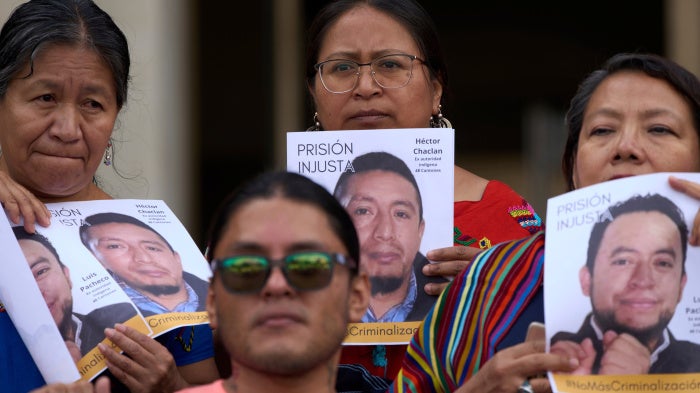
In April, police arrested Indigenous leaders Luis Pacheco and Héctor Chaclán for their role in peaceful protests in 2023 to prevent efforts to block President Arévalo’s inauguration. Prosecutors charged them with “terrorism” and other crimes, and a judge sent them to pre-trial detention, where they remained at time of writing.
In August, police arrested Indigenous leader Esteban Toc on similar charges; he remained on house arrest awaiting trial at time of writing.
In September, police arrested former student Edmar Arriola Toc for protesting the appointment of Walter Mazariegos as rector of the University of San Carlos (USAC) in 2022. The US sanctioned Mazariegos in 2023 for taking the post after “a fraudulent selection.” Toc faces charges of aggravated usurpation and damage to cultural heritage.
Ramón Cadena, a human rights lawyer, faces criminal charges for advising USAC students and faculty on the right to protest in 2022 and 2023.
Stuardo Campo has been behind bars since December 2023 on charges stemming from his work as an anti-corruption prosecutor.
Claudia González, a former prosecutor of the UN-backed International Commission against Impunity in Guatemala (CICIG), remained under criminal investigation for spurious charges at time of writing.
Other anti-corruption prosecutors, including Virgina Laparra and Juan Francisco Sandoval, remain in exile while they face criminal charges. In July, the UN special rapporteur on the independence of judges and lawyers said that over 50 justice system officials remain in exile.
The Attorney General’s Office has repeatedly sought to strip President Arévalo and members of his administration of immunity so that they can be criminally investigated for seemingly spurious charges. Judge Fredy Orellana, whom the EU and the US sanctioned for undermining democratic processes, ordered the cancellation of the registration of Arévalo’s Semilla party in November 2024. Orellana later ordered Semilla’s “absolute annulment” in an apparent attempt to remove elected Semilla officials from office, but the Constitutional Court struck down the ruling.
The president is due to appoint a new attorney general in May2026from a shortlist prepared by a nominating committee.
Attacks on Journalists and Human Rights Defenders
Arbitrary arrests and prosecutions of journalists and human rights defenders have created a hostile environment and undermined the right to freedom of expression and press freedom.
José Rubén Zamora, journalist and founder of El Periódico, was arrested in 2022 on money laundering charges. Zamora was detained for over two years before being released on house arrest. However, in March, a judge ordered him back to prison, where he remained at time of writing. The UN Working Group on Arbitrary Detention concluded that Zamora has been arbitrarily detained for exercising his right to freedom of expression.
According to the Journalists’ Association of Guatemala, 19 journalists remained in exile as of May 2025.
In 2024, Unidad de Protección a Defensoras y Defensores de Derechos Humanos de Guatemala (UDEFEGUA) documented over 4,000 incidents—including arbitrary prosecution, harassment, defamation, stigmatization, threats, intimidation, and violence—targeting human rights defenders, journalists, and justice officials.
According to the UNESCO Observatory of Killed Journalists, as of September, 23 journalists had been killed in Guatemala since 2015, including Ismael Alonzo González, who was reportedly investigating criminal groups when he was murdered in March. Only six cases have been “resolved,” meaning that the perpetrator was sentenced or died or that judicial processes determined the journalist’s killing was unrelated to their work.
UDEFEGUA reported that at least 28 human rights defenders were murdered in Guatemala in 2024, the highest reported figure since 2017. Global Witness documented the murders of 20 land and environmental defenders in 2024, compared to 4 in 2023. In November, the government adopted a public policy to strengthen protections for human rights defenders.
At time of writing, Guatemala had not ratified the Regional Agreement on Access to Information, Public Participation and Justice in Environmental Matters in Latin America and the Caribbean (the “Escazú Agreement”), a regional benchmark for protecting environmental human rights defenders.
Women’s and Girls’ Rights
Women and girls face structural barriers to justice, health care, education, and social security. These challenges are acute for girls who are survivors of sexual violence and experience forced pregnancy and motherhood. Between 2018 and 2024, nearly 15,000 girls ages 14 and under gave birth and became mothers, in many cases against their will.
Access to comprehensive health services for girls is severely limited. Long travel distances, shortages of trained personnel, and inadequate resources in health centers impair timely access to essential services and supplies, such as emergency contraception and prenatal, delivery, and postnatal care.
Guatemalan law permits abortion when the life of the pregnant person is at risk, but stigma and lack of awareness of the law among healthcare providers impede access.
Lack of support from schools and government, stigma, family pressure, and violence contribute to high dropout rates among pregnant girls. Social protection programs are inadequate; the Vida cash assistance program for pregnant girls and mothers under 14 has low coverage due to narrow eligibility and bureaucratic hurdles.
Gender-based stereotypes, mistreatment, and inaccessible government offices impede access to justice for girls who are survivors of sexual violence.
These barriers have a disproportionate impact on girls from rural and Indigenous communities.
Despite these challenges, 2025 saw critical legal victories in high-profile cases of violence against women and girls.
In August, six former government officials were sentenced to prison terms for their role in a 2017 fire that killed 41 girls and injured 15. The victims were locked inside a government-run shelter.
In May, three former paramilitaries were convicted by a Guatemalan court of crimes against humanity and sentenced to 40 years in prison for raping six Indigenous Maya Achi women between 1981 and 1983, during the internal armed conflict (1960-1996).
In June, the UN Human Rights Committee ruled that Guatemala had violated the rights of Fátima, a 13-year-old girl who in 2010 was forced to continue a pregnancy resulting from rape.
Economic, Social, and Cultural Rights
According to 2023 government data, 56 percent of Guatemalans live below the national poverty line. For Indigenous people, the poverty rate is 75 percent.
Guatemala has the highest rate of chronic malnutrition in Latin America. Nearly 47 percent of children under five are chronically malnourished, with the figure rising to 58 percent among Indigenous children.
Forty percent of Guatemalans lack access to indoor running water and nearly a third of households rely on a latrine, blind pit, or open-air defecation. Lack of adequate sanitation services, including wastewater treatment plants, results in widespread fecal contamination of water, posing serious health risks for those who depend on lakes and rivers as their primary source. In October, the Ministry of Environment and Natural Resources published a draft water law. At time of writing, the government had not yet introduced the initiative to Congress.
Guatemala’s 2023 tax-to-GDP ratio was 14 percent, well below the regional average of 21 percent, according to Organisation for Economic Cooperation and Development (OECD) figures. This limits the public resources available for rights-essential public services, including water and sanitation, health care, education, and social care services.
Forced evictions contribute to poverty, inequality, and lack of access to essential goods, particularly for Indigenous, peasant, and low-income communities. Inadequate demarcation and titling of Indigenous and ancestral land undermine economic and cultural rights and increase the risks of eviction.
Public Safety
Guatemala grapples with organized crime, drug trafficking, and institutional weaknesses in the justice system.
In August, several prison guards were taken hostage and one killed in prison riots. In October, the government announced that 20 alleged Barrio 18 gang members had escaped from a maximum-security prison. The following week, Congress designated the Barrio 18 and Mara Salvatrucha gangs as terrorist organizations, authorized the construction of additional maximum-security facilities, and increased penalties for certain crimes.
According to the National Economic Research Center (CIEN), Guatemala registered 326 more homicides from January to July than in the same period in 2024—a 21 percent increase that raised the homicide rate to 17.65 per 100,000 people.
According to the think tank Diálogos Guatemala, the Attorney General’s Office registered 25,151 complaints for extortion in 2024, a 39 percent increase from 2023.
Guatemala’s weak judicial system entrenches impunity. In July, the UN special rapporteur on the independence of judges and lawyers reported that the Attorney General’s Office had made indictments or won convictions in less than 9 percent of the 3.8 million case files it had closed since 2018.
Gender and Sexuality
Guatemala does not allow same-sex marriage or legal gender recognition for transgender people, and lacks comprehensive anti-LGBT discrimination legislation.
Guatemalan civil society groups reported at least 16 violent killings of LGBT people from January to August 2025.
Migration
Between January and August, over 27,000 Guatemalan migrants were returned to Guatemala from the US.
The Guatemalan government adopted the “Return Home Plan” to support returned migrants, opening reception centers to provide food, health care, and referrals to agencies for other needs, including legal support.
Sanctions
Several foreign governments, including the United States, United Kingdom, Canada, and the European Union, have imposed sanctions against Attorney General Porras and other justice officials for alleged corruption and actions undermining the rule of law.
In June, the EU imposed a new round of sanctions against three individuals and one entity, including against a criminal court judge, for the “persecution and intimidation” of prosecutors, other lawyers, and members of the media.