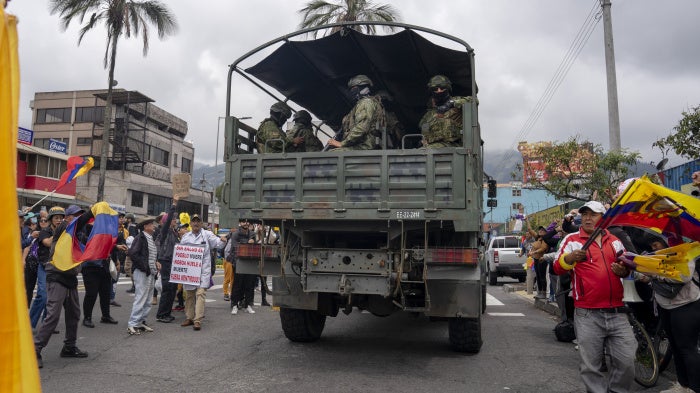
Ecuador continues to face high levels of violence, driven by organized crime. President Daniel Noboa’s security response has failed to curb violence and has led to increased reports of human rights violations.
The government has advanced laws and measures that endanger rights, undermine the independence and security of Constitutional Court judges, and threaten constitutional safeguards.
Longstanding structural problems, including limited access to health care and employment, remain largely unaddressed.
Ecuador was elected to the UN Human Rights Council for the 2026-2028 term.
Violence and Organized Crime
After declining in 2024, homicides increased sharply in 2025, by about 40 percent by September according to the Ministry of Interior, bringing Ecuador close to its highest homicide rate ever.
Between January and July 2025, the Attorney General’s Office recorded 9,522 extortion complaints, down 40 percent from 2024. Kidnapping reports declined slightly compared to 2024 but remained at high levels.
Organized crime groups have fragmented, giving rise to new groups. According to the Armed Conflict Location & Event Data monitor, the number of identifiable gangs increased 54 percent between 2023 and 2024.
“Internal Armed Conflict” and Human Rights Violations
Since January 2024, the government has repeatedly invoked the existence of an “internal armed conflict” in the country, which the Constitutional Court has called into question, to justify loosening human rights protections in its fight against crime.
The government’s response to organized crime has led to serious human rights violations by security forces, including extrajudicial killings, enforced disappearances, arbitrary arrests, and ill-treatment. On October 8, a judge sent 17 military officers to trial for the alleged enforced disappearance of four children unlawfully detained in December 2024 in Guayaquil and later found dead.
In June 2025, the Assembly passed laws granting the president broad powers to declare an “armed conflict,” dispense with crucial human rights protections, and expand intelligence gathering. The Constitutional Court struck some of them down.
Democratic Institutions and the Rule of Law
Democratic institutions remained fragile, plagued by impunity for abuses and by allegations of corruption.
Judges and prosecutors often lack basic tools and security to investigate organized crime groups. As of October, the Observatory of Rights and Justice had registered 10 attacks against the judiciary in 2025, including assassination attempts and killings of judges and prosecutors.
The government organized demonstrations against the Constitutional Court and senior officials called its judges “enemies of the people.” The UN special rapporteur on the independence of judges and lawyers, the UN high commissioner for human rights, and the Inter-American Commission on Human Rights expressed concern regarding threats to the independence and security of the judges.
In September, President Noboa issued a decree establishing a referendum to convene a Constituent Assembly to draft a new Constitution. He attempted to bypass the Constitutional Court’s review of the decree, as required under the Constitution, but electoral authorities ultimately referred the situation to the court. The court approved the referendum.
On November 16, Ecuadorians voted down the referendum proposals that included allowing the government to sign agreements to host foreign military bases and beginning a process to draft a new constitution.
Prison Conditions
Since January 2024, the military has overseen several prisons. As of August 2025, soldiers reportedly remained in 11 of the country’s 34 facilities. Since the deployment of soldiers to prisons, monitors have reported instances of corruption, incommunicado detention, physical abuse, and obstruction of medical care.
Media outlets and human rights groups reported that tuberculosis killed dozens of detainees during 2025, notably during an outbreak in a Guayaquil prison.
More than 500 detainees have been killed in violent confrontations inside prisons since 2021. As of November, prison massacres in Machala and Esmeraldas left around 60 dead and others injured.
Economic, Social, and Cultural Rights
As of June, 24 percent of Ecuadorians earned incomes below the nationally defined poverty line (US$92 per month) and 10.4 percent were experiencing “extreme poverty” (monthly income below $52), with rates much higher in rural areas (42 and 25 percent, respectively). The unemployment rate was just 3.9 percent, but 52.6 percent of workers were in the informal sector.
Almost 14 percent of Ecuadorians face undernourishment due to insufficient food consumption, according to the UN Food and Agriculture Organization.
The public healthcare system faces a severe crisis, including chronic shortages of medicines and food. In September, a patient advocacy group for people requiring dialysis warned that a clinic in Quito serving hundreds of patients would soon stop providing dialysis “due to the failure of the State to pay.”
Children’s Rights
Between 2014 and April 2025, the Ministry of Education received reports that 8,378 children suffered school-related sexual violence committed by teachers, students, and other school staff. Government measures to address these abuses have not progressed at the scale and pace needed.
Rising violence by organized crime groups has affected children, with 504 homicides of children aged 10 to 19 between January and June 2025, a 68 percent rise from 2024. Organized crime groups recruit children to engage in various roles; some are sexually exploited.
In June, President Noboa officially declared that preventing and eradicating the recruitment and use of children by non-state actors was a “national priority.” He ordered the creation of an interinstitutional committee tasked with formulating and implementing public policies to achieve this goal.
Later that month, the National Assembly passed amendments to the Child and Adolescent Code, raising sentences for children sentenced for crimes tied to the “internal armed conflict” from 8 to 15 years and prohibiting the use of any measures other than incarceration for children sentenced to five years or more. In February, the UN Committee on the Rights of the Child had urged Ecuador to allow the detention of children only as a last resort and for the shortest time necessary. The Constitutional Court struck down the amendments in September.
Environmental Protection and Indigenous People’s Rights
The government has not complied with a 2023 nationwide referendum establishing a moratorium on oil drilling in the Ishpingo, Tambococha, and Tiputini (ITT) area of Yasuní National Park. The Constitutional Court ruled that the government should end the drilling by 2024 but the government has dragged its feet, at times citing the country’s security crisis. As of September, most of the block’s 240 wells remained active.
In September, the Confederation of Indigenous Nationalities of Ecuador, joined by other Indigenous and social movements, conducted protests on cuts to diesel subsidies and the expansion of oil extraction in Indigenous territories.
Women’s and Girls’ Rights
Abortion is criminalized in Ecuador except in cases of risk to health or life, or rape, and even then access remains limited due to stigma, mistreatment, fear of prosecution, and restrictive interpretations of the law. Ecuadorian law fails to protect women and girls from violence and discrimination, undermining their autonomy and perpetuating gender inequality.
The Ministry of Women and Human Rights reported 429 violent deaths of women and girls as of late June, almost doubling the number reported during the same period in 2024.
That ministry is one of six that President Noboa merged in July, incorporating it into the Ministry of Government.
Sexual Orientation and Gender Identity
In January, the Constitutional Court ruled in favor of a transgender girl whose school failed to respect her gender identity (preferred name, uniform, bathroom access). The court ordered authorities to adopt a mandatory protocol for addressing sexual orientation and gender identity diversity in schools.
At time of writing the legislature had not taken action to align the law with other court orders to revise civil marriage provisions to include same-sex couples, regulate assisted reproduction, and allow same-sex couples to register children with their surnames.
The constitution prohibits same-sex couples from adopting children.
Internal Displacement and Migration
According to the Internal Displacement Monitoring Centre, the data analysis center of the Norwegian Refugee Council, in 2024 Ecuador had the region’s third-highest number of people displaced by violence, after Haiti and Colombia. The Ombudsperson’s Office estimates that 316,000 were displaced internally between 2022 and 2024.
Many migrants and asylum seekers in Ecuador struggle to obtain regular status and integrate. In August, Ecuador ended an agreement that simplified the procedure for Venezuelan citizens to obtain visas and residency in the country.
During a visit by US Secretary of State Marco Rubio, Ecuador said it would accept third-country nationals deported from the United States.
Freedom of Expression and Association
Journalists and civil society organizations have reported growing stigmatization, harassment, and attacks by organized crime groups and authorities.
In August, the National Assembly passed a law that allows authorities to shut down organizations that commit “grave” infractions, such as carrying out “unauthorized” activities. The law also allows authorities to freeze the bank accounts of groups without a court order.
Authorities restricted freedom of assembly and at times used excessive force in their response to anti-government protests that started in mid-September. They froze the bank accounts of environmental and Indigenous groups and leaders, claiming they had funded violent protests, and suspended community media outlets. Protesters were involved in some violent incidents.