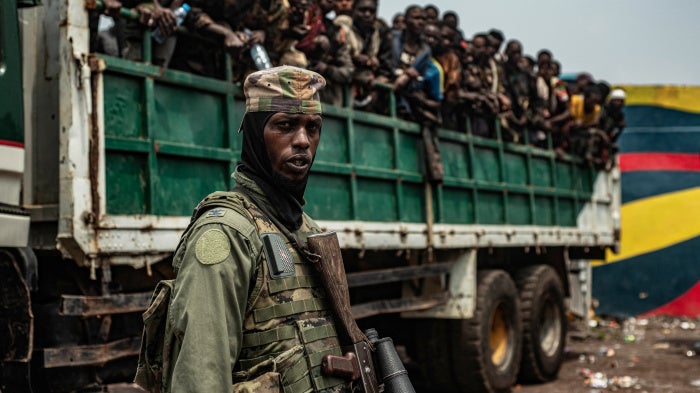
The human rights and humanitarian situation in the Democratic Republic of Congo worsened significantly in 2025 due to laws-of-war violations and other abuses in the east, including an increase in attacks on civilians by the ISIS-linked Alliance of Democratic Forces (ADF) armed group and fighting between the Rwandan-backed M23 armed group and the Congolese armed forces. Hostilities in North and South Kivu and Ituri provinces led to the killing of thousands of civilians, unlawful forced displacement of populations, and other abuses, including sexual violence, by armed groups.
The government’s crackdown on the opposition and the media continued, exacerbated by tensions in the east.
Civic, Media, and Political Space
Civic and media space remained restricted. Journalists and activists were targeted both by the Congolese authorities and the M23 and Alliance Fleuve Congo (AFC), a political-military coalition that includes the M23.
In January, the president of the Communication and Broadcasting Board (Conseil supérieur de l’audiovisuel et de la communication, CSAC) announced that Radio France Internationale, France 24, and TV5Monde’s Africa program could face suspension for reporting on “alleged advances of terrorists.” Ultimately, the CSAC took no action. Justice Minister Constant Mutamba warned that anyone sharing information about the M23 and Rwandan forces would face severe legal consequences, including possibly the death penalty.
The M23 and AFC have threatened, arbitrarily detained, and attacked journalists, critics, and civil society activists in North and South Kivu. They have also committed summary executions, including the killing of activist Pierre Katema Byamungu on February 12 and of singer and activist Delphin Katembo Vinywasiki, known as Delcat Idengo, on February 13, at his home.
In May, the senate stripped former President Joseph Kabila of his immunity, paving the way for his prosecution for allegedly backing the M23. Kabila had obtained immunity in 2019 when he was granted the title of “senator for life.” In June, Congolese authorities imposed a 90-day ban on any media coverage of Kabila or his party. On September 30, a military court sentenced Kabila in absentia, without defense counsel, to death, ruling he was guilty of treason, war crimes, conspiracy, and organizing an insurrection together with the M23. He was also ordered to pay US$34 billion in damages. His party denounced the trial and conviction as politically motivated.
Armed Conflict in the East
The M23 armed group, which constitutes an occupation force in eastern Congo, re-emerged in late 2021 with Rwandan government support. In January, it captured major cities in North and South Kivu and put civilians at risk. The M23 committed war crimes, including killings. indiscriminate shelling of civilians, sexual violence including gang rapes, and forced displacement.
On January 27, the M23 captured Goma, the capital of North Kivu, and largest city in eastern Congo, which normally has over one million residents and then housed over half a million displaced people. The fighting in Goma interrupted activities by humanitarian agencies and organizations, including those providing essential aid to the displaced and to communities that are at risk across North and South Kivu provinces. On February 16, M23 forces captured the city of Bukavu, the capital of South Kivu and the second largest city in eastern Congo.
In February, the M23 unlawfully ordered tens of thousands of people living in displacement camps around Goma to evacuate in 72 hours. In May, they rounded up as many as 2,000 people from the town of Sake and forcibly transferred them to Goma, 25 kilometers away. This appeared to be part of a broader M23 operation against suspected supporters of the Democratic Forces for the Liberation of Rwanda (Forces démocratiques de libération du Rwanda, or FDLR), a largely Rwandan Hutu armed group, some of whose leaders took part in the 1994 genocide in Rwanda. Their presence is one of Rwanda’s main arguments for their support of the M23.
The Congolese military and an allied coalition of abusive militias known as the “Wazalendo” (“patriots” in Swahili) have committed widespread abuses against civilians across eastern Congo. After the Congolese army’s retreat from the M23 offensive, the Wazalendo have taken control of several localities in South Kivu. They have beaten, killed, and extorted civilians. The Wazalendo have also targeted the Banyamulenge (South Kivu-based Congolese Tutsi), including by killing them, attacking villages, stealing goods, and threatening residents. The Congolese army continued to provide weapons, ammunition, and financial support to the Wazalendo. The Rwandan government and the M23 increasingly cited anti-Banyamulenge and anti-Tutsi sentiment to justify the M23’s resurgence and Rwanda’s support to the armed group. In September, a general strike and a protest led by Wazalendo fighters and civil society groups paralyzed Uvira for eight days. The protests were in response to the deployment of Gen. Olivier Gasita Mukunda to the city, who the Wazalendo alleged had colluded with the M23. He left the city following the protests.
Despite ongoing joint operations between the Ugandan armed forces and the Congolese army in Ituri, the ADF carried out several attacks against the civilian population throughout the year. Analysts pointed to the security vacuum and defeat of the Congolese army in Goma and Bukavu as factors explaining growing civilian casualties in the east. In July, the ADF killed more than 40 people, including women and children, during a nighttime church gathering in Komanda.
In August, a MONUSCO report stated that the ADF killed at least 52 people in Lubero and Beni.
In September, the ADF targeted civilians attending a funeral, killing at least 90 in Lubero, according to MONUSCO.
CODECO, a militia operating mainly in Ituri province, committed massacres and village burnings and displaced tens of thousands of civilians. In February, CODECO militants attacked several localities in Djugu territory, killing at least 51 civilians, and burning dozens of homes. In June, the group struck a displacement camp in Djangi, Djugu territory, killing 11 people and injuring a dozen others. On October 2 and 9, two attacks were recorded resulting in the deaths of 14 and 8 people respectively.
During 2025, hostilities caused massive displacements of the population. By September, nearly 122,500 people had fled eastern Congo to neighboring countries, including over 70,000 to Uganda and 40,000 to Burundi, and 5.7 million people had been internally displaced.
Humanitarian workers and members of international forces have been killed in the conflict in the east. Fourteen soldiers from the South African National Defence Force, as part of the regional Southern African Development Community (SADC) force in eastern Congo, were killed in January. Three Malawian soldiers and one Uruguayan peacekeeper were also killed during the first week of fighting after the capture of Goma. Thirteen humanitarian workers have been killed in eastern Congo since the beginning of the year.
International Responses to the Conflict
In February, the UN Human Rights Council (HRC) held a special session on the crisis in eastern Congo and decided by consensus to launch an urgent Fact-Finding Mission by the UN Human Rights Office as well as an independent Commission of Inquiry into the atrocities being committed by all parties to the conflict.
In September, the UN human rights chief presented the final report of his Office’s Fact-Finding Mission which concluded that grave and widespread violations and abuses committed by all parties to the conflict may constitute war crimes and crimes against humanity.
According to the Fact-Finding Mission, the M23 forcibly recruited thousands of civilians, including girls and boys, and transported them to camps where detainees were forced to work, given minimal food, beaten, sexually exploited, and some executed, before being sent to the front lines. Some stated that most of the guards and instructors at those camps were Rwandan nationals, including some Rwandan soldiers in uniform.
Despite the severity and urgency of the crisis, the set-up of the independent Commission of Inquiry mandated by the February special session was significantly delayed as a result of UN funding cuts. In October, a follow-up resolution at the HRC pressed the UN Human Rights Office to staff the inquiry and ensure a field mission could be carried out by January 2026 at the latest. Experts were appointed to lead the inquiry later that month, though staffing remained an issue.
In February, the United States government imposed financial and property sanctions on Lawrence Kanyuka Kingston, a Congolese national and spokesperson for the AFC. In August, the US sanctioned the armed group PARECO-FF and three other companies that allegedly profit from conflict minerals in eastern Congo.
In April, the US brokered the signature of a Declaration of Principles between Congo and Rwanda, which “outlines a pathway to peace, stability, and integrated economic development” in eastern Congo. On June 27, Congo and Rwanda signed a US-brokered peace deal, which aims to link economic integration and respect for territorial integrity with the promise of Western investment. Negotiations were ongoing in Doha, and the signature of the Regional Economic Integration Framework (REIF) was delayed. Fighting has continued, and the M23 announced in September the formation of over 7,000 fighters, composed of former Congolese army soldiers, Mai Mai, and Wazalendo fighters. The M23 also continued to strengthen its political authority, establishing a parallel administration in the area under its control.
A ceasefire and economic-integration pact between Congo and Rwanda brokered in Washington in December did not include effective measures to ensure justice or accountability for past atrocities. A few days later, the M23 captured Uvira, the last city under government control in South Kivu, putting the M23 in control of all of North and South Kivu provinces.
In October, a conference around humanitarian, human rights, and justice issues took place in Paris.
Justice and Accountability
The renewed International Criminal Court (ICC) investigation in Congo, which focuses on crimes committed in North Kivu since January 2022, continued.
In December, former warlord Roger Lumbala was convicted of complicity in crimes against humanity and received a 30-year prison sentence by a Paris court for crimes committed in Ituri and North Kivu in 2002 and 2003.