Azerbaijan’s poor human rights record continued to deteriorate as the government intensified its crackdown on independent media, political opponents, and civil society, silencing dissent, and further entrenching a climate of fear. Authorities also brought spurious criminal charges against exiled bloggers and journalists, convicting them in absentia, and continued to adopt and arbitrarily enforce laws paralyzing civil society. Torture and ill-treatment in custody persisted with impunity.
In continued contempt for international scrutiny, Azerbaijan suspended operations or expelled United Nations-affiliated organizations, including the UN Development Program (UNDP), the UN High Commissioner for Refugees (UNHCR), and the International Committee of the Red Cross (ICRC). Authorities also revoked accreditation for the remaining international media outlets.
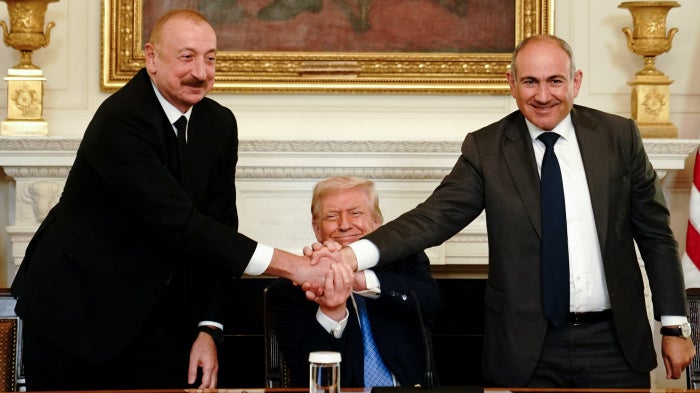
Armenian and Azerbaijan signed the US-mediated Washington Declaration in August, which set out a broad political framework for peace aimed at ending the decades-long conflict over Nagorno-Karabakh, establishing diplomatic relations, and promoting regional cooperation. The agreement grants the United States exclusive rights to develop a 42-kilometer trade route across Armenian territory that would also connect Azerbaijan proper with its Nakhichivan exclave. The agreement also led to the dissolution of the OSCE Minsk Group, the US-Russia-France-led conflict resolution format. Despite its stated commitments, Azerbaijan has taken no meaningful steps to ensure the right to return in safety and dignity for ethnic Armenians who fled Nagorno-Karabakh in September 2023, or to restore their property rights.
Freedom of Expression and Media
The government continued the crackdown on independent media that began in late 2023, targeting at least three independent media platforms: Meydan TV, Abzas Media, and Topum TV. In December 2024, the prosecutor’s office launched criminal proceedings against Meydan TV, Azerbaijan’s largest exile-based independent media outlet with staff members in the country. By August 2025, the authorities had detained at least 12 journalists associated with the outlet, including freelancers, on bogus smuggling charges. They later expanded the charges to include “illegal entrepreneurship,” “money laundering,” “tax evasion,” and “document forgery.” In the latest arrest, in August, authorities detained Meydan TV-affiliated photojournalist Ahmad Mukhtar and remanded him to pre-trial detention, where he remained at time of writing.
In June, a court convicted seven Abzas Media journalists on similar charges, including Ulvi Hasanov, Sevinc Vagifgizi, Farid Mehraliyev, Hafiz Babali, Nargiz Absalamova, Elnara Gasimova, and Mahammad Kekalov, and sentenced them to prison terms ranging from seven to nine years.
Authorities also pursued bogus prosecutions of Toplum TV journalists and staff, including Shahnaz Baylargizi, who was later released to house arrest due to health concerns, and journalist Farid Ismayilov, who remained in pretrial custody at time of writing.
Authorities suspended the broadcasting licenses of BBC Azerbaijan, Voice of America Azerbaijan, and Bloomberg services, and revoked accreditation for their journalists. In February, the well-known online outlet Turan News Agency announced its closure, citing financial difficulties.
In March, authorities opened criminal investigations against several exiled bloggers on various charges, including fraud, terrorism, incitement to mass riots, disobeying government orders, and attempting a coup. In June, district courts issued inabsentia arrest warrants against exiled journalists and activists, including Imameddin Alimanov, Suleyman Suleymanli, Elshad Mammadov, Mahammad Mirzali, Gabil Mammadov, Orkhan Aghayev, Gurban Mammadov, Tural Sadigli, Ordukhan (Babirov) Temirkhan, and former Azerbaijani International University Rector Elshad Abdullayev. All are known for their public online criticism of Azerbaijani authorities.
In July, a Baku court convicted Mammadov and Alimanov in absentia on multiple charges related to alleged crimes against the constitutional order, sentencing them to 16 and 7 years in jail, respectively. In September, a court sentenced Mirzali to six and a half years in absentia on similar charges.
Legislative amendments approved in August gave the government sweeping new powers to control media and non-governmental organizations (NGOs). The changes empowered the state-run Media Development Agency, inter alia, to ban outlets not registered with the official media registry. They also imposed additional onerous restrictions on foreign funding for NGOs, requiring prior official approval for service contracts or other external financial support. Penalties for non-compliance include fines up to approximately US$3,000 for individuals and $9,000 for legal entities.
Prosecution of Government Critics
Authorities continued to arbitrarily arrest and prosecute critics to suppress dissent. In January, a court convicted political activist Bakhtiyar Hajiyev on spurious charges of embezzlement, illegal entrepreneurship, smuggling, and other economic crimes, and sentenced him to 10 years in prison. Hajiyev’s colleague, Rail Abbasov, received a six-and-a-half-year sentence on fraud charges.
Authorities convicted labor rights activists Afiaddin Mammadov and Mohyaddin Orucov to eight and three years, respectively, on bogus hooliganism and drug trafficking charges.
In March, a court sentenced transgender activist Rauf Heydarov to 30 days’ detention on minor hooliganism and disobeying police charges after he joined an International Women’s Day protest with a poster of jailed women journalists. The same month, the Baku Grave Crimes Court convicted opposition leader Tofig Yagublu to nine years in prison on fabricated forgery and fraud charges.
In April, a court convicted Emin Ibrahimov, a former diplomat, to seven years’ imprisonment on bogus charges of inflicting serious physical harm.
In July, a court sentenced rap singer Epi (Akbar Novruzlu) to 30 days’ detention on alleged drug possession and minor hooliganism charges, after he made political remarks during a performance.
Authorities also targeted families of exiled critics. In April, police arrested Elmir Sadigov, the uncle of exiled blogger Tural Sadigli, on spurious weapons possession charges, and in October, a court sentenced him to two and a half years in jail. In January, authorities briefly imposed a travel ban on the mother of human rights defender Rufat Safarov.
In March, prosecutors launched investigations into NGOs for “illegal entrepreneurship” and “tax evasion,” leading to the arrests of veteran activists and directors Bashir Suleymanli, Mammad Mammadzade, Asaf Ahmadov, and Zamin Zaki. All four remained in pretrial detention at time of writing.
In June, a court convicted Bahruz Samadov, a scholar and peace activist, on bogus treason charges and sentenced him in a closed trial to 15 years in prison.
Also in June, a court sentenced Igbal Abilov, a Talysh minority researcher, to 18 years in prison on similar charges.
Freedom of Assembly
Authorities continued to severely restrict freedom of assembly and prosecute those who staged unauthorized peaceful protests.
In September, police thwarted several attempts by the opposition Popular Front party and National Council members to organize peaceful rallies.
In August, a court sentenced six women to three months’ pretrial detention after they were arrested for participating in a religious ceremony and chanting pro-Palestine slogans. They faced charges of unlawful religious activities. The police reportedly subjected them to inhumane treatment in custody.
In June, police detained about 50 people at a protest demanding a fair investigation into the death of 18-year-old student Elgun Ibrahimov, forcing them to surrender their phones and passwords. Authorities said Ibrahimov died from injuries sustained in a fall, after being found in the yard of an abandoned dormitory on May 13.
In January, after a police car fatally struck three schoolchildren in the southern region of Imishli, authorities arrested about 100 residents during the ensuing protests, placing them in detention, and sealing off the town with riot police. In July, a court sentenced 19 residents to prison terms of one to four years on hooliganism and disobedience charges, while withholding any information about the officer responsible for the crash.
Torture and Ill-Treatment
Reports of torture and ill-treatment in custody remained widespread.
In February, activist Jalal Javadov reported being tortured and forced to sign documents under duress after his arrest for protesting in support of jailed journalists.
In March, a court sentenced academic Fazil Gasimov to nine years in prison on spurious currency counterfeiting charges. Gasimov had testified in court that police put his head in a toilet and electroshocked him, among other things, to coerce him to incriminate Gubad Ibadoghlu, a renowned anti-corruption scholar and activist. At time of writing, Ibadoghlu had been under house arrest since April 2024, pending an investigation into bogus currency counterfeiting charges.
In May, police officers reportedly beat journalist Ulviyya Ali and civic activist Ahmad Mammadli while they were in custody. Authorities failed to conduct an effective investigation.
In July, the European Court of Human Rights found Azerbaijan in violation of article 3 of the European Convention for failing to effectively investigate credible torture allegations made by religious activist Taleh Baghirzade and journalist Fikrat Ibishbayli, both arrested in 2015 and sentenced to lengthy prison terms.