Yemen remains one of the world's worst humanitarian crises, with an estimated 19.5 million people in 2025 needing humanitarian assistance, 1.3 million more than in 2024. As the conflict entered its 11th year, warring parties, including the Houthis (Ansar Allah), the United Arab Emirates (UAE)-backed Southern Transitional Council (STC), and the Yemeni government continued to perpetrate extensive violations with impunity, including arbitrary detention and enforced disappearances. The US and Israel carried out attacks on Houthi-controlled areas, killing many civilians and including strikes likely amounting to war crimes. The Houthis have launched attacks on Israel and civilian ships and crews in the Red Sea, which include apparently indiscriminate attacks that have struck civilian objects and were likely war crimes. The Houthis have also continued to arbitrarily arrest dozens of UN and civil society staff.
Arbitrary Detention, Torture, and Enforced Disappearance
All parties to the conflict, including the Houthi forces, Yemeni government, and UAE-backed forces such as the Southern Transitional Council (STC) and the Joint Forces, have arbitrarily arrested, forcibly disappeared, tortured, and ill-treated detainees across Yemen. Hundreds of Yemenis have been detained at official and unofficial detention centers across the country.
Starting on May 31, 2024, the Houthis began a campaign of arrests targeting UN staff and civil society. Since then, they have arrested and forcibly disappeared dozens of people, including UN and foreign embassy staff, members of nongovernmental organizations, and employees of private companies operating in Houthi-controlled territories. As of December 2025, there were 69 UN employees in Houthi detention, including UN staff the Houthis detained in 2021 and 2023. The majority of those who were arrested still have not had any contact with their families, nor have they been given access to a lawyer.
These arrests were accompanied by a Houthi-led media campaign accusing humanitarian organizations and their staff of “conspiring” against the country’s interests through their projects and warning them of the dangers of “espionage.”
Repression of Free Speech
All warring parties, namely the Houthis, the Southern Transitional Council, and the Yemeni government have arbitrarily detained, forcibly disappeared, and tortured journalists and media workers throughout the conflict. The Houthis and the Southern Transitional Council continue to arbitrarily detain several journalists, including Mohamed al-Mayahi, Mohammed al-Nabhi, and Naseh Shaker.
The Houthis, the Southern Transitional Council, and the Yemeni government also continue to arbitrarily detain individuals engaged in peaceful protest, including on the basis of their social media posts.
Warring parties, namely the Houthis and the Southern Transitional Council, have shut down and taken over media institutions, and journalists across the country face arbitrary restrictions imposed by warring parties to their ability to access information and carry out their work.
Women’s and Girls’ Rights
The Yemeni government, the STC, and the Houthis have continued to crack down on women’s rights across the country. Houthis have increasingly restricted women’s freedom of movement and imposed a strict policy requiring women to travel with a male relative (mahram) or to provide written approval from their male guardian allowing them to travel, a policy that had not existed before. In the south, even though there is no official guidance banning women from traveling alone between governorates, women have reported being stopped at Yemeni government and STC’s checkpoints for several hours and sometimes forced to turn around.
Israeli and Houthi Attacks on Civilians and Civilian Infrastructure
In 2025, the Houthis continued attacking Israel with drones and missiles, including with likely indiscriminate attacks. The Houthis have directed attacks at Ben Gurion Airport several times since 2023. Human Rights Watch has called for these attacks to be investigated as war crimes.
Israel has also carried out strikes on Houthi-controlled territories of Yemen, some of which have claimed dozens of civilians' lives. Many of their strikes have clearly targeted critical civilian infrastructure, including ports through which humanitarian aid enters, power stations, and Sanaa Airport, likely amounting to war crimes.
On January 10, Israeli forces targeted Ras Issa and Hodeidah ports as well as Hezyaz power station in Sanaa. Hodeidah and Ras Issa ports are critical for delivering humanitarian aid, as well as food and other necessities, to the Yemeni population, the majority of whom rely on humanitarian aid. The strikes likely amount to war crimes.
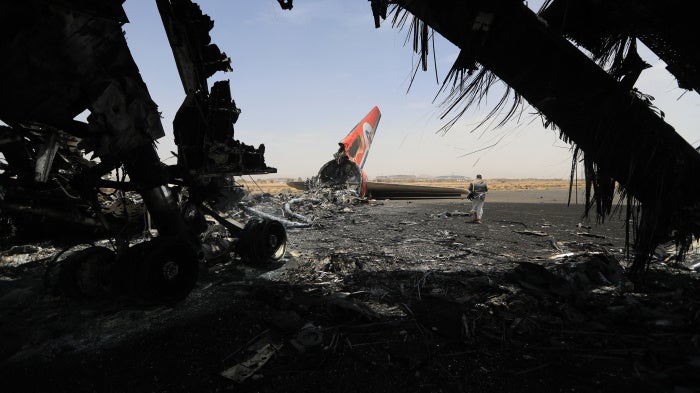
On May 6 and May 28, Israeli forces attacked Sanaa International Airport, severely damaging the airport and several civilian aircrafts. The airport is a critical lifeline for Yemeni civilians, many of whom rely on the airport as their only means to access needed medical care abroad, and the attacks should be investigated as war crimes.
On September 10, Israeli forces attacked a media complex in Sanaa, killing 31 journalists, according to the Committee to Protect Journalists.
US Attacks, Including Likely War Crimes
On April 17, US forces attacked Ras Issa Port in Hodeidah and killed 84 civilians and injured over 150 in an apparent war crime. Ten days after, on April 28, US forces struck a migrant detention center in Saada, killing over 68 civilians and injuring dozens more. In total, US airstrikes on Yemen between March 15 and May 6, killed at least 238 civilians and injured at least 467, according to the Yemen Data Project.
Houthis Red Sea Attacks
The Houthis continued attacks on commercial vessels which appeared to be war crimes in the Red Sea in 2025. On July 6 and 9, the Houthis attacked two commercial cargo vessels (Magic Seas and Eternity C). They sunk both ships, killed and injured several crew members, and unlawfully detained six rescued crew members.
As far as Human Rights Watch is aware, the Houthis continue to detain the crew members, though in January they released the crew members of the Galaxy Leader, whom they had arbitrarily detained since November 2023.
Harms Against Children in Armed Conflict
The Houthis and the Saudi- and UAE-led coalition have committed serious violations against children throughout the war. Indiscriminate attacks have destroyed schools and hospitals and killed or injured thousands of children. The Houthis have increased their recruitment of children into their armed forces under the pretext of defending Palestine.
Landmines and Unexploded Ordinance
Landmines and explosive remnants of war continue to be a major cause of civilian casualties and continue to cause displacement. In the village of al-Shaqb, on the frontlines of the conflict in Taizz, many civilians have been injured and killed from the Houthis’ placement of landmines. Between August 1, 2024, and June 31, 2025, 40 mine incidents killed 32 people and injured 27 others, including women and children, accordingto the United Nations Mission to Support the Hudaydah Agreement (UNMHA).
Sexual Orientation and Gender Identity
Yemen’s penal code prohibits same-sex relations. Article 264 punishes anal sex with 100 lashes and one year in prison if participants are not married. If married, the same article prescribes death by stoning. Article 268 punishes sex between women with up to three years in prison. In January 2024, a Houthis’ court sentenced 32 men, nine of them to death, in unfair mass trial based on dubious charges of sodomy, and the others to different sentences such as crucifixion and stoning, in addition to public flogging and imprisonment up to 10 years.
Abuses Against Migrants and Asylum Seekers
The International Organization for Migrants (IOM) estimated that 308,000 migrants would need humanitarian assistance, protection, and other services in 2024. In August 2023, Human Rights Watch reported on the mass killing of Ethiopian migrants by Saudi Border Guard forces at the Yemen-Saudi border. The report found that Saudi border guards killed hundreds of Ethiopian migrants and asylum seekers who tried to cross the Yemen-Saudi border between March 2022 and June 2023. If committed as part of a Saudi government policy to murder migrants, these killings, which appear to have continued, would be a crime against humanity.
Since the armed conflict began in Yemen in 2014, both the government and the Houthi armed group have detained migrants in poor conditions and exposed them to abuse.
Lack of Accountability
There has been virtually no accountability for violations committed by parties to the conflict. Since the UN Human Rights Council (HRC) narrowly voted to end the mandate of the Group of Eminent Experts on Yemen in October 2021, there has been no independent international mechanism to monitor the human rights situation in Yemen and lay the foundation for accountability for abuses.