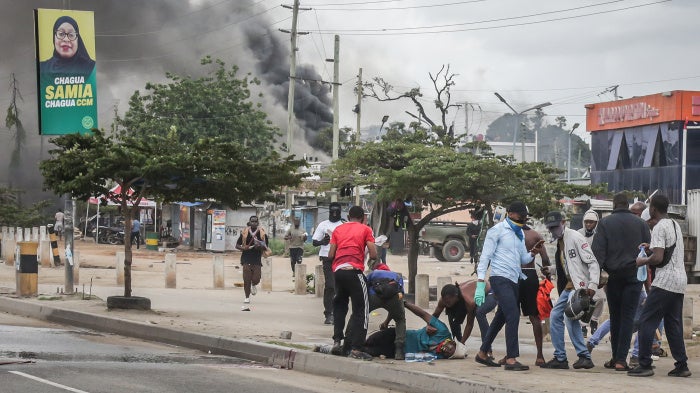
President Samia Suluhu Hassan was re-elected in October 2025 in elections marred by serious abuses. Law enforcement responded to protests that erupted on election day with unjustified lethal force among other violations, and the government imposed nationwide internet restrictions.
In the months leading up to the elections, the authorities intensified their clampdown on the political opposition, activists, and free expression. Government opponents and critics faced arbitrary arrests, violent attacks, abductions, enforced disappearances, and extrajudicial killings without the authorities holding those responsible to account.
Some political opposition parties and candidates were excluded from participating in the elections, while the government shut down websites critical of the government and blocked access to some social media platforms.
A landmark court ruling reversed legal provisions blocking the population’s access to public interest litigation. Despite making international commitments, Tanzania has not ratified the United Nations Convention Against Torture.
Media Freedom
In 2025, the authorities intensified online censorship. In May, Deputy Minister for Information, Culture, Arts and Sports Hamisi Mwinjuma announced that the Tanzania Communications Regulatory Authority (TCRA) had shut down over 80,000 websites, social media accounts, blogs, and online platforms for publishing “unethical content that poses a risk to children’s mental health,” without providing evidence for this claim. The TCRA has broad discretionary powers to license blogs, websites, and online content, including imposing hefty licensing fees on bloggers.
In the same month, the government blocked access to X (formerly Twitter), claiming that the site promotes pornographic materials. The authorities also reportedly restricted access to the social audio app Clubhouse and the Telegram messaging service.
The Chanzo, a digital media outlet, took down a video on its YouTube channel of a press conference by Bishop Josephat Gwajima, a member of parliament for the ruling Chama Cha Mapinduzi (CCM) party, against increasing abductions and other human rights violations. The TCRA had issued a directive to do so.
In September, the TCRA suspendedJamiiForums, a web forum that facilitates public discourse and whistleblowing, for 90 days for allegedly publishing “content that misled the public, insulted, and disrespected the government and the President.”
Freedom of Association
During a rally in April, authorities arrested Tundu Lissu, the leader of the main opposition party, Chama Cha Demokrasia na Maendeleo (Chadema). He remains detained and is on trial on fabricated charges, including treason, which is non-bailable and carries the death penalty. A May 8 European Parliament resolution condemned Lissu’s arrest and the charges against him, and called on the authorities to release him and end the escalating crackdown on critics.
In the same month, the Independent National Electoral Commission (INEC) banned Chadema from participating in the upcoming election and in by-elections until 2030 because of its refusal to sign a code of conduct by April 12, 2025, although the relevant law, the National Elections Act, does not clearly state the timeline. In August INEC blocked the nomination of Luhaga Mpina, the presidential candidate of ACT-Wazalendo for mainland Tanzania.
The government in June withdrew the registration of the Ufufuo na Uzima Church, after its founder Bishop Josephat Gwajima was vocal about human rights violations. The Home Affairs Ministry said these remarks sought to pit the government against its citizens.
Enforced Disappearances and Attacks on Government Critics
On January 12, 2025, unidentified people abducted Maria Sarungi Tsehai, a prominent media owner and critic of President Hassan, in Nairobi, Kenya. They blindfolded and handcuffed her, while repeatedly asking for the passcode to her phones. Speaking to the media following her release, Sarungi said, “I’m sure that the reason for the abduction was to get access to my social media and [because of] the whistleblowing job that I do.”
On May 2, unidentified individuals beat and abducted opposition activist Mpaluka Nyagali, known as Mdude, from his residence in Mbeya, in southwestern Tanzania. On July 9, the Mbeya High Court dismissed a habeas corpus petition filed by Sije Mbigi, his wife. Mdude’s whereabouts remain unknown. The police denied involvement in his abduction.
On June 16, unidentified assailants beat Japhet Matarra, a frequent critic of the government on X, with a metal bar until he lost consciousness. Unknown people attacked him again while he was waiting for surgery in the hospital.
In October, relatives reported Humphrey Polepole, a former Tanzanian ambassador to Cuba and government critic, missing. Polepole had resigned from his position in June and publicly criticized the ruling CCM party for not being “aligned with safeguarding human rights, peace, and respect for people.”
UN human rights experts said more than 200 cases of enforced disappearance of opposition leaders, their supporters, and human rights defenders have been recorded in Tanzania since 2019.
Legislative reform
On June 13, the Court of Appeal declared unconstitutional the provisions of the Basic Rights and Duties Enforcement Act, amended in 2020, which required anyone wanting to bring a legal case to establish how a violation has “affected them personally.” The law precluded groups from filing cases on behalf of victims that raise important public interest issues, unless they demonstrated they were direct victims.
Torture
In May, security officials in Dar es Salaam abducted, beat, and tortured Kenyan and Ugandan activists Boniface Mwangi and Agatha Atuhaire, who had traveled to observe Lissu’s trial. Mwangi was dumped in Ukunda, Kenya, four days after his abduction, and the next day Atuhaire was dumped in the border area between Tanzania and Uganda. Both said the officers had sexually assaulted them.
Although a signatory to the UN Convention Against Torture, Tanzania has yet to ratify the treaty. Although the constitution prohibits torture, no such prohibition appears in the penal code, making it difficult to hold abusers criminally accountable.
Indigenous Peoples’ Rights
In February, President Hassan launched two committees to address land conflicts in the country’s northern Ngorongoro district. One was established to “assess the land dispute” in the Ngorongoro Conservation Area (NCA), and the second to examine the government’s “voluntary” relocations of residents from the NCA to Msomera village in Handeni, Tanga Region, more than 600 kilometers away. The committees had a three-month mandate. To date, no official reports have been released. Human Rights Watch found in 2024 that the government had made life increasingly difficult for the estimated 100,000 Indigenous Maasai pastoralists living in the conservation area by reducing the availability and accessibility of public services, forcing many to relocate. The government removed some of these restrictions pending the conclusion of the committee’s investigations.
Sexual Orientation and Gender Identity
The Sexual Offenses Special Provisions Act of 1998 punishes “gross indecency” and “unnatural sexual intercourse” with up to life imprisonment. It is used to criminalize consensual same-sex relations. Lesbian, gay, bisexual, and transgender individuals report growing levels of discrimination, violence and harassment.
Disability Rights
In 2024, the Tanzanian government launched a National Action Plan for Persons with Albinism. In February 2025, the African Court on Human and Peoples’ Rights delivered a landmark judgment holding Tanzania accountable for human rights violations against persons with albinism, including systemic discrimination and targeted killings.
Discrimination in Education
Despite revoking its school ban against pregnant girls and adolescent mothers in 2021, the government failed to remove administrative barriers to girls re-enrolling after pregnancy, including up to two years for student-mothers to re-enter school, and a prohibition on readmission of girls pregnant a second time.