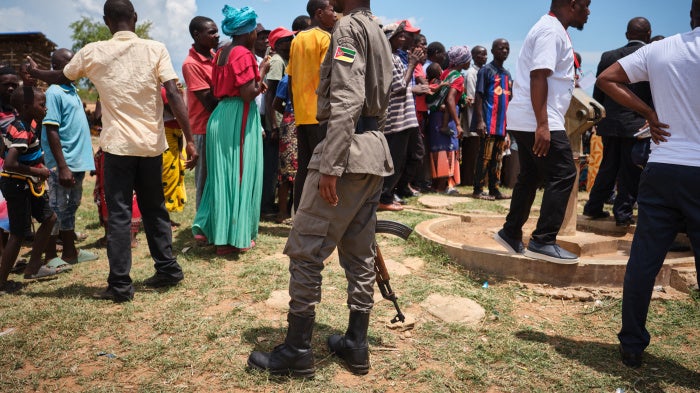
Mozambique’s human rights situation in 2025 was marked by the intensifying conflict in Cabo Delgado, food insecurity, and violent repression of post-election protests.
The Cabo Delgado conflict led to more displacement, with those forced from their homes struggling to access healthcare services and humanitarian aid. The Islamic State (ISIS) linked armed group, Al-Shabab, ramped up abductions of children in the region.
The violence, after the contested October 2024 elections, continued with security forces using lethal force and arbitrarily arresting protesters. From October 2024 to March 2025, unidentified gunmen, some wearing security force uniforms, shot dead at least 10 opposition party officials. There is still no accountability despite the Attorney General starting a hearing into the police’s involvement in the abuses during the post-election crackdown.
Cabo Delgado Armed Conflict
The armed conflict in Cabo Delgado province between the government and an armed group linked to ISIS intensified in July, August, and September. Since January 2025, according to the United Nations, over 95,000 people have fled insecurity in the region, with Chiúre, Ancuabe, and Muidumbe the most impacted. The conflict has negatively affected access to public health care and humanitarian aid. Fighting led to humanitarian organizations suspending activities, and armed groups’ ransom demands and extortion hindered movement for aid workers.
Children continued to be among the most affected by the Cabo Delgado conflict. ISIS attacks caused the displacement of thousands of people. Of the 7,000 displaced in Cabo Delgado in May, 57 percent were children, according to UNICEF.
Al Shabab increased abductions of children using them to transport looted goods, for forced labor, and as fighters against government forces. Some children were forced to marry insurgents. UNICEF and the Mozambican Ombudsman launched a Child Help Line (Linha Fala Criança) in Cabo Delgado in September to encourage reporting of child marriage, sexual and gender-based violence, and the lack of access to education.
Attacks on Human Rights Defenders
Journalists and human rights activists reported cases of kidnappings, murder attempts, threats, and harassment.
In January, journalist and political activist Arlindo Chissale was forced out of a minibus taxi by men in military uniform in Cabo Delgado. He was forcibly disappeared. Fifteen days after his abduction, Chissale’s family confirmed his torture and death to the media. As of October, his body had not been retrieved.
In June, Mozambican soldiers temporarily detained, questioned, and seized the equipment of 16 journalists in Macomia, Cabo Delgado.
In July, journalist Selma Marivate, who is based in Germany, said that she may have been poisoned with heavy metals during a work trip to Maputo. A toxicological analysis carried out in Berlin confirmed heavy metal intoxication, including mercury, cadmium, uranium, and thallium, some in dangerously high concentrations.
The authorities have not publicly provided details of any investigations into these cases.
Food insecurity
The country continued to experience an El Niño-induced drought. According to a report by the International Red Cross and Red Crescent, agricultural outputs significantly reduced in provinces such as Tete and Manica in the central region and Gaza and Inhambane in the south due to below-average rainfall. Around 2.1 million people faced crisis levels of food insecurity between April and September 2025, according to the European Commission.
Post-Election Violence
Mozambican security forces responded to protests after the October 2024 elections with unlawful killings, excessive and lethal force, and arbitrary arrests of opposition supporters.
Unidentified gunmen, some wearing security force uniforms, shot dead at least 10 opposition party officials from October 2024 to March 2025. Authorities failed to credibly investigate the wave of political killings following the elections.
The post-election violence severely affected many children. Security forces deployed to suppress nationwide protests killed dozens of children and detained hundreds, in many cases for days, without notifying their families, in violation of international human rights law.
The former commander-general of the Mozambican police, Bernardino Rafael, appeared before the Office of the Attorney General (Procuradoria-Geral da República) for a hearing about the police’s involvement in the killing of about 400 people during the civil unrest that followed the elections. President Daniel Chapo had dismissed Rafael in January 2025. As of September 2025, the results of his hearing had not been made public.
Women’s Rights
Mozambique experienced an increase in reported cases of gender-based violence, in particularly killings. As of September 2025, a local women’s rights group “Observatorio da Mulher,” had recorded at least 43 cases of femicide and 42 cases of rape against women and girls. President Chapo urged law enforcement institutions to step up actions to combat female homicide, particularly in the central region, admitting that they are of “alarming proportions.”
Business and Human Rights
In March, the Office of the Attorney General of Mozambique confirmed the opening of a criminal investigation into allegations of human rights violations committed in 2021 by Mozambican security forces, including members of the Joint Task Force protecting TotalEnergies’ Mozambique liquefied natural gas (LNG) project in the Cabo Delgado. Total denied knowledge of the alleged rights violations. The outcome of the investigations was still unknown as of September 2025. In July, community leaders in Cabo Delgado, supported by various human rights and environmental organizations, requested the Office of the UN High Commissioner for Human Rights to establish an independent investigation into the case.
In central Manica province, authorities announced the suspension of gold mining operations, following reports of river pollution, forest destruction, and risks to the health and safety of communities, which President Chapo referred to as an “environmental disaster.”