Claudia Sheinbaum, who became the first woman to serve as Mexico’s president in October 2024, inherited serious human rights challenges, including extreme criminal violence and grave abuses by the military.
Her predecessor, Andrés Manuel López Obrador, presided over a process of democratic backsliding, undermining judicial independence, transparency, and the rule of law. At the same time, 13 million people were lifted out of poverty during his government.
With the backing of Sheinbaum and López Obrador, Congress passed a justice reform in September 2024 that could severely undermine judicial independence. The amendment mandated that all judges in the country run for election, the first of which was held on June 1.
Security and Criminal Violence
Violence, which increased dramatically after the government announced a “war on drugs” in the mid-2000s, continued at extremely high levels. The official 2024 homicide rate stood at more than 25 per 100,000 inhabitants, one of the highest in the world.
Official figures released in August indicated that more than 1,800 people had been killed in Sinaloa since a kingpin was taken to the United States and detained in July 2024, triggering fighting between factions of the Sinaloa cartel.
In May, two advisors to the Mexico City mayor were murdered. At time of writing, authorities had detained two people allegedly involved in the crime, but had yet to identify the person who ordered the killings and the motivations behind it.
In September, police in Paraguay detained the former secretary of security of the state of Tabasco and expelled him to Mexico on charges of collusion with cartels.
In November, the mayor of Uruapan, Michoacán, who had openly denounced criminal groups in the area and pointed out their links to state politicians, was murdered.
Authorities estimate that around 70 percent of firearms recovered at crime scenes in Mexico were trafficked from the US. In June, the US Supreme Court dismissed a legal action brought by Mexico against some US arms manufacturers.
Access to Justice
Impunity remains widespread.
Prosecutors solve approximately one in ten intentional homicides they investigate, in many cases with evidence that has been altered, fabricated, or obtained through threats or torture. Prosecutors’ offices often lack qualified investigators, basic materials and resources, and adequate protection to carry out their work.
In September 2024, Congress passed a constitutional amendment that requires all state and federal judges, including Supreme Court and Electoral Tribunal justices, to step down and be replaced through popular elections in 2025 and 2027. The amendment also created a new “Judicial Disciplinary Tribunal” with broad powers to sanction or remove judges. The constitutional change threatens judicial independence in the country and fails to address key obstacles Mexicans face to access justice.
In June, Mexico conducted popular elections to appoint half of the judiciary, including 881 federal judges and members of the Supreme Court. The elections were marked by low turnout and concerns about the integrity of the process.
The United Nations Special Rapporteur on the independence of judges and lawyers expressed concerns during the process and after the election said that “the deficiencies observed in this first election jeopardize institutional integrity and public confidence in the justice system.”
In November 2024, Congress re-elected Rosario Piedra Ibarra as head of the Ombudsperson’s Office, a supposedly independent agency charged with protecting human rights. During her first tenure in office (2019-2024), she repeatedly failed to subject the López Obrador administration to robust, meaningful scrutiny.
Torture
Police officers, prosecutors, and soldiers continued to use torture. In June, the Federal Institute of Public Defense, which is part of the federal judiciary, had documented 3,177 incidents reported as acts of torture, involving 4,100 victims between 2019 and 2025.
The World Organisation Against Torture, a human rights group, said in June that torture continued to be a “widespread practice” in Mexico.
Arbitrary Detention
Congress passed a series of laws, the most recent one in April, to expand mandatory pretrial detention. The Inter-American Court of Human Rights has twice ordered Mexico to eliminate mandatory pretrial detention because it is incompatible with human rights standards.
In September, Congress approved a reform that makes it harder for people to request injunctions (“amparo”) against judicial decisions ordering the pretrial detention of detainees. It also limits judicial protection in collective matters such as environmental protection.
Around 40 percent of those imprisoned in the country have not been sentenced. They remain in prison with harsh conditions, including overcrowding and lack of medical and mental health services. Media outlets, human rights groups, and public defenders have reported an increase in suicide among female detainees in some prisons.
Military Abuses
The government has continued to expand the use of the military in public security and civilian tasks.
In November 2024 and July 2025, Congress passed laws transferring the National Guard, a force deployed to carry out public security tasks, to the control of the Army.
The military continued to carry out extrajudicial executions. Human rights groups and media outlets reported several cases of abuse, including the killing of two girls, aged 7 and 11, in Sinaloa in May.
In August, residents of Cozumel set fire to a military garrison after accusing a soldier of raping a 9-year-old girl.
The military and the Ministry of Defense continued to deny the military’s role in human rights violations. Organization of American States (OAS) experts said in 2023 that the military had obstructed the investigation into the unresolved disappearance of 43 students in Ayoztinapa in 2014. During the first year of President Sheinbaum’s administration, the military continued to refuse to hand over relevant documents to the new special prosecutor appointed to the case in July.
A government-mandated “Truth Commission” found in 2024 that the military committed “systematic and widespread” human rights violations between 1965 and 1990, but the Ministry of Defense has still not acknowledged the military’s responsibility for the crimes.
In September, the government acknowledged that there were corrupt links between the Navy and criminal groups involved in the illegal trafficking of diesel.
Disappearances
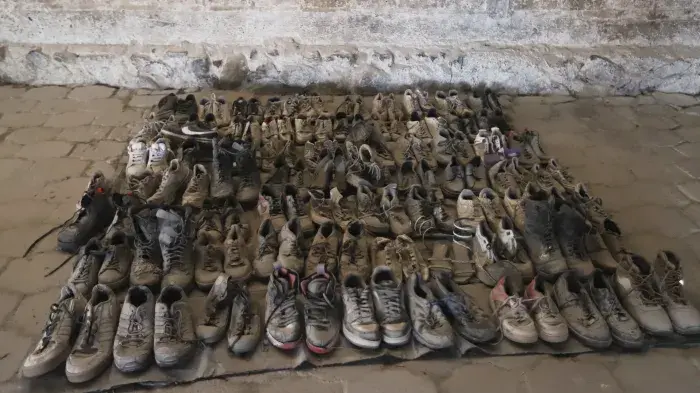
Thousands of people continue to disappear in Mexico every year, with the official total in 2025 reaching more than 130,000 individuals (the total includes cases reported since 1952). Authorities have not taken sufficient measures to prevent these disappearances and hold those responsible to account.
In March, a local group of volunteers who search for missing people reported the discovery of hundreds of shoes, clothing items, charred human remains, and what appeared to be several underground ovens on a ranch outside the city of Guadalajara, in the state of Jalisco.
That same month, the UN Committee on Enforced Disappearances initiated, for the first time in its history, a review under article 34 of the International Convention for the Protection of All Persons from Enforced Disappearance into whether enforced disappearances in Mexico were “widespread or systematic.” President Sheinbaum denied that there was a “policy of disappearances” in the country and the speaker of the Senate said he would ask the UN to “sanction” the president of the committee.
Relatives of disappeared people continued to face risks. Human rights groups reported in September that eight people looking for the disappeared had been killed in 2025.
Privacy and Access to Public Information
In November 2024, Congress reformed the Constitution to shut down the National Institute for Access to Information and Personal Data Protection, an independent government body, and transfer its powers to an agency within the Ministry of Anti-Corruption, which began operating in May. Article 19, a press freedom group, reported that the new agency undermined public access to information, ruling against most of the of the petitions.
In July, Congress passed a law creating new mandatory identity and cell phone registries. The law grants authorities virtually unlimited power to access information about citizens without judicial authorization.
Attacks Against Journalists and Human Rights Defenders
Mexico remained one of the most dangerous countries in the world for the press. Article 19 reported in November that seven journalists had been killed in 2025.
Article 19 also reported that authorities and individuals connected to them launched 51 cases of “judicial harassment” against journalists and critics between January and August.
Mexico remained a dangerous country for human rights defenders. In April, the body of Sandra Domínguez, an Indigenous human rights lawyer who had disappeared months earlier, was found in Oaxaca.
Migrants and Asylum Seekers
In April, the UN Committee on the Protection of the Rights of All Migrant Workers and Members of Their Families examined Mexico’s compliance with the International Convention on the Protection of the Rights of All Migrant Workers and Members of Their Families. The body acknowledged the assistance provided to Mexican workers abroad, but expressed concern about the apparent “outsourcing of border control by US authorities” and the “militarization of migration management.”
According to Mexican authorities, as of April, Mexico had received nearly 39,000 immigrants deported from the US, including 33,000 Mexicans. Humanitarian groups have expressed concern about the risks faced by deportees due to criminal violence in areas like Tapachula.
According to the UN Refugee Agency (UNHCR), in 2024 the Mexican Commission for Refugee Assistance received “almost 80,000 asylum and refugee applications.” UNHCR estimated that the figure could be even higher in 2025. Despite the increase, the Mexican Commission for Refugee Assistance faced budget cuts, partly due to US foreign aid cuts.
Women’s and Girls’ Rights
In November 2024, Congress amended the Constitution to recognize women’s rights and mandated gender parity in elected positions. In January, President Sheinbaum created the Ministry of Women.
In July, Mexico appeared before the UN Committee on the Elimination of Discrimination against Women. The committee welcomed the election of the country’s first female president, while noting “an increase in gender-based violence against women and girls committed by state and non-State actors.”
In June, Guanajuato’s Congress voted against a bill that would have decriminalized abortion. Supreme Court rulings protect women and girls from criminal prosecution for abortion and 24 of the country’s 32 states have explicitly decriminalized abortion. However, gaps persist in women’s sexual and reproductive health care, particularly for rural and Indigenous women. Maternal mortality remains high in some regions, and reports of obstetric violence continue.
Femicide continues to be a “major concern.” According to official figures, 444 women and girls were murdered during the first half of 2025.
Sexual Orientation and Gender Identity
Same-sex marriage is available in all 32 states. In 2025, Veracruz state passed a law allowing transgender people to change their names and gender markers on birth certificates through a simple administrative process, bringing the number of states that have done so to 23.
Lesbian, gay, bisexual, and transgender (LGBT) people continued to face violence. According to the National Observatory of Hate Crimes Against LGBT People, run by human rights groups, 31 people were killed between January and September due to their sexual orientation or gender identity.
Rights of Older People and People with Disabilities
In December 2024, Congress amended the Constitution to guarantee a pension for people living with a “permanent disability” and to require the government to ensure “rehabilitation and habilitation.” At time of writing, the disability pension covered about 1.5 million of the 8.8 million people with disabilities officially registered in Mexico.
Also in December 2024, Mexico City’s Congress reformed civil law to abolish guardianship and recognize full legal capacity for all people aged 18 and older, including people with disabilities and older people.
Congress also changed the Constitution to establish that adults 65 and older are entitled to a non-contributory pension from the state.
Indigenous People’s Rights
In September 2024, a Constitutional reform strengthened the recognition of the rights of Indigenous and Afro-Mexican peoples, for instance, by explicitly recognizing their right to be consulted in decisions regarding administrative or legislative measures that significantly affect them.
Policies on Climate Change and its Impacts
The Sheinbaum administration announced plans in August to ensure that 35 percent of electricity generation comes from renewable sources by 2030.
Economic, Social, and Cultural Rights
According to official numbers, from 2018 to 2024, a total of 13.4 million people in Mexico were lifted out of poverty and 1.7 million out of extreme poverty. Official studies indicate that 6.6 million of them were lifted out of poverty mainly due to increases in the minimum wage. Since July, the government has begun implementing new labor rules requiring digital platform companies to register workers with the Social Security Institute and contribute based on their net income.
Foreign Policy
In October 2024, Mexico was elected as a member of the Human Rights Council for the 2025-2027 term.
Mexico has supported efforts to advance a treaty on crimes against humanity. But Mexico has been ambivalent regarding some of the most critical human rights situations in Latin America, often invoking the doctrine of “non-intervention.”