Two rival entities continued to compete for control of Libya’s territory, resources, and international legitimacy amid deep political divisions, rising repression, and armed confrontations.
Fragmentation and systemic shortcomings persisted in Libya’s judicial institutions as abusive militias operated with near impunity. The judiciary remained unwilling and unable to meaningfully investigate serious crimes.
Inhumane conditions and serious abuses persisted migrant detention centers and prisons in Libya controlled by abusive, unaccountable armed groups nominally linked with authorities.
Political Process
The Tripoli-based Government of National Unity (GNU) controlled western Libya alongside affiliated security agencies and armed groups. Its rival, an armed group known as the Libyan Arab Armed Forces (LAAF), controlled eastern and southern Libya alongside affiliated security apparatuses and militias, and a civilian administration known as the “Libyan Government.” The Presidential Council operates out of Tripoli, backed by armed groups, and the country’s defunct House of Representatives is eastern-based and allied with the LAAF. This division has persisted since 2014.
In February, the United Nations Support Mission in Libya (UNSMIL) established an Advisory Committee to help resolve politically contentious issues around elections. Originally scheduled for December 2021, elections have been postponed indefinitely.
A 12-18 month political roadmap presented to the UN Security Council in August involves establishing a viable electoral framework, a new unified government, and a dialogue on governance, economy, security, and reconciliation.
A UN-led process to consolidate draft reconciliation laws covering amnesties, reparations, truth telling, and justice was still underway as of October and had not been put to a parliamentary vote.
Armed Conflict
On May 12, heavy fighting broke out between armed groups in Tripoli, after Abdelghani “Ghneiwa” al-Kikli, commander of the armed group Stability Support Apparatus (SSA) was killed. The fighting killed and injured civilians and damaged homes and civilian structures.
In June, the tri-border area between Libya, Sudan, and Egypt saw heavy fighting between LAAF Subul al-Salam militia and their allies the Sudanese Rapid Support Forces, and Sudanese government forces.
Unexploded ordnance- a legacy from multiple hostilities- continued to pose a serious risk to civilians, particularly in Tripoli’s outskirts. In September, unexploded ordnance in the Khallet al-Ferjan neighborhood of Tripoli injured three children.
Judicial System
Libya’s fragmented justice sector remained marred by serious due process violations and laws that breach international norms. The judiciary was unwilling and unable to meaningfully investigate serious crimes. Lawyers were unable to freely visit their clients in detention, were not informed of sessions ahead of time, and did not have unimpeded access to case documents. Judges, prosecutors, and lawyers remained at risk of attacks, intimidation, and harassment. Military courts continued to try and sentence civilians.
Thirty articles in Libya’s penal code provide for the death penalty, including for speech and association. Although Libyan authorities have not carried out executions since 2010, military and civilian courts continued to impose death sentences. There were confirmed death sentences against 105 people as of December 2024, including 19 who were detained, while the rest were no longer detained or had been tried in absentia, according to the Libyan General Prosecutor. Military courts issued convictions mostly in closed trials.
Penalties under the Penal Code are severe and include corporal punishments such as flogging and amputation.
The Justice Ministry exercised nominal control over prisons, while armed groups and security agencies operated detention facilities across the country. Inhumane conditions including severe overcrowding, torture, ill-treatment, and arbitrary detention are prevalent.
Disappearances
Armed groups continue to target politicians, journalists, human rights defenders, and officials, in what the UN in August called a “pervasive and systematic practice of enforced disappearances.”
In May, photos and video footage circulated on social media apparently showing House of Representatives member Ibrahim al-Drissi, chained and undressed, pleading his innocence. Al-Drissi was abducted in May 2024 in an area under the control of the LAAF, by unidentified armed groups.
The Tripoli Internal Security Agency abducted activist Abdelmoneim al-Mureimi on June 30 in the coastal town of Sorman and disappeared him until his court appearance three days later. On July 4, based on statements and video footage released by the General Prosecutor’s office, he died after jumping down a stairwell at the General Prosecutor’s office the day before, where he was being interrogated on undisclosed charges.
In August, a grainy image circulated on social media platforms that commentators said showed Seham Sergewa, a member of the Libyan House of Representatives who was abducted in July 2019, being physically abused. Masked armed men, apparently with links to the LAAF, stormed Sergewa’s Benghazi residence on July 17, 2019, and abducted her.
Mass Graves
Sixty-seven individuals remain missing from Tarhouna, where hundreds of residents were abducted or reported missing between 2014 and 2020 when the LAAF-aligned al-Kani militia controlled the town. The bodies of some were later found in unmarked mass graves. The Public Authority for Search and Identification of Missing Persons has identified 160 of the more than 260 bodies exhumed since June 2020.
In February, authorities in eastern Libya discovered 2 mass graves with 93 unidentified bodies of migrants in the vicinity of smugglers’ warehouses in al-Kufra and Jikharra.
After clashes in Tripoli in May, authorities discovered 10 charred bodies at the SSA headquarters in the Abu Salim neighborhood and 67 more bodies in hospital refrigerators in Abu Salim and Al Khadra. They also discovered a burial site at the Tripoli Zoo, previously under the SSA’s control.
International Justice
ICC Prosecutor Karim Khan confirmed in May 2025 that his office would complete active investigations in Libya by the first quarter of 2026. The Libyan government declared on May 12 its acceptance of the ICC's jurisdiction with respect to alleged crimes in its territory from 2011 to the end of 2027.
On January 19, Italian authorities arrested Osama Elmasry Njeem, a former judicial police commander, based on an ICC arrest warrant for crimes against humanity and war crimes, but released him two days later and transported him to Tripoli. ICC judges on October 17, found that Italy failed to comply with its obligation to cooperate with the court. On November 5, the Libyan General Prosecutor announced the arrest of Njeem.
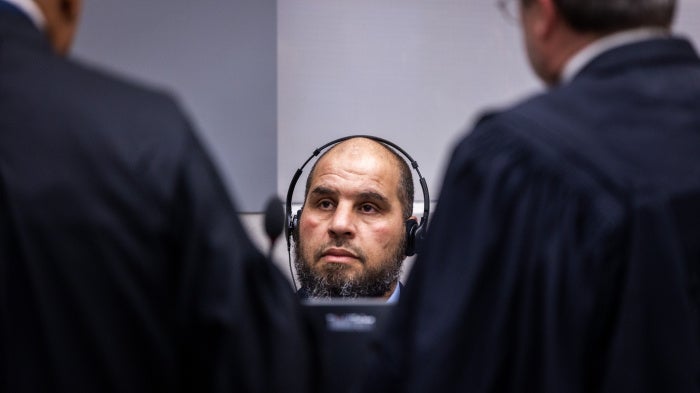
On July 16, German authorities at Berlin Brandenburg Airport arrested Libyan national Khaled Mohamed Ali El Hishri, known as “Al-Buti,” who worked at Mitiga prison, based on an ICC arrest warrant. German authorities surrendered him to The Hague on December 1, to face charges of war crimes and crimes against humanity. He becomes the first suspect to be tried at the ICC in the ongoing investigation in Libya.
Eight other suspects wanted by the ICC for serious crimes, including Saif al-Islam Gaddafi, are at large.
Women’s Rights and Personal Rights
Libya lacks legal provisions to prevent domestic violence, punish perpetrators, and protect survivors. The penal code allows for a reduced sentence if a man kills or injures his wife or another female relative on even mere suspicion of extramarital sexual relations. Perpetrators of rape can escape prosecution if they marry the victim.
Libya’s Family Code discriminates against women with respect to marriage, divorce, and inheritance. A 2010 law requires women to get authorities’ permission before marrying a non-Libyan and denies Libyan nationality to children of Libyan mothers and foreign fathers.
The penal code prohibits all sexual acts outside marriage, including consensual same-sex relations, and punishes them with flogging and up to five years in prison.
Freedoms of Association and Assembly
The penal code stipulates severe punishments, including death, for establishing “unlawful” associations and prohibits Libyans from joining or establishing international organizations without government permission. Civic groups are unable to operate independently while activists have been forced to self-censor or operate in exile.
Civic groups in Libya faced severe restrictions on their ability to operate due to legal impediments and a severe crackdown by armed groups and security agencies. The Civil Society Commission, tasked with licensing civic groups, has far-reaching oversight and can search groups’ headquarters, freeze bank accounts, suspend activities, or dissolve groups without a court order. Organizations must obtain its prior approval to receive funding, conduct activities, or communicate with foreign parties.
The absence of a unified legal framework compounded the situation. A 2021 draft Associations law submitted by civic groups to the House of Representatives was not passed.
Freedom of Speech and Assembly
A slew of draconian legislation in the penal code and others such as the 2014 counterterrorism law, restricts the right to freedom of speech and prevents dissent.
Armed groups, militias, and security agencies cracked down on dissent, and continued to target political opponents and dissenting voices.
In May, armed groups in Tripoli used live ammunition to disperse demonstrators protesting the GNU and presence of militias, after the end of armed clashes.
Migrants, Asylum Seekers, and Internally Displaced People
The International Organization for Migration (IOM) recorded 894,890 migrants in Libya as of July 2025. As of November 2025, over 197,961 refugees and asylum seekers were registered with the UN refugee agency (UNHCR) in Libya. As of December 1, 2025, over 467,000 Sudanese refugees fleeing the conflict since April 2023 had arrived in Libya, but only 86,849 of them were registered. These are in addition to 20,000 Sudanese already registered prior to the current conflict.
By the end of 2024, at least 32,791 people were internally displaced in Libya, including thousands of Tawergha residents driven from their homes in 2011, and thousands forcibly displaced by the LAAF from eastern Libya since 2014.
As of December, at least 1,189 people were found dead or went missing in the central Mediterranean mostly after departing Libya.
The European Union and its member states continued to support abusive Libyan Coast Guard forces, providing supplies, technical support, and aerial surveillance to help intercept Europe-bound migrants at sea. As of November 29, 2025, Libyan forces intercepted or rescued 25,286 migrants and asylum seekers and returned them to Libya, where they faced serious risk of torture and inhumane treatment.
Inhumane conditions and serious abuses continued at migrant detention centers and prisons in Libya that are mostly controlled by abusive, unaccountable armed groups nominally linked with authorities. Abuses include long-term arbitrary detention, enforced disappearances, unlawful killings, torture, overcrowding, beatings, deprivation of food and water, forced labor, and sexual assault.
Collective expulsions, mass arrests, and racial discrimination by authorities continued against migrants, while unfounded rumors about migrant resettlement in Libya triggered protests.
In May, the Trump administration was poised to deport an unknown number of detained migrants from the US to Libya. A US federal judge on May 7 ruled that any effort to deport migrants to Libya would “clearly” violate a prior court order barring officials from swiftly deporting migrants to countries other than their own without first weighing whether they would face persecution.