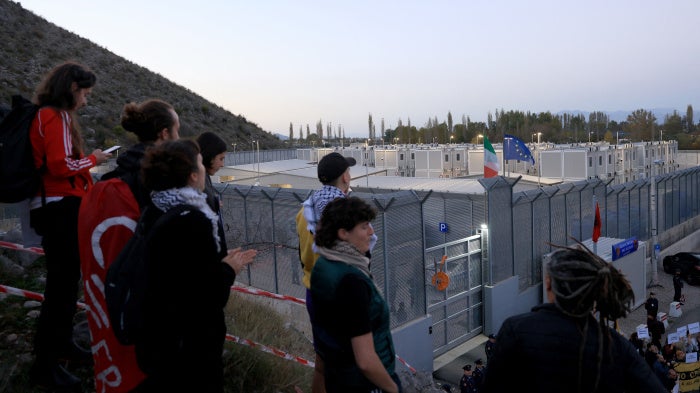
Italy pursued a repressive model of migration control including detaining people in Albania pending deportation and obstructing humanitarian rescues at sea. New security measures raised serious concerns about freedom of expression and association and the impact on marginalized groups. Italy flouted an international arrest warrant for a Libyan official wanted by the International Criminal Court for crimes against humanity. Racial profiling by the police and violence against women remain serious concerns.
Migrants and Asylum Seekers
Italian courts blocked successive attempts by authorities to process in Albania the asylum claims of men from countries on Italy’s list of “safe countries of origin.” In response, in March the Italian government repurposed the Italian-built and administered facility in Albania into a detention center for people already ordered to be deported. The Council of Europe’s Committee for the Prevention of Torture cautioned in December 2024 that problems with detention centers in Italy “call into question the application of such a model…in Albania.” Italian civil society organizations documented violations of the right to seek asylum and the rights to health, information, and to an effective remedy in Italy. A legal analysis by the Court of Cassation concluded the Italy-Albania agreement may violate the Italian Constitution, EU law, and human rights treaties.
The Court of Justice of the European Union ruled in August that Italy had not met EU asylum law standards in the case of two Bangladeshi citizens previously disembarked in Albania for asylum processing.
Italian authorities allowed a 2017 Memorandum of Understanding with Libya on migration cooperation to automatically renew on November 2 for three years despite grave abuses. In June, the European Court of Human Rights declared inadmissible a complaint involving a deadly interception by the Libyan Coast Guard in 2018 followed by ill-treatment of migrants in detention upon return to Libya, concluding it did not have jurisdiction because Italy had not exercised effective control in the case. In August, the crew of a Libyan patrol boat that was donated by Italy opened fire on a rescue ship operated by SOS MEDITERRANEE, with 87 rescued survivors on board, shattering windows and damaging equipment. An Italian prosecutor opened an investigation into the incident.
A judge ordered in July that four Guardia di Finanza (customs police) and two Coast Guard officers go to trial on multiple charges of manslaughter in relation to a February 2023 shipwreck off the Calabrian coast in which 94 people, including 35 children, died. The Cassation Court ruled in March that 177 migrants were entitled to compensation for being deprived of their liberty while held aboard the Italian Coast Guard ship Diciotti for 10 days in 2018 before being allowed to disembark.
In July, the Constitutional Court said governmental powers to fine and detain nongovernmental rescue ships were constitutional but clarified that the imperative to save lives could justify disregarding state orders. As of September 2025, the government had detained rescue ships 34 times since February 2023, keeping vessels away from vital rescue operations for 700 days. In August, the government grounded the NGO airplane Seabird, used to spot boats in distress, for 20 days.
A referendum in June to shorten from ten to five years the mandatory legal residency before eligibility for citizenship failed to meet the minimum participation requirement; Prime Minister Meloni and other leading figures in government had called on people to boycott the vote.
According to government statistics for 2025, by mid-September almost 49,000 people, including roughly 8,600 unaccompanied children, had reached Italy by sea, slightly more than during the same period last year.
Discrimination and Intolerance
The government reacted angrily to the recommendation highlighted by the European Commission against Racism and Intolerance (ECRI) in May to conduct an independent study of racial profiling by the police. ECRI had identified in October 2024 the problem of racial profiling particularly affecting Roma and people of African descent. Government statistics revealed that in the first seven months of the year, 42 percent of people stopped by the police in so-called red zones in urban areas and 76 percent of those subsequently subject to enforcement measures were foreigners (foreigners account for 9 percent of Italy’s total population).
Poverty and Inequality
The government introduced a new law adopted by parliament in June imposing harsh criminal sanctions on squatters and those assisting them, for example civil society organizations, and reduced procedural guarantees against forced evictions leading to homelessness. The government ignored concerns expressed by the United Nations special rapporteurs on housing and poverty before the legislation was adopted about its likely impact on homelessness.
Women’s Rights
Sexual and gender-based violence remains a serious concern. The Interior Ministry reported that the number of women murdered in the first seven months of the year was almost the same as for the same period in 2024 (60 compared to 61), but the percentages of women murdered by a partner or ex-partner and the percentage of women murdered who were of foreign origin increased. The police issued significantly more warnings—preventive legal orders to cease unlawful behavior—to alleged abusers for stalking and domestic violence. Those who persist in the abuse face ex officio proceedings and higher sentences if convicted. In November, the parliament approved a government-sponsored bill creating the specific crime of femicide punishable by up to life in prison, while a separate bill to define sex without consent as rape stalled in the Senate.
To overcome difficulties in access to abortion due to high numbers of medical professionals claiming conscientious objection, Sicily passed a regional law in July to oblige healthcare centers to hire staff willing to perform abortions. The Meloni government challenged the law before the Constitutional Court.
Sexual Orientation and Gender Identity
The Constitutional Court said in May that Italian authorities must allow children born to lesbian couples via medically assisted procreation abroad to be registered as having two mothers and, separately, that gay parents should be allowed to legally adopt children born via surrogacy abroad before a 2024 law criminalizing surrogacy outside Italy came into effect.
In August, the Meloni government proposed changes, not yet examined in parliament at time of writing, to limit access to gender-affirming care for people under the age of 18.
Rule of law
The government enacted in April a “security decree” including provisions of a bill that had stalled due to opposition in parliament and garnered criticism from the United Nations and the Council of Europe’s Commissioner for Human Rights, among others, for significant and unjustified limits on freedom of expression and association. The measures, which became a permanent law in June, increase penalties for participation in unauthorized demonstrations; make it a crime to engage in protests in prisons, migrant detention centers, and reception centers, including through passive resistance to orders or rules; and increase sanctions for offenses against public officials.
In January, Italian authorities took into custody Osama Elmasry Njeem, a high-ranking Libyan official under an arrest warrant from the International Criminal Court (ICC) for alleged crimes against humanity and war crimes, only to release him two days later and fly him to Libya on a state aircraft without informing the ICC. In August, the Italian judges investigating the incident dismissed a case against Meloni over her alleged role and in October the government majority in parliament reaffirmed the immunity from prosecution of three high-ranking officials under investigation.
In its yearly bloc-wide rule of law report, the European Commission urged Italy to move forward with steps to address conflicts of interest and corruption in politics, reform the defamation regime to improve protections for journalists, and to establish an independent national human rights institution. The October bomb targeting a journalist provoked debate about the risks involved in investigative journalism, including physical attacks, threats, and vexatious lawsuits.