President Prabowo Subianto Djojohadikusumo expanded the military and placed active-duty personnel in civilian posts, a throwback to the pervasive militarization of civilian functions during the discredited Soeharto era. Prabowo, a former general accused of serious human rights violations, also appointed serving members of the armed forces to senior government positions.
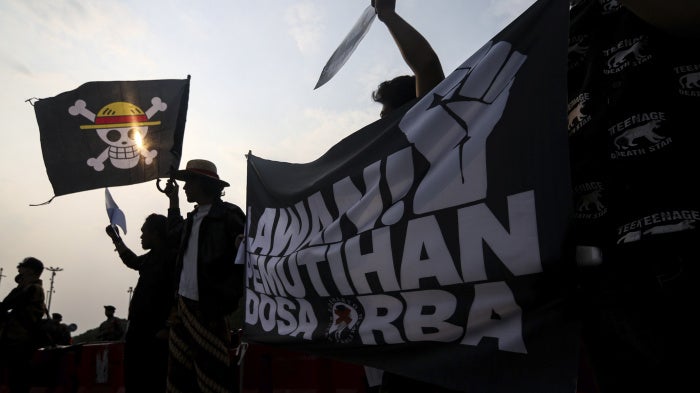
In August, hundreds of thousands of people in 107 cities nationwide protested low wages and unemployment after the government announced additional perks for lawmakers. Police used excessive force to disperse protesters, sparking arson attacks and looting in 42 cities.
Indigenous activists and government critics, particularly those opposing mining companies and oil plantations, faced threats and arrests. The government deployed more troops amidst increased fighting in five Papuan provinces by separatist insurgent groups. Religious minorities were attacked by extremist Muslim groups including in Padang, West Sumatra, and in Sukabumi, West Java.
In February, two university students were publicly flogged in Banda Aceh—77 and 82 times each—for consensual same-sex relations. In April, two men were arrested after police caught them embracing in a bathroom at a park in the same city. An Islamic court sentenced them to public caning for same-sex relations.
Many activists welcomed the government’s announcement in September that it spent US$412 million on mental health services between 2020 and 2024, a significant portion going toward community-based support.
Poverty and Inequality
The Prabowo government did not address an ongoing cost-of-living crisis and adopted policies that benefited the wealthy, including tax breaks. In July, a cabinet minister noted that just 60 families controlled 48 percent of the land certified for construction or crop cultivation in the country.
On August 15, President Prabowo announced a monthly housing allowance and other perks for lawmakers equivalent to 10 times the monthly minimum wage in Jakarta, sparking protests. The protests spread across the country after August 28 when a police armored van struck and ran over Affan Kurniawan, a 21-year-old motorcycle ride-share driver, and then sped away. Protesters attacked and looted lawmakers’ houses and burned over 150 buildings. Police responded with excessive force. The authorities also asked TikTok to temporarily shut down its live streaming feature during the protests.
Prabowo responded to the protests by rolling back the legislative perks, but also, without basis, warned against “treason and terrorism.” The police detained over 3300 people including several activists and protest organizers.
Earlier in the year, many Indonesians protested policies that increased government spending, including for military expansion. Many expressed opposition to forced evictions, land grabs, and corruption related to mining and plantations, as well as food insecurity and development projects. The government also announced austerity measures that curtailed social security benefits.
Activists also continued to protest online in what was called the “17+8 movement,” with 17 short-term demands relating to economic transparency, and 8 long-term demands, including police reform, greater political representation, and an end to militarization.
Increased Militarization
In March, the national parliament approved an amendment to the 2004 armed forces law that enables the government to use active-duty military personnel in civilian posts, including in the justice system and state-owned companies. President Prabowo said he would expand the size of the military to one million personnel in three years.
Concerned that Prabowo’s increased use of armed forces in civilian affairs could lead to the revival of authoritarianism, activists filed petitions seeking annulment of the amendments because they were passed without adequate consultation. The Constitutional Court rejected the petition in a 5-to-4 vote.
Papua
In South Papua province, Prabowo moved forward with large-scale plantations, part of his so-called “food estate” project, enabling private companies to clear more than two million hectares of land in Merauke. Nine UN rights experts raised concerns that the food estate project had forcibly displaced Indigenous communities, permitted deforestation, threatened biodiversity, and authorized the deployment of five new battalions to quash dissent. According to a Malind tribal leader in Merauke, “Bulldozers here are always guarded by soldiers with semi-automatic weapons.” The government denied the allegations.
Some activists, convicted of treason and other serious crimes when the government suppressed widespread protests after a 2019 attack on Papuan university students, remained in prison. In several cases since, police have accused Papuans of treason for peaceful protests against longstanding racial discrimination, particularly if they displayed the Morning Star flag, which authorities consider solely a symbol of secessionist demand.
In April, the police arrested four Papuan men in Sorong, Southwest Papua, charging them with treason for distributing political leaflets. In August, police arrested Yan Manggaprouw, a protest leader in Sorong, and beat him in front of his wife and their children.
After the National Liberation Army of West Papua claimed responsibility for the killing of 17 miners in April who they claimed were spies, the Indonesian military and police used drones and airstrikes in at times indiscriminate attacks that injured, killed, and displaced villagers. At least 100,000 Indigenous Papuans left their villages from 10 regencies, mostly in the Central Highlands and the Bird’s Head areas, moving to urban areas or into the forests to escape the fighting. The military set up checkpoints and arbitrarily arrested people they suspected to be militants.
New Criminal Code
In December 2022, the Indonesian parliament adopted a new criminal code set to come into force on January 2, 2026. Provisions in the new code violate the rights of women, religious minorities, and lesbian, gay, bisexual, and transgender (LGBT) people, and undermine the rights to freedom of speech and association. This includes the criminalization of all sex outside of marriage, effectively rendering adult consensual same-sex conduct a crime in Indonesia for the first time in the country’s history.
The new law also provides that the government will recognize “any living law” in the country, which can be interpreted to extend formal legality to hundreds of Sharia (Islamic law) regulations imposed by local officials in Muslim-majority areas across the country. Many Sharia-inspired regulations discriminate against women and girls, such as mandatory hijab dress codes. Many of these regulations also discriminate against LGBT people.
In November, the parliament passed the Criminal Procedure Code, complementing the Criminal Code. Rights groups said the new law will allow authorities to tap telephones, seize assets, arrest suspects, and freeze bank accounts without judicial safeguards.
Freedom of Religion
Authorities continued to use discriminatory regulations against religious minorities and failed to protect Christians, Ahmadiyah, and members of other groups, including followers of local ethnic religious faiths, who faced multiple attacks.
Freedom of Speech and Expression
Prabowo and his supporters accused government critics, including journalists and civil society activists, of being "foreign agents." The Alliance of Independent Journalists recorded 60 cases of violence against journalists and media between January 1 and August 31, including intimidation, beating, and cyber-attacks. Most alleged perpetrators were military and police officers.
In March, an unknown person sent a package containing a pig’s head to the office of Tempo, an independent media outlet, addressed to a popular talk show host. Soon after, a person on a motorcycle sent a package containing dead rats to the Tempo office.
In February, the military decided not to prosecute two soldiers who were allegedly involved in an arson attack targeting the Jubi daily newspaper. On October 16, 2024, two men in a motorcycle had thrown a Molotov cocktail that damaged two cars in the parking lot. The Jayapura police, using CCTV footage, had charged the two soldiers, handing the case to the Jayapura army in January for prosecution in military court.
The police arrested at least three activists for their role in the August protests. Khariq Anhar, a student at Riau University in Sumatra, had used Instagram to inform protesters of planned activities, while Syahdan Husein had posted on X. Delpedro Marhaen, the executive director of the Jakarta-based Lokataru Foundation, which provided legal aid to high school students detained during the protests, was also arrested.
The Supreme Court intervened in some cases to uphold the rights to speech and association.
Environment and Human Rights
Prabowo promised that his government was committed to helping address the global climate crisis, saying that Indonesia was suffering from rising sea levels. However, at the time of writing, Indonesia had yet to submit an updated climate action plan to the United Nations (UN) Framework Convention on Climate Change. The current plan is rated as “critically insufficient” by the scientists’ consortium Climate Action Tracker.
Prabowo also argued for expanding Indonesia’s oil palm plantations, saying that palm trees are also trees. “Oil palms are trees, right? They have leaves, right?” he said. “They produce oxygen, absorb carbon dioxide.” The government announced plans to clear around 20 million hectares of forest and peatland to convert into “food and energy estates.” The conversion of natural forests and peatlands for agricultural use or tree plantations is a leading driver of greenhouse gas emissions and biodiversity loss worldwide. Plantations often encroach on Indigenous peoples’ and traditional communities’ territories leading to forced evictions, loss of livelihoods, and erosion of culture.
The government’s National Research and Innovation Agency reported 216,000 hectares of deforestation in 2024. Auriga Nusantara, an independent forest monitor, put the figure at over 260,000 hectares. Both the government and civil society groups said 2025 figures are likely to be even higher.
In May, the Ministry of Environment and Forestry established a task force to accelerate the legal recognition of customary forests—areas traditionally governed by Indigenous communities. The group is tasked with completing the recognition process for over 4 million hectares of customary forest areas by 2029.
In 2024, Indonesia produced more than half of the world’s nickel, which is used for electric vehicle batteries and the production of steel. Nickel mining and processing companies, including in Sulawesi and North Maluku, reportedly cleared tens of thousands of hectares of forests and polluted communities’ water supplies. The continued expansion of coal plants for nickel processing has accelerated the country’s coal use.
Foreign Relations
As a member of the UN Human Rights Council, Indonesia did not vote in favor of many UN resolutions on country situations except for those related to Palestine. For example, Indonesia abstained on the resolutions to renew the mandate of the Commission of Inquiry on Ukraine and the Special Rapporteur on Eritrea.
The Prabowo government rebuked Israeli military abuses in Gaza and offered to evacuate Palestinians “who are injured or traumatized, and orphans” to Indonesia’s Galang Island.
In January, Indonesia joined the BRICS group to expand its economic and strategic partnerships.
Though it accepted Rohingya refugees, the Indonesian government failed to hold the Myanmar junta and various armed groups to account for ongoing abuses.
In August, Prabowo attended the annual Chinese military parade in Beijing, appearing with Chinese leader Xi Jinping, Russian President Vladimir Putin, and North Korean leader Kim Jong Un.