After a campaign season marked by the mainstreaming of far-right rhetoric, particularly targeting minorities and migrants, as well as attacks against civil society, general elections in February 2025 saw a surge in support for the far-right Alternative for Germany (AfD) and led to a coalition government between the conservative Christian Democratic Union (CDU)/Christian Social Union (CSU) and the Social Democratic Party (SPD). Increases in regressive migration and asylum policies, hate crimes and hate speech, and restrictions on freedom of expression and assembly raised serious concerns.
Rule of Law
German authorities undermined freedom of expression, assembly, and association, particularly targeting Palestine solidarity protests. The Council of Europe’s Commissioner for Human Rights raised concerns about restrictions on assembly and speech relating to Israel’s assault on Gaza, excessive police force against protesters at assemblies in Berlin, and restrictions on free speech and academic freedom at cultural and educational institutions, respectively, based on the “blanket classification of criticism of Israel as antisemitic.”
In May, a court suspended an attempt by the Berlin state migration authority to deport four foreign students that the authority accused of spreading antisemitic hatred and committing other offenses at a university sit-in in October 2024.
The criminalization of climate activism continued. In March 2025, the Munich Public Prosecutor General’s Office brought further charges against five climate activists of the climate activist group, Last Generation, which it alleged was a criminal organization.
Civic space was further attacked in February, just after the general elections, when the CDU/CSU submitted 551 parliamentary questions about 14 civil society organizations, questioning their funding sources and “neutrality.” The groups had previously protested against right-wing extremism, criticizing the CDU/CSU’s willingness to join with the far-right AfD to pass a parliamentary motion for tighter migration control. Affected groups claimed that this was an attempt to silence them, but the outgoing government rejected this accusation and defended the importance of civil society to democracy.
Reporters Without Borders documented a total of 89 attacks against journalists and media outlets in 2024, more than double the number in 2023.
Discrimination and Intolerance
The CDU/CSU’s move to pass a non-binding parliamentary motion to further restrict immigration with the support of the AfD broke a long-standing taboo across democratic parties on working with the far-right.
In October, Chancellor Merz said that migration was affecting cities’ safety, especially for women, in an effort to defend the government’s tough stance on migration. Political opposition called his comments “racist.”
Following years of investigations, in May, the German Federal Office for the Protection of the Constitution designated the AfD as a right-wing extremist entity, finding that repeated racist statements, xenophobic views, and anti-constitutional positions threatened Germany’s free democratic basic order. The AfD challenged the designation in court.
Official statistics showed an unprecedented 40 percent uptick in politically motivated hate crimes in 2024 compared to 2023, with 50 percent of the total 84,172 registered offenses classified as right-wing extremist. Authorities also registered 1,848 so-called anti-Islamic crimes (a 26 percent increase compared to 2023). Civil society, based on its broader human-rights-based definition of anti-Muslim hate crimes, documented 3,080 anti-Muslim cases (a 60 percent increase compared to their statistics in 2023). The authorities also marked another increase in antisemitic hate crimes, registering 6,236 offenses (a 21 percent increase compared to 2023).
The fatal police shooting in April of Lorenz A., a 21-year-old Black man, resurfaced debates about systemic racism within the German police. Germany’s oldest self-empowerment group by and for Black people in Germany called for a transparent investigation as well as a comprehensive examination of institutional racism; the Justice Ministry said there was no evidence of racist motivation behind the killing.
Migrants and Asylum Seekers
The new government doubled down on Germany’s toughened stance on migration with measures to limit access to asylum and family reunification and restrict pathways to citizenship. In May, the government intensified existing border controls to allow for rejection of asylum seekers and maintained the policy despite a June ruling by a Berlin administrative court that it was incompatible with EU law. In June, the government instituted a two-year suspension of family reunification for beneficiaries of subsidiary protection. In December, parliament passed a law to give the executive the power to change, without parliamentary scrutiny, the list of “safe countries of origin” to facilitate rejection of asylum applications.
In July, the government suspended a special humanitarian admission program for Afghan refugees introduced after the Taliban seized power in 2021. In September, a successful legal challenge lifted the suspension for Afghans already awaiting resettlement, with 10 families immediately relocating to Germany. The coalition agreement foresees an end to refugee resettlement and humanitarian admission programs to curb migration.
The government plans to cut access to additional welfare benefits for Ukrainian refugees who entered Germany after April 1, 2025; they would only have access to limited benefits under Germany’s Asylum Seekers' Benefits Act. Third-country nationals who fled from Ukraine to Germany and did not have a permanent residence in Ukraine, after March 5, 2025, would no longer fall within the special regulatory framework for Ukrainian refugees.
Gender Identity and Sexual Orientation
Authorities registered 1,765 offenses based on sexual orientation (an increase of 18 percent compared to 2023) and 1,152 offenses related to gender diversity (an uptick of 35 percent compared to 2023).
The Interior Ministry proposed a registration system that records transgender, intersex, and non-binary people’s gender entry and first name before they changed their gender marker on official documents pursuant to Germany’s 2024 self-determination law. Human rights groups argue this is unnecessary to ensure traceability and risks exposing people to discrimination. On October 17, the upper parliamentary chamber, the Bundesrat, postponed the vote on the draft regulation as the necessary backing for it was not guaranteed.
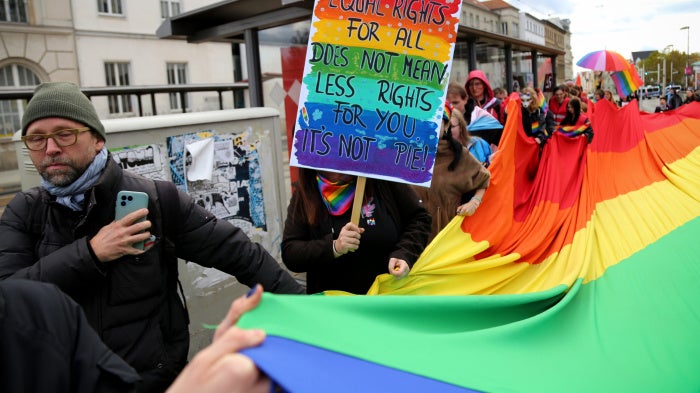
Breaking with a tradition observed since 2022, Parliamentary President Julia Klöckner refused to raise the rainbow flag atop the parliamentary building during Germany’s annual Pride celebrations in summer. In July, the parliament’s administration ordered lawmakers to remove rainbow flags from their offices.
Women’s Rights and Domestic Violence
Official statistics showed police registered 265,942 persons affected by domestic violence in 2024, an increase of 18 percent over the last five years, and women comprised over 70 percent of victims of domestic violence and nearly 80 percent of 171,069 victims of violence by an intimate partner.
Poverty and Inequality
The coalition government pursued its plans to replace the “Citizen’s Income,” introduced only in 2023, with a “New Basic Income for Jobseekers” and enact other changes that would effectively limit access to basic social security support, with draft legislation published in November.
Official statistics showed that, in 2024, 17.6 million people (one-fifth of the population) were at risk of poverty or social exclusion; the figures were stable relative to previous years. The data showed that people living alone were at particular risk of poverty, with 29 percent of single people under the monetary poverty threshold. Women across all age groups were more likely than men to be at risk of poverty or social exclusion, with the gap widening for those 65 and older.
Business and Human Rights
In September, the government proposed amending Germany’s Supply Chain Act, which requires companies to conduct human rights due diligence, to abolish reporting requirements for companies and reduce sanctions in case companies violated their obligations. At time of writing, the amendments were pending before parliament.
Foreign Policy
Under the new government elected in February, Germany’s foreign policy underwent a marked shift. The government prioritized security, migration control, and economic interests, while references to human rights or values-based foreign policy became notably scarce in official speeches and strategic documents. Chancellor Merz took a more prominent role in shaping foreign policy based on his perception that liberal democracies are facing an existential threat from within the “global west” and from the “axis of autocracies.”
Merz made Russia’s full-scale invasion of Ukraine one focus of his chancellorship. Germany assumed a leading role in the “coalition of the willing,” pressing for security guarantees for Ukraine and a ceasefire. In a major turn of policy in September, Merz advocated for the use of frozen Russian assets for the armament of Ukraine.
The government showed growing unease regarding Israel’s atrocities in Gaza while coming under intense pressure from civil society and legal experts over its arms exports and continued blockage of EU measures to address war crimes by Israel. In a cautious but symbolic move, Germany partially suspended arms deliveries for use in Gaza, marking a rare break from its traditional stance but failed to use all means available to prevent genocide in Gaza, risking legal liability. Germany reversed this decision and lifted the suspension by mid-November, citing the ceasefire that went into effect on October 10th.
Germany’s support was critical to the June European Council agreement to gut the EU Corporate Sustainability Due Diligence Directive, which had been adopted only the year before to help prevent and remedy companies’ negative human rights and environmental impacts.