The government of President Nayib Bukele continued to remove checks on executive power and increased its repression of human rights defenders and critics. In July, the Legislative Assembly, controlled by the ruling party, amended the Constitution to remove presidential term limits. Bukele won a second term in 2024 despite a constitutional prohibition on immediate re-election.
A state of emergency enacted in March 2022 remains in effect, suspending constitutional rights. Authorities have committed widespread abuses, including mass arbitrary detention, enforced disappearance, torture and ill-treatment of detainees, and due process violations. Gang violence has markedly declined.
Concentration of Power
In July, lawmakers from the Nuevas Ideas party approved constitutional amendments allowing indefinite presidential re-election, among other changes.
The Inter-American Commission on Human Rights (IACHR) said the measures were “a serious setback for democracy and the rule of law in the country.”
In January, the Assembly passed a reform to article 248 of the Constitution, allowing the Assembly to reform the constitution in a single legislative session. Previously, such amendments required approval by two successive legislatures.
In December 2024, lawmakers re-elected Rodolfo Delgado as attorney general. Delgado had first been appointed in May 2021, when pro-Bukele lawmakers summarily removed and replaced the previous attorney general and all five judges of the Supreme Court’s Constitutional Chamber. In 2021, Attorney General Delgado dismantled the Special Anti-Mafia Group (GEA), a unit within the Attorney General’s Office that was investigating alleged corruption by senior Bukele officials and government negotiations with gangs.
In September 2021, legislators passed laws allowing the Supreme Court and the attorney general to dismiss judges and prosecutors aged 60 or older and to transfer them to other posts. These laws expanded executive control over the judiciary, contradicted international standards on judicial independence, and have been used to dismiss or reassign independent judges and prosecutors.
Attacks on Civil Society
The government has intensified attacks against journalists, human rights defenders, activists, and union leaders.
In May, authorities arrested José Ángel Pérez, a community leader, and Alejandro Henríquez, a lawyer, on unfounded charges of “aggressive resistance” and “public disorder” for peacefully protesting against the eviction of a community. They remained incommunicado in pre-trial detention at time of writing.
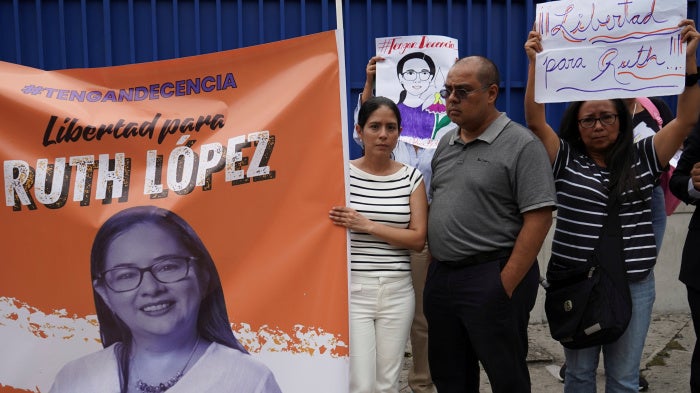
Later that month, authorities arrested Ruth López, a prominent human rights defender and director of anti-corruption and justice at Cristosal, a Central American human rights organization, and charged her with “illicit enrichment.” In June, authorities arrested Enrique Anaya, a lawyer and outspoken government critic, on charges of “money laundering.” Both remain incommunicado in pre-trial detention, and their cases have been placed under judicial seal. In September, the IACHR issued precautionary measures in their favor, urging the Salvadoran government to end their prolonged incommunicado detention, ensure they have access to their family and legal counsel, and review the legality of their pre-trial detention.
In May, the Legislative Assembly passed a Foreign Agents Law that requires any individual or organization in El Salvador that directly or indirectly receives funds, goods, or services of foreign origin to register as a “foreign agent” with the Interior Ministry. Authorities have broad discretion to grant exemptions under vague criteria and to sanction activities they deem contrary to “public order” or threatening to “the social and political stability of the country.”
Organizations or individuals who fail to register face sanctions, including fines and the “suspension or cancellation” of their legal status. The law also imposes a 30 percent tax on all foreign funding, including donations, goods, and services. The Foreign Agents law violates El Salvador’s obligations under international human rights law, including the International Covenant on Civil and Political Rights and the American Convention on Human Rights, which protect freedom of expression and association. The law entered into force in September.
In July, Cristosal announced it was closing its offices in El Salvador, citing “escalating repression.” Between May and September, at least 140 human rights defenders and journalists—including staff from El Faro, a prominent digital outlet—fled the country fearing reprisals for their work. El Faro had already moved its legal operations to Costa Rica in 2023.
The Association of Journalists of El Salvador (APES) reported 789 “press freedom violations” during 2024, a 154 percent increase over 2023. These included digital harassment, stigmatizing statements targeting journalists, and restrictions on journalists’ work and access to public information.
In September, APES also announced it was closing its offices in El Salvador, citing the “suffocating” requirements imposed by the Foreign Agents Law. At least three other organizations have shut down since the law came into force.
Security Policies
A state of emergency adopted in March 2022 suspending certain due process rights has been extended 45 times and remained in force at time of writing.
Under the state of emergency, police and soldiers have conducted hundreds of indiscriminate raids, particularly in low-income neighborhoods, arresting over 90,000 people, including more than 3,000 children. Most remain incommunicado in pre-trial detention.
Local and international human rights groups have documented enforced disappearance, mass arbitrary detention, torture, and, in some cases, sexual violence against women and girls in detention. Authorities have not reported charging, indicting, or convicting any police or military officers in connection with these abuses. In a 2024 September report, the IACHR noted “reports” of “widespread and systematic human rights violations” and urged authorities to “end the state of emergency.”
Many detainees have no apparent connections to gang-related violence. Arrests often appear to be based on the detainees’ appearance, tattoos of any kind, uncorroborated calls, false reports, and pressure to meet arrest quotas.
Mass imprisonment has raised El Salvador’s prison population to an estimated 118,000 detainees, more than double the country’s capacity, significantly worsening already poor prison conditions. A total of 1.9 percent of the country’s population was in detention at time of writing, among the highest rates in the world.
In February, lawmakers amended the Juvenile Criminal Law to allow the transfer of children detained for “organized crime offenses” to separate pavilions in adult prisons. The measure exposes them to a heightened risk of abuse and violates international juvenile justice standards.
In August, the Assembly amended the Organized Crime Law to extend pre-trial detention for people accused of belonging to criminal organizations, allowing detainees to be held for up to five years before trial.
At least 458 detainees have died in prison during the state of emergency, according to Socorro Jurídico Humanitario, a rights group. No one appears to have been held accountable for these deaths.
Gang Violence
Gang violence continued to decrease in 2025. For decades, gangs exerted territorial control over areas throughout the country, committing abuses such as homicides, forced recruitment of children, rapes and sexual assaults, abductions, extortion, and displacement.
The country’s longstanding high homicide rate, which peaked at 105 per 100,000 people in 2015, has sharply diminished since 2019, reaching a historic low in 2024, according to official figures. At time of writing, the government had not reported the homicide rate for 2025. Extortion cases have also decreased, authorities reported.
Government restrictions on public access to homicide and other crime data and changes to which killings are counted as homicides in official statistics make it hard to assess the accuracy of official claims about the reduction in and the prevalence of crimes.
Deportations from the US
Between March and April, the Trump administration transferred 252 Venezuelans to El Salvador, where they were held in the Center for Terrorism Confinement (Centro de Confinamiento del Terrorismo, CECOT), a mega prison notorious for its abusive conditions. The US government paid El Salvador to hold the deportees in prison. They were then sent to Venezuela in July as part of a prisoner exchange.
During their four months in CECOT, the Venezuelan detainees endured systematic human rights violations, including arbitrary detention, enforced disappearance, torture and ill-treatment, prolonged incommunicado confinement, denial of adequate health care and food, and unsanitary conditions. The US actions—sending people to a place where torture was likely—violated the international prohibition on non-refoulment.
Media reports citing internal correspondence indicate that Salvadoran officials proposed a “50 percent discount” on the US payment to hold the Venezuelan migrants in exchange for the transfer to El Salvador of nine senior MS-13 members then held by the US. US authorities subsequently removed 23 Salvadorans to CECOT, including César Humberto López Larios (“El Greñas”), an MS-13 leader who was facing terrorism and conspiracy charges in US federal court.
López Larios’s removal appears to be an effort to prevent him and others from testifying in US courts about their negotiations with Bukele’s government. According to US indictments, Bukele officials had negotiated with MS-13 leaders since 2019 for looser prison regimes, reduced sentences, early releases, and protection from extradition, in return for lowering homicides and political support during elections.
Transparency and Anti-Corruption
Authorities’ excessive use of secrecy classifications and weak oversight by the institution tasked with enforcing the Access to Public Information Law hinder transparency and have contributed to increasing perceptions of public sector corruption.
El Salvador’s score on Transparency International’s Corruption Perceptions Index, which measures perceived public sector corruption globally, has fallen sharply from 36 in 2020 to a 13-year low of 30 in 2024.
The Supreme Court has classified President Bukele’s asset declaration, departing from previous practice and fueling concerns about official corruption.
Access to Abortion
El Salvador criminalizes abortion under all circumstances. For years, courts have convicted women who have experienced obstetric emergencies on charges of qualified homicide and sentenced them with up to 50 years in prison.
In December 2024, the Inter-American Court of Human Rights found El Salvador responsible for obstetric violence in the case of Beatriz, a woman denied an abortion in 2013 despite facing a high-risk pregnancy. The ruling was a landmark precedent for reproductive rights in the region.
Sexual Orientation and Gender Identity
El Salvador does not allow same-sex marriage or legal gender recognition for transgender people and lacks comprehensive anti-LGBT discrimination legislation. The legislature continues to ignore a 2022 Supreme Court order to create a legal gender recognition procedure that would allow trans people to change their names on identity documents.
Foreign Actors
In April, Bukele met with President Trump in the Oval Office to discuss migration and security cooperation. Bukele said he would not return Kilmar Abrego García, a Salvadoran man unlawfully deported from the United States in March. Abrego García was returned to the United States in June, where he faces migrant-smuggling charges.
The 2024 US State Department human rights report on El Salvador claimed there were “no credible reports of significant human rights abuses,” although it cited “complaints” and “reports” of mistreatment, extrajudicial executions, and disappearances. The 2023 report mentioned extrajudicial executions, torture, and “harsh and life-threatening prison conditions.”
In February, the government reached a US$1.4 billion agreement with the International Monetary Fund (IMF). The IMF has identified concerns over judicial independence as a factor in the country’s speculative-grade credit rating and as a barrier to foreign investment, and has issued recommendations relating to judicial transfers and tenure. An IMF review published in July found that these reforms had not been implemented. The review also noted delays in implementing some recommendations on transparency and anti-corruption.
In June, the European Union raised concerns for the first time about El Salvador’s deteriorating human rights situation at the UN Human Rights Council.