The government continues to repress and punish dissent and public criticism. Hundreds of critics and protesters, including many participants in landmark July 2021 demonstrations, remain arbitrarily detained. Protests continue to erupt over prolonged blackouts, shortages, deteriorating living conditions, and a sharp rise in internet costs.
Cubans continue to flee the country in large numbers. The country has lost around 10 percent of its population in recent years, according to government figures. Independent studies indicate the actual number may be higher.
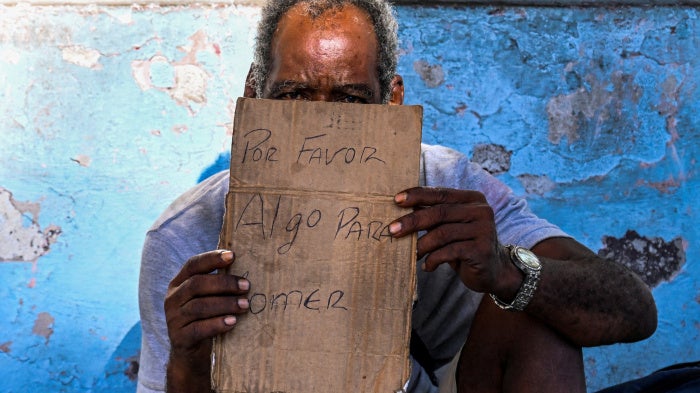
A worsening economic crisis has undermined public access to food, health care, and electricity.
Arbitrary Detention
Authorities arbitrarily detain, harass, and intimidate critics, independent activists, journalists and political opponents. Many have been held incommunicado, and some report ill-treatment.
According to the nongovernmental organization (NGO) Cubalex, at least 203 people were arbitrarily detained in police and state surveillance operations between January and June 2025.
Political Prisoners and Prosecution
The NGO Prisoners Defenders reported that as of October, Cuba held nearly 700 political prisoners behind bars.
In October, the NGO Justicia 11J reported that 359 people connected with the July 2021 protests remained in prison, with sentences of up to 22 years. Hundreds more remain under house arrest or other restrictions.
Government critics risk criminal prosecution and are not guaranteed due process, including the right to fair and public hearings before an independent and impartial tribunal. Courts remain subordinate to the executive branch.
The families of political prisoners face state harassment. In several instances, state security agents visited their homes to harass and dissuade them from speaking out against abuses.
In January 2025, Cuban authorities announced the release of 553 detainees, following negotiations between the Cuban government, the Vatican, and the United States.
Independent Cuban NGOs estimate that approximately 200 of those released were political prisoners. Many former prisoners said they have been subject to surveillance and strict conditions following their release.
In April, authorities re-arrested José Daniel Ferrer, leader of the Cuban Patriotic Union opposition movement, and Félix Navarro, founder of the Pedro Luis Boitel Party for Democracy. In 2020, the United Nations Working Group on Arbitrary Detention found Ferrer’s detention at the time to be arbitrary.
In May, authorities re-arrested Donaida Pérez Paseiro, president of the Free Yoruba Association. Cuban NGOs also reported the rearrest of Jaime Alcide Firdó and Marlon Brando Díaz Oliva in April and July, respectively.
Maykel Castillo Pérez and Luis Manuel Otero Alcántara remain in jail. Castillo Pérez, a musician, activist and co-writer of the song “Patria y Vida” (Motherland and Life), which criticizes the Cuban government, was detained in May 2021 and remains in prison. Otero Alcántara, an artist who also appeared in “Patria y Vida,” was arrested in July 2021 after announcing in a video that he would join the protests.
Prison Conditions and Ill-Treatment
Authorities have repeatedly denied prisoners medical care, subjected them to overcrowded and unsanitary conditions, and failed to ensure adequate access to food and water. Families face restrictions on visits. Detainees have no effective complaint mechanism to seek redress for abuses.
Protesters detained during the July 2021 demonstrations said that authorities beat them, placed them in prolonged solitary confinement, and used stress positions to punish them. Cubalex and the Centro de Documentación de Prisiones Cubanas continue to document deaths in custody, which they attribute to lack of medical care, violence, negligence, and inadequate prison conditions.
The government denies Cuban and international human rights groups access to prisons.
Economic, Social, and Cultural Rights
Cubans continue to endure a severe economic crisis that severely restricts their ability to access essential goods and services. People face prolonged electricity blackouts, in some places for up to 20 hours a day, and acute shortages of food, medicine, and other essential items.
Between October 2024 and September 2025, Cubans suffered five nationwide blackouts. In July, the Minister of Public Health reiterated that only 30 percent of the medicine on its essential medicines list could be found in the country.
In a survey conducted between June and July 2025, the Cuban Observatory of Human Rights reported that seven in ten Cubans skip daily meals, and over half struggle to afford essential items.
Freedom of Expression
The government controls all media, restricts access to outside information, and censors critics and independent journalists.
In May, Cuba’s state-owned telecommunications monopoly, ETECSA, significantly increased internet prices, making it harder for most Cubans to access it. Cuban university students issued public statements condemning the price hikes and calling for university strikes—an unprecedented development in Cuba, where universities are state-controlled. According to Justicia 11J, the ETECSA price hikes triggered 46 protests in June, the highest number triggered by a specific event in 2025 at time of writing.
In June, state security agents arrested journalist Henry Constantín, accusing him of “contempt” for posting about state security surveillance. He was held for four days.
Sexual Orientation and Gender Identity
In July, Cuba’s parliament adopted a new civil registry law enabling legal gender recognition for transgender people. However, legal gender recognition requires an assessment by the National Center for Sexual Education (CENESEX), which operates under the Ministry of Public Health. Requiring a favorable CENESEX opinion before recognition, as opposed to allowing self-identification, constitutes a disproportionate barrier.
International Actors
The US continued its policy of isolation toward Cuba, including maintaining a decades-long embargo that further undermines access to economic rights. Cuban authorities continue to use the US embargo as a pretext for abuses.
In January, the Biden administration removed Cuba from the US list of state sponsors of terrorism. President Trump put Cuba back on the list six days later. Several independent UN experts argued that this designation has adverse human rights and humanitarian impacts on Cubans and runs contrary to international law.
The Trump administration also expanded the list of Cuban businesses with which US citizens are prohibited from conducting financial transactions, and it restricted visas for Cuban President Miguel Díaz-Canel and other senior officials, citing their involvement in human rights abuses during the July 2021 anti-government protests.
The European Union continued its policy of critical engagement with the Cuban government.