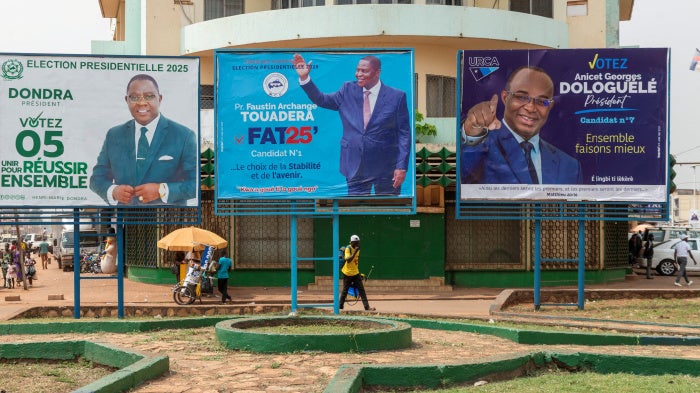
While the presence of armed groups and foreign militias has long caused conflict, fighting in 2025 slowed down for the first time in years. Government armed forces and some armed groups signed a ceasefire agreement and the United Nations and bilateral forces continued peacekeeping. Presidential and local elections held in December 2025, some for the first time in 36 years, and the continued work of the Special Criminal Court (SCC), are encouraging steps towards improving respect for human rights.
Serious challenges persist, however, around armed group activities and demobilization. Security for major towns continues to rely on mercenaries from the Russian state-funded private military company Wagner. Elections have been postponed multiple times as the opposition denounced irregularities. Isolated fighting continued to drive displacement and create challenges for humanitarians to access some areas.
In August, the country ratified the Protocol to the African Charter on Human and Peoples’ Rights on the Rights of Women in Africa, known as the Maputo Protocol.
The mandate for the Independent Expert on the situation of human rights in the Central African Republic was renewed for another year.
2025 Elections
The December local elections, the country’s first in over 36 years, were originally slated for October 2024. Initially postponed to April 2025 due to lack of funding, they were postponed again to December. In 2024, the National Elections Authority (Autorité nationale des élections, ANE) began a revision of electoral files and enrolment of new voters. In June, UN Experts called for urgent reforms of the ANE, saying “persistent internal dysfunction has hampered its effectiveness, compromising the running of the electoral timetable.”
The political opposition, united under the Republican Bloc for the Defense of the Constitution (Bloc républican pour la défense de la constitution, BRDC), expressed doubts about the fairness of the electoral process. A political dialogue, requested by the BRDC for two years, took place in September.
The 2023 constitution extended the presidential mandate from five to seven years and removed term limits, enabling President Faustin-Archange Touadéra, in power since 2016, to run again. His party, the Mouvement coeur unis (MCU), officially nominated Touadéra as its candidate in July. In September, former prime minister and BRDC leader Anicet-Georges Dologuélé, gave up his French citizenship in compliance with the new 2023 constitutional provision which barred candidates from holding multiple citizenships.
Civic and Media Space
In May, the National Assembly voted to revise the law on press freedom by reintroducing the criminalization of “press offences”—broadly defined as using the media to incite crimes or threatening national security—reversing modest legal protections which had decriminalized them since 2020.
The authorities detained in May the editor of the newspaper Le Quotidien de Bangui, Landry Nguéma Ngokpélé, for allegedly spreading information that would disturb public order, complicity in a rebellion, and incitement to hatred. The charges were changed in July to violation of the press law.
Joseph Figueira Martin, a former International Crisis Group analyst and researcher for FHI 360, an American NGO, was found guilty of association with criminals and attacks against state security. He was sentenced to 10 years of forced labor and a fine of 50 million CFA francs (about US$88,700). He was arrested in May 2024 by Russian forces in Zemio, in the southeast.
Peace Deal with Armed Groups
In April, a new ceasefire agreement was signed in N’Djamena, Chad, between the Union for Peace in the Central African Republic (UPC) and the Return, Reclamation and Rehabilitation (3R) groups. This followed the 2019 agreement that led to the dissolution of 9 out of 14 armed groups and some security improvements. In July, Touadéra led a ceremony in which UPC and 3R leaders confirmed the disbanding of their political and military wings. A week later, the government appointed two officials from the groups as minister counsellors, and two others to additional government positions.
This disarmament effort is supported by both Wagner and the UN peacekeeping mission in the Central African Republic, MINUSCA. Between 2014 and 2016 both groups committed serious crimes against civilians, including war crimes.
In August, former members of 3R declared that in violation of the peace deal, they were attacked by Wagner fighters who killed one person, injured three, and burned and looted several of their bases.
Security Situation
Government forces and armed groups continued sporadic attacks against civilians, including the abduction, recruitment and use of children as soldiers, sexual violence, and attacks against schools and hospitals. The country is still dangerous for humanitarian actors, with 103 incidents reported between January and October, including one death.
In February, some UN Security Council member states expressed concern over the spillover of the Sudanese conflict given the alleged presence in the country of one of the warring parties, the Rapid Support Forces.
In August, Russia asked to replace the Wagner group, which has been present in the Central African Republic since 2018, with Africa Corps, which is under the direct command of the Russian defense ministry. The Wagner group, however, continued to be involved in commercial activities and armed group demobilization throughout 2025.
In April, members of the armed group Azande Ani Pki Gbe, a Zandé-based ethnic militia in the southeast, attacked both national military forces and Wagner fighters, despite a 2024 peace and training deal.
In June, an explosion at Barthelemy Boganda High School in Bangui killed 29 students, and injured at least 250 others, according to media reports. During a vigil in memory of the victims, the authorities briefly arrested seven people, including three of the organizers, for allegedly violating a 2022 ban on protests in public spaces.
Justice for Serious Crimes
In March, the Special Criminal Court (SCC)—a war crimes court in the domestic justice system with national and international staff and assistance—arrested and charged Mohamed Ali Fadoul. Fadoul, a former Seleka armed group member, was charged with crimes against humanity and war crimes linked to the 2014 attack at the Notre-Dame church, a former displacement camp in Bangui, the capital. Fadoul joined eight other individuals who had already been arrested and charged in relation to this case.
In June, the SCC convicted six members of the Popular Front for the Renaissance of the Central African Republic (Front populaire pour la renaissance de la Centrafrique, FPRC) of war crimes and crimes against humanity. Four of the seven defendants in this case were sentenced in absentia, with prison terms ranging from 18 to 25 years. In July, the court convicted six additional members of the FPRC for war crimes and crimes against humanity and sentenced them in absentia to prison terms ranging from 20 to 25 years.
In July, the International Criminal Court (ICC) convicted two anti-balaka militia leaders, Alfred Yékatom, on charges involving 20 war crimes and crimes against humanity, and Patrice-Edouard Ngaissona, on charges involving 28 war crimes and crimes against humanity, committed between December 2013 and August 2014. They were sentenced to 15 and 12 years in prison respectively.
In September, ICC judges found the case against Edmond Beïna inadmissible before the ICC after determining that the Central African Republic is willing and able to genuinely prosecute the case. Beïna had been wanted by the court since 2018 for war crimes and crimes against humanity committed between February and March 2014, with the warrant for him sealed until 2024. Beina was arrested and charged by the SCC in July 2024 and will be tried alongside five other defendants.
Armel Sayo, a former minister and rebel leader, was arrested in Cameroon in January under an international warrant issued by Central African authorities for charges including rebellion, war crimes, and crimes against humanity.