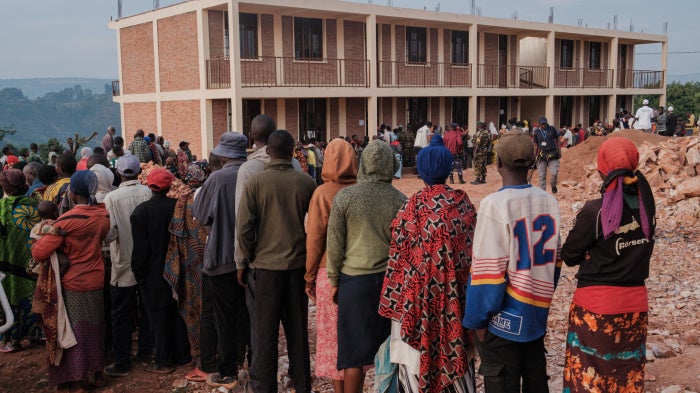
Burundi’s political space in 2025 was marked by deteriorating human rights conditions as the ruling party consolidated power. Burundians faced restrictions on free expression, assembly, and participation of the political opposition during local and legislative elections. At the same time, Burundi experienced one of the largest refugee inflows in recent decades, stemming from escalating conflict in the neighboring Democratic Republic of Congo. The country’s economic conditions worsened amid fragile public services, high inflation, fuel shortages, and foreign‐exchange constraints. The mandate of the United Nations Special Rapporteur on Burundi was renewed by the UN Human Rights Council in October 2025.
Elections
In June and July 2025, Burundi held legislative, senatorial, and local elections without any real opposition. The ruling party, the National Council for the Defense of Democracy-Forces for the Defense of Democracy (Conseil national pour la défense de la démocratie-Forces pour la défense de la démocratie, CNDD-FDD) ‐FDD), won 96.5 per cent of the vote. They secured all contested seats in the National Assembly and the Senate, along with almost all commune‐level council seats. Opposition parties were effectively sidelined before the election through legal, administrative, and coercive means. Opposition candidates—including from the National Congress for Freedom (CNL), the Union for National Progress (UPRONA), and others—were barred from contesting in some polls. During the campaign period, reports emerged of harassment, intimidation, arbitrary arrests, physical abuse, enforced disappearances, and threats by members of the Imbonerakure, the ruling party youth league, local officials, and other state‐linked actors.
Media coverage of the elections was tightly controlled, with content subject to censorship, and reports critical of the process, suppressed. Observers noted self‐censorship among journalists, and some outlets were pressured not to report irregularities. Irregularities included inflated voter numbers, selective distribution of voter cards excluding opposition supporters, ballot stuffing, and exclusive representation of ruling party officials at polling stations.
The CNDD-FDD imposed compulsory contributions on the population from August 19, 2024, demanding payments ranging from 1,000 to 5,000 Burundi francs per person, and up to 100,000 francs for businesses. Imbonerakure members and local officials enforced collection through threats, denial of public services, and reprisals, echoing patterns documented by Human Rights Watch ahead of the 2020 general elections.
Civil Society and Media Space
United Nations experts reported that between January 2024 and May 2025 there were at least 200 reported cases of sexual violence (including rape of children), 58 enforced disappearances, 62 acts of torture, 892 arbitrary detentions, and 605 extrajudicial killings—often with state agents or their proxies involved. The experts raised concern about access to services for survivors of torture and sexual violence. The Imbonerakure played a prominent role in these abuses, especially around the elections, engaging in intimidation, extortion, beatings, and sometimes killings.
Most Burundian human rights organizations, particularly those investigating human rights violations and working on civil and political rights, continue to work from exile due to threats to their security. Freedom of expression is guaranteed by the Constitution, but in practice, is strictly limited by draconian press laws and a dangerous operating environment for media professionals, including women journalists, who receive threats and are victims of harassment and arrest.
At time of writing, journalist Sandra Muhoza remains arbitrarily detained after conflicting judicial decisions. On June 13, the Mukaza Court of Appeal found it did not have jurisdiction because the alleged offence was committed in Ngozi, not in Bujumbura. This decision calls into question the initial conviction and the arrest warrant for the journalist. However, Muhoza remains imprisoned in Mpimba central prison.
Economic Crisis
Burundi’s economic situation in 2025 compounded political repression and humanitarian pressure. Inflation surged to 40 percent in February, official foreign exchange reserves are limited, and fuel shortages have persisted, hindering mobility and commerce. The discrepancy between official and unofficial exchange rates continued to squeeze households’ purchasing power.
In September, the country director of the Belgian Development Agency (Enabel) in Burundi, was reportedly ordered to leave the country by Burundian authorities. According to media reports, this decision follows a post published on LinkedIn, in which the manager shared a cartoon illustrating the fuel shortage in Burundi.
Conflict in Eastern Congo
Burundi continued to provide political and military support to the Democratic Republic of Congo, including through the deployment of troops in South Kivu. This involvement fueled tensions within Burundi’s armed forces. In February, a military appeals court confirmed heavy sentences following the 2024 military courts’ conviction of 272 soldiers who refused to be deployed to Congo, citing poor conditions of service. Some were sentenced to life imprisonment.
In September 2025, the United Nations Special Rapporteur on Burundi reported that members of the Imbonerakure received paramilitary training in Cibitoke province in preparation for deployment to Congo. The training raised concerns about the further militarization of the movement, which has long been implicated in abuses. Recruitment drives were also documented across the country, with new recruits sent to military training camps in Ngozi, Cankuzo, Bururi, and Muramvya.
Refugee Rights
In 2025, Burundi received a large influx of refugees fleeing the escalating conflict in eastern Congo. According to the UN refugee agency, UNHCR, over 70,000 people had crossed into Burundi by September. Many of the refugees, including women and children, were living, as of September, in transit centers and camps, such as Rugombo stadium in Cibitoke province, in harsh conditions with insufficient shelter, inadequate sanitation, overcrowding, shortages of food and water, and health services stretched to breaking point.
Funding shortfalls have further worsened the humanitarian situation. UNHCR and other aid agencies have issued alerts that available resources are insufficient to deliver assistance at the levels required.
In September, police and ruling party youths detained hundreds of Congolese refugees and asylum seekers, according to several witnesses and media reports. They were required to go to an official camp or return to Congo, which about 80 people did. Discriminatory practices were reported throughout the year, particularly by Imonerakure members or local officials, against Tutsi, who were suspected of interacting with Rwanda or the M23 armed group, according to the UN Special Rapporteur and Human Rights Watch research.
National Institutions
On April 18, 2025, Sixte Vigny Nimuraba, the former chair of the National Human Rights Commission, left the country after police searched his residence. Some sources attributed his departure to internal divisions within the commission. Others said it reflected mounting pressure on dissenting voices ahead of Burundi’s legislative, senatorial, and local elections scheduled for June to August 2025.
New members of the Commission were elected by the National Assembly at its plenary meeting of May 5, 2025, even though the term of the previously elected members had not yet expired. This measure violated Burundian law and the Paris Principles relating to the status of national institutions for the promotion and protection of human rights.
The Truth and Reconciliation Commission, a central pillar of the transitional justice process under the provisions of the Arusha Agreement, also faced reports of political interference. In early 2025, according to media reports, two members of Burundi’s Truth and Reconciliation Commission fled the country amid escalating institutional tensions.
The rapid replacement of the two members took place with no transparency or prior consultation with civil society or stakeholders in the transitional justice process, raising serious concerns about the growing politicization of that body.
Sexual Orientation and Gender Identity
Burundi’s penal code, under article 590, punishes same-sex relations with up to two years’ imprisonment.