Bosnia and Herzegovina (BiH) has been slow to implement the reforms to improve human rights required for EU accession.
The long-standing failure of authorities in BiH to resolve constitutional discrimination against Jews and Roma came under renewed international scrutiny. While policies against domestic violence improved in the Federation entity, there was little progress on war crimes accountability or protecting asylum seekers and migrants overall, and media freedom and legal protections for lesbian, gay, bisexual, and transgender (LGBT) people deteriorated.
Milorad Dodik was convicted and removed as president of the Republika Srpska entity (RS) in February 2025 over separatist laws and threats of secession. In response, the RS assembly adopted new laws limiting the authority of the federal state over RS, which were suspended by the state Constitutional Court in March 2025. A planned referendum in October, challenging the court decisions against Dodik, raised concerns about the rule of law and BiH’s territorial integrity, and caused alarm among non-Serbs living in the entity.
Discrimination and Intolerance
In March, the Council of Europe’s Committee of Ministers scrutinized Bosnia’s failure to implement the European Court of Human Rights rulings on constitutional discrimination against Jews, Roma, and others, demanding that Bosnian authorities provide a detailed action plan and implementation timeline.
Roma residents of Banlozi camp near Zenica won a victory in March against a water company for denying them access to water. In general, Roma continued to face discrimination and social exclusion.
Between January and July 2025, there were 20 ongoing hate crime trials according to the Organization for Security and Cooperation in Europe; in addition, two cases resulted in convictions and one in an acquittal during the first half of 2025. All had ethnic or religious motivation.
Disability Rights
In May, a Bosnia-wide survey of civil society organizations found limited progress in the implementation of UN recommendations on the rights for persons with disabilities and inadequate protections of their rights.
Accountability for War Crimes
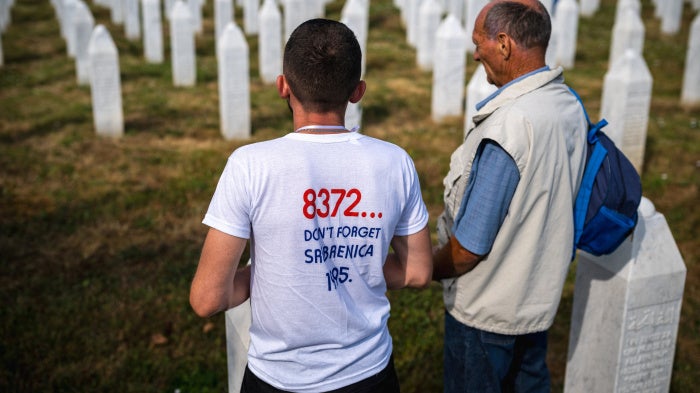
July 11 marked the 30th anniversary of the Srebrenica genocide, a somber reminder that, three decades later, accountability for war crimes remains slow and incomplete.
In January, BiH authorities extended again the deadline for full implementation of the Revised National War Crimes Strategy until the end of 2025.
According to the OSCE, as of September 1, there were 222 war crimes cases pending before all courts in BiH. There were first-instance judgments in 8 cases during the first eight months of 2025, with 12 defendants found guilty and 2 acquitted. Final judgments were rendered in 7 cases during the same period, with 12 defendants found guilty.
As of September 2024, there were 53 ongoing cases involving conflict-related sexual violence (CRSV), 3 with final judgments in which 6 defendants were found guilty on CRSV charges.
Nearly two years after the Federation Bosnia and Herzegovina (FBiH) entity Law on the Protection of Civilian Victims of War came into force, its enforcement remains blocked by cantonal regulations.
Despite calls from the UN and EU to end the practice, authorities in RS continue to impose court costs on war crimes victims seeking compensation from perpetrators through civil courts. Victims do so because criminal courts refuse to order compensation alongside convictions.
Asylum Seekers and Migrants
In the first half of 2025, Bosnian authorities reported irregular arrivals falling to 5,178 compared to 12,334 in the same period in 2024. According to UNHCR, most came from Afghanistan and remain vulnerable or in need of international protection due to the humanitarian crisis there.
Between January and July 2025, only four people in Bosnia were recognized as refugees. UNHCR has long expressed concern that most people meeting the criteria for refugee status are instead granted only subsidiary protection, which does not confer rights to naturalization, family reunification, or travel documents.
According to Bosnian authorities, the country accepted 3,049 readmissions of third-country nationals from the EU in 2024. Given limited access to legal protection, many readmitted to Bosnia risk being subjected to prolonged detention.
Gender-Based Violence, Including Domestic Violence
Gender-based violence is a serious concern, and the state response remains insufficient.
In November 2025, Aldina Jahić was chased through the city of Mostar and murdered by her former partner. The authorities had failed to take action after an indictment was issued against the perpetrator based on a report in January by someone else for endangering their safety.
In June, an appeal was filed with the Constitutional Court of BiH in the 2021 murder of Alma Kadic, citing violations of the European Convention on Human Rights due to institutional failures to protect women from violence.
After months of advocacy by grassroots organizations, BiH passed a law recognizing femicide—the gender-related killing of women and girls—as a distinct criminal offense in August 2025. While the law strengthens legal protections for women against gender-based violence, bringing them closer to standards of the Istanbul Convention on violence against women, advocates have highlighted the need for increased funding and training of judiciary and police to ensure consistent implementation.
A draft femicide law in Republika Srpska was withdrawn in 2024 and had not been reintroduced at time of writing.
Sexual Orientation and Gender Identity
In March 2025, Republika Srpska adopted amendments to its criminal code that eliminated gender identity as a protected category, including in provisions on hate crimes and hate speech. In July, the FBiH parliament explicitly excluded same-sex couples from domestic violence protections, which drew criticism from the international community and rights groups.
The main pride event saw two attacks, which organizers reported to the police, yet the authorities stated later that no incidents had occurred.
Freedom of Media
Media freedom in Bosnia and Herzegovina faces serious challenges. The country ranked 86th globally in the Reporters without Borders 2025 World Press Freedom Index.
In January, the FBiH authorities proposed changing the penal code to make it an offense subject to imprisonment for journalists not to obtain prior consent before publishing any personal information. As of this writing, the draft law had not been adopted.