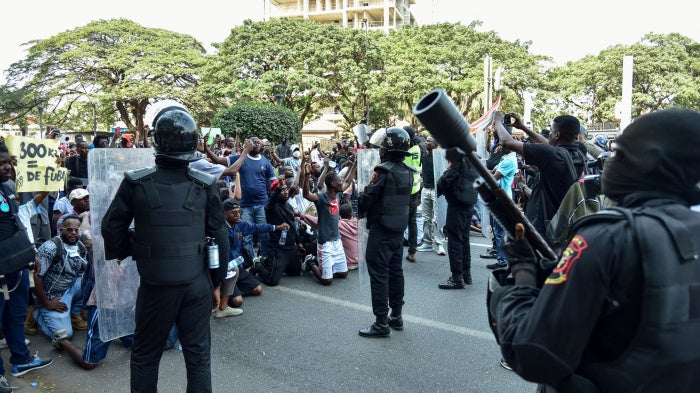
The Angolan security forces frequently responded to demonstrations with excessive and lethal force and arbitrarily detaining protesters. Youth movements and civil society groups protested the government’s decision to raise fuel prices and eliminate public transport subsidies without public consultation. Authorities violated press freedom and the right to a fair trial. Renewed clashes between the Angolan Armed Forces and the separatist Front for the Liberation of the Enclave of Cabinda (FLEC) group reportedly led to the killings of six civilians in Cabinda. Authorities violated freedom of the press and the right to a fair trial.
Freedom of Assembly
Angolan police continued to be implicated in excessive use of force and arbitrary detention of journalists, activists, and protesters. During a three-day taxi drivers’ strike starting on July 28, police used excessive and unlawful force against protesters reportedly resulting in death of at least 29 people, the injury of hundreds and the arrest of over 1,200 people in Luanda, Huambo, Benguela, and Huíla provinces. Earlier that month, police fired tear gas and rubber bullets, and assaulted protesters, injuring several people, and carried out arbitrary arrests while dispersing peaceful protests in Luanda.
The Office of the United Nations High Commissioner for Human Rights (OHCHR) called on Angolan authorities to conduct prompt, thorough, and independent investigations into the deaths and reported use of excessive force during the protests.
In August, the Angolan police announced an investigation into deaths of protesters, after denying officers had orders to shoot to kill. As of September, the results of the investigations were not public.
In February, police detained a Deutsche Welle correspondent and others, including two opposition parliamentarians, during a march against the killing of older women in Kwanza Norte. Police also reportedly in March detained 10 women, while destroying their protest signs, during a march against gender-based violence in Luanda.
Press Freedom
Press freedom faced several threats in 2025. In September, a court in Luanda suspended a strike by state media over pay and working conditions stating it violated the right to information.
In August, Angola’s Criminal Investigation Service (SIC) detained two journalists in connection with a terrorism-related case involving two Russian citizens. The police accused the journalists of terrorism-related crimes, including sharing “fake information” on social media, without providing details. One of the journalists, Armando Bumba, was later released without charge. Angolan rights groups expressed concern over the arrests, calling on the press not to be intimidated.
In May, Portugal’s public broadcaster, RTP, denounced their press team’s expulsion from an event at the office of the president in Luanda, describing it as an “attack on press freedom.” The Presidency Press Centre also removed the broadcaster from its WhatsApp group. The Angolan president of the Portfolio and Ethics Commission for journalists, Luísa Rogério, said that this type of expulsion of private media keeps happening.
Fair trial
As of September, 198 people convicted in 2024 of alleged participation in protests supporting regional autonomy were still imprisoned and waiting for their appeal. They had been sentenced to between four to eight years in prison, plus fines, after an unfair trial without access to legal counsel of their choice. The authorities charged them with rebellion, criminal association, disobeying orders to disperse, participation in riots, and damage to public property, despite the demonstrations being generally peaceful.
Situation in Cabinda
Tensions resurged in Angola's Cabinda exclave, after reported clashes between the Angolan Armed Forces and FLEC, in May. FLEC accused the Angolan government of killing at least six civilians, while claiming it had killed 11 soldiers, in response to a government army attack. The Angolan authorities have not publicly commented on this.
The armed conflict in Angola’s Cabinda province is one of the world’s longest but least reported armed conflicts, lasting over 40 years. The human rights situation in the oil-rich province has been characterized by violent crackdowns on peaceful protesters and activists, among other abuses.
Children’s Rights
Outbreaks of measles and cholera severely impacted children’s health and lives. The cholera outbreak is one of the most severe in recent years, with over 27,000 cases and 759 deaths reported as of June 2025. As of September, 30 percent of the cholera cases were children and adolescents under 19 years, according to the United Nations Children's Fund, UNICEF.
The situation of Angolan children in neighboring Namibia, who fled their country due to drought causing severe shortage of food, was widely publicized. The Bishops' Conference of Angola and São Tomé and Príncipe (CEAST) challenged the Angolan government to “take responsibility and act urgently” on the matter.
Authorities launched a campaign to eradicate child marriage and prevent teenage pregnancy, championed by the country’s parliament. The campaign prioritizes the strengthening of sexual education in schools, the promotion of gender equality and the improvement of health services for adolescents, ensuring access to contraceptive methods and adequate maternal care. The Angola Penal Code establishes 18 as the legal age for marriage, except for marriage with parental consent at 15 for girls and 16 for boys.
Food Insecurity
Southern Angola, especially Huíla and Cunene provinces, continued be impacted by the El-Niño-related drought affecting southern Africa. An estimated 2.2 million people required humanitarian assistance, including 1.8 million who were food insecure and 1.3 million who required nutritional support, according to the World Food Programme (WFP). Early in the year, the humanitarian organization Care International placed Angola top of the 10 most underreported humanitarian crises, noting that “many of the water access points once used in the drought-affected region are now dry.”
The Angolan government has acknowledged that food insecurity remains a "pressing issue," especially in the south and east of the country, which have been heavily affected by floods and droughts.