Algerian authorities continued to crack down on dissent and criminalize peaceful expression and activism. They continued to severely punish criticism of government policies, including online, and to prevent or restrict public mobilization of political and social movements. Security forces unlawfully expelled migrants, asylum seekers, and refugees, mainly nationals of other African countries, to Niger, under inhumane and dangerous conditions.
Freedom of Expression and the Press
The authorities arrested several dozen people who used the hashtag #ManichRadi, which appears to have emerged in December 2024 as a way to express online discontent with the country’s social and political situation. On January 20, the Rouïba court near Algiers sentenced activist Mohamed Tadjadit to five years in prison and a fine of 500,000 Algerian dinars (US$3,860) for “undermining national unity,” “publishing information detrimental to national interest,” “inciting an unarmed gathering” and “insulting a public authority” in connection with his social media posts, including the hashtag #ManichRadi, and political expression. Tadjadit, a well-known activist, has been imprisoned at least six times for exercising his human rights since 2019.
On January 21, a Béjaïa court sentenced activists Soheib Dabbaghi and Mehdi Baaziz to 18 months in prison and a fine in connection with the hashtag.
On January 19, Fethi Ghares, former coordinator of the suspended Social and Democratic Movement Party (“Mouvement Démocratique et Social,” or MDS), was convicted of “publishing fake news,” “spreading hateful and discriminatory speech,” and “insulting the president” in connection with statements he made on social media. The court sentenced him to a year in prison, a fine of 200,000 dinars ($1,540), and a compensation payment.
Messaouda Cheballah, an ex-board member of the MDS and Ghares’s wife was accused of complicity and sentenced to six months in prison, a fine of 100,000 dinars ($772) and a compensation payment. In May, their sentences were confirmed on appeal, but as of September 2025, Ghares and Cheballah have not been arrested.
On February 16, Ouargla court in south-east Algeria sentenced activist Derama Kemari (known as Abla Kemari) to three years in prison, including a one year-suspended sentence, and a 300,000 dinar ($2,315) fine for “insulting the president” and “incitement to hatred and discrimination,” in connection with Facebook posts denouncing the authorities’ crackdown and social and economic issues.
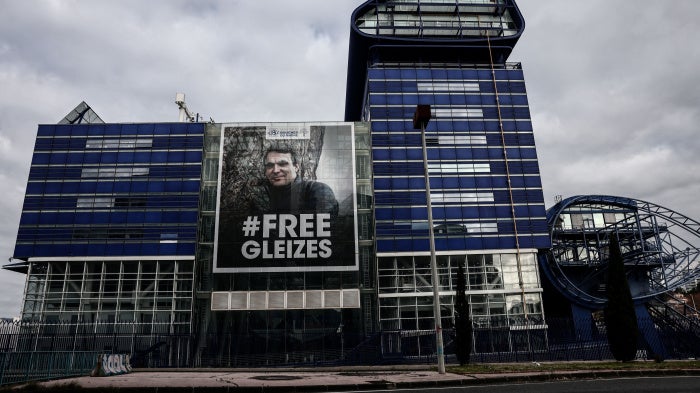
On June 29, an Algiers court sentenced French sports journalist Christophe Gleizes to seven years in prison for “apology for terrorism” and “possession of publications for propaganda purposes detrimental to the national interest,” for his work. According to Reporters Without Borders, Gleizes was convicted on the grounds of meeting a source in 2015 and 2017 who was also a member of the Movement for the Self-Determination of Kabylie (MAK), which the Algerian authorities later labelled a terrorist organization in 2021.
On July 1, Boualem Sansal, an Algerian-French writer, was sentenced to five years in prison and a 500,000 dinars ($3,860) fine on appeal. Sansal was arrested at Algiers airport upon arrival from France on November 16, 2024. He was charged with “undermining national unity,” “insulting an official authority,” “practices harmful to the national economy,” and “possession of videos and publications threatening the security and stability of the country,” in connection with statements he made in October 2024 on Algeria’s border with Morocco, his lawyers said. Sansal was released following a presidential pardon on November 12.
Freedom of Association and Assembly
The Algerian authorities have proposed a bill to replace the current law on associations, which includes overly broad and vague provisions and imposes burdensome registration and operating procedures on associations. As of September 2025, the draft bill under consideration did not address the shortcomings of the 2012 law. If adopted, it would grant the Interior Ministry sweeping authority over the creation, functioning, and financing of associations and virtually unlimited control over their activities.
On February 24, Messaoud Boudiba and Boubaker Habet, two education unionists traveling to M’Sila in south Algiers to support a strike movement, were arrested, placed under judicial supervision, and banned from speaking to the media, social media, or taking part in public demonstrations.
In November 2024, resident doctors started a months-long protest movement demanding better working conditions and salaries. Authorities arrested Charaf Eddine Talhaoui, a leader of the Tlemcen Medical School resident doctors, on January 28, for his participation in the movement. He was convicted of “spreading fake news,” “undermining public order,” and “undermining national interest,” and on March 23, a Tlemcen court sentenced him to 18 months in prison and a fine. Talhaoui was released on May 4, after his sentence was reduced on appeal that day to a year in prison, including nine-month suspended sentence.
On August 20, security forces prevented many people planning to gather in the village of Ifri Ouzellaguen for the commemoration of a historic event of Algeria's war of independence from accessing the site. Dozens of people were arbitrarily arrested, including activists and supporters of the Democratic Constitutional Rally, the party said. The authorities have regularly prevented this gathering.
Arrest and Detention of Perceived Opponents
On May 26, an Algiers court convicted three former prospective candidates for the September 2024 presidential election, Saïda Neghza, Belkacem Sahli, and Abdelhakim Hamadi, of buying endorsement signatures and sentenced them to ten years in prison and a fine, media reported. On July 9, their sentences were reduced to four years on appeal.
Freedom of Movement and Travel Bans
Algerian authorities continued to implement arbitrary travel bans to silence perceived critics, including activists, journalists, trade unionists, and academics, violating their right to freedom of movement and undermining the rights to freedom of association, assembly, and expression. The arbitrary bans can be imposed without formal notice, are often unlimited in duration, and are almost impossible to challenge.
On July 30, authorities prevented Nassera Dutour, an Algerian activist, from entering Algeria without legal grounds. Dutour is president of the association SOS Disparus, which represents the families of thousands of people who disappeared between 1992-2002. Dutour was arrested upon arrival at Algiers airport, interrogated, and deported to France on the same day.
Migrants’ Rights
Algerian authorities continued to arbitrarily and collectively expel migrants of various African nationalities, including children, to the desert at the border with Niger, where they face life-threatening conditions. The expulsions have often been accompanied by abusive treatment and in many cases have taken place without individual screenings or due process. The nongovernmental organization Alarme Phone Sahara found that Algeria expelled about 5,000 people to Niger between January and April and documented at least five deaths due to abuse or harsh conditions of expulsion for the same period. On June 4, Niger authorities declared that at least 16,000 people, including children, were expelled from Algeria in April and May alone.
Sexual Orientation and Gender Identity
Same-sex relations remain punishable under article 338 of the penal code by up to two years in prison.