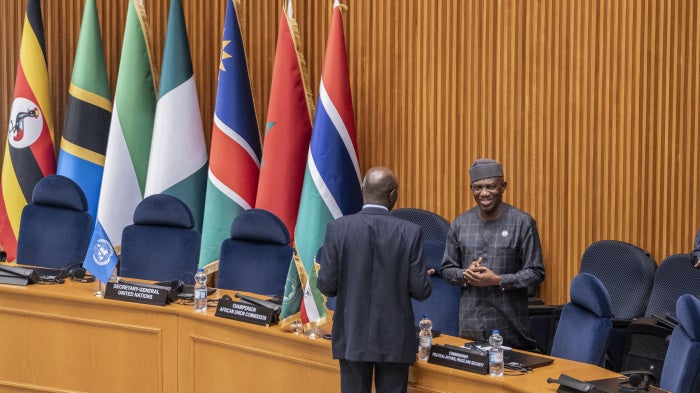
In 2025, the African Union (AU) sought to reassert its leadership on peace, security, and human rights amid deepening political instability across the continent. The AU’s key organizations–the Peace and Security Council (PSC), the African Commission on Human and Peoples’ Rights (ACHPR), and the African Court on Human and Peoples’ Rights (the Court)–faced renewed tests of their credibility in responding to abuses in conflicts in Sudan, eastern Democratic Republic of Congo (DRC), and the Sahel. The year also saw the AU shift toward thematic approaches to longstanding issues, including corporate accountability, environmental justice, reparations, and the rights of women and girls.
AU Peace and Security Council Fact-Finding and Accountability in Conflict Situations
Following years of criticism for inaction on atrocities, the PSC took steps in 2025 to reaffirm the centrality of human rights in its peace and security mandate. However, political divisions within the council—especially by states with active conflicts, and those prioritizing sovereignty over a continental response—continued to limit its ability to enforce accountability measures.
In West Africa, the PSC prioritized informal consultations on the deteriorating security and political situation in Burkina Faso, Mali, and Niger, focusing on restoring constitutional order. Its most comprehensive communiqué on the Sahel lacked a coherent framework to address civilian harm caused by both state and non-state actors.
In Sudan, the ACHPR’s Joint Fact-Finding Mission (FFM) on Sudan became the most visible example of AU engagement on atrocity crimes. In October, with worsening humanitarian conditions and attacks on civilians in El Fasher, the ACHPR published its preliminary report detailing serious human rights violations by both warring parties, the Sudanese Armed Forces and the Rapid Support Forces.
The preliminary report covers widespread, targeted, and systematic attacks against civilians– including killings, sexual violence, starvation tactics, and destruction of civilian infrastructure–amounting to serious violations of international humanitarian and human rights law, constituting possible war crimes and crimes against humanity. The ACHPR called for urgent and coordinated measures to protect civilians, including immediate ceasefires around population centers, humanitarian access guarantees, strengthened protection mandates for relevant AU and UN mechanisms, and the establishment of safe corridors for those fleeing violence. It further urged credible, independent accountability processes to investigate and prosecute those responsible, alongside robust evidence-preservation efforts in anticipation of future judicial proceedings.
At time of writing, the PSC has yet to hold a public session on the report or endorse and operationalize the FFM’s recommendations. The ACHPR mission operated under difficult circumstances, including limited financial and human resources and lack of access to Sudan or neighboring countries, including Chad, Egypt, Ethiopia, Libya, South Sudan, and Uganda, where Sudanese people had fled.
Rights, Peace Process in eastern DRC
The AU responded, through the Luanda and Nairobi mediation processes, to renewed conflict in eastern Democratic Republic of Congo, where the Rwanda-backed M23 armed group expanded its territorial control. The M23 killed and forcibly transferred civilians, and Congolese security forces committed retaliatory abuses. The PSC did not name external interference in the eastern Congo in its communiqués on the situation. The government of Rwanda has provided military, logistical, and other support to the abusive M23 in eastern Congo.
The AU’s limited leverage over Kigali and Kinshasa hindered its mediation efforts through João Manuel Lourenço, the president of Angola and AU Champion for Peace and Reconciliation. President Lourenço relinquished his facilitator role when the two warring leaders looked for an alternative mediation forum in the Middle East, further demonstrating disregard for AU leadership and leverage over the warring parties. Although the incoming AU Commission chair designated Faure Gnassingbé of Togo as a new mediator, supported by five facilitators, and merged the Nairobi and Luanda processes, the peace agreements between the governments of the DRC and Rwanda were brokered by Qatar and the United States. The situation in eastern Congo remains unstable, with armed conflict and severe humanitarian and human rights crises in North and South Kivu provinces.
Corporate Accountability and Environmental Rights: The Kabwe Lead Mining Case
Decades of lead mining have left tens of thousands of children in Kabwe, Zambia, exposed to toxic waste, with little redress. The AU, including the November session of the African Committee of Experts on the Rights and Welfare of the Child (ACERWC), continued to debate corporate responsibility and environmental justice. The legacy of contamination in Kabwe has also prompted a class action lawsuit by affected women and children against Anglo-American, a firm that transferred toxic lead waste across borders. At time of writing the South African Supreme Court of Appeal was deliberating whether to certify the class action.
The Kabwe case contributes to the ongoing discussions within the AU and its member states on the need to advance a continental framework on business and human rights, guided by the ACHPR Working Group on Extractive Industries, Environment and Human Rights Violations. While the Kabwe case underscored the need for stronger regional regulation, AU member states remain divided on binding corporate obligations and access to remedies for affected communities.
Reparations, Historical Justice, and the Chagos Question
The AU deepened its engagement on reparations and historical justice, its theme of 2025, drawing inspiration from the reparative justice movement across Africa and the Caribbean. Nongovernmental groups including Human Rights Watch called on the AU and its member states to take a principled stance on the right of return and reparations for Chagossians forcibly displaced by the United Kingdom and the United States in the 1960s and 1970s.
Beyond declarations, the AU’s capacity to pursue reparative justice remained limited, with some member states privately indicating that capitals were prioritizing bilateral diplomacy over collective legal action. At the time of writing, a common African position is yet to be reached, as the AU enters the decade of reparations 2026-2036.
Key Human Rights Institutions: African Commission, African Committee of Experts and the African Court
In 2025, the ACHPR reinforced its role as the continent’s primary human rights monitoring body, despite persistent gaps in state cooperation. It issued letters of urgent appeal to states, including on extrajudicial executions and enforced disappearances of mostly Fulani men in Mali, trade union dissolutions in Niger, a joint letter with the ACERWC on the death of a child after a female genital mutilation procedure in The Gambia, and on displaced persons in Senegal. The ACHPR also sent a letter to Burundi on human rights issues including refugee management and prison conditions.
The ACERWC played an increasingly visible role, particularly in advancing the right to education for pregnant girls and adolescent mothers. The ACERWC issued a General Comment on article 11 of the African Charter on the Rights and Welfare of the Child aimed at eliminating school exclusions and ensuring equal access to education. These efforts highlighted ACERWC’s growing influence in shaping AU policy and strengthening continental child-protection standards.
At the same time, developments around the African Court on Human and Peoples’ Rights raised renewed concern about the future of judicial protection on the continent. In March 2025, Tunisia formally withdrew its article 34(6) declaration, which had allowed individuals and NGOs direct access to the court. This followed earlier withdrawals by Rwanda, Tanzania, Benin, and Côte d’Ivoire, further weakening the court’s accessibility and eroding justice avenues for victims of human rights violations.
Despite the AU’s rhetorical reaffirmation of human rights as central to its continental agenda, 2025 revealed persistent gaps between commitments and concrete action. The Peace and Security Council’s cautious embrace of investigative mechanisms in Sudan and the DRC showed potential for accountability but remained constrained by political will. The AU’s emerging focus on corporate accountability, reparations, and gender equality broadened the human rights discourse beyond conflict situations, yet implementation continued to depend on national adoption.