

Although not defined in international law, the term “predatory lending” has been used in different contexts to describe a set of practices that extend credit and collect payments through unfair, deceptive, or abusive means and that disregard a borrower’s ability to repay. Such lending typically aims to maximize lender profit without regard to borrower financial stability, often leading to high levels of debt and further borrower financial hardship.
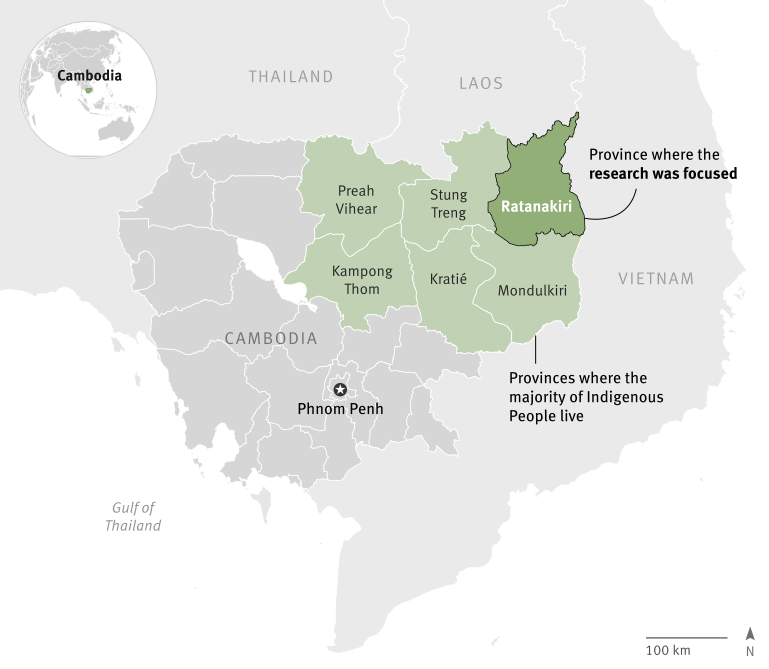
This report focuses on the irreversible impacts of predatory lending by Cambodian MFIs on Indigenous peoples in Ratanakiri province, one of four provinces in the country’s northeast where most Indigenous peoples live and where poverty rates are higher than elsewhere in the country. Human Rights Watch interviewed 56 Indigenous residents and community leaders, of whom 52 had microfinance loans and described being trapped in cycles of debt. Most of these Indigenous borrowers held microfinance loans collateralized with land titles.
Their accounts showed that over-indebtedness has compounded the marginalization of Indigenous peoples and made them vulnerable to repeated threats from MFI credit officers collecting payments. This report documents harms related to predatory lending to Indigenous peoples in Cambodia’s northeast, specifically:
the loss of Indigenous lands and the impact of microfinance loans collateralized with land titles on the collective land titling process for Indigenous land;
repeated issuance by Cambodian MFIs of loans to Indigenous borrowers based on the value of their land used for collateral, despite inadequate income to make scheduled repayments;
loss of means of subsistence due to forced land sales and sales of other productive assets, exacerbated by impacts of climate change on incomes of Indigenous farmers;
harmful coping mechanisms due to over-indebtedness, including decreased food consumption, children dropping out of school to work or because their indebted parents could no longer afford the cost of education, and debt-related suicides.
Story of Vannak and Sreyleak
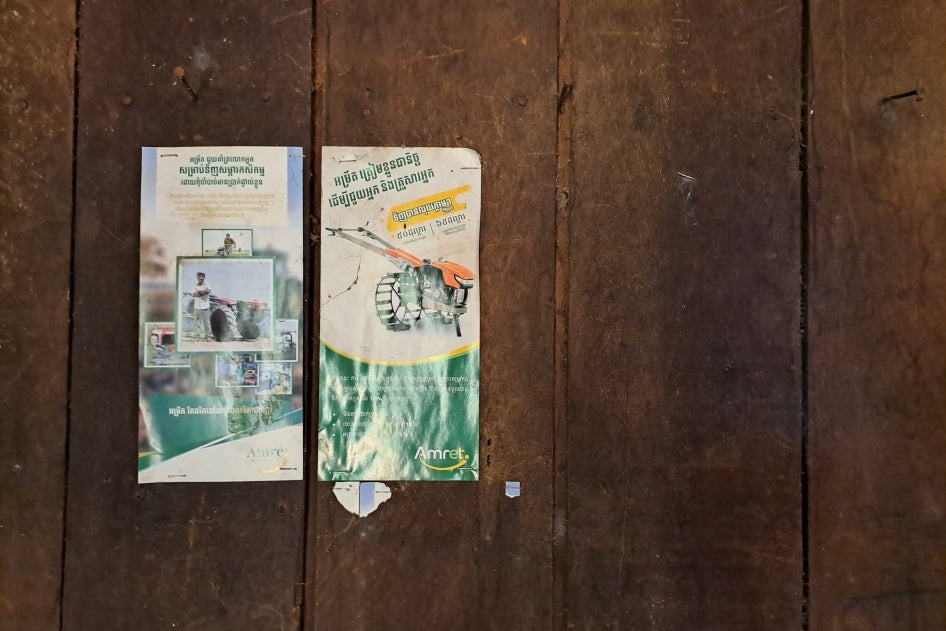
The couple Vannak and Sreyleak are Indigenous farmers from a rural village in Ratanakiri province. Starting in 2015, MFIs and banks began placing advertisements in their village that said land of any size could be used as collateral to borrow money. The couple took out small loans in 2016 and 2019 and soon paid them back. Afterwards, they were offered larger and larger loans by the MFIs operating in the area, which they took.
In 2023, the couple borrowed about US$2,500 from Amret, a Cambodian MFI whose shareholders include the World Bank’s International Finance Corporation (IFC) and the Netherlands’ state development bank (FMO), among others. Amret's website states its mission is “to provide underserved clients with financial services tailored to their needs.”
Vannak and Sreyleak took out the loan to invest in their farm, as their crops were their main source of income. Amret accepted a land title as collateral for the loan, even though the land title overlapped with protected Indigenous land that was already part of an application to the Cambodian government to secure an Indigenous Collective Land Title (CLT), which would prevent its sale to anyone outside of their Indigenous community.
Shortly after taking the loan from Amret, the couple’s crops began to fail. When Vannak and Sreyleak fell several days behind on their monthly payments, Amret credit officers began to show up at their house and demand that the couple sell their land and other assets to repay the loan.
During these visits, Amret credit officers pressured Sreyleak to thumbprint documents on multiple occasions promising to repay her loan by the next day. The documents were written in the national Khmer language, which she cannot read. The credit officers told her that if she did not pay the next day, she would be reported to local government officials—a practice specifically prohibited under Cambodian law, but a common tactic of credit officers pressuring borrowers into repaying.
The threats escalated as the couple continued to struggle to repay. Once, when the couple was just two days late on a repayment, an Amret credit officer arrived at their house. Vannak and Sreyleak said that the credit officer noticed the couple's 15-year-old daughter coming down the stairs of their house, turned to them and said that they should sell her to a local entertainment establishment, widely known to be a brothel. Vannak and Sreyleak were horrified; their daughter, who heard what the credit officer suggested, was terrified. They said she stayed in her room for several days and missed school out of fear that the credit officer would kidnap her and sell her to the establishment.
As the pressure from Amret ratcheted up, Sreyleak’s elderly mother, who was living with the family at the time, became increasingly distressed by the Amret credit officers’ frequent visits. She was suffering from health issues, and she began to say repeatedly to Vannak and Sreyleak that she was placing further financial burden on her daughter and son-in-law.
“My mother was stressed about us having to borrow money for her medical expenses,” Sreyleak said. “I believe that she did not want to burden us. She would also tell me that she was afraid every time the credit officers from Amret would come to ask for money.”
One day, Sreyleak’s mother went to the back of their house and hanged herself. Sreyleak believes her suicide was due to the pressure from the credit officers.
In correspondence with Human Rights Watch about policies and actions it had taken in response to reports of predatory lending and collection practices by its staff, Amret said it has a “zero tolerance policy regarding aggressive sales, coercive recovery practices, or any action that compromises a client’s dignity or legal rights” and conducts internal investigations into allegations of wrongdoing, even when complainants provide few details.
Amret noted that it had investigated one instance of a staff member allegedly urging a client to sell her child to settle a loan but could not identify the client concerned nor confirm any wrongdoing by its staff. When asked by Human Rights Watch if Amret had ever confirmed any cases of credit officers encouraging borrowers to sell their children to pay off Amret MFI debts, Amret did not confirm whether it had verified any such allegations.
When Human Rights Watch provided a follow-up letter with more details about this case —without sharing the names of the clients—Amret responded: “To be able to investigate and respond to this specific case we need sufficient and verifiable information. Anonymous complaints make it difficult to review the circumstances fully and to ensure that any affected parties receive the resolution they deserve. In the interest of the family involved we welcome the opportunity to review this case in more detail. We can offer several confidential channels through which the family may share their concerns directly with us or through an independent mediator, with full respect for their privacy and safety.”
Amret did not address Human Rights Watch’s questions about measures to identify and mitigate borrower distress, including suicide risk, and to provide debt restructuring or other remedial support in such situations.
Indigenous Borrowers, Debt Traps, and Losing Titles to Collective Land
Human Rights Watch found that Cambodian microloan providers advertised heavily to Indigenous communities in Ratanakiri province and worked with local government authorities, usually village chiefs, to encourage Indigenous borrowers to take out loans. Most credit officers from MFIs assigned to the people we interviewed did not speak the Indigenous languages and did not have interpreters present when explaining or finalizing loan documents, which were written in Khmer. Indigenous borrowers often did not understand the terms of their loans and were subject to repeated threats from credit officers when they fell behind on their payments.
Indigenous borrowers reported that when offering new loans, credit officers from banks and MFIs were primarily concerned with the value of the land that borrowers were pledging as collateral, rather than the borrower’s repayment capacity. Human Rights Watch also learned about these practices through interviews with credit officers, who said that their MFIs approved large loans to borrowers because they had valuable land that could be used as collateral.
The land titles used by Indigenous borrowers for collateral were so-called “soft titles”—an informal but commonly used document issued by a local authority—in contrast to “hard titles” recognized and issued by national-level authorities. Both types of land titles are accepted as collateral by MFIs in Cambodia. Indigenous borrowers in Ratanakiri said they were able to take out MFI loans once local authorities began issuing soft titles. In Cambodia, “soft titles” are often treated like “hard titles” due to their prevalence and role in everyday transactions.
Under both Cambodian law and international standards, there is no prohibition against Indigenous peoples using their land as collateral for loans. However, such decisions need to be made in a manner that is compatible with Indigenous rights — particularly the internationally recognized right of Indigenous people to free, prior, and informed consent.
The use of Indigenous land as collateral without free, prior, and informed consent raises serious concerns, and risks violating collective land rights, especially when loans are secured by land that is customary or communally held, or in the process of being registered as such. In these cases, even if an individual borrower agrees to use the land, doing so without the informed participation and consent of the broader Indigenous community may result in the loss of communal lands — undermining their identity, livelihoods, and survival as Indigenous peoples.
Some Indigenous borrowers interviewed by Human Rights Watch said their “soft titles” were part of a Collective Land Title process, a protracted and bureaucratic process through which Indigenous communities can receive titles for communal land. While a CLT is pending, that land should be subject to additional protection that prevents further granting or transfer of “soft titles” in the pending CLT-designated area.
Human Rights Watch found that Cambodian MFIs continued to lend to Indigenous peoples using “soft titles” that overlapped with pending CLTs, and that credit officers did not inquire whether these titles were part of an existing CLT or undergoing a CLT process. The acceptance of these soft titles as collateral by MFIs undermines the CLT application process, as the process requires community members to collect all such soft titles and give them to Cambodian government officials – which is not possible if these titles are being held by MFIs or informal lenders as collateral.
Some Indigenous peoples in Ratanakiri province who used “soft titles” as collateral have withdrawn from ongoing CLT processes because of microfinance debt, according to interviews and review of documents from multiple Indigenous communities. Indigenous borrowers from many different CLTs indicated that their community left or dropped out of the CLT process because of MFI debt in their community.
The Cambodian government provides free public health services. However, Human Rights Watch found that such services often are inaccessible to Indigenous people in rural areas such as Ratanakiri, exacerbating the impacts of the ongoing microfinance debt crisis. Many Indigenous respondents borrowed money because they needed funds quickly for emergency expenses, such as healthcare costs. For borrowers already in debt, many cited unexpected medical expenses as disrupting their ability to repay their loans.
Additionally, the impact of climate change on crop yields has further affected the ability of Indigenous borrowers to manage and repay their loans on time. Indigenous farmers described unexpected losses of income from failing harvests due to droughts, flooding, or unusually high temperatures. Agricultural insurance is at a very early stage of development in Cambodia, and farmers in Indigenous communities have no practical access to it. A single failed harvest can lead to financial devastation for Indigenous households, making them unable to repay their microfinance debts.
Once Indigenous peoples were in debt to MFIs, they fell into similar cycles of loan juggling and indebtedness that affects borrowers across Cambodia. Although part of the rationale for a regulated, formal microfinance sector is that these microloans can replace the informal and often more expensive system of unregistered moneylenders, in Cambodia, informal lenders play a crucial role in sustaining the formal MFI sector. Indigenous borrowers described relying on informal moneylenders to repay their formal MFI loans, at times at the instigation of credit officers. This loan juggling enabled MFIs to meet their performance targets while borrowers spiraled further into debt.
Indigenous borrowers described credit officers continuing to offer them new loans, even though they were aware of their inability to repay existing ones. Borrowers said they were told by credit officers working for the MFIs to list on their loan documents that micro-business investments were the reason for their loans, despite credit officers knowing these reasons to be untrue. Once Indigenous borrowers entered into cycles of deeper indebtedness, they were unable to break the cycle.
Credit officers acting on behalf of Cambodian MFIs and banks regularly threatened Indigenous borrowers late on repayments of their loans with legal action, although there are no criminal penalties for non-repayment of loans in Cambodia. Credit officers frequently threatened to report Indigenous borrowers to courts or the police or say they would take them to meet with local authorities.
Coercing borrowers to sign or thumbprint agreements promising repayment within a day or two was another common tactic of credit officers. Credit officers also threatened to sell the borrower’s collateralized land or possessions for below-market value if repayments were missed. Because most Indigenous borrowers did not understand their loan documents, many of them believed these threats and felt coerced by these unethical collection practices to repay their loans by whatever means possible.
Under pressure from credit officers, Indigenous people interviewed by Human Rights Watch felt compelled to manage their debts in ways that resulted in further harm. These strategies include forced sales of their land or other possessions at the instigation of credit officers seeking repayment of loans. Borrowers described how they felt they had no other choice, due to fears of either being reported to authorities or heavily fined. Loss of land in turn has profoundly affected their ability to earn a livelihood and their standard of living.
One common method for managing over-indebtedness is cutting back on food consumption. Indigenous borrowers described spending less on food than they did before taking MFI loans due to pressure to repay their microfinance loans.
Other families cut their spending on education, describing how their children had dropped out of school because the debt repayments meant parents could no longer afford the associated costs, or because their children needed to work to help their parents pay their MFI debt. Other children still able to attend school, experienced repeated and consistent interruptions in their education when they had to work intermittently to help their parents pay off their loans.
Human Rights Watch documented four suicides and two attempted suicides among Indigenous peoples in Ratanakiri and Preah Vihear provinces that followed acute anxiety over microfinance debt and its consequences. In some of these cases, MFIs and banks continued to pressure and threaten surviving family members to repay the loan after the suicide.
Obligations and Responsibilities of the Cambodian Government, MFIs, and Investors
Taking on debt in certain circumstances can help individuals and households improve their standard of living and enable investment in their own businesses, as microfinance loans were originally intended. However, when microcredit is needed to obtain public services, including education and health care, because they are inaccessible or too expensive, governments may be failing to fulfill their economic, social, and cultural rights obligations. An excessively high amount of debt—over-indebtedness—will also limit an individual’s enjoyment of their right to an adequate standard of living, including the rights to food, housing, and water, when household income must be diverted to service that debt.
Under international human rights law, including the United Nations Guiding Principles on Business and Human Rights (the UN Guiding Principles), governments have the obligation to respect, protect, and fulfill human rights obligations, including protecting the rights of persons within their territory from harmful conduct of private actors, such as banks and other financial actors. Private actors also have distinct responsibilities regarding human rights, including a responsibility not to cause, contribute to, or be linked with actual or potential adverse human rights impacts, and should adequately remediate adverse human rights impacts.
Cambodia has adopted laws and policies to regulate MFIs and protect consumers, but they have proven inadequate and are largely not enforced. The Cambodian government and private actors—both Cambodian MFIs and their international investors—have opted to promote voluntary measures and self-regulation. To our knowledge, there have not been meaningful steps taken to remedy the harms or prevent and mitigate the risk of harms from these predatory lending and collection practices.
In a letter responding to questions from Human Rights Watch about the enforcement of policies related to lending and collecting in the MFI industry in Cambodia, the National Bank of Cambodia (NBC), which has the authority to sanction and suspend or revoke licenses of MFI’s, did not provide any responses to direct questions about instances in which MFIs were penalized or sanctioned for any violation of consumer protection or regulatory laws or policies. The NBC did however state that it “focuses on strengthening consumer protection frameworks … as well as supporting capacity-building initiatives. Sanctions and discipline for non-compliance are applied according to Article 52-55 of [the] Law on Banking and Financial Institutions.”
Cambodia’s microfinance crisis has been fueled by international investors, in particular by the International Finance Corporation, the World Bank’s private sector lending arm, which has had the longest and deepest involvement in the microfinance sector of any foreign actor. In early 2022, two Cambodian human rights organizations, the Cambodian League for the Promotion and Defense of Human Rights (LICADHO) and Equitable Cambodia, filed a complaint with the IFC's grievance mechanism, the Compliance Advisor/Ombudsman (CAO), regarding IFC investments in six Cambodian microfinance institutions. They alleged that IFC-funded microfinance institutions engaged in predatory lending practices that led to human rights abuses, including loss of land and livelihoods, food insecurity, health threats, and child labor.
In an appraisal report issued in June 2023, the CAO concluded that the NGOs’ complaint regarding IFC financing of MFIs in Cambodia “meets the criteria for a CAO compliance investigation as there are preliminary indications that IFC may have failed to comply with its Environmental and Social (E&S) policies in assessing and supervising the social impacts of these investments, and that the alleged harm to complainants is linked to this potential non-compliance.” The findings of the CAO’s full investigation are expected to be released in 2025.
IFC investments in Cambodian MFIs have contributed to the human rights harms experienced by Indigenous peoples, in particular through IFC failure to ensure borrowers and would-be borrowers receive adequate information about the terms and conditions of loans in a language they understand and that loan terms respect Indigenous rights, including the right not to be dispossessed of collective land without free, prior, and informed consent. IFC obligations to respect human rights are reflected in its own “Sustainability Framework,” which is comprised of their Sustainability Policy, Performance Standards, and Access to Information Policy and articulates the IFC’s strategic commitment to sustainable development. The CAO’s preliminary appraisal drew attention to potential non-compliance with two performance standards and an exclusion list (which defines the types of projects the IFC does not finance) set forth in the framework.
Under IFC Performance Standard 7, recipients of IFC investments are required to “identify, through an environmental and social risks and impacts assessment process, all communities of Indigenous Peoples within the project area of influence who may be affected by the project, as well as the nature and degree of the expected direct and indirect economic, social, cultural … and environmental impacts on them.” Under Performance Standard 1, recipients of IFC investments “will undertake an engagement process with the Affected Communities of Indigenous Peoples … includ[ing] stakeholder analysis and engagement planning.” The IFC’s exclusion list also states that the IFC does not finance “[p]roduction or activities that impinge on the lands owned, or claimed under adjudication by Indigenous Peoples, without full documented consent of such peoples.”
Human Rights Watch is not aware of any environmental or social risk impact assessment or engagement process with affected Indigenous communities undertaken by the IFC, or any MFI, bank, or other international investor, prior to the provision of the loans to Indigenous peoples documented in this report.
In its response to the CAO’s preliminary findings, IFC management stated: “The alleged harms, while serious, are not the result of non-compliance with the IFC E&S Policies but are related to lending and collection practices by IFC clients, which IFC addresses through its responsible finance framework.” IFC management claims that risks and impacts suffered by microfinance borrowers are not covered by the institution’s E&S policies, because “Customers or consumers of a client’s products are not referenced in the Sustainability Policy or Performance Standards as a category of stakeholder to which E&S risk mitigation measures should apply.”
The IFC’s response to a letter from Human Rights Watch summarizing our findings similarly stated that: “[R]isks and impacts related to consumer protection are not managed through IFC’s current E&S requirements.” IFC management appears to dispute the basis of the CAO’s investigation, undertaken because of concerns over potential non-compliance with Performance Standards, including 1 and 7, and the IFC’s Exclusion List. The IFC also stated that it “requires all microfinance institution clients to maintain and comply with applicable codes of conduct, procedures and controls for responsible finance and consumer protection consistent with their business and customer profile, in full compliance with applicable national laws and regulations.” It also said it is working with the National Bank of Cambodia, industry associations and other sector-level bodies “to raise consumer financial capacity and enhance industry self-regulation and has supported establishment of a Financial Consumer Center.”
Since the CAO complaint was filed in early 2022, the IFC has not provided any additional direct financing to Cambodian MFIs, though some European state development banks and private investors have continued to provide loans and maintain equity to MFIs in Cambodia.
Right to a Remedy
Predatory lending by Cambodian MFIs has contributed to harms that require a holistic response and meaningful remedies for affected borrowers and communities. Remedies should address the direct harmful impacts of over-indebtedness, including coerced sales of Indigenous land, as well as the structural inequalities that lead Indigenous peoples to borrow to obtain services such as education and health care. The Cambodian government, Cambodian MFIs, the IFC, foreign state development banks, and private investors should ensure access to remedies that include mechanisms for debt forgiveness and substantive debt restructuring, as well as recovery of Indigenous land obtained through coerced land sales.
While some investors have sought to reduce their exposure or divest entirely from Cambodia’s MFI sector, they remain responsible for harms they contributed to while they were involved. Remedies should extend beyond current actors to include investors and shareholders who profited from predatory lending in the sector and have since exited without addressing their legacy of harms.
To ensure meaningful redress and potential recurrence, investors who have profited from predatory lending in Indigenous communities should establish an independent grievance mechanism accessible to and culturally appropriate for Indigenous borrowers. The mechanism should comply fully with guidance on non-judicial grievance mechanisms set forth in the UN Guiding Principles, including effectiveness criteria to be: legitimate, accessible, predictable, equitable, transparent, rights-compatible, continuous learning, and based on engagement and dialogue.
The Cambodian government, the Cambodian MFI sector, and their international financial backers should provide alternative financial mechanisms that allow Indigenous peoples to access credit without using their land as collateral. Community Development Financial Institutions, for example, have demonstrated that credit can be extended based on an individual’s ability to repay — without leveraging land as collateral. Other examples, such as rotating savings and credit associations and solidarity lending groups, also provide trust-based models that are likely to pose little or no risk to the rights of Indigenous peoples.
The Cambodian government should also meet its obligations to ensure economic, social, and cultural rights, including access to health care and education, and the right to an adequate standard of living. Indigenous communities should not have to rely on debt to obtain services the state is obligated under international law to provide.
Key Recommendations
To the Government of Cambodia and the National Bank of Cambodia
Enforce existing laws and policies that are designed to protect borrowers including: interest rate caps, requirements that borrowers have full and clear information about loan terms, including in languages understood by Indigenous peoples, and requirements to assess borrowers’ ability to repay prior to extending loans;
Impose penalties for predatory lending practices, including aggressive debt collection, and put in place a system of escalating sanctions for non‑compliance written into Cambodian law or NBC licensing conditions.
Expedite and strengthen collective land titling (CLT) processes to protect Indigenous communities from land loss;
Require that all loans to Indigenous borrowers comply with principles of free, prior, and informed consent, known as FPIC, ensuring they are fully informed of terms, in a medium and language they understand, prior to them signing or thumbprinting any agreement. Loan collaterals that overlap with collective lands require a free, prior, and informed consent process that includes the individual borrower and representatives of the Indigenous community whose collective land would be affected.
To Cambodia’s Microfinance Sector
End Predatory Lending and Coercive Collection Practices – MFIs should cease exploitative lending, intimidation tactics, and coercive collection strategies such as forced repayment agreements under duress, including by removing financial incentives for credit officers that encourage such practices;
Conduct Independent Audits of Microfinance Loans – Engage independent, third-party auditors—entities with no financial, governance, or business ties to MFIs, industry associations, investors, or self-regulatory initiatives—to review loan portfolios in Indigenous regions and identify contracts issued without proper income assessment; any such contracts should be declared null and void.
To the World Bank Group, IFC, and Private and State Development Bank Investors
Acknowledge and Address Microfinance-Related Harms – Publicly recognize and take responsibility for the negative impacts of microfinance lending on Indigenous communities. Implement safeguards to prevent further harms, including land dispossession;
Ensure Accountability and Provide Remedies – Provide substantial financial and non-financial remedies proportionate to the scale of harm and ensure that Indigenous borrowers and communities harmed by microfinance projects receive appropriate and commensurate remedies;
Implement Systematic Debt Relief and Grievance Mechanisms – Support debt restructuring for over-indebted borrowers and establish an independent grievance mechanism in line with UN human rights standards to provide fair and transparent remedies for microfinance-related harms.
Methodology
This report is based on research conducted by Human Rights Watch between February and December 2024. It builds on previous research by Human Rights Watch into this issue.[1]
We have chosen to focus on Indigenous borrowers in Cambodia because there has been relatively little research done on the potentially irreversible harms to these Indigenous communities as a result of microfinance loans.
The province of Ratanakiri was selected for in-depth research because a large proportion of Indigenous communities there had faced increasing harms from over-indebtedness to MFIs and informal lenders.[2] We obtained information from a variety of sources, including interviews with Indigenous peoples, 52 of whom had microloans from Cambodian MFIs and banks, mostly from Ratanakiri province. Most of those interviewed identified as a member of one of the Indigenous groups in Cambodia, specifically: Kachock (16), Kouy (11), Kreung (13), Tampuan (8), Jarai (6), and Bonong (2), and almost all came from communities in or around Ratanakiri, with additional interviews from Mondulkiri, Preah Vihear, and Kampong Thom provinces.
We also interviewed 10 Indigenous representatives; 5 non-Indigenous borrowers in Kompong Thom province; and 3 credit officers from microfinance lenders in Siem Reap, Kampong Cham, and Pursat provinces.
Due to security concerns, we have used pseudonyms for all Indigenous respondents, and other identifying information, including in some cases their location, has been withheld. Human Rights Watch conducted some of the interviews in Ratanakiri province but outside of Indigenous communities, such that local authorities and MFI credit officers would not be able to identify those interviewed. Interviews were conducted in Indigenous languages and Khmer, with interpretation from native speakers. Where possible, accounts were corroborated with local activists, news coverage, journalists, and other available sources, including sector reports, internal MFI shared industry data that included loan portfolios sizes in Ratanakiri, the specific area this report researched. Loan documents or credit history reports were reviewed from 49 of the 52 borrowers interviewed for this report to help corroborate respondent accounts. All of the borrowers whom we quote in the report were part of the group of 49 whose loan documents or credit history reports we reviewed.
All interviewees gave informed consent in advance of being interviewed. Before asking for consent, Human Rights Watch explained the purpose of the research, how the information would be used, and potential risks to all interviewees, and only proceeded with the interview once consent was given. Human Rights Watch did not provide any incentives in exchange for interviews.
Human Rights Watch also researched information from public sources, including relevant national law and international human rights standards, civil society organization reports, domestic and international news media reports, and academic journals.
Human Rights Watch sent written questions to all Cambodian MFIs named by Indigenous borrowers in this report, as well as to relevant Cambodian government bodies, industry associations, state development banks, and international investors with known financial ties to the Cambodian microfinance sector. Each letter outlined key findings, requested information regarding policies and practices, and offered an opportunity to respond prior to publication.
Human Rights Watch wrote to, but did not receive replies from: ACLEDA, KB Prasac, Sathapana Bank Plc., Phillip Bank Plc., Hattha Bank Plc., Ministry of Land Management, Urban Planning and Construction, Ministry of Economy and Finance, Ministry of Interior, Ministry of Health, Ministry of Education, Youth and Sport, Council of Ministers, Cambodia Human Rights Committee, or the Cambodian Microfinance Association (CMA).
BIO, the Belgian investment company for developing countries, did not initially reply but agreed to a follow-up discussion on the report's findings.
As of September 17, 2025, Human Rights Watch had received written responses from five Cambodian MFIs: AMK Microfinance Institution Plc. (AMK), Amret Microfinance Institution Plc. (Amret), MOHANOKOR Microfinance Institution Plc. (Mohonokor), LOLC (Cambodia) Plc. (LOLC), and Woori Bank (Cambodia) Plc. (Woori).
We also received replies from the National Bank of Cambodia, the Association of Banks in Cambodia (ABC), Cerise+SPTF, the Microfinance Enhancement Facility (MEF)/Global Gender Smart Fund (GGSF), the International Finance Corporation (IFC), and several state development banks and investment funds, including, MIFA (Blue Orchard); KfW, the German state-owned investment and development bank; DEG, a German development finance institution that is part of the KfW group; BII, the UK government’s development finance institution; DFC, The United States’ development finance institution; Finnfund, the Finnish development financier and impact investor; FMO, the Dutch entrepreneurial development bank; Swedfund, the development finance institution of the Swedish government; Proparco, the development finance institution partly owned by the French Development Agency; and Norfund, the Norwegian investment fund for developing countries.
This correspondence is summarized and excerpted where relevant throughout the report; full text of the responses is available in the Appendix.
I. Microfinance Loans in Cambodia
Microcredit is a type of banking service to improve access to capital for people living in poverty, in particular to develop their small businesses, as they would otherwise not easily be able to do.[3] The Nobel prize-winning concept was designed to provide small loans largely to rural communities based on mutual trust and accountability. Originally in the mid-1970s, microfinance loans did not require collateral. According to the microfinance pioneer and Nobel Laureate Muhammad Yunus, they were “collateral-free income generating, housing, student and micro-enterprise loans to the poor.”[4] Microfinance aimed to improve businesses of recipients by providing capital through smaller loans.[5]
Currently in Cambodia, most microfinance loans are individual loans collateralized with borrowers’ land titles. A smaller portion of microfinance loans are group loans, given without collateral to between two to five people.[6] With group loans, the other borrowers are responsible for payment if an individual within that group defaults.
Some loans are structured to require equal repayments each month, consisting of both principal and interest. Other loans, often offered to rural borrowers who receive their yearly income in bulk during their agricultural harvest, charge interest-only repayments for 6 to 12 months, and then a single, large principal repayment, roughly aligned to when the borrowers’ harvest is expected.
Although microcredit benefits some borrowers, microcredit is not universally regarded as beneficial. A 2020 study that examined systematic reviews of financial inclusion programs in low and middle-income countries found that financial inclusion programs (of which microloans are one part) that seek to increase access to financial services for “poor” and “low-income” households have had small and variable impacts.[7] Research indicates that loans to people living in poverty do not necessarily result in increased income, reduction in poverty, or improvement in well-being, as has often been claimed by proponents of microfinance, including UN agencies and investors in MFIs.[8] In 2022, Yunus himself criticized development banks for driving a “personal profit-making version” of microcredit, saying the concept was “abused by some and turned into profit-making enterprises for owners of microcredit institutions.”[9]
Cambodia has adopted laws and policies to regulate MFIs, but they have proven inadequate: implementation and enforcement of these laws have been largely ineffectual at reducing over-indebtedness and land dispossession, particularly among Indigenous communities. [10] There is an urgent need for more meaningful regulatory oversight and support mechanisms accessible to borrowers. In a letter to Human Rights Watch, the National Bank of Cambodia cited a range of laws and regulations intended to promote transparency, responsible lending, and consumer protection but did not identify any cases in which it had enforced penalties or sanctions on financial institutions for violations.[11]
Although Cambodia has a 2019 law on consumer protection that prohibits business operators from engaging in “unfair act[s]” that “may be misleading or deceptive” and requires them to “disclose a minimum of information to consumers in accordance with the information standard” set by regulators, it expressly excludes microfinance activities.[12]
Privatization and Rapid Growth of MFIs in Cambodia
The nine largest MFIs and microloan providers in Cambodia that dominate more than 85 percent of the country's microloan market all began as non-profit organizations backed by international donors more than three decades ago. For example, Amret was established by the French NGO GRET in 1991.[13] ACLEDA, now one of Cambodia’s largest commercial banks and a large microloan provider, was created as a non-profit in 1993 out of a development project originally led by the UN Development Program and ILO.[14] In the ensuing years, PRASAC (now KB PRASAC) was established as a European Union-funded development project.[15] AMK was started by Concern Worldwide.[16] Canadian Organization for Solidary and Development (OCSD) and Oxfam Quebec set up Hattha Kaksekar (now Hattha Bank).[17] World Relief US started Kredit (now Phillip Bank).[18] World Vision created VisionFund (now Woori).[19] Catholic Relief Services started Thaneakea Phum (now LOLC (Cambodia)).[20] The US Agency for International Development (USAID) along with World Relief were initial backers of Cambodia Community Building (now Sathapana).[21]
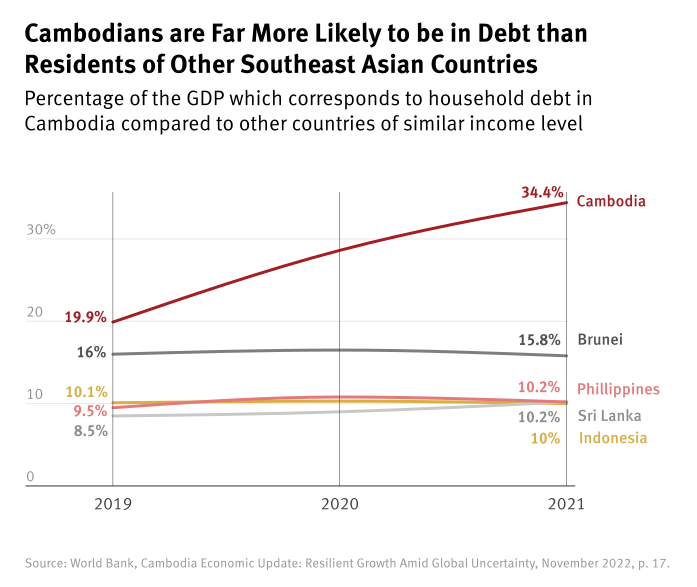
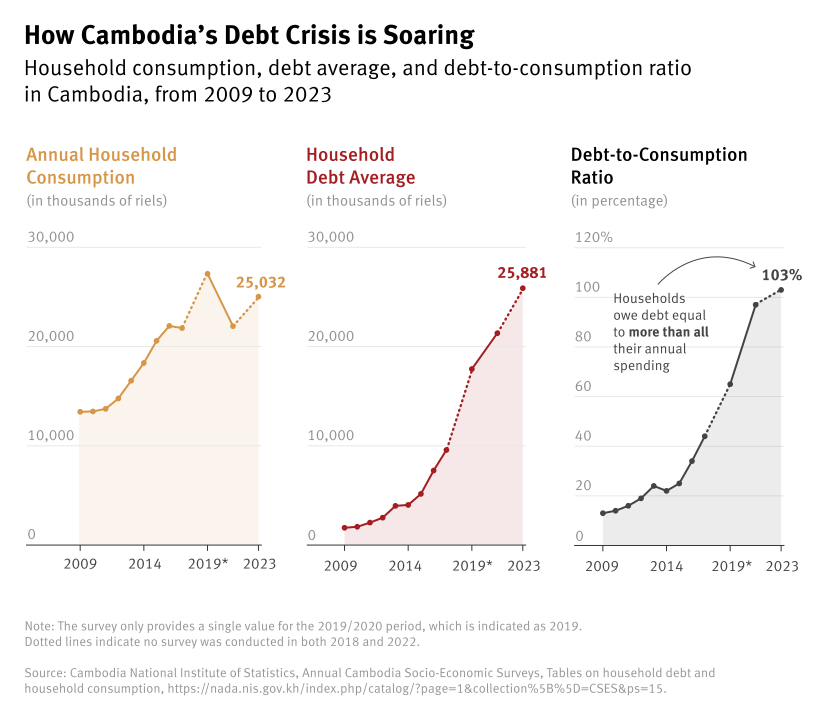
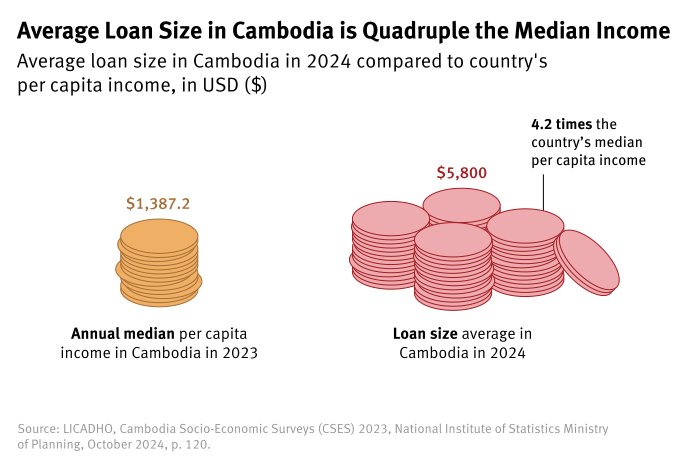
Over time, all of these institutions became for-profit private lenders, and their ownership structures have changed. MFIs and foreign financial investments in what started out as small non-profits created pressure to prioritize investment returns for shareholders and creditors. By 2024, the value of microloan debt in Cambodia had more than doubled in five years, with the country’s 3.8 million households holding more than 3.1 million microloans worth more than US$18 billion.[22]
These institutions, and their foreign investors, have driven the rapid growth of Cambodia’s microfinance sector over the past three decades. For example, in 2017 the Sri Lankan conglomerate LOLC, founded and controlled by one of Sri Lanka's wealthiest individuals,[23] purchased a majority stake in Prasac. Some of those shares were bought from European development banks, including BIO, the state bank of Belgium, and FMO, the Dutch entrepreneurial development bank.[24]
After the purchase, Prasac began to expand its loan portfolio.[25] In 2021, LOLC sold the MFI for more than $1 billion to KB Financial Group, a Korean financial services giant. In 2023, Prasac become a commercial bank, KB Prasac Bank Plc., and is now the country’s largest microloan provider, holding more than $5 billion in loans across Cambodia.[26]
While some foreign state development banks have sold shares and reduced investments in recent years, many remain involved in Cambodia’s MFI sector, whether through direct investments in individual institutions or indirectly through microfinance funds.[27]
Foreign state development banks with active or recently exited investments in Cambodian MFIs mentioned in this report include FMO, the Dutch Entrepreneurial Development Bank; DFC, the US development finance institution formerly known as OPIC; Norfund, the Norwegian Investment Fund for Developing Countries; Finnfund, the Finnish development financier and impact investor; BII, the UK government's development finance institution; KfW, the German state-owned investment and development bank; DEG, a German development finance institution that is part of the KfW Group; BIO, the Belgian Investment Company for Developing countries; Swedfund, the development finance institution of the Swedish government; and Proparco, the development finance institution partly owned by the French Development Agency.[28]
These institutions are among the largest and most influential foreign state development banks in the world.[29] In addition, development financial institutions have invested in and profited from Cambodia's microfinance sector through sales of and collection of interest payments.[30]
Loan Portfolio Quality, Loan Juggling, and Concealed Harms
The involvement of private and foreign state-owned investors intensified Cambodian MFIs’ reliance on performance indicators from commercial banking. In particular, the percentage of “non-performing loans” (NPLs), usually categorized as loans on which borrowers are typically 90 days late on repayment,[31] became the most important indicator of an MFI's loan portfolio quality, and therefore its ability to attract further investment.[32]
Figures from the National Bank of Cambodia show the NPL rate in Cambodia began slowly increasing during the Covid-19 crisis of 2020-2022, [33] then nearly tripled between 2022 and 2023.[34] The relatively low non-repayment rate among Cambodian borrowers did not mean that they were not struggling, however, as years of reporting indicates that repayments were being made in other ways, including by taking out informal loans.
Cambodian MFIs could achieve a low NPL rate because borrowers have relied on informal moneylenders to repay their formal MFI loans, while spiraling further into debt.[35] Although part of the rationale for a regulated, formal microfinance sector is that it would replace the informal, and often more expensive, system of private moneylenders, in Cambodia informal loans have continued to play a crucial role in propping up the formal MFI sector.[36] The result is “a system that both hides and exacerbates ways that borrowers engage in loan juggling.”[37]
In a 2023 report, the Cambodian League for the Promotion and Defense of Human Rights (LICADHO), a Cambodian human rights NGO that has published five reports on harms in Cambodia’s microfinance sector, found that MFIs regularly avoid banking regulations intended to prevent using one MFI loan to pay off another MFI loan, which would be an illegal practice based on Cambodian regulations.[38] By having borrowers juggle their loans through informal lenders, MFIs could bypass existing credit monitoring systems. Borrowers will borrow from an informal lender to repay one MFI and then borrow from a second MFI to repay the informal lender—thus completing one “cycle,” while increasing their overall loan burden and risk of over-indebtedness.[39] The practice of cycling loans in Cambodia has its own Khmer expression, “bangvil luy,” or cycling money.[40]
Predatory Lending, Over-indebtedness, and Interest Rates
Although not defined in international law, the term “predatory lending” has been used in different contexts to describe a set of practices that extend credit and collect payments through unfair, deceptive, or abusive means. Predatory lending can also include a disregard for a borrower’s ability to repay, typically for the primary purpose of maximizing lender profit, rather than ensuring borrower financial stability, often leading to further borrower financial hardship and high levels of debt.
Core elements of predatory lending in Cambodia include loans with interest rates, fees, or terms that are not consistent with local regulations or justified by the borrower’s income stability and debt-to-income ratio; practices that mislead borrowers about the true cost or nature of the loan; a focus on vulnerable populations that include individuals who may have limited financial literacy, low income, or face uniquely severe negative consequences should they become over-indebted; utilization of land as collateral without informed consent, often resulting in land dispossession; issuance of loans without adequately assessing the borrower’s ability to repay, including encouraging repeat refinancing cycles that increase borrower indebtedness; aggressive marketing through high-pressure tactics to lure borrowers into decisions without fully understanding loan terms; and aggressive debt collection practices, including harassment, misrepresentation of consequences, threats, or third-party pressure to intimidate borrowers into making payments that often lead to further financial hardship.
Over-indebtedness is a subjective, often self-reported experience. One academic study on over-indebtedness in Cambodia defines it as a situation in which borrowers “struggle to repay loans to the point that they are frequently making unacceptable sacrifices to repay their loans that affect their household living standards.”[41]
The Cambodian government has taken some measures to address predatory lending. In 2017, the National Bank of Cambodia imposed an interest rate cap of 18 percent annually for the microfinance sector.[42] Before the rate cap, MFIs offered interest rates of between 20 percent and 30 percent per annum. However, non-interest fees like commissions charged on new loans tripled following the introduction of this rate cap, according to a report by the International Monetary Fund.[43]
Although nominal interest rates seemed to align with the interest rate cap by 2018, the effective interest rates (EIR)—which includes fees, timing of payments, and product restructuring—often resulted in much higher actual interest paid by borrowers. In loan documents reviewed by Human Rights Watch, EIRs were found to be as high as 22 percent. In 2020, LICADHO and Equitable Cambodia publicly called for MFIs to “[s]top the use of up-front fees that result in effective interest rates exceeding the 18 percent annual cap instituted by the National Bank of Cambodia in March 2017.”[44]
Continued Inaction Amid a Growing Crisis
The financial sector itself began responding to signs of over-indebtedness over the past decade.[45]
In 2017, Cambodia was identified as the country with the most microfinance debt per borrower in the world.[46] That year, roughly 2 million Cambodians held $8 billion in microloan debt; The World Bank’s Microfinance and Household Welfare report of January 2019 found that in Cambodia, “Over the past five years, the average loan size increased more than ten-fold, as did the share of loans for consumption needs and the portfolio-at-risk. [47] These trends are due to a combination of the low penetration of financial instruments, deteriorating lending practices, and low financial literacy.”[48]
The UN independent expert on the effects of foreign debt in his January 2020 report on private debt and human rights stated that, “There have been many cases of over lending and over borrowing that led to microfinance crises in countries such as … Cambodia.”[49] In his 2022 report on Cambodia, the UN secretary-general stated that microfinance lending has heightened the vulnerabilities of already vulnerable populations.[50]
An external report in March 2020 by the Microfinance Index of Market Outreach and Saturation (MIMOSA), based on data provided by the IFC, found that Cambodia’s rate of credit saturation was the highest among the 11 countries it studied. It noted that client protection in Cambodia is “uneven,” and there are “no clear [government policies] regarding aggressive sales and debt collection practices.”[51]
In 2022, a German government-funded study found more than 160,000 Cambodian households had sold land to repay microloan debts over the last five years.[52] In response to a parliamentary inquiry raising both the German-funded study and other reporting from local groups, the German federal government said in April 2024 that, “Until further notice, the German government will not be financing any new measures in the Cambodian microfinance sector.”[53]
In its response to questions from Human Rights Watch, the German state-owned investment and development bank KfW said its investments in the Cambodian microfinance sector are an “expiring portfolio” with no new funding planned.[54] DEG, a German development finance institution that is part of the KfW Group, confirmed in its response that it has not made any new financial commitments in Cambodia since the end of 2020 and emphasized that it has "no plans to provide further financing" in the Cambodian microfinance sector.[55] Both funders mentioned the 2022 study, with DEG acknowledging the German federal government’s April 2024 statement not to finance new measures in the sector “until further notice” due to risks of over-indebtedness and land dispossession, and KfW noting that competition among Cambodian financial service providers may “lead to irresponsible lending practices.”[56]
In replies to Human Rights Watch, several other state development banks and funds acknowledged current or past investments in Cambodian microfinance institutions. Some—including FMO, Swedfund, and Proparco—stated that they had reduced or suspended new investments in Cambodia in recent years.[57] These state development banks emphasized their alignment with international standards such as the UN Guiding Principles on Business and Human Rights and the IFC Performance Standards and described internal social and environmental due diligence systems. Some—including Norfund, DEG, FMO, and Proparco—noted their use of third-party certification and grievance mechanisms such as whistleblowing channels, as well as efforts with Cambodian institutions such as the NBC.[58]
However, to date, no international investor has systematically provided remedies for land sales and other harms experienced by Cambodian borrowers. Even as some investors have sought to reduce their exposure or divest entirely from Cambodia’s MFI sector, they remain responsible for harms they contributed to while they were involved. Remedies should extend beyond current actors to include investors and shareholders who profited from predatory lending in the sector and have since exited without addressing their legacy of harms.
The Sector's Response: Voluntary Measures and Industry Certifications
Despite mounting evidence of over-indebtedness and related harms due to predatory lending, the Cambodian government has largely failed to enforce applicable laws. Instead, Cambodian MFIs and their financial backers have relied heavily on ineffective self-regulation. In response to Human Rights Watch questions about how they address such issues, representatives of these institutions often referred in their replies that they adhere to Cambodian law and participate in certification schemes.
The global microfinance industry has adopted the same approach as other sectors that have come under public pressure following reports that implicated them in human rights abuses: voluntary codes of conduct and certifications by third parties to assess compliance against such codes. Such processes too often are plagued by conflicts of interest, loopholes, and other problems that render them inadequate tools for ensuring respect for human rights standards.[59]
Standard-setting for the microfinance industry is spearheaded by Cerise+SPTF, a membership organization that is made up primarily of microfinance investors, state development banks, and MFIs from across the world, including some from Cambodia.[60] Cerise+SPTF has developed eight “Client Protection Principles” against which third-party auditors certify adherence of entities issuing microloans.[61] While Cerise+SPTF does not certify MFIs itself, it provides a directory of MFIs and shows grades and ratings certifications that they have received from third-party auditors who have completed Cerise+SPTF trainings and conducted assessments of whether MFIs have adhered to the Client Protection Principles.[62]
In their reply to Human Rights Watch, Cerise+SPTF clarified that “Cerise+SPTF does not provide certifications. Our role is to serve as standard setters—we maintain the Client Protection Standards.”[63]
However, Cerise+SPTF’s website carries a significant disclaimer: “Please note that Cerise+SPTF has not investigated or confirmed compliance by the third-parties with the Guidelines and Client Protection framework, nor does it recommend, endorse or make any representations regarding any third-party.”[64] In effect, Cerise+SPTF plays no role in verifying institutional compliance, nor does it monitor how CPP-certified entities actually treat borrowers in practice. In their reply to Human Rights Watch, Cerise+SPTF said that “While we cannot compel behaviour, we actively support client protection efforts in Cambodia through governance training, client empowerment initiatives, and work with regulators and industry bodies.”[65]
Cerise+SPTF claims that this standard-setting provides protection to vulnerable borrowers, even though it cannot enforce its standards. For example, in response to a 2022 Bloomberg investigation that documented predatory practices of MFIs in several countries, including in Cambodia, Cerise+SPTF released a statement claiming that their standards serve as a "safeguard against such practices," and that Cambodia "provides a timely example of SPTF's work."[66]
When asked by Human Rights Watch if there are there any instances in which Cerise+SPTF publicly revised the published rating of a Cambodian MFI or any microfinance lending institution following substantiated abuses, their response stated:
Cerise+SPTF does not issue or revise ratings; these are conducted and published by independent rating agencies. As such, we do not have the authority to revise or withdraw a rating. When substantiated concerns arise, we refer the information to the relevant rating or certifying body for review. Any decision to revise, suspend, or withdraw a rating lies with that agency.[67]
In 2023, The Guardian documented multiple debt-driven suicides among Cambodian Indigenous Peoples with loans from MFIs certified as adhering to the standards. [68] In response, Cerise+SPTF said it could not "force willingness" on MFI partners to comply with its standards and that: "Ultimately our work is not for those who need it. It is for those who want it."[69] Human Rights Watch inquired about subsequent follow-up to The Guardian’s reporting, to which Cerise+SPTF replied:
Cerise+SPTF formally referred the findings to the relevant certifying bodies and requested that they review the affected certifications. As Cerise+SPTF does not issue or revoke certifications, decisions regarding downgrades or suspensions rest solely with the certifiers. In the case of Cambodia, our team has also visited several sites of concern and documented its own findings that are regularly shared with the rating agencies. We have also pushed for more client surveys to be included in the certifications. We have also emphasized that these surveys need to include a sample of clients who are currently not repaying their loans, and whose loans have been restructured and refinanced. This is to check for aggressive sales and collection practices.[70]
In 2023, research funded by the Cambodian Microfinance Association (CMA), the industry body that is made up of MFIs, commercial banks, and rural credit operators in the country, found that roughly 15 percent of Cambodian borrowers are paying more than 70 percent of their monthly income toward debt repayments, and 6.4 percent owe above 100 percent of their monthly income toward debt repayments.[71] The 70 percent threshold is set by Cerise+SPTF itself – yet the Cerise+SPTF website still lists several Cambodian microloan providers, including Amret, AMK, LOLC (Cambodia), MOHANOKOR, and Sathapana, as certified under the organization’s client protection principles as of August 2025.[72]
In correspondence with Human Rights Watch, several state development banks and Cambodian MFIs cited certification according to the Cerise+SPTF client protection principles as central to their efforts to address risks of over-indebtedness and harms related to microloans. They highlighted gold-level certification awarded by Cerise+SPTF as evidence of responsible financial conduct. Others framed the client protection principles as core to their own due diligence and oversight.[73]
However, Cerise+SPTF's members include the Cambodian Microfinance Association, LOLC (Cambodia), MOHANOKOR (a local MFI), and FMO, all of whom have a direct interest in maintaining the profitability of Cambodia's microfinance sector. No borrowers or human rights organizations are represented within Cerise+SPTF’s structure.[74]
Cerise+SPTF’s financial model further compromises its independence and oversight capacity. According to its website, Cerise+SPTF relies heavily on membership fees to sustain its operations, especially during periods when grant funding is unavailable.[75] Cerise+SPTF acknowledges that the ongoing financial contributions of its members, which include Cambodian MFIs and their investors, are critical to its survival and ability to secure new donor support.[76]
When asked about how it ensures that third party auditors are independent, especially given that providers pay for audits and third-party certifications, Cerise+SPTF replied that “While it is standard practice across the industry for providers to cover the cost of their own assessments, auditors/assessors operate under a code of conduct that requires full impartiality. We also conduct periodic quality control reviews, including random sampling of audit reports, to ensure the integrity and independence of the audit process.”[77]
The Cambodian MFI sector has similarly turned to voluntary measures in response to allegations of predatory lending and related harms. In 2022, the Banking and Financial Institutions Code of Conduct was adopted by the Association of Banks in Cambodia (ABC) and the Cambodian Microfinance Association (CMA). Cerise+SPTF is currently supporting the “alignment of the … Code of Conduct with our global Client Protection standards. This includes the design of a measurement tool.”[78]
The Code of Conduct aims to “promote effective, reliable, accountable and responsible banking and financial practices by setting business operation standards for the Banking and Financial Institutions to follow and execute.”[79] The code also states: “Disciplinary action shall be taken against those who fail to comply with applicable laws and regulations according to the level of impact and nature of such misconduct based on fairness and without discrimination.”[80]
However, in its response to Human Rights Watch, the National Bank of Cambodia did not report any cases in which disciplinary action, sanctions, or penalties were imposed on member institutions for violating the code of conduct.[81] The lack of reported disciplinary action raises serious concerns about the effectiveness of self-regulation, given widespread reports of over-indebtedness, aggressive collection tactics, and harm to borrowers. In its reply to Human Rights Watch, Cerise+SPTF noted that certification alone is not enough: “We recognize there are risks and cannot verify all practices in every country, which is why we push the sector—including investors, rating agencies, regulators, and governance bodies—to stay vigilant and not rely solely on certification.”[82]
Following a United Nations–National Bank of Cambodia multi-stakeholder policy dialogue on microfinance—launched in November 2023 and followed by a high-level consultation in January 2025,[83] a new Financial Consumer Centre (FCC) was established under the joint oversight of the Association of Banks in Cambodia (ABC) and the Cambodia Microfinance Association (CMA) in July 2025. The FCC is intended to handle and resolve complaints from consumers of micro-loans.[84]
Limited information about the FCC was available at the time of writing. Human Rights Watch wrote to both CMA and ABC about the FCC’s governance, budget, and operational independence from the microfinance industry, as well as its accessibility to Indigenous borrowers, including considerations of language, literacy, trust, and protection from retaliation.
In its replies to Human Rights Watch, ABC noted that it had “initiated [the] establishment [of] the FCC,” but that it would eventually “function as a separate and independent entity with its own management and board of directors.” The funding model, however, appears to rely on contributions from the microfinance industry, initially from “… ABC and CMA and additionally … from [its] services operation and development partners.”[85]
It remains unclear how the FCC’s complaint mechanism would differ from prior industry-led mechanisms to address borrower complaints. All five of the Cambodian MFIs – AMK, Amret, LOLC, Mohanokor, and Woori – that replied to letters from Human Rights Watch mentioned having their own grievance processes, including through hotlines, in-branch systems and digital methods.[86] The FCC mechanism will involve a similar range of methods, as described by ABC in its response to Human Rights Watch.[87]
Amret provided information on the number of consumer complaints: “In 2024, 17 complaints alleged staff misconduct, with 11 cases verified after investigations, resulting in disciplinary actions: eight verbal warnings, two written warnings, and one dismissal.”[88] ABC responded that between January and May 2025, more than 500 calls have reached their hotline, explaining that: “[A]bout 60% were queries about advice and/or support; and, 40% were complaints, of which, more than 95% (> 170 cases) were successfully solved.”[89] NBC reported approximately 69 complaints per month and noted that Cambodian banks and MFIs “are required to submit quarterly complaint reports to NBC.”[90]
Often borrowers are deterred from complaining for fear of retaliation. In its initial reply to Human Rights Watch, Amret explained that it had publicly posted one client’s image across 150 branches in order to identify the individual who had been featured in a TV broadcast. Queried about this practice in a follow-up letter from Human Rights Watch, Amret replied “Our primary objective was to identify customers to address their grievances.”[91]
II. IFC Performance Standards and Investigation
The International Finance Corporation, the private investment arm of the World Bank Group, is the primary multilateral development finance institution invested in the Cambodian microfinance sector. Other multilateral banks, such as the Asian Infrastructure Investment Bank (AIIB) and Asian Development Bank (ADB), have also invested in and lent money to Cambodian MFIs.[92] However, the IFC has had the largest, longest, and deepest impact and involvement in the development and trajectory of Cambodia’s microfinance sector.[93]
An early investor and shareholder in the sector, the IFC provided support through technical assistance, direct investments, and the development of financial infrastructure.[94] In a 2015 report, the IFC had already identified the risks of over-indebtedness, together with a weak consumer protection framework for financial markets in Cambodia.[95] The report described a lack of sector standards, particularly with regard to collection practices, and found some “lending collection practices that are alleged to be abusive” and “that there are currently no rules to protect consumers from such aggressive collection activities.”[96]
Yet the IFC went on to approve at least 16 separate investments to microloan providers in Cambodia, totaling more than US$438 million, between 2016 and 2021.[97]
Previous Human Rights Watch Communications with the IFC
In July 2020, Human Rights Watch highlighted concerns raised by Cambodian nongovernmental groups about rights abuses in micro-loans.[98] The same year, Human Rights Watch wrote two letters to the IFC relating to coerced land sales and the problem of over-indebtedness of Cambodian borrowers, exacerbated by Covid-19.[99]
In its reply on August 28, 2020, the IFC recognized that “there are legitimate concerns about indebtedness” and “over-indebtedness” in Cambodia’s micro-loan sector. In a follow-up letter on November 5, 2020, the IFC stated that it had worked with the Cambodian Microfinance Association (CMA) to issue guidelines to CMA members that would limit any borrower from having more than three active micro-finance loans.
The IFC’s response also referred to the National Bank of Cambodia’s Financial Consumer Protection Unit, which introduced a hotline for borrowers. But civil society groups continued to report that much of the country’s largely rural population either does not know about or has found ineffective the complaints mechanisms run by the national government or the micro-loan providers themselves.[100]
The IFC also said it was conducting due diligence, through assessments, and monitoring how lending practices and borrowers’ protection measures are being carried out. However, the IFC did not specify how it dealt with non-compliance by a client.
NGO Complaint to the Compliance Advisor/Ombudsman
In early 2022, two Cambodian human rights organizations, LICADHO and Equitable Cambodia, filed a complaint with the IFC's grievance mechanism,[101] the Compliance Advisor/Ombudsman (CAO), regarding the IFC’s investments in Cambodian microfinance institutions. The CAO is the IFC's internal monitoring body tasked with assessing compliance with its own policies and finding resolutions to problems when they arise.
The complaint, filed on behalf of Cambodian borrowers, implicated many of the largest microlenders in Cambodia: ACLEDA, Amret, Hattha Bank, Prasac, LOLC, and Sathapana, all of which had received IFC funding.
The IFC’s Sustainability Framework articulates its commitment to sustainable development and risk management. Eight “Performance Standards” establish guidelines that recipients of IFC funding are to meet throughout the life of that investment.[102] The IFC Performance Standards have also been adopted by many other investors, in Cambodia and around the world, as standards for ethical investment. State development banks and private investors that have adopted IFC Performance Standards or publicly claim that they use IFC Performance Standards or align their own standards with the IFC’s include FMO, OPIC/DFC, Finnfund, Norfund, CDC, KFW, DEG, BIO, Swedfund, Kookmin, Proparco, and Blue Orchard. Two additional large funds, MEF and MIFA, are both projects established with IFC support and funds, are a party to the IFC-CAO complaint.[103]
In an appraisal report issued in June 2023, the CAO concluded that LICADHO and Equitable Cambodia’s complaint regarding IFC financing of MFIs in Cambodia “meets the criteria for a CAO compliance investigation as there are preliminary indications that IFC may have failed to comply with its Environmental and Social (E&S) policies in assessing and supervising the social impacts of these investments, and that the alleged harm to complainants is linked to this potential non-compliance.”[104]
The CAO’s preliminary findings on the IFC’s investments in Cambodian MFIs suggest that not only the IFC but also state development banks and private investors that have adopted the IFC Performance Standards or similar ones in their own investments may be falling short of their commitments.[105]
The findings of the CAO’s full investigation are expected to be released in 2025 and will focus on whether the IFC’s investments in the six Cambodian financial institutions complied with IFC’s Sustainability Framework, specifically:
Performance Standard 1 (PS1): Assessment and Management of Environmental and Social Risks and Impacts.[106]
Performance Standard 7 (PS7): Indigenous peoples, including requirements to avoid impacts on Indigenous lands and culture and to engage with Indigenous peoples in a culturally appropriate manner.
The IFC exclusion list, particularly regarding the obligation to not impinge on the lands owned, or claimed under adjudication, by Indigenous peoples, without full documented consent of such peoples.[107]
IFC management does not believe the criteria for a compliance investigation were met, writing in its response to the CAO that: “The alleged harms, while serious, are not the result of non-compliance with the IFC E&S Policies but are related to lending and collection practices by IFC clients.” According to them, those E&S policies would not apply because: “Customers or consumers of a client’s products are not referenced in the Sustainability Policy or Performance Standards as a category of stakeholder to which E&S risk mitigation measures should apply” and therefore “the risks and impacts on individual sub-borrowers themselves” are not a matter of non-compliance with those policies.[108]
IFC management formally objected to the CAO investigation moving forward in a submission to the IFC board, writing that the omission of sub-borrowers from E&S policies is “a considered decision, and one that all other major development finance institutions are also aligned on – risks related to consumer protection are not included in E&S policies but addressed through broader social protection strategies and collaborations.”[109]
In the same request to the board, the IFC management wrote: “… [p]rotections for individual borrowers are addressed under IFC’s Financial Inclusion and Consumer Protection Strategy, specifically through its Client Protection and Responsible Finance Principles … and that risks related to consumer protection are not included in E&S policies but addressed through broader social protection strategies and collaborations…”[110]
The objection would have prompted an IFC Board Review to decide on the path forward.[111] However, IFC management later withdrew its objection.[112]
Since the CAO complaint was filed in early 2022, the IFC states that it has not provided any additional direct financing to Cambodian MFIs, which means that there have been no new loans to Cambodian MFIs by the IFC.
IFC Response to Human Rights Watch Findings
In its reply to a letter outlining the findings of this report, the IFC stated that many of the issues raised by Human Rights Watch “relate to IFC’s Sustainability Policy and Performance Standards” but said “risks and impacts related to consumer protection are not managed through IFC’s current E&S requirements.”[113]
The response outlined the IFC’s global efforts to promote financial consumer protection and initiatives in Cambodia, in particular its efforts with the National Bank of Cambodia “to work with the main industry associations and other sector-level bodies to raise consumer financial capacity and enhance industry self-regulation.”[114]
The IFC informed Human Rights Watch that it conducts due diligence prior to investing in microfinance institutions: “IFC requires all microfinance institution clients to maintain and comply with applicable codes of conduct, procedures and controls for responsible finance and consumer protection consistent with their business and customer profile, in full compliance with applicable national laws and regulations.”[115] The IFC did not clarify in its response whether this due diligence considered risks specific to Indigenous peoples, including the use of land under pending CLT applications as loan collateral, or whether it conducted any environmental and social risk impact assessments prior to lending to Cambodian MFIs.
Regarding the impact of predatory lending on Indigenous borrowers, the IFC replied: “We know that to address the systemic, sector-wide problems related to lending and debt collection practices and the use of indigenous land as collateral for loans, all microfinance stakeholders in the country must work together.”[116] However, the IFC did not respond to questions about whether it or its clients ensured that loans to Indigenous borrowers complied with the principle of free, prior, and informed consent, as well as provisions designed to protect Indigenous rights under Performance Standard 7 and the exclusion list. The IFC’s efforts to address the use of land titles that are part of Indigenous CLTs for collateral and forced sales of Indigenous land are discussed in the next chapter.
The IFC did not respond to questions posed by Human Rights Watch about debt relief and access to remedy for Indigenous borrowers. It did however highlight that its effort to support national consumer protection reforms had led to “the establishment of a now operational Financial Consumer Center (effective since July 1, 2025) and envisions a Financial Ombudsman.”[117] It did not specify how the center would address complaints and alleged harms involving IFC-backed institutions.
III. Indigenous Peoples, Land Titles, and Microloans
Targeting of Indigenous Peoples for Loans
Predatory lending—extending credit and collecting payments through unfair, deceptive, or abusive means and disregarding a borrower’s ability to repay—by Cambodian MFIs has had irreversible impacts on Indigenous peoples.
There are estimated to be at least 170,000 Indigenous peoples in Cambodia, roughly 1 percent of the total population of 17 million.[118] Cambodia’s Land Law defines “original minority nationalities” (ជនជាតិដើមភាគតិច) as a “group of people that resides in the territory of the Kingdom of Cambodia whose members manifest ethnic, social, cultural and economic unity and who practice a traditional lifestyle, and who cultivate the lands in their possession according to customary rules of collective use.”[119] Most live in the four northeastern provinces of Ratanakiri, Mondulkiri, Kratie, and Stung Treng, where poverty rates are also higher than the countrywide average.[120] In Ratanakiri province, the majority of residents are Indigenous.[121] A 2019 report by the UN special rapporteur on the situation of human rights in Cambodia noted that Indigenous peoples are “lagging behind on several socioeconomic indicators, reflecting limited enjoyment of the rights to health, education, and an adequate standard of living.”[122]
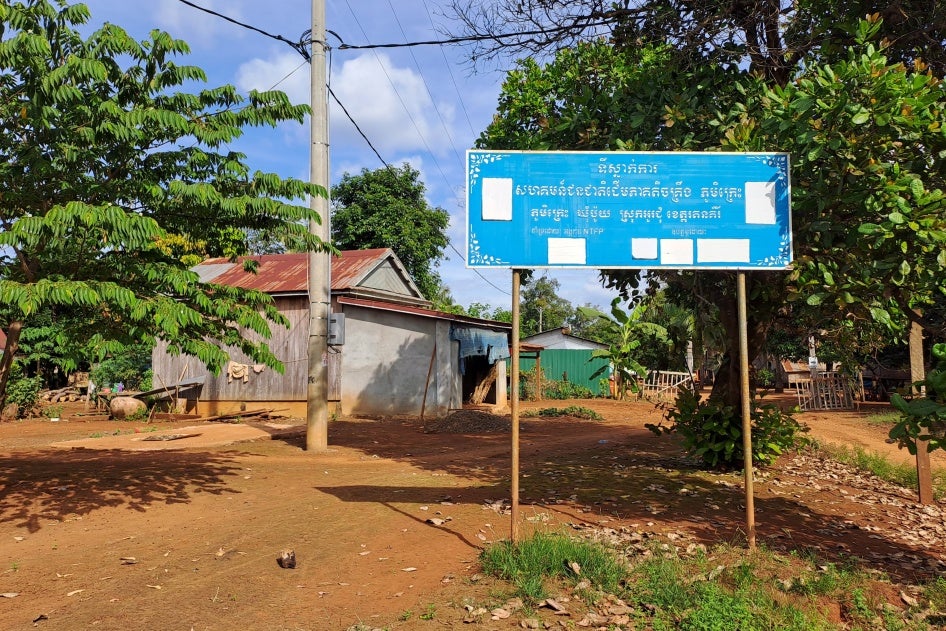

Cambodian MFIs have advertised heavily in Indigenous communities in Ratanakiri province, encouraging people to take out loans through visits to people's homes, posters, advertisements, and information sessions coordinated through local government authorities, usually village chiefs. Indigenous peoples who spoke to Human Rights Watch recalled the tactics used by credit officers from MFIs who were encouraging them to take out microfinance loans.
R. Sokchea, a 42-year-old Indigenous Kachock farmer, said:
I remember the credit officers came over the course of four days at first. The first day they just spent time with us casually, on day two they started talking about money, on day three they gave a few more promises and started to talk about what we can buy with the money. On the fourth day they would say things like “smart people borrow, they can do business,” and the village chief helped to distribute the information and advertise for them. [123]
S. Chenda, a 35-year-old Indigenous Tampuan farmer, said, “When I saw other villagers receive money, I became interested in getting a loan for myself.” [124]
Borrowers said that they did not fully understand loan repayment, reasons for fees, or how interest rates worked prior to receiving their loans.
“In 2007 when the credit officers started to enter the village, people didn’t understand the process, they just wanted to borrow,” said Ch. Borey, a 39-year-old Tampuan farmer. “When the credit officers explained the loans, they didn’t explain the percentages or how the interest worked. If they tried to explain, I still do not think many of the villagers would understand … even now people don’t understand.”[125]
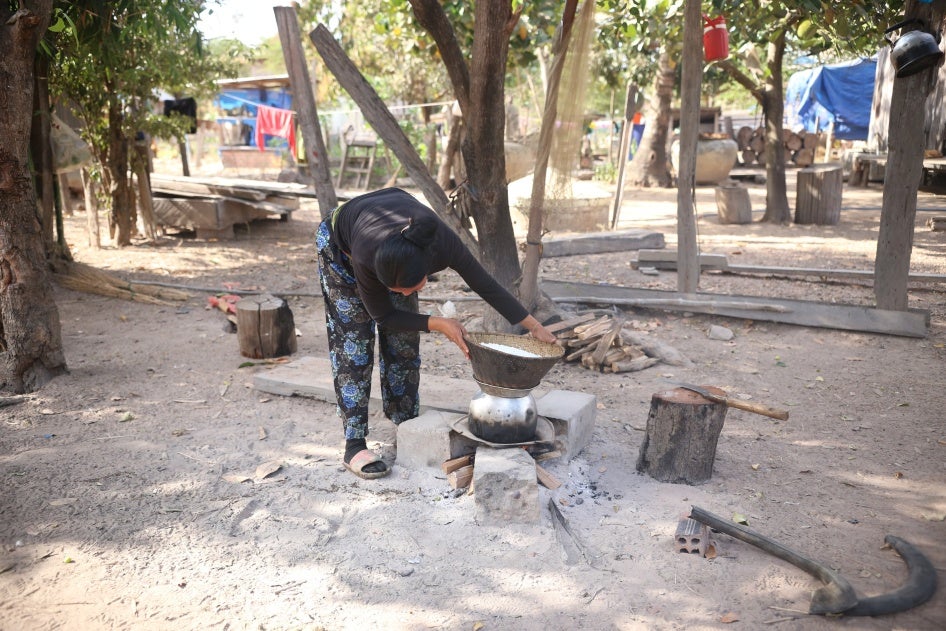
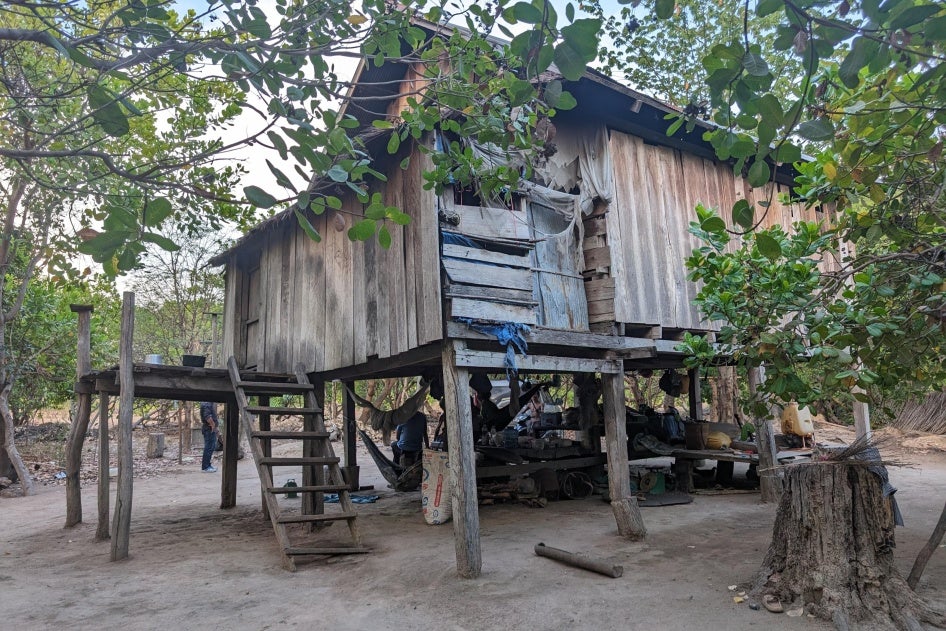
Many Indigenous peoples do not speak or read Khmer, the official language of Cambodia and the language of MFI loan contracts. Of the Indigenous borrowers interviewed by Human Rights Watch, about two-thirds could speak and understand some Khmer, but only one-third could read and write any Khmer at all. In most cases, the credit officers did not speak the native language of borrowers and all of the 52 borrowers interviewed by Human Rights Watch in Ratanakiri said that the credit officers did not have interpreters present when explaining or finalizing loan documents. Indigenous borrowers said that credit officers took advantage of their limited understanding of Khmer to persuade them to take out loans.
K. Sarith, a 55-year-old Indigenous farmer, said, “The credit officers spoke in Khmer. I understand maybe 10 to 20 percent Khmer, so my older sister helped to translate for me, but she only speaks a bit more Khmer than I do.”[126]
“The credit officers just explained that I would be paying interest, but I did not fully understand the process because I cannot read or write in Khmer,” said S. Chenda. “I just heard 1.5 percent or 1.2 percent [per month], but I did not understand the whole process.”
Credit officers made repeated visits to Indigenous communities after the initial loans were issued to encourage them to borrow again.
Said R. Sokchea: “They would start with just lending us US$100 and tell us that we were good customers. Then the banks started competing with one another, offering lower interest rates and offering loans to [take over] the previous loans we already had that we had not yet finished paying off.”
Other Indigenous borrowers had similar experiences. According to K. Sarith: “When people were able to pay off their first small loan, they were encouraged to take a second loan for a higher amount of money at a high interest rate [when other banks were not competing for borrowers].”
S. Chenda said: “Before, if we wanted to borrow money, it would be from family or friends for a small amount without much interest, maybe from US$150-500 at most. And we would borrow just one time, not the repeated borrowing again and again like now with the MFIs.”
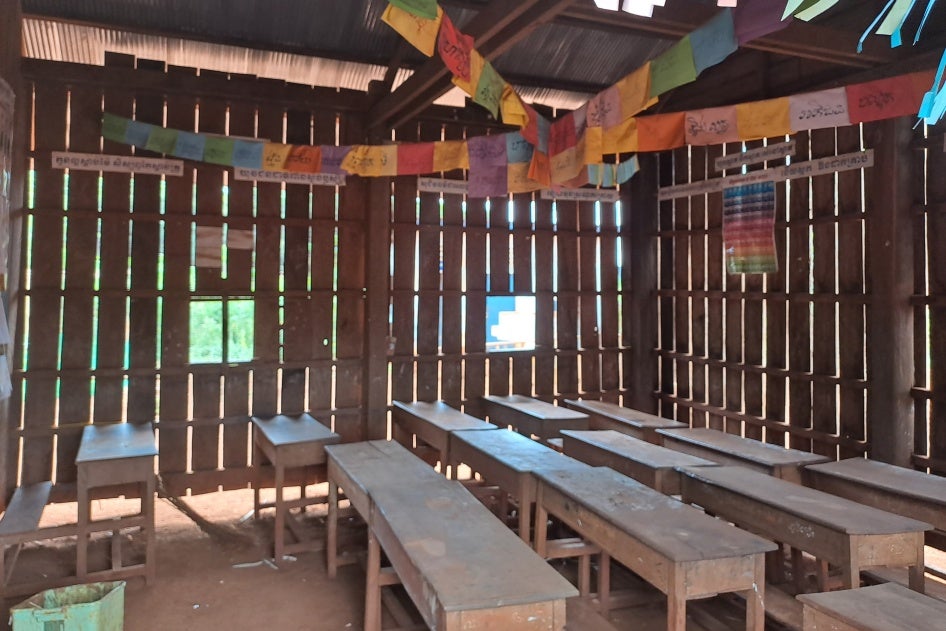
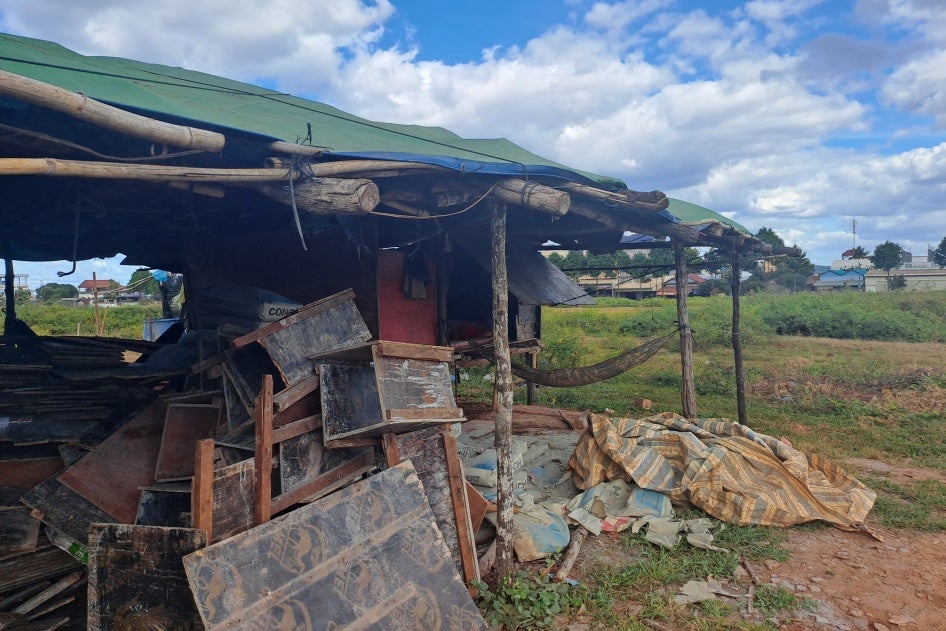
The five Cambodian MFIs that replied to letters from Human Rights Watch—Amret, AMK, LOLC, Mohanokor, and Woori—denied aggressively marketing loans to Indigenous communities.[127] They did acknowledge language and literacy barriers and said their staff use different strategies to communicate even if they only provide loan documents in the national Khmer language.[128] For example, Amret stated that it assigns Indigenous-speaking staff to explain terms.[129] However, the Amret borrowers Human Rights Watch spoke with had not been offered explanations in Indigenous languages. Mohanokor said it is expanding the use of Indigenous languages and visual materials to communicate loan terms.[130] AMK said it only provides loans to Indigenous borrowers who can communicate in Khmer with its staff.[131]
No Cambodian MFI acknowledged that Indigenous borrowers may have misunderstood loan terms due to language barriers, marketing tactics, or lack of written literacy. The National Bank of Cambodia indicated in its reply that to ensure clear communication of credit terms, financial institutions “are expected to explain loan terms in a manner that is fully understood by borrowers, including through verbal explanations in foreign languages or dialects where appropriate.”[132]
Indigenous Land Titles as Collateral
Although Indigenous peoples are often poorer than Khmer Cambodians, Human Rights Watch found that MFIs in many cases approved large loans to Indigenous borrowers because they had valuable land that could be used as collateral. By requiring Indigenous borrowers to put up their land as collateral for individual microfinance loans, MFIs and their foreign investors contributed to the loss of culturally significant Indigenous lands.
Land in Cambodia is governed by the 2001 Land Law, which allows General Department of Cadastre and Geography authorities to issue land titles. [133] Such a land title is often referred to as a “hard title” in Cambodia, to contrast with what is commonly referred to as a “soft title” – an “informal” but frequently used land certificate issued by commune-level authorities, but not recognized by the national authorities. Both types of land titles are accepted as collateral by MFIs in Cambodia, including in Indigenous areas.[134] Most Indigenous respondents from Ratanakiri interviewed by Human Rights Watch reported taking out MFI loans once local authorities began issuing soft titles.
S. Narin, a 40-year-old Indigenous farmer, said that many of his neighbors were able to borrow from MFIs once soft titles became available:
It was around 2009 in my village when ACLEDA [MFI] staff went from home-to-home advertising about MFIs. They asked to put up posters on homes and shared information about loans. From 2012, many of us used hard land titles for loans, but around 2020 people started receiving soft land titles and using them for loans. Outside of land, if you don’t have hard or soft land titles, people can borrow as a group, but you cannot get as much money.[135]
Some Indigenous borrowers have provided more than one soft title to a credit officer, either because they wanted to borrow more money, or because the credit officer demanded additional titles in exchange for a larger loan to replace the borrowers’ existing loan. Some credit officers leveraged the fear of losing land from the first loan to motivate Indigenous borrowers to put up additional soft titles for collateral to get a larger loan, thus acquiring more Indigenous land as collateral.
Human Rights Watch interviews with Indigenous borrowers and credit officers found that MFIs appeared primarily concerned with the value of collateral, rather than the borrower’s repayment capacity, when giving loans. Borrowers reported that credit officers would often prioritize questions about their land titles and the extent of their landholdings, while questions about their income or business activity were secondary and, if asked at all, did not appear to be a primary factor when it came to assessing loan amounts.
S. Vuthy, an MFI credit officer, said that he was instructed by his credit officer colleagues to overestimate the repayment ability of borrowers when doing pre-loan appraisals of potential clients, including by overstating the value of their collateral and the ability of the borrower to make repayments. His colleagues explained that by doing so, he would make it easier for branch managers to approve the loans. He said staff were incentivized to find new customers and ensure repayment rates, often receiving bonus payments or promotions linked directly to these metrics. There were never any checks or consequences by branch managers for when he overestimated repayment abilities of borrowers.[136]
Many borrowers acquired more debt than they could ever hope to repay, and pledged more Indigenous land as collateral for loans, without knowing if they would ever get their land titles back.
Said R. Sokchea: “They want our land titles and will do anything to keep the land titles. They will not even let blood relatives or husbands or wives go to receive the land titles once we pay our loans off. Now there are Indigenous people in my community with up to US$25,000 in MFI debt.” [137]
S. Chenda said, “My first loan was in 2015, and I was told that I needed two soft land titles for LOLC to use as collateral before I could receive a loan.”
Many Indigenous borrowers interviewed by Human Rights Watch were registered in the Cambodian government’s Identification of Poor Households Program, or “IDPoor,” which was set up in 2011 to contribute to Cambodia’s efforts to reduce poverty. It identifies at-risk households for targeted services and social assistance.[138] While some local civil society groups have criticized the program for being used by local authorities as a political tool to revoke IDPoor cards based on political affiliation, the system remains one of the only government programs identifying low-income households.[139]
Credit officers interviewed by Human Rights Watch said that they were never instructed to consider IDPoor as a factor when assessing loan amounts or whether to offer a loan to a potential borrower.
In their written responses to Human Rights Watch, all of the Cambodian MFIs that replied indicated they approve loans based on repayment capacity, citing cash flow analysis and other tools, such as credit checks.[140] For example, Mohanakor wrote: “Loan approvals are based on a thorough assessment of the client’s repayment capacity, household cash flow and overall risk profile—not solely on collateral.”[141] Woori specified that “the loan repayment amount must be <=67% of customer’s net cash flow.”[142]
In their replies to Human Rights Watch, ABC and NBC similarly stated their policies, lending guidelines, and training initiatives to ensure responsible lending. NBC replied that it works to ensure banks check customers are creditworthy and “do not take extra loans and burden themselves.”[143]
Impact of MFI Loans on Collective Land Titling
The 2001 Land Law allows for the granting of Collective Land Titles (CLTs) to Indigenous communities in Cambodia, which is intended to preserve traditional, communal land use practices of Indigenous communities in the country. Sub-decree No. 83 on Procedures of Registration of Land of Indigenous Communities, issued in 2009, specifies a process for granting CLTs. The first CLTs were issued to Indigenous communities in 2011, but as of August 2025, only 43 Indigenous communities out of 488 in Cambodia had received CLTs[144]. Twenty-seven of these CLTs are in Ratanakiri Province.[145]
The current CLT process is lengthy and bureaucratic, preventing many Indigenous groups from being able to register their collective land.[146] Hundreds of communities have applied for CLTs but have never received them—in some cases waiting for more than a decade. There have been reports of intimidation and attacks against Indigenous peoples as they seek to exercise their rights as it relates to these collective lands.[147] The UN Office of the High Commissioner for Human Rights (OHCHR) has criticized the CLT process as being “too complex, expensive, slow and inaccessible to secure protection of Indigenous land, especially in a context where land is sold or leased easily and often in full disregard of procedural safeguards and national law.”[148] Despite concerns raised by the UN and civil society organizations, the Cambodian government has not taken on recommendations to simplify the legal and administrative procedures for the CLT process.[149]
Meanwhile, many Indigenous peoples awaiting the outcome of CLT processes have become a target for MFIs who accept soft titles issued by local authorities as collateral. Under Cambodian law, once a CLT is issued, there are legal restrictions on selling or buying that land by people outside the community. Even before the CLT is issued, during the CLT application process, local authorities are supposed to issue protective orders that also prevent further granting or transfer of soft land titles in the pending CLT-designated area. However, the protracted CLT process and inadequate enforcement of these restrictions have meant these orders often have not been issued, allowing MFIs to lend to Indigenous peoples based on soft titles that overlap with land pending adjudication under the CLT process.
In a 2020 report, OHCHR noted that a 2016 circular by the Ministry of Land Management and Urban Planning, meant to provide guidance for its staff at “the national and provincial levels concerning procedures related to converting private land titles into collective ones, and vice versa,”[150] remained unknown to Indigenous communities. The report went on to note that Indigenous villagers who wished to join a collective land title after opting for a private land title were not aware of their rights to do so.[151]
Most Indigenous borrowers Human Rights Watch interviewed said MFI credit officers had not inquired about whether the land titles being accepted as collateral were Indigenous lands, either as part of an existing or pending CLT application process.
The couple C. Borey and K. Sopheap, Tampuan Indigenous farmers, said that AMK credit officers did not ask any questions about whether their land was Indigenous; they only inquired about why they were borrowing and whether they had a land title to offer up as collateral. The couple did not have a land title at the time because the land was part of a collective land titling process. They went to their village chief and asked him to sign a soft title document that could be used in place of an actual land title.
Borey said, “We knew our land had value because credit officers were telling us that the land had value and told us that they could also arrange land sales [for us].” [152]
The acceptance of these soft titles as collateral by MFIs undermines the CLT application process, as the process requires community members to collect all such soft titles and give them to Cambodian government officials – which is not possible if these titles are being held by MFIs or informal lenders as collateral.
Reports from researchers and Cambodian NGOs have indicated that widespread microfinance debt in communities in Ratanakiri has also led some Indigenous peoples to withdraw from ongoing CLT processes, as community members fear that they would lose access to their soft land titles and thus face problems with their microfinance lenders if a CLT were to be granted. [153] Human Rights Watch has reviewed documents from a number of Indigenous communities indicating that they chose to withdraw from ongoing CLT application processes due to microfinance debt.[154] In many interviews, respondents from a dozen different potential CLTs indicated that their community left or dropped out of the CLT process because of MFI debt in their community.[155]
M. Sokun, a 54-year-old Indigenous Kouy woman from Kampong Thom province, said that her community had been on the third and final step of completing their CLT process and were waiting for their collective land title when they tried to start a village savings group to offer small loans to support those in need as an alternative to MFI loans.
Sokun said that in 2020, their commune chief told villagers that it was unlikely they would complete the CLT process, and they should instead secure individual land titles so they could borrow from MFIs individually.
As of March 2024, Sokun believed that about half of the families in the village now have microloans. “Some people sleep at their farms now to avoid credit officers,” she said. [156] Although some people in her community still want a title for their communal land, she doubted it would still be possible because so many villagers are now in debt to MFIs.
M. Rachana, an Indigenous Bonong woman from Mondulkiri, believes her community did not engage with the CLT process starting in 2019 because of MFIs loans:
[Our] community discussed the CLT’s benefits, [such as] having protection of land over a long period, but also that we could not sell our land for a high price. At that time, the community wanted a CLT, only a few people wanted to leave and not join. But if you wanted to do a CLT, you have to pay off the banks …. We did not know where we would get the money. I think about 80 percent of my community borrowed from MFIs.[157]
The community previously consisted of 72 families, but 25 of those 72 families have now submitted formal requests to leave the CLT process. Rachana heard that five of those families left so they could use their land titles to borrow more money to pay off their existing debts.
The Microfinance Sector and Free, Prior, and Informed Consent
Following a second high-level convening led by the UN of stakeholders in the microfinance sector in January 2025, Cambodian MFIs and their investors announced strengthened lending rules, stating that they “prohibit the use of indigenous land titles as collateral and prevent the forced sale of such titles.”[158] They also noted that banks and financial institutions “can now check online information on title deeds registered as indigenous land titles and state-owned land that is prohibited by law from being used as collateral.”[159] Both the IFC and the National Bank of Cambodia referred to this UN-led process in their replies to Human Rights Watch, as did the Netherlands Development Finance Company (FMO).
Four Cambodian MFIs—Amret, AMK, Mohanokor, and Woori—also stated in response to Human Rights Watch that they do not knowingly accept Indigenous collective land as collateral.[160] In its reply, AMK stated that “strict protocols are enforced” related to acceptance of collateral from indigenous collective territories, and said its “verification process involves rigorous review of legal documentation and on-site field assessments.”[161]
If the IFC and its clients had applied the Sustainability Policy Performance Standards to the Cambodian microfinance sector—which the IFC management maintains do not apply—they would have ensured substantial safeguards to protect Indigenous rights.
Recipients of IFC investments are required under IFC Performance Standard 7 to “identify, through an environmental and social risks and impacts assessment process, all communities of Indigenous Peoples within the project area of influence who may be affected by the project, as well as the nature and degree of the expected direct and indirect economic, social, cultural … and environmental impacts on them.”[162]
In addition, under IFC Performance Standard 1, recipients of IFC investments, “will undertake an engagement process with the Affected Communities of Indigenous Peoples … includ[ing] stakeholder analysis and engagement planning.”[163]
All IFC financing—including financial intermediary (FI) and microfinance activity—must comply with the IFC Exclusion List. The list has a subset of prohibitions specific to microfinance that forbids “Production or activities that impinge on the lands owned, or claimed under adjudication, by Indigenous Peoples, without full documented consent of such peoples.”[164]
Yet IFC-funded Cambodian MFIs accepted “soft titles” for Indigenous land—including when that land was part of an ongoing CLT process—without free, prior, and informed consent of Indigenous communities over many years.
Human Rights Watch asked Cambodian MFIs and the IFC if they had undertaken any environmental and social risk impact assessments or engagement process prior to the provision of the loans to Indigenous borrowers. None indicated that they had conducted environmental or social risk impact assessments or similar engagement processes. Such an assessment would have likely shown that the acceptance of soft titles as collateral without free, prior, and informed consent from Indigenous communities impinges on the land rights of Indigenous peoples.[165] Nor did any Cambodian MFIs or investors contacted by Human Rights Watch answer a question about whether they ensured individual borrowers and community representatives gave their free, prior, and informed consent prior to taking as loan collateral titles that are part of collective Indigenous land.[166]
Recent efforts to prohibit the use of Indigenous land titles for collateral appears to be a belated recognition from the Cambodian microfinance sector, regulatory bodies, and investors that failing to provide information to Indigenous borrowers in languages they can understand when requiring them to hand over soft titles to their land has directly impeded Indigenous peoples’ ability to protect and collectively manage their land. The principle of free, prior, informed consent, however, does not require a blanket prohibition on accepting Indigenous land as collateral – only that such decisions need to be made in a manner compatible with the principle.
IV. Cycles of Borrowing and Debt
Respondents shared multiple motivations for borrowing from MFIs. Some explained that they used microcredit loans to pay for public services such as school and healthcare fees because they were too expensive or to invest in their farms after an unexpected crop failure. Others used MFI loans to improve their standard of living and enable investment in their own businesses, as microfinance loans were originally intended. But whatever the reason, once they were in debt to an MFI, subsequent loans were often driven by the need to service that existing debt, leading to a cycle of unsustainable borrowing and over-indebtedness.
Reasons for Borrowing
Most of the Indigenous borrowers interviewed by Human Rights Watch earned their income through small-scale agriculture. On MFI loan documents produced by credit officers, given to borrowers, and viewed by Human Rights Watch, specific reasons for borrowing included paying for herbicides, agriculture tools and machinery, or clearing of land, or acquiring land for small-scale farming.[167]
The written reason for borrowing did not always align with what borrowers told their credit officers. Some people said they wanted to invest in their farms as indicated on the form, others said they were told by credit officers working for MFIs to list micro-business investments as the reason for their loans on the paperwork regardless of the actual reason.
Almost all Indigenous borrowers interviewed by Human Rights Watch said they had taken out additional MFI or private loans to pay back their previous MFI debt, yet only 3 out of 48 loan documents reviewed by Human Rights Watch indicated "repaying existing debt" as a reason for borrowing.
Borey and Sopheap, the Tampuan Indigenous couple, earned money from their small cassava and soybean farm, and by selling vegetables around their village. The first time they heard about MFI loans was in 2007 when AMK microfinance representatives entered their village and advertised that they could borrow money easily for their basic needs and could receive the funds immediately.[168] At meetings, their village chief would say that anyone could borrow from the banks – they would just need to tell the banks that the money was for agriculture. Eventually, one person in their village successfully borrowed money to buy a motorbike while claiming that the loan was for agriculture, which encouraged others from the community to borrow from the MFI.
According to Borey, “The AMK credit officers told us: ‘Banks know that we are borrowing for other reasons than agriculture. When you go to borrow and get the money, don’t say what you’re using it for, say it’s for farming … If you tell the truth, you will not get the money.’”
M. Dara, a 39-year-old Indigenous Kouy man, said that in 2022 he approached Hattha credit officers to borrow money to pay off a previous debt. A credit officer instructed him to borrow money from a private lender to pay off his previous debt first to get his land title back, and then he could use that land title for a new loan from Hattha to repay the informal lender. Dara did as he was instructed, and the paperwork for a new loan from Hattha stated that it was for “seasoning and spice trading.”[169]
Interviews with credit officers confirmed that falsifying the reason for taking a loan was common practice. Credit officers from two different Cambodian MFIs told Human Rights Watch that they encouraged Indigenous borrowers to disguise their real reasons for taking out microfinance loans, due to pressure to meet quotas tied to financial incentives for credit officers. The financial incentives served as monthly bonuses for meeting loan amounts.[170]
K. Piseth, a credit officer, said, “I have seen my colleagues change facts or use facts they know are not true about the borrower or their ability to repay on a loan application, in order to get the loan approved.” [171] Another credit officer R. Dara, further explained, “Practically, the pre-loan appraiser has often overestimated the actual facts, of the collateral or the possibility of that borrower to repay, such as inflating the borrower’s job position or other facts, in order for the branch director to approve the loan.”[172]
A 2025 report by the Korean Transnational Corporations Watch, a network of human rights, labor, environment, and public interest law organizations based in South Korea, stated that a KB Prasac executive, when asked about the company’s salary and incentive structure, said “new credit officers receive a base salary of $250 per month, plus 15 percent of the amount they collect as an incentive, up to a maximum of $1,000.”[173] However, the incentive would be zero if the NPL ratio of the employee’s portfolio exceeds 3 percent.[174] Human Rights Watch wrote to KB Prasac to confirm this information about the company’s salary and incentive structures, but did not receive a reply.[175]
Among Cambodian MFIs, only AMK and Woori confirmed to Human Rights Watch that its credit officers receive performance-based incentives.[176]
Pressure to Loan Juggle
The need to repay MFI loans often leads to further cycles of borrowing and indebtedness. Forty-seven Indigenous people interviewed by Human Rights Watch reported that they had taken additional loans from MFIs and banks to pay off existing formal microloans. Indigenous borrowers described credit officers offering them new loans for increased total loan amounts, even though they were aware of their inability to repay existing ones. At the urging of credit officers, many borrowers entered into cycles of deeper and deeper indebtedness, ultimately leading to more serious harms, such as coerced land sales.
In addition to borrowers using formal microfinance loans to repay existing formal microfinance loans, credit officers often encourage borrowers to borrow from informal lenders to repay debts. In Cambodia, “informal lenders” can be a wide range of people—from wealthier people in the same village, to local authorities, to people from outside the village—who lend money without formal registration or approval from the government, and often at higher interest rates than formal institutions.
R. Vichea, a 62-year-old Kouy Indigenous cashew farmer, borrowed US$8,000 from Woori in 2023, using two soft land titles as collateral to purchase farming equipment. She fell behind on her payments in September 2023 when her crops failed. Woori credit officers began repeatedly visiting her home, threatening her to make her payments by borrowing more from Woori or from informal lenders so that she could pay off her previous loan with a new bigger loan.
A Woori credit officer introduced Vichea to an informal lender that she could borrow from—at even higher interest rates—to make her Woori payments. The Woori credit officer accompanied Vichea to the informal lender three times, taking her directly from the informal lender to Woori bank to make her loan payment. The credit officer even charged her an administration fee of about US$100 each time. In addition to her Woori loan, she owed US$1,800 to informal lenders and had to put more land up for collateral with the informal lenders.
Vichea described how the Woori credit officers urged her to borrow again despite her reluctance:
I don’t know how to read or write in Khmer or any other language. Even my vision is not good, I can barely see across the street, so I do not understand any of my loan documents. I told them that I no longer wanted to borrow, but they said, “How will you pay off your other loans if you don’t borrow more?” [177]
S. Leakhena, a 61-year-old Indigenous Tampuan farmer, was pressured to borrow money from an informal lender with high interest rates, using her land titles as collateral, due to pressure from Sathapana credit officers to repay her debts. “Sathapana [credit officer] told us that if we get a loan from the private lender to pay them back, they would give us a new loan to pay back the private lender,” she said. [178]
Human Rights Watch wrote to all the Cambodian MFIs named in this report to ask how they prevent borrowers from using informal loans to repay their MFI loans.[179] Amret replied that its credit officers are prohibited “from encouraging informal loans for repayment.”[180] Woori Bank stated that they monitor “after loan disbursement, including finding out if the customer obtains additional loan[s] from other formal and informal lender during the period.”[181]
In response to a question from Human Rights Watch about the practice of “debt juggling” or informal loan stacking, especially where credit officers facilitate such arrangements, the NBC stated that refinancing based on borrowing from outside lenders is prohibited and subject to penalties but did not provide any examples or data on enforcement.[182]
Crop Failures and Extreme Weather Events Lead to Default
Some Indigenous borrowers were able to repay their loans on time until they suffered a loss of income from failing harvests due to erratic weather or extreme weather events, some of which are intensified or made more likely by climate change. Droughts, flooding, or heatwaves can cause severe losses for Indigenous farmers who have limited resources to adapt. Agricultural insurance is at a very early stage of development in Cambodia, and farmers in Indigenous communities have no access to such insurance. [183] A single failed harvest can lead to financial devastation for Indigenous households, making them unable to repay their microfinance debts.
A 2022 academic report on microfinance, over-indebtedness, and climate adaptation in Cambodia found that Khmer farmers have had to “increasingly rely upon formal credit and microcredit” due to changing climate conditions that are affecting harvests and lowering outputs. The need for expensive farming inputs to adapt to a changing environment, such as machinery, fertilizer, and herbicide, in turn is driving Cambodian farmers further into debt.[184] The report found that once farmers incurred debts, they were nearly impossible to repay, and rather than offering short-term help, the microcredit loans ultimately reduced farmers’ ability to adapt to changes in climate conditions.[185]
M. Sovathya, a Bonong Indigenous farmer from Mondulkiri, began taking loans from ACLEDA in 2016, using her home and farmland soft titles as collateral. Her first three loans were for small amounts, and she was able to make the repayments until 2019, when she decided to take her first big loan of US$2,000 from ACLEDA to run her farm. She believed she needed to invest in her farm because her crops were not profitable enough. In 2020, she took out a loan from Prasac for an additional US$3,500 to pay for more farming equipment and herbicides. Still unable to make a profit, she began borrowing money from informal lenders in her community to pay back Prasac on time.
Sovathya described the impact of crop failures on her financial situation:
I used the money I borrowed for farming equipment, believing that I would get crops to pay back the money I owed, but the crops did not earn enough money. Because of the weather, there was not enough water. A lot of people in my community are farmers, and people started to farm rice that requires a lot of fertilizer and chemicals to grow. Starting in 2019, we either had very bad droughts or flooding that destroyed our crops. When there is not enough rain, we needed to all use water from a canal that everyone in the community shared, and there was just not enough for everyone. [186]
The couple D. Vathana and M. Sreyleak, Kachock Indigenous farmers, borrowed from LOLC in 2021 and again in 2022 to help care for their cashew farm and to build a home with internal plumbing. The LOLC credit officer visited the couple and saw their farm and agreed to lend them a total of US$4,000, taking their farmland soft title as collateral, combining the balance from their previous loan and including it within the US$4,000.
Vathana explained his income at the time he took out the earlier loans:
Back when I borrowed money in 2022, my crops would yield about US$1,800 per year and with other added work, we could make US$2,000 per year or more before expenses, so we thought we could make our payments, which added up to US$1,000 per year for our principal and interest combined per year.[187]
In 2024, a heatwave affected the couple’s cashew crops and they received only US$700 from their harvest.[188] Said Vathana:
Early in 2023, temperatures were normal but starting from September 2023 into 2024, the temperatures were up to 39 degrees Celsius (102 degrees Fahrenheit). In September the cashews usually begin to flower, and by October the flowers become fuller, but due to the temperatures being really hot during the day and cold at night, strong winds came and blew the harvest away. When March and April came around to harvest, there was nothing left.[189]
In 2024, Cambodia faced the highest temperatures it had seen in 170 years according to Chan Yutha, a spokesperson for the Ministry of Water Resources and Meteorology. [190]
A community representative in Nang Commune, Ratanakiri, where the couple resides, confirmed that the 107 Indigenous families in their community farm a combined total of roughly 1,000 hectares of cashews, and all failed during that harvest.
Other farmers in Ratanakiri had similar concerns about the impact of climate change on their harvests. R. Sokchea, a Kachock farmer in Nay Village, Ratanakiri province, began taking loans between 2012 and 2021 from Sathapana, AMK, LOLC, and Prasac for farming needs, to repair his home, and to buy a motorbike for his children to use to go to school. He consolidated his loans, using four soft land titles to borrow from Prasac in 2021 to pay off his previous loans. He later experienced crop failures in 2023 that made it impossible for him to make his principal and interest payments.
Sokchea said:
It is the whole village that is worried about climate, we talk about it when we are taking breaks when we are drinking water together, we all worry about it, men and women. There are more than 500 people in the village, 105 families, and there is not one person who does not talk about it.[191]
In their replies to Human Rights Watch, Cambodian MFIs noted that they have policies to enable loan restructuring. AMK for example stated: “In situations of income disruption—such as crop failures, [failure] of business or [loss of] job—borrowers may request loan restructuring which is assessed on a case-by-case basis to prevent over-indebtedness.”
Loans for Health Care and Expenses
Inadequate healthcare provision by the government has contributed to the ongoing microfinance debt crisis. Many Indigenous respondents said that they borrowed money because they needed cash quickly for unforeseen expenses, including to cover healthcare costs or funeral expenses. And many borrowers already in debt cited unexpected medical expenses as disrupting their ability to repay their loans.[192] In interviews with Human Rights Watch, 22 Indigenous borrowers reported healthcare costs as a reason for taking out a loan.
Cambodia’s healthcare system is highly dependent on these kinds of inherently regressive out-of-pocket costs to fund health care. Such out-of-pocket costs worsen healthcare inequalities by creating access barriers based on the ability to pay and can undermine the enjoyment of other rights including rights to food, housing, and education.[193]
In 2022, the most recent year for which data is available, 61 percent of all money spent on health care in Cambodia came as out-of-pocket payments by individuals and households, according to the World Health Organization’s (WHO) Global Health Expenditure Database.[194] This was among the highest percentages in the world that year, and was by far the highest among countries in the Western Pacific Region, into which the WHO groups Cambodia.
Similarly, a 2023 World Bank study found that most healthcare costs in Cambodia are paid out-of-pocket, and that the share of out-of-pocket financing in Cambodia is roughly double that of countries at similar income levels.[195]
As Human Rights Watch documented in 2024, the more a country spends on health care through domestically generated public sources such as tax revenues or social health insurance contributions, the less reliant its healthcare system is on these kinds of harmful out-of-pocket costs. [196] Unsurprisingly, Cambodia spends far less on health care through public means than most of its income group peers.[197]
Government programs to help low-income Cambodians access health care, such as ID Poor, do not appear to have lessened the financial strain on Indigenous peoples faced with high medical costs, according to ID Poor recipients interviewed by Human Rights Watch.[198]
More than a dozen people interviewed by Human Rights Watch said they had to pay high out-of-pocket fees at private hospitals when free or low-cost public hospitals refused to treat them or were unequipped to address their medical needs. [199] They also said they often lived far from private and state hospitals, resulting in high travel expenses and lost income from taking time away from work.
K. Sophea, a 42-year-old Indigenous Kreung, borrowed US$1,000 from a private lender in 2016 to pay for her father’s medical care in both private and public hospitals. She first took her father to a public clinic in Banlung, the provincial capital of Ratanakiri, but the doctor there did not know how to treat him. So Sophea took her father to a private hospital that required a two-night stay to treat high blood pressure, joint pain, and another unknown illness. The stay cost US$300. A second private hospital visit for US$200 and a third visit for US$300 followed. With additional expenses for transportation and meals on top of US$800 in medical bills, the private loan was not enough to cover the costs. Sophea was forced to sell her cashew harvest early, at a lower price, to cover the medical bills.
She later took her father to a public hospital in Phnom Penh that required her father to stay five nights at US$200 per night, costing roughly US$1000. Over five years, Sophea estimated she spent about US$5,000 in savings and borrowed money to pay for her father’s care, with other family members also contributing, until her father’s passing.
In 2018, the family decided to borrow from an MFI to pay off their informal loans and invest in their farm, buying seedlings for cashews, paying to clear farmland as well as for medical expenses. Sophea said, “I had no choice but to borrow because I needed the money and had no other way to survive or pay my expenses from my father’s illness.” The family had heard that the interest rates from MFIs were not as high as informal lenders. Sophea used the soft title for her cashew farm, which is part of an ongoing CLT process, as collateral. She said:
I only understood that the interest rate was low because the credit officer told me this, I did not understand myself, I just trusted them. My niece also needed money to help pay for medical expenses for her grandfather and her grandmother, so we borrowed US$10,000, US$5,000 each. [200]
In another case, R. Vanna and his wife, D. Sokha, faced emergency medical care costs after Sokha suffered a motorcycle accident in February 2022. When the couple went to their local public hospital, they were told that the injury could not be treated there and were directed to go to a hospital in Vietnam. The couple could not afford to travel there and decided instead to go to a private hospital in Cambodia. Medical and travel expenses for going to the private hospital cost the couple about US$1,500.
The couple also wanted to borrow money from an MFI after they incurred these costs, but had no land to use for collateral, so they took out an informal loan and eventually fell behind on payments. The couple was then able to use the soft title for Vanna’s father’s farmland as collateral for a loan with Amret, which began a cycle of borrowing from multiple MFIs to repay existing loans.[201]
V. Threats from Credit Officers
Cambodia does not impose criminal penalties for non-payment of loans, but credit officers acting on behalf of Cambodian MFIs have regularly threatened Indigenous borrowers unable to repay their loans with legal action. [202] Credit officers said they would report Indigenous borrowers to courts or the police, and that they would sell the collateralized land or possessions of borrowers for below-market value. As noted above, most Indigenous borrowers did not understand their loan documents, which were written in Khmer, believed the threats made by credit officers, and felt compelled by these threats to repay their loans by whatever means possible.
In the 52 interviews conducted by Human Rights Watch with Indigenous borrowers, all but one respondent said they had experienced threats and harassment from credit officers. Although collection efforts, including reminders, are an acceptable part of collecting on a loan, Human Rights Watch found that collection practices by credit officers went beyond acceptable practices, and included predatory practices such as harassment, misrepresentation of consequences, threats, and third party pressure to intimidate borrowers into making payments that often lead to further financial hardship. Respondents reported being threatened with one or more of the following: being reported to authorities; being heavily fined; or being forced to sell their land or possessions at a much lower value than their worth.
The Cambodian government has prohibited officials from involvement in the settlement of MFI debts. On March 31, 2017, the interior minister instructed sub-national authorities, including at capital, provincial, municipal, district, khan, commune, sangkat, and village levels, to inform local authorities that microfinance institutions and private rural credit operators are privately owned and not state run. The notice barred local authorities from engaging in activities with private banks that would mislead borrowers into believing that MFIs belong to the state and are not private institutions, microfinance institutions, or private rural credit operators. It also forbade local authorities from acting as agents, guaranteeing repayment of debts, promoting any microfinance institution, or participating in confiscating people’s property.[203]
A credit officer interviewed by Human Rights Watch said that, even after the March 2017 announcement, MFI supervisors continued to instruct officers to establish close relationships with local authorities, including by giving them non-cash gifts such as cakes or fruits during holidays, so local authorities would be more likely to help facilitate settlements in favor of the credit officer and the MFI when customers miss payments. [204]
Human Rights Watch also found that despite the March 2017 announcement, KB Prasac’s Loan Recovery procedure document from January 2023 sets out a policy for solving non-performing loans, including intervention from relevant local authorities and requesting repayment from the borrower’s relatives. [205] Human Rights Watch wrote to KB Prasac about the document and asked if intervention from local authorities or requesting repayment from relatives are permissible under Cambodian law. KB Prasac did not reply.
Forced Agreements to Repay Loans
A common tactic of credit officers is to make Indigenous borrowers sign or thumbprint repayment agreements in Khmer, which they do not understand. Credit officers said the agreements committed borrowers to pay back the bank within a specified timeframe. After making borrowers sign or thumbprint the agreements, they took the agreements with them. In interviews with Human Rights Watch, at least 23 respondents were pressured to thumbprint an agreement to repay by a certain date, under threat of being reported to local authorities or receiving heavy fines.
C. Vathana is an Indigenous Kachock farm laborer. Her husband, V. Sareth, is a farm laborer and tree logger. The couple said they took out three different loans from Amret related to farming and eventually combined all three loans into a single fourth loan in March 2023, despite their being enrolled in ID Poor and unable to read or write in Khmer.[206]
The couple said that when they were late making a payment in August 2023, an Amret credit officer began regularly visiting to ask about late payments, pressuring the couple to sell their belongings. C. Vathana said:
[The credit officer] wrote a document and had me thumbprint to agree to pay the next day. He hand wrote the letter in front of me that moment. He read the letter [back] to me about my agreement to pay the next day.[207]
K. Channa, a 21-year-old Indigenous Kachock farmer, similarly said she was pressured to thumbprint a repayment agreement by Amret credit officers:
They [credit officers] forced me to thumbprint the repayment document by using angry language. I remember replying, “I don’t know what this is, how can I thumbprint it?” I was all alone at the time and was intimidated and afraid of them.[208]
Scared of the two credit officers yelling at her, she eventually agreed to thumbprint a document that she did not understand. She said the credit officers did not explain the letter but said she must pay back the Amret loan by the following day.
The Cambodian MFIs that replied to Human Rights Watch—AMK, Amret, LOLC, Mohanokor, and Woori Bank—all affirmed that they have strict policies in place that prohibit coercive or threatening conduct by their credit officers and take disciplinary action when necessary. They cited training and monitoring of staff among the measures taken to ensure their credit officers conduct collections professionally and respectfully.[209] Human Rights Watch also wrote to ACLEDA, Hattha Bank, KB PRASAC, Phillip Bank, and Sathapana, but did not receive any response.[210]
Meetings with MFI Officials and Local Authorities
Credit officers often said they would take Indigenous borrowers to meet with local authorities if they did not repay their loans. Respondents described receiving “invitation letters,” being shown an invitation letter, or being given an oral invitation to meet authorities and bank representatives in relation to their late payments, under threat of being reported to local authorities or receiving heavy fines. Human Rights Watch spoke to 35 Indigenous borrowers who received such a communication from a credit officer, of whom three went to meet their MFI and eight met with their local authority.
In most cases documented by Human Rights Watch, borrowers reported that credit officers told them they would bring the borrowers to local authorities without carrying out the threat. Rin Kimseng is a 34-year-old Indigenous Kreung farmer who began to struggle to pay back his loans in April 2023 after his crops failed for the second consecutive year. He tried collecting trash to earn extra money to make payments on his LOLC loan, but it was not enough. By July 2023, he was under immense pressure from credit officers—whom he said sometimes visited his home twice a day—to borrow from informal lenders. LOLC credit officers said they would file complaints against him with the local commune chief and urged him to sell his land, which he refused to do.[211]
Some Indigenous borrowers said they were intimidated on MFI premises. In April 2024, P. Rithy, a 42-year-old Indigenous Tampuan farmer, went with his wife and their year-old baby to meet with Sathapana credit officers at the bank. They said bank officials kept them inside a room and did not allow them to leave for around one hour, as a credit officer pressured them to find money to repay the loan principal that they owed. The couple tried to request a restructuring of their loan because their crops had yielded a smaller harvest than expected, but they said the credit officer refused and instead pressured them to borrow from an informal lender or to sell their land to make the repayment. During the meeting, the couple felt unwell and requested to leave multiple times.[212]
Credit officers appear to have involved local authorities to ramp up pressure on borrowers, often after they had already thumb printed an agreement to repay their loans. K. Sothin, a 51-year-old Indigenous Kreung cashew farmer, said he had fallen behind on his payments after his family lost income due to unprofitable crops and had to pay expensive hospital fees for his wife who had fallen ill. He said that on December 27, 2022, a Woori credit officer told him that he needed to meet authorities in the commune hall the next day. At 10 a.m. on December 28, he went to the hall, where he said three bank representatives and six commune authorities, including the commune chief, were present. He said:
The commune chief asked me, “Why do you pay late? Because you never paid late before and remember you made a thumbprint to agree to pay.” I said that I could not find the money due to my failed cashew and casava crops and that I could also not go to collect trash for extra income because I needed to care for my sick wife. Then another commune staff suggested that I needed to sell my land to repay my loan so that there are no more problems going forward.[213]
K. Sothin said the commune chief tried to pressure him to thumbprint an agreement letter to sell his land, but he refused because he saw his land as his only way to make money in the future. “During the meeting I felt a lot of pressure because authorities do not typically accept people not doing what they want,” he said.
M. Chantrea, a 35-year-old Indigenous Kreung farmer, said that in January 2023, a credit officer from Sathapana bank came to his house to demand payment and said that if he did not pay on time, he would file a complaint against him with local authorities. The credit officer then took a photo of Chantrea and his home and told him that he must sell his motorbike and farmland to make payments. He said the credit officer told him, “I will give you one more week. If you do not find money to pay, I will meet you at the commune hall and file a complaint.”[214]
Chantrea said that at the time, he believed that MFIs could arrest him and his family because he did not know the law. “Even now that it has been explained to me that I cannot be arrested for MFI debt, I still worry that I can be arrested because of the constant threats.”
He said that he thought he could be arrested because of a village meeting in October 2023, where the village chief said that a car may come to arrest people that cannot pay debt. The police were present during the meeting, confirming the village chief’s threat as real in the eyes of the villagers in his community.[215]
These collection practices by Cambodian MFIs and their credit officers terrified Indigenous borrowers, causing serious harms and leading to a range of coping mechanisms.
Human Rights Watch asked the Cambodian MFIs named in this report how they ensure that loan recovery practices by their credit officers do not involve the inclusion of intervention from local authorities or including borrowers’ relatives for late payment or non-performing loans. ACLEDA, Hattha Bank, KB PRASAC, Phillip Bank, and Sathapana did not reply to Human Rights Watch’s letters.[216]
In their responses to Human Rights Watch, AMK, LOLC, and Mohanokor did not directly address questions about their staff involving local authorities in loan collection efforts.[217] Woori Bank stated that local authorities could become involved in resolving outstanding loans only in “the serious cases which required … court action.”[218]
Amret replied that its credit officers are prohibited from “involving local authorities … without client initiation.”[219] It also indicated that it had investigated at least one case that allegedly involved local authorities and was reported to them:
In one instance in Kandal province, Amret was publicly accused of dispatching groups of staff, in collaboration with local authorities, to a client’s residence to enforce loan repayment. However, after a comprehensive internal review and investigation, we ascertained that the individual involved was not a client of Amret but a customer of a different financial institution.[220]
In response to Human Rights Watch’s question about efforts to ensure local authorities are not involved in coercive debt collection practices, NBC replied that prior to the Interior Ministry’s instructions to local authorities on March 31, 2017, it had issued its own statements about microfinance institutions being privately owned in February 2017.[221] Both NBC and ABC referred in their letters to workshops held at provincial and district levels on microfinance, but neither said an objective of these workshops was to ensure that local authorities did not involve themselves in debt collection and the settlement of overdue loans.[222]
VI. Harms from Microfinance Loans
Loss of Land and Possessions
Credit officers working for Cambodian MFIs and banks have coerced Indigenous borrowers into using land titles as collateral and then forced premature, extra-legal sales of their land to ensure repayment of those loans. This pressure and these land sales have undermined Indigenous communities’ rights, including their cultures, traditions, and means of subsistence. Forty-six indigenous borrowers interviewed by Human Rights Watch believed that MFI debt has negatively impacted their communities and culture.
Human Rights Watch interviewed 13 Indigenous borrowers, 8 women and 5 men, who sold their land to pay back their loans, due to fears of either being reported to authorities, heavily fined, or forced to sell their land by their MFI at a much lower value than its worth. Twenty-six borrowers indicated that they have had to sell other possessions such as motorbikes and furniture due to threats from MFI credit officers.
All 13 land sales documented by Human Rights Watch in Ratanakiri province occurred outside the legal foreclosure process that is laid out in Cambodian law. Instead, the sales appear to have been improperly encouraged, pressured, or coerced by a borrower’s credit officer, often with the participation of non-Indigenous local authorities. Human Rights Watch reviewed land sale documents that included stamps by the local commune chief. Interviews with Indigenous borrowers and local civil society organizations indicate that local authorities are almost always involved in the buying and selling of land in Cambodia at some stage in the process.[223]
The couple Vathana and Sareth, the Kachok Indigenous farmers and day laborers who said that Amret credit officers had pressured into thumbprinting a letter of agreement to repay their loans, eventually felt compelled to sell possessions and some of their land. Around the same time, they said they were first coerced to thumbprint an agreement to repay their loan, an Amret credit officer had visited Vathana’s mother, who is listed as a guarantor of her loan, and told her: “If you do not pay, we will take you to the police station.” The family was under enormous pressure: the couple have four children, their crops were failing, and Sareth had become very sick earlier that year.
They said that shortly after being made to thumbprint a letter of agreement to repay their loans, the couple decided to sell a motorbike they had recently purchased for US$800 for only US$400 to raise the funds to make their late payment. The couple continued to face pressure and also sold two hectares of land, only receiving immediate payment for one of those hectares, which amounted to roughly US$1,100. A few days after selling her land, Vathana transferred roughly US$1,000 to Amret.
In February 2024, the couple was again three days late making their MFI payments, and credit officers continued to use thumbprinted letters to threaten them. Vathana said:
They read the letters back to us to pressure us to pay. They would tell me that I would face legal consequences if I did not pay … that I would have to go with them to court.… I do not know the law, I just am afraid that I would be taken to the police station and that I would be pressured to pay the money. I was worried that I could be put in jail for this.[224]
Other Indigenous borrowers said they experienced similar methods of intimidation, including the involvement of local authorities, to pressure them into a forced land sale.
S. Kosal and V. Tola are Jarai Indigenous cashew farmers and small business owners who used three separate soft land titles—a total of 12 hectares, all of which overlapped with land in a CLT process—to borrow US$4,000 from Prasac in 2016. After having trouble making repayments, the couple took a second loan for US$10,000 in 2020 for farming and to pay off their first loan. They took a third loan and then a fourth loan in 2021 to help repay their debts, eventually consolidating all of their Prasac loans into one US$25,000 loan, using a total of eight different soft land titles as collateral.
The couple also has multiple loans with LOLC that they used to make payments on their previous loans when they first began to fall behind on repayments due to their failing crops and business. Beginning in 2019, the couple borrowed US$10,000 from LOLC to open a business to sell general items, using two different soft titles. Their second loan from LOLC was in 2020, a third loan in 2021, and a fourth LOLC loan in 2022 for a total of roughly US$20,000.
The couple used to earn roughly US$12 per day selling medical supplies and would make about US$2,500 per year from farming. But their business began to fail during Covid-19 and their profits from farming also decreased at that time. The couple currently makes only about US$1,000 per year from their crops.
The couple could not afford their principal payment in May 2023 of US$1,500. They said credit officers from Prasac and LOLC would visit them four or five times per month to pressure them to make payments. Kosal said:
I told the credit officer, “When you threaten me and speak to me like that, I feel weak and I have a heart condition, my arms and legs feel weak and I get dizzy and I cannot handle the stress.” The credit officer would reply, “If you have land, sell it. Whatever possessions you have to sell to pay us back, if you need to borrow from family or sell your land do it so you can pay us back.”[225]
Kosal said she found the pressure unbearable:
I was so worried, I thought about killing myself when I heard this. I was also worried about being shamed in my community and having reputational damage, and making my family look bad. I did not want to bring shame on me and my family.[226]
Kosal went to borrow money from her husband’s relatives following the credit officers’ threats. But more payments were still required and she said threats from the credit officers continued when the couple could not make their payments.
Around June 2023, the couple decided to sell four hectares of their land for US$6,000. After selling this land, they continued to be short on repayments and started to sell their other possessions. Due to the pressure, the couple sold their car that they used for their general store business to transport goods.
Borrowers said that even when they told credit officers the impact of threats, the pressure could be unrelenting. R. Vichea said that in November 2023, she was behind on payments when a Woori credit officer visited her home with his supervisor to pressure her to sell her land to make her payments. After repeatedly urging Vichea to sell the land for less than its value, Vichea told the credit officer that she intended to commit suicide.[227] She said:
He replied, “If you want to commit suicide, then go buy the drugs to do it already.” I was shocked when he said this—he told me this and pointed at me. I said if he would buy the drugs for me then I would take them right away.[228]
Following this conversation, Vichea sold assets to repay the Woori loan, including a hand tractor, a motorcycle, three wooden beds, a rice thresher, and 20 wood chairs. The credit officer also arranged buyers for her items, all at below-market prices.
Human Rights Watch wrote to the Cambodian MFIs named in this report to confirm whether their credit officers are involved in sales of land or personal property outside the formal legal foreclosure process.[229] Of the five MFIs that responded, two addressed this issue in their replies.
AMK wrote that:
In the event of a loan default, AMK strictly adheres to Cambodian legal framework governing the sale of collateral. Credit officers do not engage in informal asset repossession or sale outside the judicial process; their role is limited to assisting borrower in legally facilitating the deposition of collateralized asset when necessary.[230]
Woori Bank wrote that:
Woori Bank (Cambodia) Plc. didn't have any policy to govern the sale of customer’s land or asset used as collateral as it’s under the right of customer. So, Credit Officer and/or relevant staff are not allowed to involve in these activities.[231]
Impacts on Income and Food Consumption
Indigenous borrowers have had to sell land and other assets important to earning an income to repay their loan. Forced sales of valuable and productive assets are short-term financial decisions that significantly impact affected peoples’ rights, especially their ability to obtain food. More than 50 Indigenous borrowers interviewed by Human Rights Watch indicated they have spent less on food than they did before taking MFI loans due to pressure to repay their microfinance debts. In focus groups and individual interviews with civil society groups, borrowers said they frequently eat less food now because they need to save money to repay their debts.[232]
C. Vathana said, “Before we could spend up to 5,000 to 10,000 riel per day on food – now we don’t buy food at all, we just eat the fruits and vegetables that grow around our home.” [233]
S. Narin said:
Before the MFI loans, I was able to eat and buy food regularly, now I hardly buy meat or other food from outside. I will go find fruits and vegetables in nature now instead of buying food, even buying vegetables is expensive if you buy from outside. My family has seven people – in a week we would pay around 10,000 to 15,000 riel [and] we were able to eat meat and rice and vegetables, and now we eat much simpler … because we are trying to pay off the MFI loan. [234]
For Vichea, the forced sales of her assets, including land, have been catastrophic. She said she has no money for food and is under constant pressure to repay her loans. She thinks about committing suicide. She described her current situation:
Before I had farmland, I had a way to make a living, and my life was not this hard. But now that I do not have land or a way to make a living, I am stressed I do not have a way to earn money. Even when I have food I do not want to eat. I feel like people look down on me and talk down to me because of my situation, because I am Kouy Indigenous, and they say that I am stupid. I feel like everyone hates me. I have sold everything now. I only met NGOs who explained to me my rights after I had already been pressured to sell everything I have.[235]
Vichea does not eat at all some days and cannot find water to drink on a regular basis. Due to increasingly frequent droughts, her community needs equipment to dig wells to find water to drink now.
Before when we had land, we could … eat enough at the very least. But when they came and forced us to sell everything and leave us with nothing to make a living, what are we to do now? I have no land and no possessions or money [for food] to eat, and now we don’t even have water to drink.[236]
Other Indigenous borrowers described similar effects of selling their land under pressure from MFI credit officers. Unable to continue farming their own land, either due to a land sale or a series of failed harvests, some Indigenous people have become day laborers to pay back their loans.
The Indigenous farmer M. Sovathya from Mondulkiri said she was under pressure from both private lenders and Prasac credit officers, who were threatening to report her to authorities or the courts if she did not make her payments. In 2024, she decided to put all three of her land titles—soft titles to two plots of farmland and the land where her home sits—as collateral for a new loan of US$10,000 from Woori, which she planned to use to pay off her previous loans. [237]
Although her farm was no longer yielding profits, Sovathya resisted pressure from credit officers to sell the land. She and her husband instead moved in February 2023 to live and work on a rubber plantation. The couple makes a combined US$200 to $600 per month depending on how much work is available. They make monthly payments of roughly US$400 for their MFI and informal loans. When they are short on money for their repayments, they borrow from informal lenders to make up the difference, driving them further into debt. [238]
Vathana Chheang and Sareth Vorn said that Amret credit officers continue to pressure them for payments they are unable to make even after they sold some of their land. The couple continues to maintain a farm with their remaining land, but the harvests have not been profitable enough for them to make their monthly MFI payments on time. The couple now also both work as day laborers. Sareth works as a hired farm hand and sometimes as a tree logger and can make US$200 per month when work is intermittent, and up to US$600 per month if he can work every day, which is very rare. Vathana makes roughly US$5 to $8 per day working on a farm. The family’s debt has caused tensions in their marriage and they have had to decrease their spending on food. As Vathana said, “We used to spend up to US$2.50 per day on food as a family, now we don’t buy food at all, we just eat the fruits and vegetables that grow around our home.”[239]
Impact on Education
Indigenous children from families who are overindebted have had their right to education curtailed, among other harms. Human Rights Watch documented 10 cases of children dropping out of school to help their parents pay their MFI debt, or because their parents’ indebtedness made school fees and related costs unaffordable. Other children were still able to attend school, but experienced frequent interruptions to their education when they had to work intermittently to help their parents repay their MFI debt.
People interviewed said that the fees and additional costs related to sending their children to schools far away from their homes made educating their children difficult. The additional burden of MFI debts was a compounding factor that led to their children dropping out of school either partially or fully.
Vichea now relies on her children to help her because without her land she no longer has a way of earning money for her basic needs. Her 17-year-old daughter is working to help repay the debts. She dropped out of school at 15, shortly after Vichea sold the motorbike that her daughter used to travel to the school to repay debts. The impact on her children is Vichea’s biggest regret: “They were studying and now they have left school because of my debt to help me, and now they have no future or jobs or any prospects for the future without an education.”[240]
Other parents said that they regretted the impact their debt has had on their children. P. Rithy, a 42-year-old Indigenous Tampuan farmer, said his son decided to leave school in 2023 at age 15 to help the family repay their loans. His son said he would stop going to school because he saw his father suffering and worried the family would lose their land if they did not pay their debts. “It was difficult for me to hear my son say this because I could not find a solution.… It is a waste that he has to leave school because of this situation,” Rithy said. [241]
N. Rathana, a 38-year-old Indigenous Kreung woman, had similar regrets about the family’s debt burden and its impact on her children’s education. Two of her three children had to drop out of school—at ages 12 and 16—to work at a nearby restaurant as service staff. [242] “Before I was able to support them, but now I cannot and they have to work to pay for things and to take care of themselves,” she said. [243]
Some Indigenous people said they dropped out not only because they felt obliged to work, but also because their school fees and related costs were an additional burden for their parents. Cambodian law guarantees only nine years of tuition-free public education, with pre-primary and upper secondary education not guaranteed to be tuition free. Sopheak Rith, a 22-year-old Indigenous Kouy farmer, dropped out of school at age 17 when his family could no longer afford school fees with their mounting MFI debts. Teachers at public schools in the area all offer an extra hour of teaching called “rean kous” [private tutoring] from 11 a.m. to noon for a fee. Without attending that extra hour, Sopheak knew he would not succeed in his exams but the cost was too much:
My school charged [15,000] riel [US$3.75] per subject per month for the extra teaching sessions, so that was over [40,000] riel [US$10] per month. We also had to pay for food and travel – the school was more than 10 kilometers away from my home, so I needed to live with a villager for most of the week, which was also expensive for us.[244]
Sopheak had hoped to become a teacher to educate Indigenous children in his village because he had experienced discrimination and bullying from non-Indigenous students at the school he had attended outside their community. He is now a farmer and has had loans with Prasac since 2023.
V. Sarin, a 25-year-old Indigenous Kachock, was also trapped in a cycle of indebtedness like his parents after he dropped out of school at age 17 before completing secondary school, to work on his parent’s cashew and casava farm. As the oldest child, he felt he needed to help his parents.
“I miss school, I miss studying,” he said. “If my parents did not borrow, I would have never stopped attending school. We could always find ways to get by before on our own but the debt forced them to work in a way that they could not pay back what they owed. I still worry about my parents and am nervous that they have debt, and now I have MFI debt too.” [245]
Debt Suicides
In interviews with Indigenous borrowers, Human Rights Watch identified four debt-driven suicides and two cases of attempted suicides. Twelve other respondents said they had experienced suicidal ideation due to their over-indebtedness. Cambodian media and civil society groups have also reported suicides in the context of microfinance over-indebtedness.[246] Research from other countries also has shown microfinance debt leading to suicides.[247]
L. Sokchea’s daughters, her husband, her neighbor, and her son-in-law described her death by suicide following months of pressure from Hattha credit officers to repay her loans.
In June 2022, Sokchea borrowed US$4,000 from Hattha to buy pigs to raise and land for farming, with an interest rate of 1.45 percent per month. In October 2022, she again borrowed from Hattha, this time for US$6,000, rolling her previous debt into her new Hattha loan with an effective interest rate of 1.29 percent per month. Sokchea, an Indigenous Kouy woman, used a title for the land she had been living on since 2002 as collateral.
The pig and farming business was not profitable enough to make her interest and principal repayments. The pressure on Sokchea mounted in January 2024. Her neighbor and friend Sreyla Phan said that credit officers from Hattha came to Sokchea’s home asking for money and pressuring her. Sreyla saw Sokchea walking around her village asking to borrow money, but no one lent to her.[248] Sokchea’s daughter Rathana said that a Hattha credit officer had also visited the home around January 20, 2024 requesting repayment of the loan.[249]
On January 25, a Hattha credit officer came to deliver a letter from the bank requesting Sokchea “to discuss the case of failure to comply with the loan agreement with interest, mortgage establishment contract and guarantee contract to meet with Hattha bank on January 27, 2024 at 1:00 p.m.”[250] Sokchea was not home at the time, but the credit officer spoke to Rathana and told her that if Sokchea failed to pay by the next morning, Hattha would file a complaint letter at the commune hall.
When Sokchea arrived home that evening and learned of the letter and threat, she seemed very worried and withdrawn, Rathana recalled. She went on foot to visit neighbors and relatives to try to borrow money, but was unable to find anyone to lend to her. Later that night, Sokchea told her husband, who normally went each morning to work on their farm about 10 kilometers away, “You have to stay home, [the bank] invited me to the police station.” She was last seen walking away from the house towards her farm. Early the next morning her family found her body hanging from a tree.
Sokchea’s neighbor said Sokchea had been afraid of authorities since 2012, when she had been arrested by the police after she and a friend had been unable to repay their joint loan. An informal lender had filed a complaint with local authorities, prompting the police to detain her for one night before releasing her. The neighbor said: “[Sokchea] killed herself because of the money she owed that she could not pay—she kept telling me that she was afraid of being taken to the commune office. I know that she was very afraid of the letter that she received from the credit officer before her suicide.”[251]
Another of Sokchea’s daughters said that three days after Sokchea’s suicide, the same credit officer who had delivered the letter came to the house and said to her: “If I knew that by giving the letter, she would kill herself, I wouldn’t have done it. It was not necessary. Do you blame me that she killed herself because of the letter?” The daughter said the credit officer said the family had misunderstood the letter and denied telling them that Sokchea had to come to the office.
The family said that Hattha credit officers have continued to contact the family about their mother’s outstanding debt.
Other Indigenous families said that after a debt-driven suicide, they continue to face pressure to repay MFI loans. The pressure compounds the harms already suffered by surviving family members.
S. Leakhena’s husband, Kiry Vann, died by suicide in March 2023 after the family fell into a spiral of borrowing and missed payments. Leakhena, a 61-year-old Tampuan Indigenous farmer, said she first heard of MFI loans around 2010 when credit officers came to her village to attract new borrowers. Leakhena did not know the value of her land but a credit officer who assessed the value told her how much she and Kiry could borrow if they used the land as collateral.
The couple first borrowed about US$1,500 from Sathapana in 2019 for farming-related costs, followed by additional loans from Prasac and ACLEDA. In May 2021, the couple decided to combine all of their existing loans to borrow US$8,000 from Sathapana, believing that if they did not continue to borrow and roll over their debts, they would be forced to sell their land, where they had lived since 1998. They said they were under constant pressure from credit officers to sell their land to make their overdue payments, but had refused to do so.
The couple continued to fall behind on payments due to failed harvests. Leakhena recalled her husband becoming increasingly overwhelmed by their over-indebtedness in early 2023. During these months, every day Kiry would say things like “[We have] too much debt, less income, have to buy this, buy that, have to pay interest every month, there is no money to pay our debts.” Leakhena said Sathapana credit officers were visiting their home two to three times per week and calling every day when they were late on their payments.[252]
On March 21, 2023, Leakhena found her husband hanging in their farmhouse in an apparent suicide. “I believe my husband killed himself because of our MFI debt,” she said. “He did not worry about anything else other than the money we owed. He would complain everyday about how much debt we have. I have regrets that he did not tell me more about how he was feeling.”[253]
Leakhena said that following her husband’s death, Sathapana credit officers continued to visit the family to ask for payment and pressure her to sell the land. The couple’s 17-year-old daughter decided to drop out of school to help her mother pay off their debts by working at a rubber plantation. Leakhena eventually took out a high-interest loan from a private informal lender, at the urging of Sathapana credit officers, who promised that if she used that loan to make her formal loan repayments, Sathapana would issue a new loan, allowing the family to quickly pay off the informal lender. Believing this arrangement would avoid a forced land sale, Leakhena agreed and borrowed money from an informal lender to pay Sathapana. However, she said that following her repayment to the bank, the credit officer refused to give them the new loan, leaving the family with a large informal loan that they cannot repay. Leakhena continues to resist pressure to sell the land.
D. Vathana and his wife, M. Sreyleak, are Indigenous Kachock farmers whose cashew crops failed in 2023. At the time, they had consolidated their loans and owed US$4,000 to LOLC, with their cashew farmland soft titles as collateral. The poor harvest meant they were late in their MFI payments to LOLC.
Vathana said that credit officers began to pressure the couple beginning March 2024, visiting their home three times a week and sometimes multiple times per day: at 9 a.m., noon, and again in the afternoon. Vathana was also sick at that time with stomach and heart issues, a constant fever, and low energy. “I was feeling pressure to sell my land from the credit officer who told me that I would be fined for being late and that they would increase my interest rate and blacklist me from borrowing more in the future,” he said. “The illness and the constant pressure from the debt made me want to kill myself.”[254]
Sreyleak said that on March 21, 2024, she found her husband attempting to hang himself:
I screamed when I saw that he had tried to hang himself, I called for help, and it was my cousin-in-law who came to help cut the rope that my husband used.… I now stay by my husband’s side every day out of fear he would try this again because we are still under pressure to pay back our loans.
Following the attempted suicide, Vathana’s younger brother sold a portion of his land to help pay back US$2,000 of the couple’s debt to LOLC. They still owe US$2,000 on their loan.[255]
LOLC also replied to questions about what measures or procedures are taken following a debt-suicide case, writing that “deaths resulting from suicide fall outside the conditions of insurance coverage” that would otherwise be applied to settle a loan balance in the event of a borrower’s death or permanent disability. In such cases, LOLC “undertakes a compassionate, case-by-case review.” LOLC also said that it “make[s] every effort to identify clients in distress and to respond with empathy and flexibility—including considering repayment rescheduling and, where appropriate, restructuring loans to match the client’s cash flow.”
VII. Cambodian and Foreign Lenders’ Human Rights Obligations and Responsibilities
As detailed above, microfinance operations in Cambodia are contributing to violations of human rights of borrowers from Indigenous communities.
While governments have the obligation to respect, protect, and fulfill human rights under international law, businesses also have internationally recognized responsibilities regarding human rights, including a responsibility not to cause, contribute to, or become complicit in actual or potential adverse human rights impacts, and ensure that any abuses that occur despite these efforts are adequately remedied.
The UN Committee on Economic, Social and Cultural Rights, the international expert body charged with monitoring compliance with the ICESCR, notes that international financial institutions (IFIs) “are obligated to comply with human rights.”[256] In discharging their duty to comply with human rights under international law, IFIs are exercising the powers that have been delegated to them by their member states to refrain from adopting measures that would result in human rights violations.[257]
The ICESCR also obligates member states, where needed, to facilitate “international assistance and coordination” to protect economic, social, and cultural rights. Particularly in situations of economic crisis, humanitarian aid and debt relief, technical cooperation, and concerted international action are often critical to enabling governments to adequately respond to protect rights under the covenant.[258]
UN Guiding Principles on Business and Human Rights
Under international human rights law, states have obligations with respect to the conduct of business operations, including microfinance loans. As outlined under the UN Guiding Principles on Business and Human Rights, private investors in MFIs and banks offering microfinance loans have certain responsibilities. Both state and private actors need to periodically conduct human rights due diligence to identify human rights risks associated with their operations, take effective steps to prevent or mitigate those risks, and ensure that the victims of any abuses have access to remedies.[259] Under the Guiding Principles, companies specifically have a responsibility to “avoid causing or contributing to adverse human rights impacts through their own activities,” as well as to “seek to prevent or mitigate adverse human rights impacts that are directly linked to their operations, products or services by their business relationships, even if they have not contributed to those impacts.”[260]
The responsibility to respect human rights means that these organizations should have “policies and processes appropriate to their size and circumstances” to do the following:
Avoid causing or contributing to adverse human rights impacts through their own activities (both actions and omissions), and to address such impacts when they occur.[261]
Prevent or mitigate adverse human rights impacts that are directly linked to their operations, products or services by their relationships, even if they have not contributed to those impacts.[262]
“Enable the remediation of any adverse human rights impacts they cause or to which they contribute” and use their business leverage to do so.[263]
“Establish or participate in effective operational-level grievance mechanisms for individuals and communities who may be adversely impacted.”[264] Such grievance mechanisms “support the identification of adverse human rights impacts as part of an enterprise’s ongoing human rights due diligence” and are effective.[265]
“Communicate externally… particularly when concerns are raised on behalf of affected populations,” and “provide information that is sufficient to evaluate the adequacy of the enterprise’s response.”[266]
IFC Sustainability Policy’s Areas of Alignment with UN Guiding Principles
The International Finance Corporation’s Environmental and Social (E&S) Requirements broadly align with the UN Guiding Principles, as both aim to promote responsible business conduct concerning human rights.[267] However, independent international experts and human rights organizations have criticized the IFC in Cambodia and elsewhere of failing to address harms incurred by its projects.[268]
The IFC recognizes that the IFC itself and its clients have a responsibility to respect human rights and to prevent and minimize rights abuses.[269] The IFC's Sustainability Policy states that the:
IFC recognizes the responsibility of business to respect human rights, independently of the state duties to respect, protect, and fulfill human rights. This responsibility means to avoid infringing on the human rights of others and to address adverse human rights impacts business may cause or contribute to. Meeting this responsibility also means creating access to an effective grievance mechanism that can facilitate early indication of, and prompt remediation of various project-related grievances. IFC’s Performance Standards support this responsibility of the private sector.”[270]
In accordance with the Sustainability Policy, IFC clients are responsible for implementing the seven Performance Standards, while the IFC provides oversight and should take corrective action to ensure compliance by clients with the standards.[271] Under Performance Standard 1, IFC clients are required to establish and maintain an Environmental and Social Management System that is “appropriate to the nature and scale of the project and commensurate with the level of its environmental and social risks and impacts.”[272] But there is no requirement for IFC clients to conduct comprehensive human rights due diligence.[273] In contrast, the UN Guiding Principles outline a comprehensive human rights due diligence process, which includes assessing human rights impacts, acting upon the findings, tracking responses, and communicating how impacts are addressed.[274]
Another core component of the Guiding Principles is the responsibility of businesses to provide access to an effective remedy.[275] In 2020, an external review of the World Bank Group’s private funding institutions, including the IFC, found that these institutions had taken inadequate action in response to social and environmental abuses caused by their projects, leaving victims without remedies.[276] Despite the admission of the IFC and the Multilateral Investment Guarantee Agency that they “can do more to facilitate and support remedial actions to address adverse E&S impacts that may occur in the projects they support, their efforts to develop an “Approach to Remedial Action” policy has been widely criticized by stakeholders during its public consultation process as insufficient.[277] Stakeholders have highlighted the lack of details on types of remedies, failure to address financing of remedies, lack of remedies after project are complete, and lack of remedies for past harms.[278]
VIII. Domestic and International Standards Applicable to Indigenous Peoples and Microfinance in Cambodia
Cambodian Law and Policies
Cambodia has adopted laws and policies to address Indigenous land rights and regulate MFIs, but they have proven inadequate. The implementation and enforcement of these laws have been largely ineffective at reducing over-indebtedness and land dispossession, particularly among Indigenous communities. There is an urgent need for more meaningful regulatory oversight and support mechanisms to Indigenous communities to ensure that Indigenous rights are protected.
2001 Land Law and 2009 Sub-Decree
Throughout Cambodia’s history, smallholders under the authority of village chiefs, or elders in the case of Indigenous communities, would clear forested areas for subsistence and semi-subsistence purposes.[279] In 2001, as Cambodia emerged from three decades of armed conflict, crimes against humanity, and genocide that caused mass internal displacement, a Land Law was instituted to formalize land tenure relations.
The 2001 Land Law sets out a system of land classification and land ownership rights, eight years after the 1993 Constitution of the Kingdom of Cambodia first recognized the right to private property. The Land Law nullified all claims to land prior to 1979 — the year that the Khmer Rouge regime was deposed by the Vietnamese armed forces.[280]
Cambodia’s 2001 Land Law entitles all Cambodians to occupy, use, and sell land.[281] Cambodians who have occupied land peacefully and without force for five years are entitled to request a title of ownership.[282]
The 2001 Land Law introduced provisions by which Indigenous communities can gain legal collective title over land. Individuals who meet the “ethnic, cultural and social criteria of an indigenous community”—a vague definition—are eligible for registration, and lands where they “carry out traditional agriculture” are eligible for a communal title.[283]
Cambodia’s Land Law defines “original minority nationalities” (ជនជាតិដើមភាគតិច) as a “group of people that resides in the territory of the Kingdom of Cambodia whose members manifest ethnic, social, cultural, and economic unity and who practice a traditional lifestyle, and who cultivate the lands in their possession according to customary rules of collective use.”[284] The Land Law protects the rights of Indigenous communities to traditional lands even when they are yet to be registered.[285]
Sub-decree No. 83, issued in 2009, aims “to provide indigenous communities with legal rights over land tenure, to ensure land tenure security, and to protect collective ownership by preserving the identity, culture, good custom and tradition of each indigenous community.”[286] Crucially, it establishes that Indigenous communities may obtain collective land titles, instead of titles to individual parcels of land, that include residential land, farmland, spiritual forests, and burial sites.[287] The specific processes by which such groups can obtain collective ownership over their communal land, the “communal land title”, has been slow.[288]
Cambodia’s National Policy on the Development of Indigenous Peoples (2009)
In 2009, the government of Cambodia established an inter-ministerial committee to work with the UN Development Program for the “preparation of a project on the development of indigenous peoples,” with the Ministry of Rural Development as chair and implementing agent. [289] The 2009 National Policy on the Development of Indigenous Peoples recognizes the unique relationship that Indigenous peoples have to their land and natural resources, and outlines the following goals:
All Indigenous peoples shall have a living standard beyond starvation and extreme poverty.
All Indigenous peoples shall be provided with at least nine years of fundamental education and shall be provided with appropriate vocational skills training services according to their needs and based on the geographical areas in which they live.
Indigenous peoples be provided with good healthcare services.
Cultures of Indigenous peoples shall be carefully protected and safeguarded.[290]
The policy identifies access to education and health care for Indigenous peoples as priorities. Goals with regard to land include:
Relevant ministries and institutions acknowledge the collective ownership of Indigenous peoples’ communities, including any rights and protections of possession as private ownership.
The lands of indigenous peoples’ communities that are collective properties shall not be sold or transferred to any individual or group outside the communities.
Indigenous peoples’ communities may not be changed or forced to leave the lands they have been occupying and using as collective ownership.[291]
Consumer Protection
The Cambodian government has issued various decrees, official directives (prakas), and laws in response to over-indebtedness. These efforts have aimed to protect consumers, including Indigenous peoples, by regulating the activities of MFIs in Cambodia. However, the 2019 consumer protection law does not apply to the microfinance sector and is not included below.[292]
Law on Banking and Financial Institutions (November 1999)
The law with respect to consumer protection states:
The supervisory authority shall define, after having consulted the profession, a corpus of rules of good conduct aimed at ensuring customer protection, in particular concerning: 1) transparency, openness, and levels of allowable charges and remuneration for banking or financial operations; 2) the opening and termination of credit lines; and 3) and the renegotiation of loans.[293]
The law also outlines disciplinary sanctions for violations of the law.[294]
The National Bank of Cambodia enforces the law, which mandates that MFIs adhere to specific operational standards.
Announcement by the Ministry of Interior on the Subject of Private Banks and Microfinance Institutions
On March 31, 2017, the Ministry of Interior made an announcement to inform sub-national authorities, including capital, provincial, municipal, district, khan, commune, sangkat, and villages to instruct local authorities that microfinance institutions and private rural credit operators are privately owned and not state run. [295]
The notice goes on to instruct local authorities to not engage in activities with private banks, microfinance institutions, or private rural credit operators that lead people to misunderstand that those institutions or operations belong to the state. The notice also instructs local authorities not to act as an agent, guarantor for repayment of debts, promote any microfinance institution, or participate in confiscating people’s property.[296]
Banking and Financial Institutions Code of Conduct
Adopted on March 4, 2022, the Code of Conduct (CoC) was adopted by the Association of Banks in Cambodia (ABC) and the Cambodian Microfinance Association (CMA).
The CoC aims to:
To promote effective, reliable, accountable and responsible banking and financial practices by setting business operation standards for the Banking and Financial Institutions to follow and execute.
To increase transparency so that Consumers can have a better understanding of what they can reasonably expect from the services provided.
To build a fair and professional relationship between Consumers and the Banking and Financial Institutions based on the principles of equity and equality.
To foster confidence in the banking and financial system; and
To encourage a corporate culture of fair dealing and competition.[297]
The Code also states that:
Disciplinary action shall be taken against those who fail to comply with applicable laws and regulations according to the level of impact and nature of such misconduct based on fairness and without discrimination.[298]
Additional Prakas and Laws are listed in Annex II.
Cambodia’s International Legal Obligations
The Cambodian government is obligated under international human rights law to protect the rights of all Cambodians—including its Indigenous people—through legal and regulatory frameworks and ensure that victims of human rights violations have access to redress. Cambodia has ratified the core international human rights treaties.[299]
Article 31 of the 1993 Cambodian Constitution enshrines international human rights obligations into domestic law and policy.[300] The Constitutional Council in a 2007 decision restated the direct applicability of international human rights norms in Cambodian courts.[301]
As a party to the International Covenant on Economic, Social and Cultural Rights (ICESCR), the Cambodian government is obligated to adopt policies and enact laws that prevent businesses from harming the enjoyment of economic, social, and cultural rights. In its General Comment 24 on state obligations under the ICESCR in the context of business activities, the UN Committee on Economic, Social and Cultural Rights stated:
The obligation to protect means that States parties must prevent effectively infringements of economic, social and cultural rights in the context of business activities... States would violate their duty to protect Covenant rights, for instance, by failing to prevent or to counter conduct by businesses that leads to such rights being abused, or that has the foreseeable effect of leading to such rights being abused.[302]
Indigenous Peoples’ Rights to Traditional Land, Prohibition of Dispossession
Cambodia has obligations under international human rights law to protect the rights of Indigenous people and to ensure that victims of abuses have access to redress. Companies have responsibilities under human rights law to respect Indigenous peoples’ rights in their business operations.
The UN Declaration on the Rights of Indigenous Peoples was adopted by the UN General Assembly in 2007, with Cambodia voting in favor.[303] Although not a treaty, the UN considers this declaration to be “an important standard for the treatment of indigenous peoples.”[304] The declaration recognizes the rights of Indigenous peoples, as a collective and as individuals, to the full enjoyment of all rights under international human rights law.[305] Under the declaration, states have a responsibility to prevent actions that dispossess Indigenous peoples of their lands, territories, or resources and provide access to redress when they are dispossessed.[306]
The UN Committee on Economic, Social and Cultural Rights stated in General Comment 21 on the “Right of everyone to take part in cultural life,” that governments should “take measures to recognize and protect the rights of Indigenous people to own, develop, control and use their communal lands, territories and resources.”[307]
Rights to Adequate Standard Of Living, Including the Rights To Food, Water, and Housing, and the Right to Social Security
The ICESCR protects every person’s rights to an adequate standard of living, which includes the rights to food, water, and housing.[308] States are obligated to use the maximum of their available resources to progressively realize, by all appropriate means, economic, social, and cultural rights, and avoid any non-justified retrogression.[309]
While debt creation does not directly contravene this obligation, over-indebtedness and abusive collection practices have detrimental consequences for the ability of many microfinance borrowers to realize their rights to food, water, and housing, for themselves and their families. In fulfilling its human rights obligations, the Cambodian government should take action against practices that have such consequences and work to mitigate any harms that occur. The state’s failure to take adequate steps toward progressive realization of people’s right to an adequate standard of living has also contributed to unsustainable borrowing practices.
The government should also act to ensure that no one is left without adequate food, water, and housing. This may be achieved through a range of policies, including by putting in place adequate social security systems.
At the international level, the Committee on Economic, Social and Cultural Rights sets out that social security benefits need to be sufficient to allow for an adequate standard of living and access to health care: “Benefits, whether in cash or in kind, must be adequate in amount and duration in order that everyone may realize his or her rights to family protection and assistance, an adequate standard of living and adequate access to health care.” [310]
In addition, international standards recognize that the determination of benefit levels should take into account the needs of the population, as well as the capacity to finance and deliver these benefits and services. Minimum benefit levels should enable access to essential goods and services required to fulfill economic, social, and cultural rights, and should be defined at the national (and sub-national) level, with the participation of beneficiaries. As stated in ILO recommendation 202, cash and in-kind benefits taken together should, at a minimum, provide protection against economic insecurity and poverty, and ensure a life in health and dignity.[311]
Similarly, ILO conventions and social security instruments also establish principles of adequacy of social security benefits, and state that regular monitoring of adequacy criteria is necessary to ensure that beneficiaries can pay for the goods and services necessary for the full enjoyment of their rights.[312]
The National Social Security Fund (NSSF) is Cambodia’s state-run social protection program. Established under the Law on Social Security Schemes for Persons Defined by the Provisions of the Labor Law (2002), the NSSF provides social insurance coverage to formally employed workers.[313] However, the majority of Indigenous peoples in Cambodia fall outside of the formal NSSF system and are excluded from social security coverage.[314] Those interviewed for this report also consistently said that they had to travel long distances to find adequate medical care, given the lack of available medical facilities, including NSSF healthcare facilities, in the rural areas in which their communities are located. A 2023 ILO report found that 80 percent of rural respondents were more likely to live closer to a non-NSSF health facility than a NSSF-contracted facility, and added that this “scenario could prove detrimental to NSSF members in the event of an emergency.”[315]
Right to the Highest Attainable Standard of Physical and Mental Health
The right to the highest attainable standard of physical and mental health is enshrined in numerous international treaties binding Cambodia, including the ICESCR and the Convention on the Rights of the Child (CRC).[316] States have an obligation to ensure that health facilities, goods, and services be available and accessible to everyone without discrimination, and are culturally appropriate.[317] In its General Comment No. 14 on the right to the highest attainable standard of health, the Committee on Economic, Social and Cultural rights elaborated on states parties obligations to ensure that health care is affordable:
[H]ealth facilities, goods and services must be affordable for all. Payment for health-care services, as well as services related to the underlying determinants of health, has to be based on the principle of equity, ensuring that these services, whether privately or publicly provided, are affordable for all, including socially disadvantaged groups. Equity demands that poorer households should not be disproportionately burdened with health expenses as compared to richer households. [318]
Since 2005, the World Health Organization has urged countries to introduce health financing systems that provide for “sharing risk among the population and avoiding catastrophic health-care expenditure and impoverishment of individuals as a result of seeking care.”[319]
The Sustainable Development Goals, a UN-led universal call to action to end poverty, protect the planet, and ensure that all people enjoy peace and prosperity by 2030, call for the introduction of universal health coverage, which would ensure access to quality essential health services and protect patients against catastrophic health expenditure, an important element of the right to health.[320]
Right to Education
The right to education is protected under the ICESCR and CRC, with both mandating that primary education be compulsory and available, free to all, and that secondary education should generally be available, accessible to all, and progressively made free.[321] Governments also have an obligation to “[t]ake measures to encourage regular attendance at schools and the reduction of drop-out rates.”[322]
The UN Declaration on the Rights of Indigenous Peoples provides that governments should ensure that Indigenous children have the right to all levels and forms of state education without discrimination.[323] Governments, in consultation and cooperation with Indigenous peoples, should “take specific measures to protect indigenous children from economic exploitation and from performing any work that is likely…to interfere with the child’s education.”[324]
Right to an Effective Remedy
Under the International Covenant on Civil and Political Rights, Cambodia has an obligation to uphold the right to an effective remedy for victims of human rights violations. Victims have the right to have their claims determined by competent judicial, administrative, or legislative authorities or any other competent authority, which should also enforce such remedies. Cambodia’s politicized judicial system, however, controlled by the ruling Cambodia People’s Party, lacks independence and impartiality and is inaccessible to ordinary victims of rights abuses seeking remedies for injustices perpetrated by the powerful.
The UN Guiding Principles on Business and Human Rights outline the responsibilities of states concerning human rights abuses involving private sector actors within their territories. According to the UN Guiding Principles, states are expected to take appropriate steps to prevent, investigate, punish, and redress such abuses through effective policies, legislation, regulations, and adjudication.[325]
While states are not necessarily responsible for human rights abuses committed by private entities, they may breach their international human rights obligations if they fail to take appropriate actions to prevent, investigate, punish, and redress abuses by private actors.[326]
The UN Guiding Principles state that “States must protect against human rights abuse within their territory and/or jurisdiction by third parties, including business enterprises,” and that they “should take appropriate steps to ensure... that when such abuses occur... those affected have access to effective remedy.”[327]
United Nations Guidance on Grievance Mechanisms
Any potential future grievance mechanism to address alleged harms to Cambodian borrowers, including Indigenous borrowers, should align with UN standards and principles, including UN Office of the High Commissioner on Human Rights (OHCHR) guidance on accountability and grievance mechanisms.
OHCHR’s Accountability and Remedy Project applies to non-state-based grievance mechanisms, including but not limited to:
Company-based grievance mechanisms: mechanisms established and administered by companies (e.g., operational-level grievance mechanisms);
Grievance mechanisms developed by industry, multi-stakeholder, or other collaborative initiatives: mechanisms external to companies that administer a set of commitments that the companies have agreed to adhere to; and
Independent accountability mechanisms of development finance institutions: mechanisms through which those adversely impacted by institution-financed projects can seek remedy.[328]
The Accountability and Remedy Project has found that few mechanisms have fulfilled the aspirations of their role and that rights holders have continued to report significant problems of these mechanisms in practice, and lists a broad range of recommendations that grievance mechanisms should follow, including referral to “third party adjudicators or mediators who are able to carry out their duties independently and objectively.”[329]
Recommendations
To the Government of Cambodia and National Bank of Cambodia
Strengthen Protections for Indigenous Borrowers in Cambodia's Microfinance Sector
Interest Rate Caps, Transparent Pricing, Heavier Penalties
Enforce stricter limits on interest rates with a focus on added fees to prevent predatory lending.
Enforcement of the 2022 Code of Conduct through regular monitoring, independent audits, and public reporting of violations and introduce proportionate penalties—including fines, license suspensions, or revocations.
Strict Loan Assessment and Responsible Lending
To prevent over-indebtedness, mandate thorough assessments of borrowers’ repayment capacity before approving loans.
Conduct Independent Audits of Microfinance Loans – engage only truly independent, third-party auditors with no financial, governance, or business ties to MFIs, industry associations, investors, or self-regulatory initiatives to review loan portfolios in Indigenous regions. Ensure that contracts issued without proper income assessment are declared null and void.
Debt Collection Regulations and Ethical Practices
Prohibit and enforce penalties for aggressive debt collection practices.
Ensure that all MFIs and lenders follow ethical standards for loan recovery, with proper oversight from truly independent regulators.
Promotion of Alternative Lending Models and Debt Relief
Encourage community-based lending models, such as cooperatives and savings groups, to reduce dependency on high-interest microfinance loans.
Establish debt relief programs for Indigenous borrowers in extreme financial difficulty.
Introduce policies that allow loan adjustments, including extended repayment periods, lower interest rates, or temporary repayment moratoriums during hardship.
Enhance and Protect Indigenous Collective Land Titling (CLT) Processes in Cambodia
Streamline and expedite the CLT process and allocate adequate resources to promptly address pending applications.[330]
Enforce protections against land loss in Indigenous communities and ensure that land sales of “soft titles” overlapping with pending CLT areas are not vulnerable to predatory collection practices of MFIs.
Require confirmation from the borrower and/or the Indigenous group that land does not overlap with Indigenous collective land or CLT processes.
Where forced sales of Indigenous land have occurred under pressure from MFIs, ensure an effective remedy for those affected.
Mandate Free, Prior, and Informed Consent for New Loans
The National Bank of Cambodia should mandate that MFIs and banks ensure that all new loans to Indigenous borrowers are granted in accordance with the principles of free, prior, and informed consent.
Mandate that MFIs provide loan information in Indigenous languages and in a medium that is accessible to them to help ensure that borrowers fully understand loan terms and conditions.
- Removing Barriers and Improving Access to Education
Allocate education resources to ensure that underserved populations, including marginalized Indigenous children, have equal access to education.
Ensure adequate funding for Indigenous areas when allocating national and sub-national budgets.
Removing Barriers and Improving Access for Health Care
Set spending benchmarks such as the equivalent of at least 5 percent of GDP or 15 percent of general government expenditures on health care through domestically generated public funds, or an amount that otherwise ensures the maximum available resources for the realization of rights, including the right to health.
To Cambodia’s Microfinance Sector
Conduct Comprehensive Consumer-Driven and Consumer-Led Audits of Microfinance Loans in Indigenous Regions
The Cambodian microfinance sector should undertake thorough and truly independent audits that are consumer-driven and consumer-led in their design and methodology, of all existing loans in provinces with Indigenous populations to determine the number of loans issued to Indigenous borrowers, identify the types of collateral accepted, ascertain whether such collateral includes land overlapping with Collective Land Titles or other protected Indigenous territories, and identify instances of forced land sales in need of redress.
Truly independent audits should ensure that proper income assessments were conducted prior to loan approval. Contracts should be nullified in instances where loans were based on improper evaluations.
Cease Predatory Lending and Coercive Collection Practices in Microfinance Operations
The Cambodian microfinance sector should immediately cease predatory lending and coercive collection practices such as threats of heavy fines; intimidation of borrowers by local authorities or MFI credit officers; and pressuring individuals under financial duress to sign or thumbprint repayment agreements, sell property or other items, or take additional loans to repay previous loans.
Eliminate Incentive Structures that Promote Predatory Lending Practices
Cambodian MFIs should immediately discontinue any financial incentive schemes for credit officers that prioritize lending and collection quotas or otherwise incentivize aggressive tactics linked to predatory lending, including coercive loan recovery methods and the issuance of loans without proper assessment of borrowers' repayment capacities.
To the World Bank Group and International Finance Corporation (IFC)
Acknowledge IFC Performance Standards Apply to Microfinance Borrowers in Cambodia
Formally recognize that its Performance Standards apply to microfinance borrowers.
Provide Effective Remedy for Affected Indigenous Borrowers
Ensure that Indigenous borrowers and communities harmed by microfinance projects funded by IFC-supported institutions receive appropriate and commensurate remedies.
Remedies should include compensation, debt relief, and land restitution for borrowers who were misled or coerced into loans that jeopardized their livelihoods.
Implement Compliance Advisor/Ombudsman (CAO) Recommendations on Remediation and Compensation
Ensure that any recommendations from the CAO regarding remediation, compensation, and/or mitigation for those impacted by MFIs financed by the IFC are promptly and fully implemented.
Take responsibility for ensuring that affected communities receive timely and just redress.
Conduct Loan Portfolio Audits to Protect Indigenous Lands
Assist partners in auditing loan portfolios to ensure that no land titles held as collateral belong to Indigenous communities undergoing Collective Land Titling applications.
Any land found to have been wrongfully used as collateral should be immediately returned to Indigenous communities.
Establish an Independent Grievance Mechanism
Establish a non-state-based, independent grievance mechanism that meets the effectiveness criteria outlined in principle 31 of the UN Guiding Principles on Business and Human Rights.
This grievance mechanism should be governed and operated independently of Cambodian financial institutions, industry bodies, and government entities to ensure impartiality and effectiveness.
To Private and State Development Bank Investors
Conduct Loan Portfolio Audits to Protect Indigenous Land Rights
Assist partners in auditing loan portfolios to ensure that no land titles held as collateral are part of an ongoing or completed Indigenous Collective Land Titling application process.
Implement Systematic Debt Restructuring for Over-Indebted Borrowers
Demand the immediate implementation of systematic debt restructuring for borrowers who are distressed or over-indebted due to loans issued without proper income assessment.
Debt restructuring measures should include reducing interest rates and lowering principal amounts to prevent further financial exploitation and distress.
Review Consumer Protection Certifications
Ensure that Cerise+SPTF introduces systemic reforms including the right to suspend and revoke certification of lenders against whom credible allegations of predatory lending and collecting are made, and in the interim, institute a suspension of Cerise+SPTF certification in Cambodia.
Establish an Independent Grievance Mechanism
Support the establishment of a non-state-based, independent grievance mechanism in accordance with principle 31 of the UN Guiding Principles on Business and Human Rights.
The grievance mechanism should provide affected Indigenous borrowers with a transparent and accessible avenue for seeking redress for microfinance-related harms and be governed independently of Cambodian financial institutions and government entities to ensure impartiality and effectiveness.
Publicly Acknowledge and Address Microfinance-Related Harms to Indigenous Communities
Formally recognize and publicly acknowledge the documented human rights harms caused by microfinance loans in Cambodia, particularly the negative impacts on Indigenous communities.
Take immediate action to ensure that further harms do not occur, including the implementation of safeguards against predatory lending and land dispossession.
Commit to Meaningful Financial and Non-Financial Remedies for Affected Communities
Provide substantial financial and non-financial remedies, proportionate to the scale of harm, to address past injustices and prevent further violations in Indigenous communities.
Remedies should include compensation, debt relief, and community rehabilitation efforts to restore financial stability and mitigate long-term economic damage.
Acknowledgments
This report was written by a researcher in Human Rights Watch’s Asia division (name withheld at their request) with wide-ranging and essential support by a Cambodian consultant with extensive experience in MFI’s impacts to Indigenous communities in and around Ratanakiri province (name withheld at their request).
This report was reviewed and edited by Bryony Lau, deputy Asia director at Human Rights Watch. The report was also reviewed by Aruna Kayshap, associate director in the Economic Justice and Rights Division; Sylvain Aubry, deputy director in the Economic Justice and Rights Division; John Sifton, Asia advocacy director; Brian Root, senior quantitative analyst; Juliana Nnoko, senior women’s rights researcher; Luciana Téllez Chávez, senior environment and human rights researcher and Matt McConnell, researcher in the Economic Justice and Rights Division, all at Human Rights Watch.
James Ross, legal and policy director, and Joseph Saunders, deputy program director, provided legal and programmatic reviews, respectively.
Robbie Newton, senior Asia coordinator provided editing and production assistance for the report. Production assistance was provided by Travis Carr, publications manager, and graphics by Laura Navarro Soler.
Outside expert review of the report, with essential contributions on various nuanced aspects covered was provided by an independent expert (name withheld at their request) and a member of Cambodian civil society with in-depth expertise and experience on the impacts of MFIs in Cambodia (name withheld at their request).
Human Rights Watch is grateful to the Indigenous community members in Cambodia who courageously shared their experiences for this report. We also thank the numerous Cambodian human rights organizations and advocates whose longstanding efforts to document abuses in the microfinance sector laid the groundwork for this research.
