The Labour government’s mainstreaming of anti-immigration narratives emboldened the far-right amid rising hatred against migrants expressed on social media, in large rallies, and in targeted attacks on migrants in Northern Ireland. The government deepened restrictions on protest, undermining democracy. Rising poverty and inequality was met with an inadequate state response. A Supreme Court ruling threatened the rights of transgender and intersex people.
Rule of Law
Repressive anti-protest laws and the invoking of anti-terrorism legislation continued to undermine freedom of expression, assembly, and association.
Relying on the Police, Crime, Sentencing and Courts Act 2022 and the Public Order Act (POA) 2023, the police and courts continued to restrict and criminalize peaceful protest.
In May, the Court of Appeal ruled that part of the POA granting the police "almost unlimited powers" to restrict protests had been unlawfully enacted by the previous government. It remains unclear how the ruling affects persons already convicted or charged under that part of the act.
In September, the House of Commons passed the Crime and Policing Bill. It codifies new police powers to identify protesters, including by prohibiting facial coverings, and sets overly broad restrictions on protests near places of worship, statues, and memorials, undermining the right to protest and free speech. The legislation was under examination in the House of Lords at the time of writing.
In October, the Home Secretary proposed police should have additional powers to limit repeat protests, in part as a response to Palestine solidarity protests across the country.
In July, the government proscribed activist group Palestine Action as a terrorist organization via a parliamentary vote. The decision came after Palestine Action activists broke into a military base in Oxfordshire and sprayed paint on two military planes to protest UK military support to Israel. The ban renders membership in or support for Palestine Action a criminal offense. UN rights experts called the decision unjustified, “arguing that “acts of protest that damage property, but are not intended to kill or injure people, should not be treated as terrorism.” A court challenge by Palestine Action to its proscription was pending at this writing.
In subsequent protests against the decision to proscribe Palestine Action, police made mass arrests—365 protesters in July and at least 890 people in September. Some were charged and prosecuted under the Terrorism Act for alleged support for the group.
Anti-protest laws led to the conviction and harsh sentencing of 16 environmental activists for their non-violent civil disobedience. In March, the Court of Appeal dismissed 10 out of the 16 activists’ appeals for lower sentences but deemed the sentences of the other six “manifestly excessive” and reduced them. The sentences ranged from twenty months to five years, including a reduced four-year jail term for one activist who merely attended a Zoom call to plan a protest.
UK law enforcement agencies continued to ramp up their use of facial recognition technology in public spaces. London’s Metropolitan Police announced it would double its use of facial recognition and establish the UK’s first permanent live facial recognition camera structures. The UK’s Equality and Human Rights Commission (EHRC), the UN Human Rights Committee, and civil society groups expressed rights concerns about the use of this technology, including at protests.
Migrants and Asylum Seekers
In May, a government consultation paper unveiled a toughening stance on migration that risked entrenching a punitive approach to asylum that violates the UK’s obligations under international refugee law. Listed measures included a prohibition on citizenship for anyone entering irregularly, such as by small boat, and preventing refugees who come irregularly from ever becoming British citizens. In November, the government announced plans to make asylum in the UK temporary and subject to periodic review, limit family reunification, and increase from 5 to 20 years minimum eligibility for citizenship. The government will no longer be obliged to support asylum seekers though restrictions on work authorization will remain. Plans to increase deportations include limiting appeal rights and fast-tracking certain cases.
In August, France and the UK launched a pilot “one in, one out” migration deal, under which France accepts the return of one person who traveled irregularly by boat to the UK for each asylum seeker the UK accepts from France. Migrant rights groups condemned the deal as dehumanizing.
Poverty and Inequality
Official data released in March showed that although relative poverty remained stable in 2024, absolute poverty increased from 17 to 18 percent of the population. The Joseph Rowntree Foundation found that that low-income families with three or more children and households including a person with a disability were at higher risk of poverty.
Government policies were inadequate to safeguard people’s economic, social, and cultural rights, including the right to social security. Two harmful policies include the “two-child limit” and “benefit cap,” which restrict the amount of social security people can receive. In November, the government announced that it would end the “two-child limit” policy in April 2026.
In September, the government passed legislation to significantly cut spending on disability-related social security. The measure would halve new applicants’ benefits after April 2026, a clear retrogression in the right to social security that creates a two-tier system.
Discrimination and Intolerance
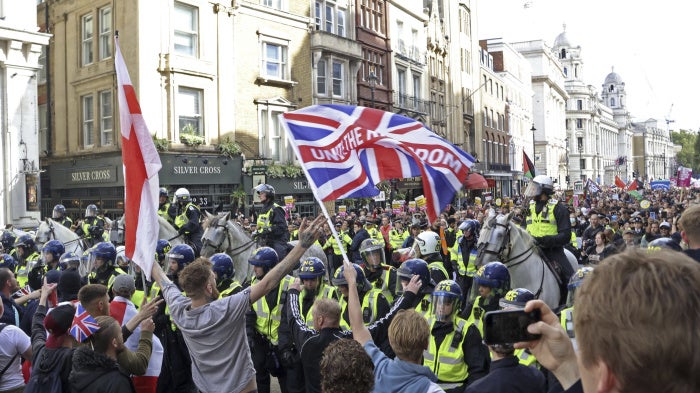
The rhetoric of some opposition parties and activities of far-right activists on social media, coupled with an ambivalent attitude by the government, created fertile ground for inflammatory and racist narratives, which resulted in racist mobilization, including a mass far-right rally in London in September.
Misinformation campaigns targeting Muslim and migrant communities fueled incidents of racist, Islamophobic, and anti-migrant violence. In several UK cities, anti-migrant rallies and anti-racism counter protests took place outside asylum seeker hotels following a court ruling that asylum seekers could continue to be housed in a hotel in Essex.
The government supported a change to police guidance to permit disclosure of suspects’ ethnicity and migration status following an alleged rape of a 12-year-old girl. Civil society groups warned that this risked framing violence against women and girls as an issue of ethnicity instead of misogyny. A senior Met Police officer said that inflammatory anti-migrant discourse distracts from tackling violence against women and girls.
In October, on Jewish holiday Yom Kippur, an attack killed two people and injured three others at a Manchester synagogue, underscoring the problem of antisemitism in the UK. Forty percent of all religious hate crimes in London targeted Jewish people in 2024, according to the Met Police.
In May, the UK government presented a UK-Mauritius Chagos Treaty, still under examination in parliament, to transfer sovereignty over the Chagos Islands to Mauritius while granting the UK a 99-year lease over the military base on Diego Garcia. The treaty, purporting to complete a decolonization process of the UK’s last African colony, fails to provide for full reparations for Chagossians.
In September, the Windrush commissioner expressed deep concern that 66 Windrush members had died while awaiting compensation for the impacts of the government’s “Windrush Scandal.” Following a March decision by the Parliamentary Ombudsman finding flaws in the scheme and calling on the government to review its policy excluding private pension losses, the government announced their inclusion with retroactive application in October.
Disability Rights
As of October, the government’s Mental Health Bill had reached its final parliamentary stages. While the bill includes positive measures, it falls far short of international human rights standards. The bill continues to allow for arbitrary detention in psychiatric hospitals, treatment without consent, and stripping people of their legal capacity, and fails to provide for supported decision-making.
Women’s Rights
In June, the UK parliament voted to decriminalize abortion in England and Wales after years of police investigating over 100 women, some of whom faced prosecution.
Gender Identity and Sexual Orientation
A UK Supreme Court ruling in April threatened the rights of transgender and intersex people. The court ruled that the word “sex” in the Equality Act 2010 refers to biological sex assigned at birth, rather than legal gender identity. The decision underminedpeople’s legal rights derived from gender recognition certificates since 2015, compounded by problematic guidance from the EHRC on single sex spaces, and is likely to lead to segregation and exclusion of trans and intersex people.
Foreign Policy
The UK had a patchwork record on human rights and foreign policy in 2025. In response to Israel’s atrocities in Gaza, the UK eventually halted arms sales to Israel used in Gaza but critically omitted to include the sale of UK F-35 fighter jet components that go indirectly to Israel. The UK announced a pause to negotiations over a new trade deal with Israel and a review of the 2030 UK Israel Road Map. However, unlike the EU, it did not initiate a review of the current UK Israel Trade and Partnership Agreement, which provides trade privileges to Israel and is premised on respect for human rights. The UK sanctioned two Israeli ministers and some individual settlers and settler entities for West Bank violations.
In response to the ongoing atrocities in Sudan, the UK co-chaired an international conference, but no concrete steps were adopted to protect civilians or ensure accountability despite the Rapid Support Forces armed group undertaking egregious attacks on the Zamzam internally displaced persons camp south of El Fasher as the conference took place. The UK led on the renewal of the mandate of the Fact-Finding Mission on Sudan at the UN Human Rights Council (HRC), ensuring ongoing investigations into atrocities.
The UK continued to lead or be active on other resolutions at the Human Rights Council renewing important mandates including on Sri Lanka, South Sudan, and Syria.
On the other hand, for the first time, the UK failed to co-sponsor the resolution on Afghanistan, as the HRC moved to establish a robust independent accountability mechanism with a mandate to investigate past and ongoing abuses committed by all actors in the country.
The UK signed trade deals with India and the Gulf Cooperation Council without incorporating robust and legally binding human rights protections.