South Sudan’s human rights situation significantly deteriorated with escalating political violence and intensified armed clashes between government forces and aligned militias and armed opposition groups, including the Sudan People’s Liberation Army in Opposition (SPLA-IO). Clashes occurred mainly in Western Equatoria, Western Bar El Ghazal, Upper Nile, Unity and Central Equatoria, bringing the implementation of the 2018 peace agreement to a standstill.
The government conducted indiscriminate aerial bombardments in populated areas under opposition control, killing and injuring civilians and destroying property.
The National Security Service (NSS) severely curtailed civil and political rights, escalating arrests, detentions, harassment, surveillance, and other abuses against civil society and political actors. Authorities initiated criminal proceedings against the SPLA-IO leader and first vice president Riek Machar and other opposition figures with charges including treason.
The National Salvation Front (NAS), a non-signatory to the peace deal, continued its insurgency campaign in Greater Equatoria and formed a military alliance with the SPLA-IO in September.
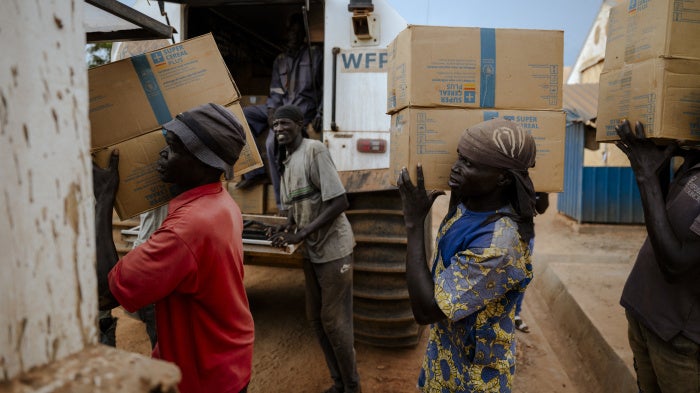
The humanitarian crisis worsened with approximately seventy percent of the population needing food assistance amid conflict, food insecurity, the impacts of extreme climate events and USAID aid cuts.
According to the UN refugee agency (UNHCR), as of October 2025, 1.9 million people were internally displaced in South Sudan. South Sudan also hosted nearly 600,000 refugees, mostly from Sudan, and over 800,000 South Sudanese returnees who fled the conflict in Sudan since April 2023.
Conflict and Attacks against Civilians
Many civilians were killed in the context of conflict and intercommunal violence.
The Office of the High Commissioner for Human Rights reported that at least 1, 854 people were killed, 1, 693 injured, 423 abducted and 169 subjected to sexual violence between January and September due to intercommunal violence and fighting between government and armed opposition groups including SPLA-IO and NAS.
Intercommunal violence in Warrap, Lakes, Eastern Equatoria, Jonglei, Abyei and Unity states, driven by ethnic tensions, revenge attacks, cattle raiding, political influence, and competition over natural resources, continued to escalate with killings, abductions, sexual violence, and destruction of property.
In mid-January, reports of killings of South Sudanese in Sudan, by Sudanese armed forces, triggered anti-Sudanese riots in South Sudan with attacks on Sudanese nationals and their properties. While authorities moved to protect Sudanese people and businesses, the UN reported allegations that the security forces used live ammunition to disperse protesters in Aweil and Juba. Following this, the National Communication Authority ordered Internet service providers to block social media.
In early March, hostilities between government forces and the “White Army” armed Nuer youth, historically allied with the SPLA-IO, intensified. This followed a March 4 “White Army” attack on a government military base and Nasir town and a March 7 attack by armed men on a UN helicopter that killed a UN crew member and over two dozen South Sudanese soldiers.
Uganda then deployed its troops at South Sudan’s request to provide technical support in military operations against the “White Army” and the SPLA-IO in Upper Nile state. The deployment violated the UN Security Council arms embargo as neither Uganda nor South Sudan sought prior exemption.
The government conducted indiscriminate aerial bombardments in populated areas, killing and maiming civilians including older people and people with disabilities. Human Rights Watch found that at least 58 people were killed and 17 others severely burnt after government forces used incendiary weapons in Nasir, Longechuk and Ulang counties of Upper Nile state in early March.
In early March, the NSS and military intelligence arrested and detained at least 22 members of the SPLA-IO, holding them incommunicado. On March 26, 2025, the government placed Machar under house arrest. On September 11, the justice minister announced treason, conspiracy, murder, and crimes against humanity charges against Machar and seven others for the “White Army” attacks on a government military base in Nasir. Thirteen others were indicted in absentia. The trial began on September 25. Authorities gave the South Sudan Broadcasting Corporation unrestricted access to the proceedings, while blocking independent journalists and civil society.
The UN peacekeeping mission, UNMISS, documented serious violations including killings, abductions, sexual violence, forced recruitment, and looting and destruction of property by government forces, SPLA-IO and NAS in Western Equatoria between January and June 2025. In September, an unidentified armed group attacked UN peacekeepers, looting weapons and ammunitions, during a patrol in Tambura, Western Equatoria.
Women and Girls’ Rights
Gender‑based violence remained pervasive. Most victims of conflict-related sexual violence were women and girls. The UN peacekeeping mission reported that armed groups used sexual violence as a weapon against communities. Survivors face stigma, inadequate healthcare, and little access to psychosocial support and other essential services.
The parliament failed to adopt the Anti-Gender Based Violence and Child Protection Bill, which could strengthen legal protections, criminalize forced and child marriage, and guarantee survivors free medical and psychosocial support.
Children’s Rights
Children in conflict-affected areas remained especially at risk of recruitment, violence, displacement, and hunger. During the first six months of 2025, UNMISS documented 326 children killed, injured, abducted, or subjected to conflict-related sexual violence.
Humanitarian Crisis
Humanitarians continued to face frequent attacks from armed actors. According to UNOCHA, 15 humanitarian workers and 11 contractors were killed or injured between January and August.
Media reported that kidnapping for ransom of aid workers had increased. One local aid worker abducted in August in Western Equatoria reportedly died in captivity.
On April 13, an armed group attacked and looted a hospital operated by a medical charity, Doctors Without Borders (MSF) in Ulang, Upper Nile state.
On May 3, government forces bombarded an MSF hospital in Fangak and the old Fangak market, in Jonglei state, killing seven and injuring at least 20.
Systemic Corruption Impacts
A September report by the UN Commission on Human Rights in South Sudan concluded that systemic government corruption and predation, notably of oil and non-oil revenues, by South Sudan’s political elites is resulting in “preventable deaths, widespread malnutrition, and mass exclusion from education,” and “fueling deadly armed conflict over resources.”
Restrictions on Civil and Political Rights
The NSS detained political actors, activists, and journalists under the 2024 NSS Act, which allows arrests without warrants and grants broad powers with little oversight.
In September, the South Sudan Human Rights Defenders Network published a report documenting at least 114 cases of censorship, harassment and arbitrary arrests of civil society actors and journalists between July 2022 and July 2025.
Justice and Accountability
Justice for conflict-related violations remained elusive.
In March 2025, authorities in Unity state, with UNMISS support, deployed a mobile court to Leer to address a decade-long backlog of criminal cases in southern Unity state. The court tried charges of murder, rape, and other serious crimes, but did not have jurisdiction to prosecute war crimes or crimes against humanity, including from the February-April 2022 violence.
In November, South Sudan and the African Union separately started recruiting South Sudanese and non-South Sudanese commissioners for the Commission for Truth, Reconciliation and Healing. There was no progress on the Hybrid Court for South Sudan, as the African Union and South Sudan government failed to take action to establish it.
In April, the UN Human Rights Council extended the Commission on Human Rights in South Sudan’s mandate, expressing concern over the lack of progress on the establishment of the Hybrid Court, and noting “persistent impunity for violations and abuses.”
In May the UN Security Council extended the arms embargo on South Sudan for another year despite opposition of certain Council members.
US Deportations
In April the US imposed a visa ban on South Sudan passport holders owing to failure to “accept the return of its citizens in a timely manner.” South Sudan’s Ministry of Foreign Affairs and International Cooperation confirmed on September 4 that it was holding seven foreign nationals deported from the United States in July, while a South Sudanese national was released to his family. On September 6, the authorities formally announced the repatriation of one Mexican national to Mexico but did not clarify where the remaining six men are held and under what conditions, or the legal basis for holding them. On November 5, the US terminated Temporary Protection Status for South Sudan.